I’m sure you know how much it costs you to acquire a new customer and the profit you get from each sale. But if you base your strategy on these metrics, you’ll be overlooking your true goal: the long-term survival of your company.
To achieve that, you need to know one of your business’s key metrics: the Customer Lifetime Value, or the profit you get from each customer.
Through this calculation you’ll come to understand your customers’ life cycle and be able to invest your resources efficiently to maximize your profits.
In the following sections we’ll review the advantages of knowing the Customer Lifetime Value, how it’s calculated and which strategies you can carry out to optimize it.
But first, let’s take a moment to look at its definition.
What is Customer Lifetime Value
Customer Lifetime Value (CLV) represents the value you expect to get from each customer for as long as they maintain their relationship with the company.
This figure is calculated based on your customer history and lets you make a projection for the future that helps you make better business decisions.
One of the most useful applications of CLV is customer segmentation according to the profit each customer brings to the company.
This segmentation is related to the customer journey, the retention rate (churn rate) and the customer loyalty process.
We’ll review these concepts in the following sections.
To maximize your profits, you should invest more resources in the customers who are most profitable for your company. As well as in the actions that are most effective at increasing loyalty to your brand.
But before we look at the strategies that will help you increase your business’s profitability by optimizing your Customer Lifetime Value, we need to be able to calculate it.
How to calculate Customer Lifetime Value
I can tell you upfront that it’s a simple process, where the only challenge is having the information needed for the calculation.
First, we need to decide the period we’ll use for our calculation. It should be related to the useful life of your product/service and/or how often customers buy again.
For example, for an online fashion and accessories store, annual data will be enough. But for an electronics and home appliances store, we’ll have to work with multi-year data.
And, on the other hand, for a monthly subscription business we’ll need to work with monthly data.
To illustrate the calculation, I’ll use the most typical case as an example: a company that sells products with a useful life of less than a year. To continue with the previous example, let’s say it’s an online fashion and accessories store.
In this case we’ll need annual data.
To do the calculation we need information from the last two years on:
- Revenue data
- Number of sales
- Number of customers
- Operating margin: “Ratio indicating the percentage that earnings before interest and taxes (EBIT) represent of total sales”.
I invite you to gather this data before starting the process of calculating Customer Lifetime Value.
1 Calculate the average value per purchase
The first step is to find out your average ticket, or average value per purchase. To do this, we divide last year’s revenue by the number of sales we’ve made.
Average value per purchase = revenue / number of purchases
In the example of my fashion store, annual revenue was €150,000 and the number of transactions was 1,100:
AVP = 150,000 / 1,100 = €136
2 Calculate the purchase frequency
The next step is to calculate the purchase frequency. In other words, how many times our customers buy during the period we’re analyzing.
Purchase frequency = number of purchases / number of customers
Continuing with the example, the number of purchases was 1,100 and the total number of customers in this period was 450:
PF = 1,100 / 450 = 2.44
3 Calculate the average value per customer
Now you need to take the results you got in the previous steps to calculate the average value per customer.
Average value per customer = Average value per purchase * purchase frequency
In the case of the clothing and accessories store:
AVC = 136 x 2.44 = €331.84 per customer per year
4 Calculate the average customer lifespan
Calculating the average customer lifespan may involve some extra complexity.
One way to do it is to calculate the period between the first and last purchase of each of your customers and then work out the average (add up the total and divide it by the number of customers):
Customer lifespan = [Sum: (date of last purchase – date of first purchase)] / number of customers
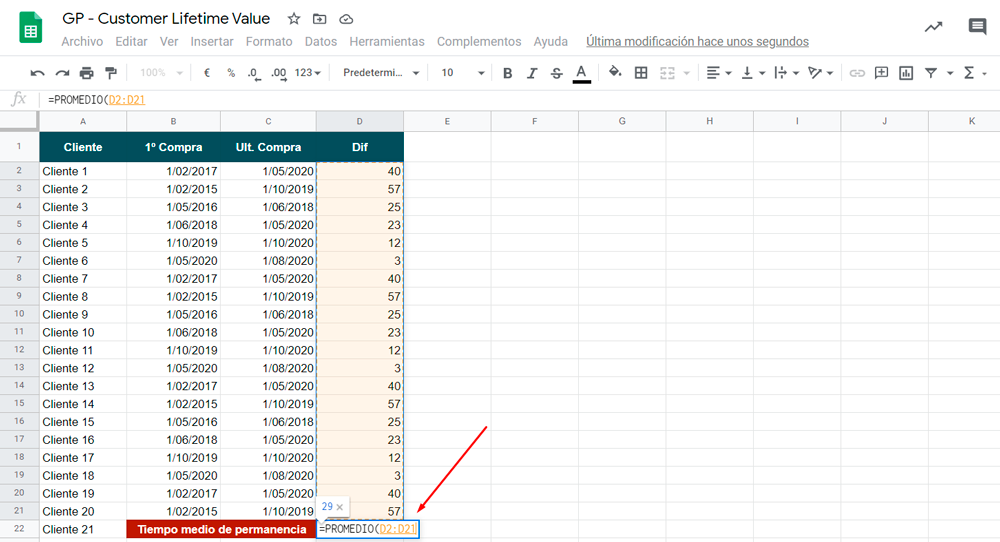
You can do this calculation easily if you organize the data properly in your spreadsheet. You need to have three columns: your customers, the date of their first purchase and the date of their last one.
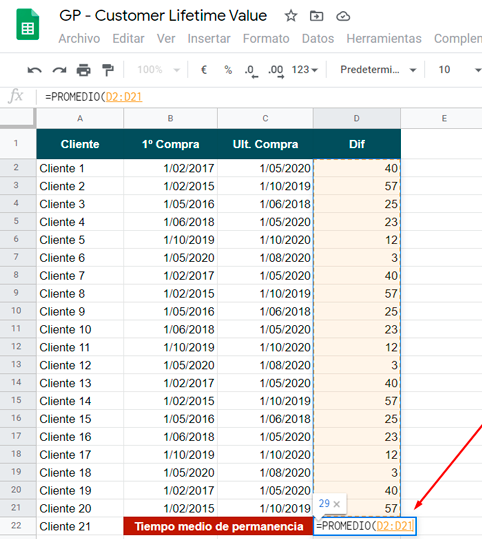
In the next column you calculate the difference between the dates, which gives you the number of days between them. Now you just need to take the average of this result to find out your average lifespan per customer.
Once you have the time in days, you can convert it to weeks, months or years, whichever suits you best.
Continuing with my example, let’s say that in my fashion store the average customer lifespan is 2.55 years.
But if you have a subscription business model, you can calculate it by dividing 1 by the attrition rate, or churn rate:
Customer lifespan = 1 / attrition rate (churn rate)
As you’re probably wondering, the attrition rate is calculated by dividing the number of customers who left during the period analyzed by the number of customers in the previous period. If we take a year as the reference, it would be:
Attrition rate (churn rate) = Number of customers who were customers last year but did not continue this year / Number of customers last year.
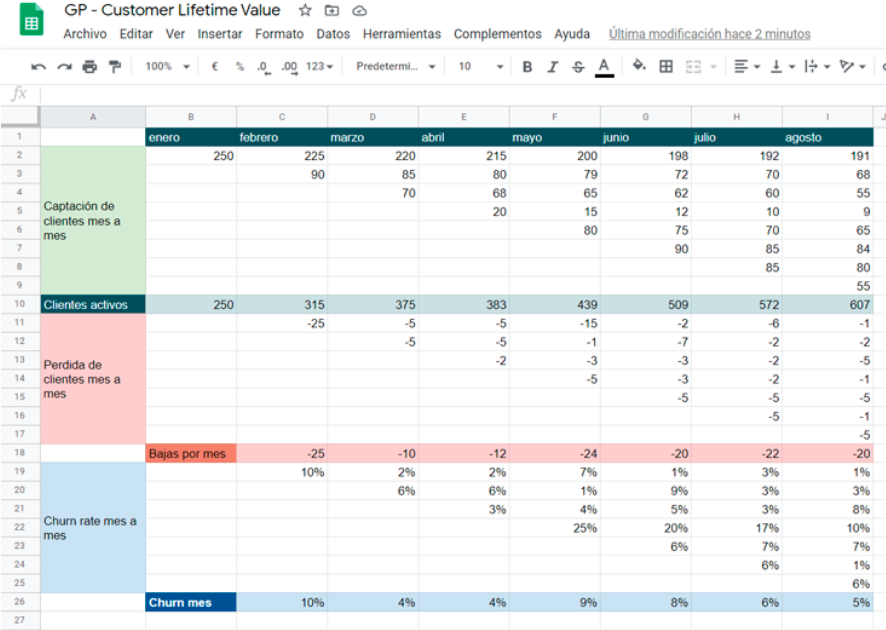
It’s advisable to monitor the attrition rate month by month. This figure is usually provided by customer management tools, but you can also calculate it with Excel or Google Sheets.
In the following image you can see an example of the procedure for calculating the churn rate month by month.
5 Calculate the Customer Lifetime Value
Now we have all the information we need to calculate the Customer Lifetime Value. To do this, we just need to multiply the average value per customer by the customer lifespan.
This calculation gives us the revenue per customer, but we want to calculate the profit we get from each of them. To do this, you need to include your operating margin in the formula:
CLV = Average value per customer x customer lifespan x operating margin
In the case of my fashion store, the calculation of my Customer Lifetime Value would look like this:
CLV = €331.84 x 2.55 years x 70% operating margin = €592.33
Now that we’ve calculated the CLV, we can move on and look at which decisions we can make based on it before analyzing strategies to maximize it.

Decisions based on Customer Lifetime Value
The CLV in itself doesn’t give you any information beyond its value.
But it’s very useful as a reference for making business decisions with the long term in mind.
Let’s go over some of the most relevant ones.
Set your maximum acquisition cost
As we’ve already seen, the CLV represents the profit you get from each customer for as long as they stay in a relationship with your company.
Therefore, this amount marks the point beyond which your investment in acquiring new customers stops being profitable.
In other words, it’s the maximum limit your acquisition cost can reach before you start making a loss.
You can adopt an aggressive strategy in which losses are accepted for a while in order to penetrate a new market. Uber has been losing money for 10 years with the aim of dominating the market.
But exceptions aside, you should follow the maxim of trying to keep your acquisition costs as low as possible.
Identify the most profitable strategy
Using the CLV as a reference will help you understand the long-term profitability of the strategies you carry out and will allow you to make better decisions.
Let’s look at an example.
Continuing with the accessories e-commerce store as an example, let’s say it dedicates part of its budget to working with influencers and the conversion metrics of the campaigns are very good because it offers very attractive deals.
However, when it segments its customers by acquisition channel, it realizes that the CLV of customers coming from influencer campaigns is far below average.
Most of them buy to take advantage of the offer but don’t buy again.
Identify the most profitable customer segment
Thanks to the long-term view the CLV gives you, you can identify the most profitable customer segments.
If you look at other metrics, you may give more weight to a group of customers because you get more profit from them in the short term, but in the long run they are less profitable.
Let’s say a company tailors its messages and focuses its campaigns on a young audience because that’s where most of its sales come from. However, when it compares CLV by age range, it realizes that its customers between 45 and 55 years old have triple the CLV.
What would the decision be based on this data?
Shift the company’s focus to concentrate on the customers who offer it the greatest profitability.

5 Strategies to optimize Customer Lifetime Value
After all our analysis, let’s go over some strategies that will let you increase your customers’ loyalty and repeat purchases in order to optimize your Customer Lifetime Value.
1 Optimize your onboarding process
Communication with your customers at the start of your relationship will be key to shaping how they perceive your brand.
In their first interactions your customers don’t know how to use your product/service and don’t know what to expect. So it’s common for problems to come up that spoil their buying experience.
To avoid this, you should design a support process that serves as a usage guide and communicates all the advantages your product/service offers and your company’s differentiating values.
Email is the usual channel for this process, and with email marketing tools like Mailrelay you can make sure all your customers understand your offer.
Some examples of information you can share in your onboarding process are:
- A usage guide for your product/service.
- Analysis of your customers’ success stories.
- Your company’s history and the values it holds.
2 Work on your content strategy
Designing a content strategy that provides valuable information to your users throughout their buying process will position you as a leading brand.
Developing a content strategy will benefit you in different ways, depending on the type of content you create.
Some examples of content you can create and how it will help you improve your CLV are:
· Usage guides for your product/service on your blog: with this content you’ll increase your customers’ satisfaction by showing them how to get the most out of your product.
· Articles solving your customers’ problems: related to your product/service, they will help increase your brand awareness.
· Industry news: by regularly sharing news from your industry on your blog, you’ll become an information resource for your customers. Improving your brand’s perception and awareness.
· Analyzing success stories: looking at how your company has helped one of your customers or how you’ve gone through an internal transformation process at the company.
· Running brand activities: partnering with initiatives or promoting activities related to your industry or that share your company’s values.
3 Invest in personalization
Nowadays your customers are used to their go-to brands offering them a personalized service.
For example, when you visit Amazon you see a product catalog tailored to your tastes and all the messages you receive are based on your buying behavior.
Through personalization you can turn commercial communication with your customers into a reason for loyalty.
With marketing automation tools you can personalize your messages to offer relevant information based on your users’ behavior.
Some examples would be:
· Use software to personalize your website’s content. There are many companies that provide this service, but Bunting is the only one that offers a price range accessible to any budget.
· Create automated email sequences. With Mailrelay you can create simple actions such as cart recovery messages or complex sequences that send users information tailored to their behavior.
4 Invest in remarketing campaigns
One of the most effective tactics for improving Customer Lifetime Value is reconnecting with customers who have had a relationship with your brand.
This way you can create highly profitable campaigns thanks to personalization based on the user’s past behavior.
For example, you can create remarketing campaigns on Facebook to show your customers new products from your catalog in the same category as their previous purchases.
Or create campaigns to improve your brand image by showing your customers the branding actions you’re carrying out at your company and increase their sense of belonging.
5 Create loyalty programs
Calculating Customer Lifetime Value shows you how profitable it is to build loyalty among your customers. This figure should serve as an argument for launching a program to reward your most loyal customers and thus raise the barriers to entry for your competitors.
These actions will make your most loyal customers increase their commitment and will show new customers all the benefits they can get if they maintain a lasting relationship with your brand.
The typical approach is to design tier-based loyalty programs. In these, customers move up a level as their commitment to the brand grows and unlock benefits at each one.

This figure is easier to understand when you compare it with the customer acquisition cost (CAC), and it improves directly when you get customer loyalty right.