Live shopping: what it is, how it works and how to make your first live sale in 7 steps
Platforms, real examples and the steps to sell live, with three emails to fill your stream
Platforms, real examples and the steps to sell live, with three emails to fill your stream
Someone shows a product live, answers questions in the chat and, while they talk, viewers can buy it with a single click. That’s live shopping. It’s good old TV shopping, but on your phone and with a conversation.
In this guide you’ll see what it is, which platforms it runs on today, real examples and how to organize your first stream in 7 steps. At the end you’ll find three email templates so your stream doesn’t start empty.
Live shopping is selling products through a live stream in which viewers can buy without leaving the video. A host, who can be someone from the brand or an influencer, shows the product, tries it out and answers questions in real time.
It’s also called live commerce, social live shopping or live selling. It took off in China from 2016 with Taobao Live and reached Europe a few years later.
What sets it apart from a product video is that it’s live. A viewer asks “how big is it?” or “do you have it in blue?” and gets the answer within seconds. That conversation is what turns a visit into a purchase.
Shopping is often about more than meeting a need. Seeing a product in use, listening to someone who knows it and asking questions are part of the enjoyment. Live shopping brings those three things together.
| TV shopping | Online store | Live shopping | |
|---|---|---|---|
| Channel | Television | Website or app | Social media, website or app |
| Who builds trust | The channel and the brand | Product pages, photos and reviews | The host or the influencer |
| Interaction | Phone calls | Chat or email, not in real time | Live chat |
| Purchase | By phone | On the website | Without leaving the stream |
| Duration | Scheduled program | Always available | Scheduled event, then a recording |
The most important difference is where credibility comes from. In TV shopping, trust came from the channel. In live shopping, it comes from the person presenting. That’s why choosing the right one is half the battle.
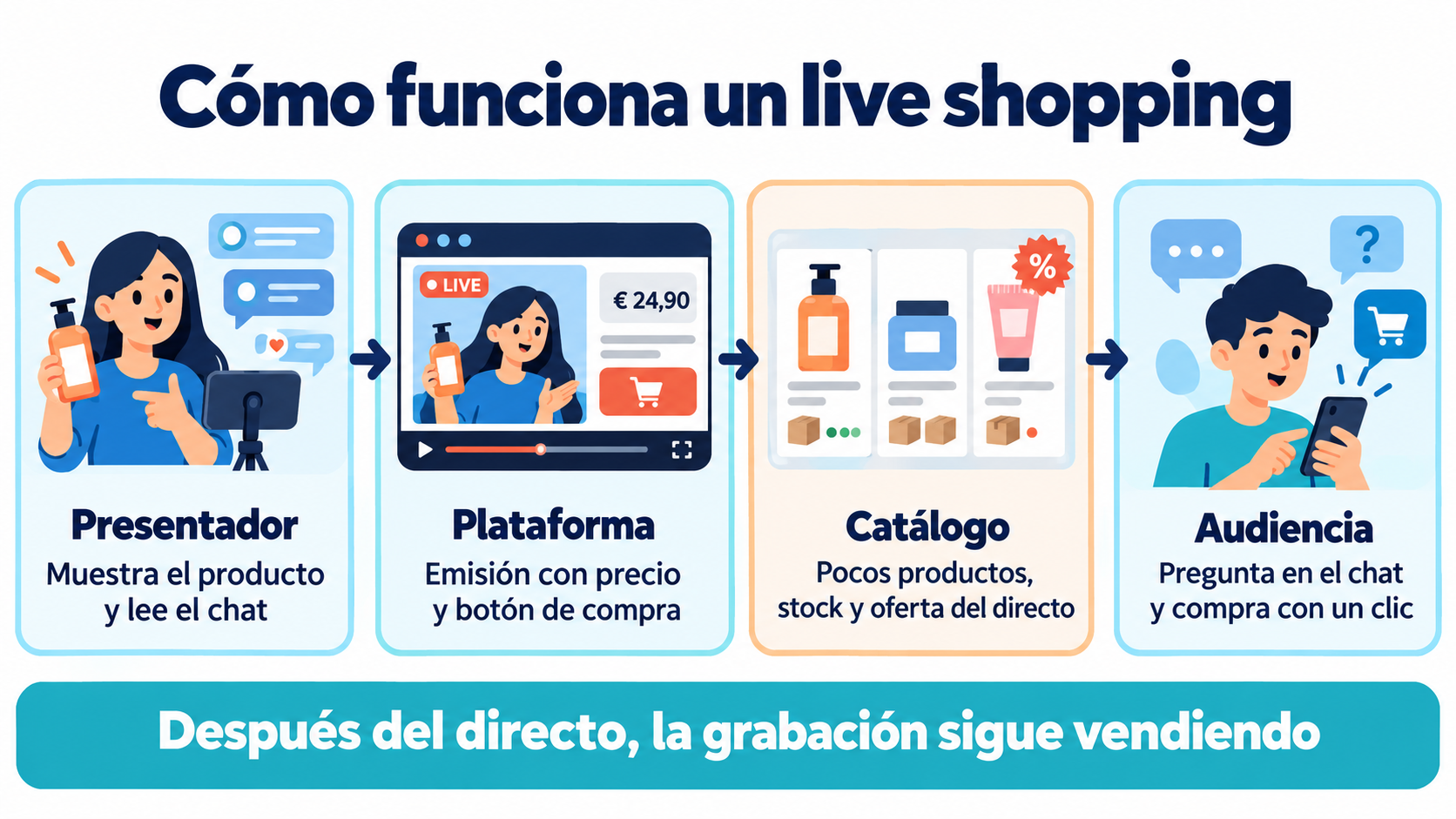
Every stream has four pieces:
The host. Someone from the team, an expert or an influencer. They show the product, explain how to use it and read the chat.
The platform. The social network or tool you stream on. It must let you show the product with its price and a buy button.
The catalog. A few products, prepared in advance, with enough stock and a price or perk for anyone who buys during the stream.
The audience. The people who tune in. Without a good invitation beforehand, the stream may end up with very few viewers.
During the stream, viewers see the product pinned on screen, ask questions in the chat and buy with one click. Once it ends, the recording keeps selling for days.
The options have changed quite a bit in recent years:
| Platform | Status in 2026 | Who it suits |
|---|---|---|
| TikTok Shop (LIVE) | Available in Spain since late 2024 | Fashion, beauty, home and impulse products |
| YouTube | Lets you pin products in live streams where YouTube Shopping is active | Products that need explaining or demonstrating |
| Instagram and Facebook | Meta removed live shopping (Facebook in 2022 and Instagram in March 2023) | You can stream and link to your website, with no buy button in the video |
| Your own website | With live video tools that have a built-in cart | Brands that want customer data and don’t want to depend on a social network |
In Spain, TikTok Shop passed 12,000 stores in its first year, with more than 15,000 LIVE sessions a month, according to figures published in October 2025.
If your audience is on Instagram, you can still go live. The difference is that viewers will have to go to your website to buy, so you need a short, easy-to-remember link.
Three cases that help show what works:
IKEA Spain. It started in March 2022 with “Ikea en directo” (Ikea live): brand experts present new products and decor ideas and answer questions in the chat. In 2023 it also brought the show to Movistar Plus+. In 2024 it tried out an AI-generated virtual host alongside two real hosts.
TikTok Shop stores. Small cosmetics, fashion and accessories brands go live every day for one or two hours. They repeat the format, present just a few products and create offers only for the stream.
China’s Taobao Live model. There, live shopping is a regular sales channel, with hosts who stream for hours and huge peaks on dates like Singles’ Day.
What they have in common: a host who knows the product, a regular time slot and a reason to buy right then.
| Advantages | Challenges |
|---|---|
| Customers see the product in use and get their questions answered on the spot | You need an audience before you start |
| Creates urgency: offers that last only as long as the stream | The host needs to know how to sell without sounding like an ad |
| Humanizes the brand | Requires technical preparation: lighting, sound and connection |
| The recording keeps selling afterwards | It’s hard to measure the impact if you don’t plan for it |
| You collect real questions from customers | Each network’s terms can change |
Fill your next live stream
Let your customers know by email before you go live and start with an audience from the very first minute.
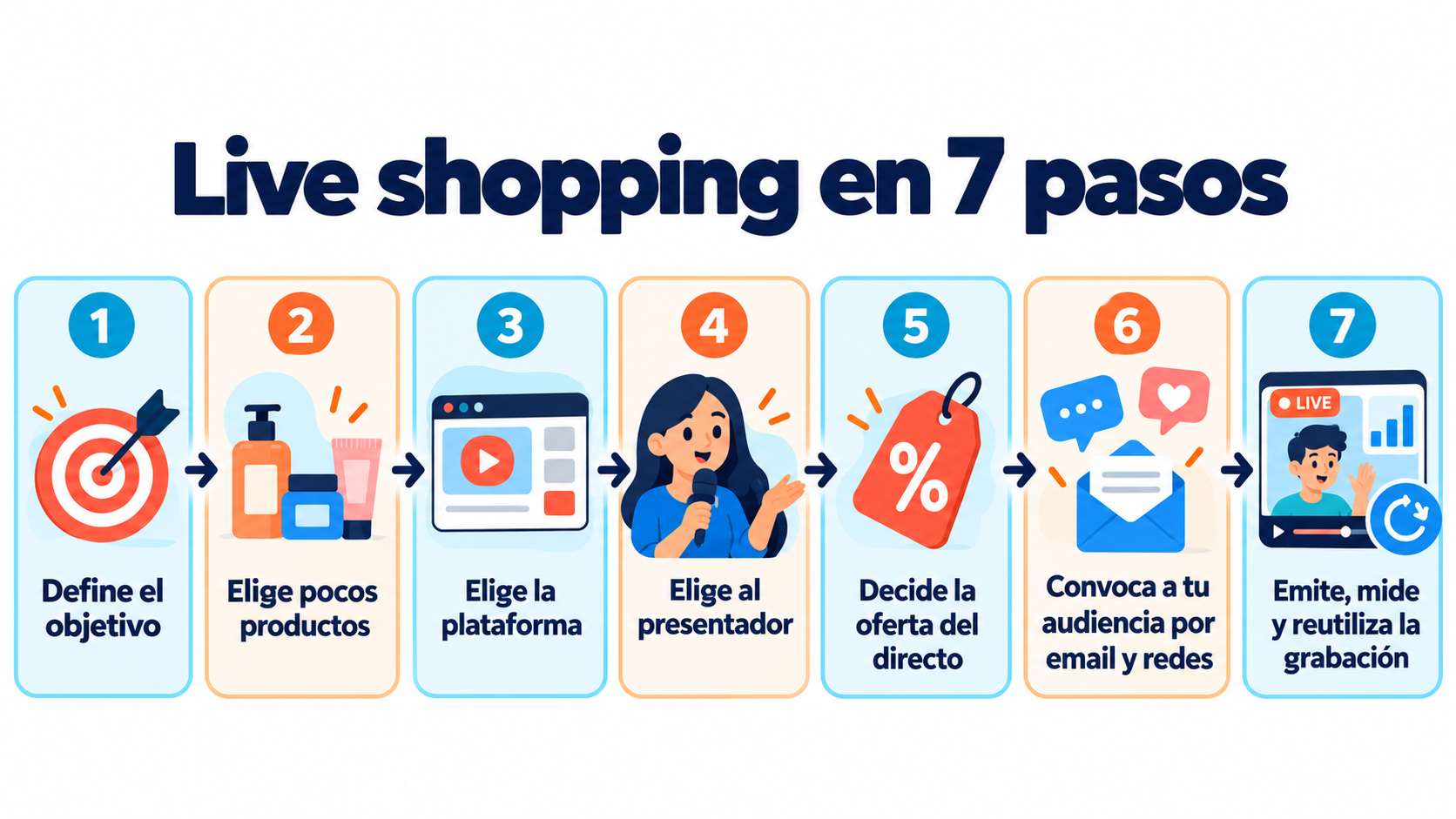
1. Define your goal. Sell a specific product, launch something new or clear out stock. One goal per stream.
2. Choose just a few products. Between 3 and 8. Prepare the price, sizes, colors and stock for each one.
3. Choose the platform. Where your audience already is and where buying is easy.
4. Choose the host. Someone who knows the product and inspires trust. Below you’ll find how to choose an influencer.
5. Decide on the offer. A discount, a gift or free shipping just for the stream. Besides selling more, it helps you measure.
6. Invite your audience. Announce the date on social media, on your website and by email. This is the step people forget most often.
7. Stream, measure and reuse. Record the stream, check the sales and turn the best moments into short videos.
If no one from your team is hosting, the influencer will be the key piece. The first thing people look at is the number of followers, but it’s not the only thing.
Engagement matters more. The goal is to sell, and if the person can’t get their followers to comment and ask questions, it won’t work.
Look for someone connected to your industry, credible and able to persuade without pushing. Ideally, they should share your brand’s values. If they’ve worked with competitors, don’t rule them out straight away: look at the results they achieved.
Before closing the deal, ask them these three questions:
| Question | What it tells you |
|---|---|
| How well do you know this type of product? | Whether they can answer questions without a script |
| Do you use it in your daily life? | Whether their recommendation will be credible |
| How many interested people can you bring in? | Whether the stream will have a big enough audience |
More ideas in our guide to influencer marketing.
With influencer campaigns, it’s hard to get from viewers and likes to sales. That’s why it’s worth setting it up before you go live.
Use a discount code just for the stream. Every time someone uses it, you know the sale came from the stream.
Share a link with tracking parameters. That way you can see in your analytics how many visits come from the stream. If you use both, you’ll also know what percentage buys.
These are the most useful figures:
| Metric | What it indicates |
|---|---|
| Live viewers | Whether the invitation worked |
| Comments and questions | Whether the host got a conversation going |
| Product clicks | Whether the offer is appealing |
| Sales with the code | How much the stream sold |
| Conversion rate | What share of viewers bought |
| Sales from the recording | How much it keeps selling afterwards |
It may seem that email isn’t needed, because the influencer already brings their audience. But your contact list has the people who know you best: customers who have already bought, prospects who are still undecided and curious subscribers.
If you let them know, many will tune in. Some will buy, won over by the stream. And those who don’t buy will add numbers to the stream, which also builds trust among the other viewers.
Email helps at three moments: before, to invite people; right before it starts, as a reminder; and afterwards, to sell to those who couldn’t watch. You can adapt these three templates to your brand.
Email 1: the announcement (3–5 days before)
Subject: This Thursday at 7 p.m. we’ll show you the new collection live
Hi [name],
This Thursday at 7 p.m. we’re going live to show you the new collection. You’ll be able to ask anything you like and buy without leaving the stream.
Anyone who buys during the stream will get a 15% discount.
Put it in your calendar and we’ll remind you before we start.
Email 2: the reminder (1 hour before)
Subject: We’re starting in one hour
Hi [name],
Our live stream starts in one hour. Join from this link and leave your questions in the chat.
Remember: the 15% discount is only valid while the stream lasts.
Email 3: after the stream (the next day)
Subject: Did you miss it? Here’s the recording
Hi [name],
Yesterday we showed the new collection live. If you couldn’t join, here’s the recording with the products we presented.
For subscribers only, the discount stays active for another 24 hours with the code LIVE15.
Send the reminder only to people who opened or clicked the first email. With segmentation you avoid wearing out people who aren’t interested.
Send your invitations with Mailrelay
Announcement, reminder and recording to your list, segmented by interest and with statistics for every send.
Do a test run first. Check the lighting, sound, connection and that the purchase links work.
Have someone on the chat. While the host talks, another person answers questions and pins the products.
Prepare a flexible script. Product order, offer and moments to read questions. Not a text to read out.
Make it a regular event. A one-off stream sells little. A stream every week or every month builds a habit.
Talk to your customer, not to the camera. It’s a conversation. Conversational marketing works the same way live as it does in a chat.
With Mailrelay you can send the announcement, the reminder and the email with the recording to your list. You can segment by interests or past purchases and see who opened and who clicked to fine-tune your next send.
You can also capture new subscribers during the stream with a subscription form linked from the stream. That way your next invitation doesn’t depend only on the algorithm.
The free account includes up to 80,000 emails a month and 20,000 contacts, with human support by chat, ticket and phone.
Start for free with Mailrelay
Up to 80,000 emails a month and 20,000 contacts for free, with human support on every plan.
Live shopping works when there’s a credible host, a few well-prepared products, an offer for the stream and an audience invited in advance.
It works very well in fashion and cosmetics, but it’s useful for any product where the opinion of someone you trust helps people decide. If you want to keep going, you’ll find more ideas in how to run a product launch.
These are the most common questions about live selling.
It’s selling products in a live stream where viewers can ask questions and buy without leaving the video.
In practice, none. They’re two names for the same live selling technique.
You can go live and show products, but since March 2023 Instagram doesn’t allow purchases within the live stream. Customers have to go to your website.
Between 30 and 60 minutes is usually enough for a brand that’s just starting out. Some TikTok Shop stores stream for several hours.
No. Someone from your team who knows the product well can host. An influencer helps you reach more people, but you can also invite your own audience by email and social media.

Jose Argudo
CMO at Mailrelay. Writes about email marketing, copywriting and conversion for small businesses and entrepreneurs.