The elements of copywriting are like the pieces of a puzzle: a resource that makes communicating with your audience easy and turns your email copywriting into a game.
Finding information and inspiration about copywriting in Spanish for marketing campaigns and bulk emails isn’t that easy, which is why we bring you new approaches and techniques from time to time.
This time it’s the turn of the elements of copywriting, a resource that makes communicating with your audience easy and turns your email copywriting into a game.
You’ll soon see why.
How is copywriting like a puzzle?
The elements of copywriting are like the pieces of a puzzle. That’s exactly why we said it can be like a game. In other words, by choosing the right place for each piece, you gradually build up a picture. In this case, the picture could be an email, a landing page or a blog post.
But copywriting is even better than puzzles because it gives you more flexibility: depending on who writes and their goals, they’ll play with the pieces one way or another.
And that, of course, can produce different results.
What’s clear is that good copywriting, whoever writes it and whatever picture they want to build, is copywriting whose purpose is conversion. Converting into leads, sales or visits is part of each brand’s strategy.
However, this isn’t the only superpower of good copywriting: choosing the right pieces and words can help increase the open rate and the read rate. What use would it be to offer highly valuable content or an amazing deal if nobody reads you?
Not to mention overcoming blank-page syndrome.
And as we said, this applies to your email marketing campaigns as well as to sales pages, posts and all kinds of communications.
Now that we know the benefits of playing with the elements of copywriting, let’s see what those pieces are, along with some email copywriting examples (by the way, here are some copywriting examples for email marketing), which is the best way to learn.

Elements of copywriting
The elements of copywriting are the pieces we were talking about. Let’s go through them one by one, in the order they appear in an email:
#1 The subject line
Even if you know very little about copywriting, you’ll have heard and read a thousand tips on striking, effective subject lines that help get the recipient to open your email.
OK, the open rate may not be directly related to sales, buuut one thing is certain: if they don’t open, they don’t read, and if they don’t read, they don’t buy.
That’s why it’s essential to pay attention to the short persuasive texts that make up your email subject lines.
How do you know whether your subject line invites people to click or to scroll past?
Ask yourself the four questions of the so-called 4 U’s rule:
1. Does it convey urgency?
2. Is it unique, different from what the competition promises?
3. Does it offer the reader something useful or a benefit?
4. Is it ultra-specific to the audience?
If the answer to all of them is YES, go ahead with the subject line.
If the answer to two or more of them is NO, keep writing headlines until you meet the rule.
Tip: write subject lines as if there were no tomorrow so you can reach for them when you need them. You’ll see how, after the 20th or so, they come to you faster.
Here are some examples:
- Open your own hair salon in 30 days, starting now: it conveys urgency, promises something unique, offers a benefit and is ultra-specific.
- If you want a change in your body and mind… read me now: it conveys urgency, offers a benefit and is ultra-specific.
- Why people who use copywriting have the upper hand: it promises something unique, offers a benefit and is ultra-specific.
- How to get 10 customers a day: it promises something unique, offers a benefit and, once again, is ultra-specific.

#2 The email body
The body of your emails is where the substance is, the part where you have to captivate readers so they don’t leave halfway through. Because if they don’t finish reading, you won’t be able to sell them anything, as we said.
To start winning over your audience, here are some professional copywriting tricks:
- ● Address the reader directly as “you”. Speak to them one to one, to connect with them.
- ● Don’t personalize your messages, because almost everyone (if not everyone) on a list knows they’re just one of many. However often you say “Hi, Adelaide”, good old Addie knows that nobody in the world calls her by her full name except the form she filled in to subscribe or sign up on a website. And of course… the magic is gone.
- ● You don’t need to ramble on. In other words, write emails of between 250 and 400 words so you don’t take up too much of the reader’s time, especially in the early stages of the relationship. However, if the lead is already mature or deep in the sales funnel, you can go into more detail and develop the content.
- ● Be careful with images, because emails that include them are more likely than others to end up in the spam folder. Not to mention that they affect your hosting quota, of course.
- ● Don’t overdo the links. Or better yet, just include one CTA at the end of the message; we’ll talk about this later.
With these golden rules and a few more copywriting techniques, you’re very likely to catch the reader’s attention and get them to stay and see what you’re offering.
The main writing techniques you can play with in the body of your emails are formulas and storytelling.
◆ Copywriting formulas: yes or no?
Do copywriting formulas work magic?
No.
Is a template the same as a copy formula?
No.
Do formulas help you write persuasive text with rhythm and a purpose?
Yes.
Ergo, use them as a guide and adapt them to your message so they support you rather than constrain you.
With the debate about copywriting formulas settled, let’s look at one of the most versatile for short formats; you can use it for your emails as well as for ads, sign-up pages and short sales pages.
We’re talking about the PAS formula = Problem – Agitation – Solution
Its name says it all: you take a problem (the one you’ll solve for the customer with your service or product), blow it up by touching on the reader’s pain points and finish by giving them the solution.
Et voilà, you’ve turned pain into a sale.
The first example we’ll look at is from someone who agitates problems like nobody else, although he then mixes in the other elements in a less structured, more spontaneous way.
It’s Nudista Investor, a financial education expert who very effectively puts himself in the shoes of the clueless investor and then sells you his membership.
All his emails are long and in-depth, but the beginning of this one is worth reading because every single word counts.
◆ Copywriting example: the PAS formula
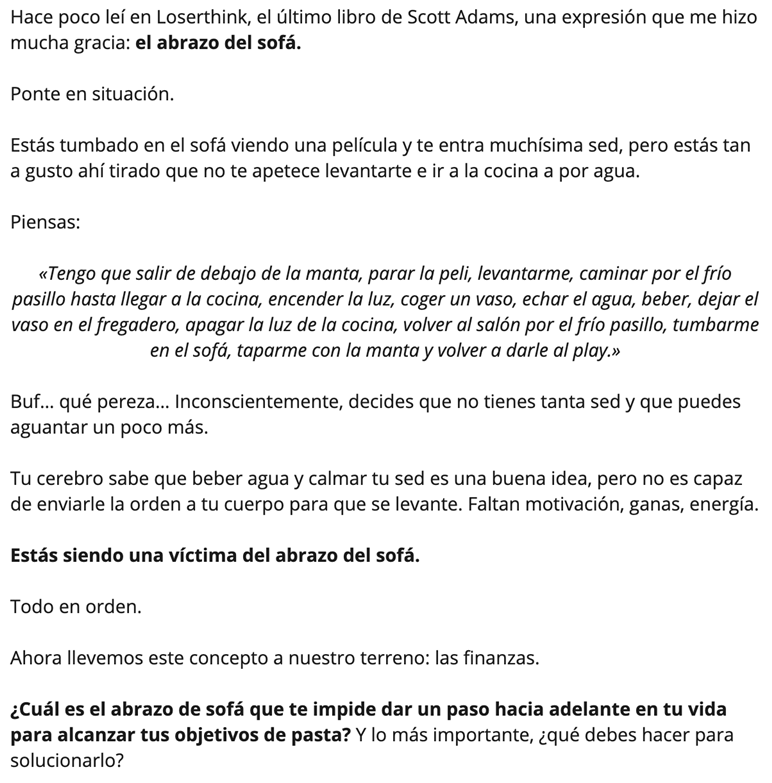
As you can see, this is a great example of using a formula with intelligence and personality, without rushing to close the sale.
Another area where this email shows mastery is in removing obstacles. Notice how it tackles a major pain point for its audience (overcoming laziness, resistance), which is also an obstacle in its own funnel. And he turns this into a concept that’s completely outside the typical sales pitch: the sofa’s embrace.
Among copywriting formulas, there’s another widely used one worth knowing, because it’s also like a Swiss army knife. It’s the AIDA formula.
Attention – Interest – Desire – Action
Start by grabbing attention so readers focus on what you’re going to say (with a question, for example), add information, data or stories they can identify with, present the product with its benefits to create desire and finish with an invitation to act.
Let’s look at a couple of examples that are very different in style and industry.
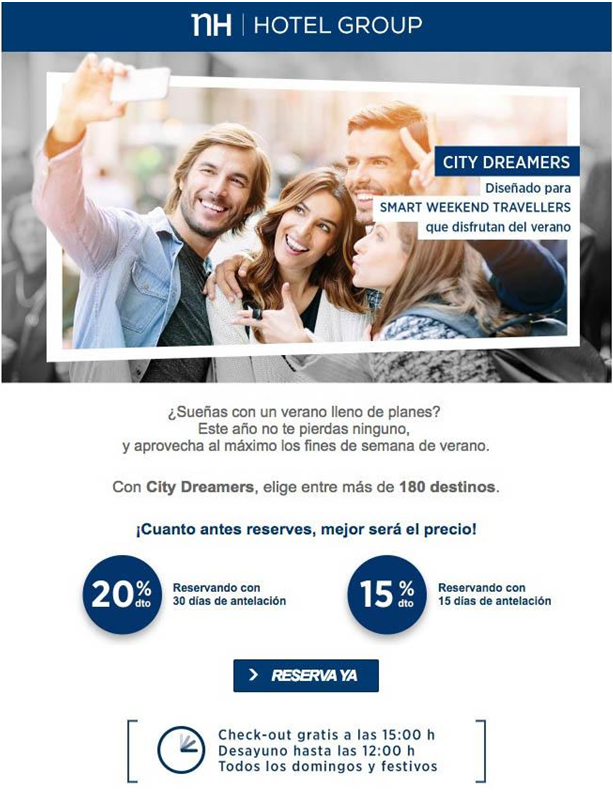
The first is from NH Hotels, and we chose it because it brings together all the elements of the AIDA formula in its most basic form: without long explanations, in just a few lines it touches on desire, pain points, benefits and the mental trigger of urgency.
Copywriting example: AIDA
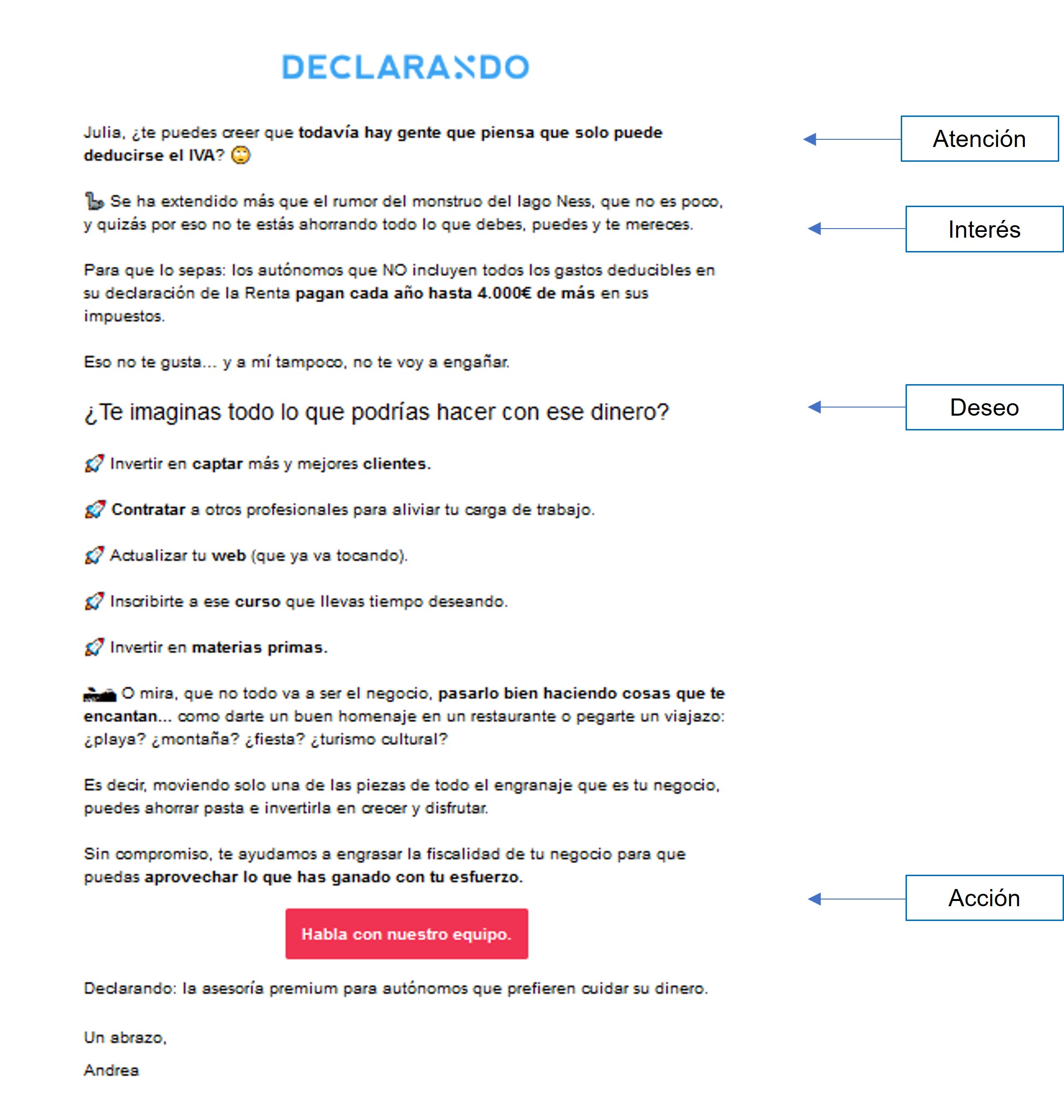
The second is from Declarando, an online advisory firm for the self-employed that specializes in easing one of its customers’ main pain points: dreaded taxes.
In this copywriting example, we can also see how the A for attention, the I for interest and the D for desire of the AIDA formula easily converge with the P, the A and the S of the PAS formula.
Storytelling
Telling good stories is the best way to persuade (what you’re after as a company) and to entertain (what the reader is after, since we get enough information every day).
Why?
Because we humans don’t retain data for more than a few days. Stories, on the other hand, stay etched in our minds.
And that’s why storytelling copywriting has become essential.
You don’t need to tell elaborate plots; a story related to everyday things is enough. All you have to do is make sure the main storyline is related to what you want to sell.
That, and be yourself: make sure your stories represent you and your reader, and speak to them directly. If you don’t, you’ll sound like everyone else. You’ll be noise among the countless messages consumers receive every day.
How?
If you’re a large company, your audience will give you your tone and language. Yes, because if you know who you want to address, you can build your verbal identity.
If you’re an entrepreneur writing your own emails, simply be yourself and don’t overcomplicate things.
To work on storytelling in your emails, there’s also a very useful copywriting formula if you’re not sure where to start.
It’s the Story – Hook – Call to Action formula.
Choose an anecdote, a thought or a person around you who could inspire you and fit into your email (Story). Then think about how you’ll link your story to the product (Hook). And finally, serve up the interaction on a plate (Call to Action).
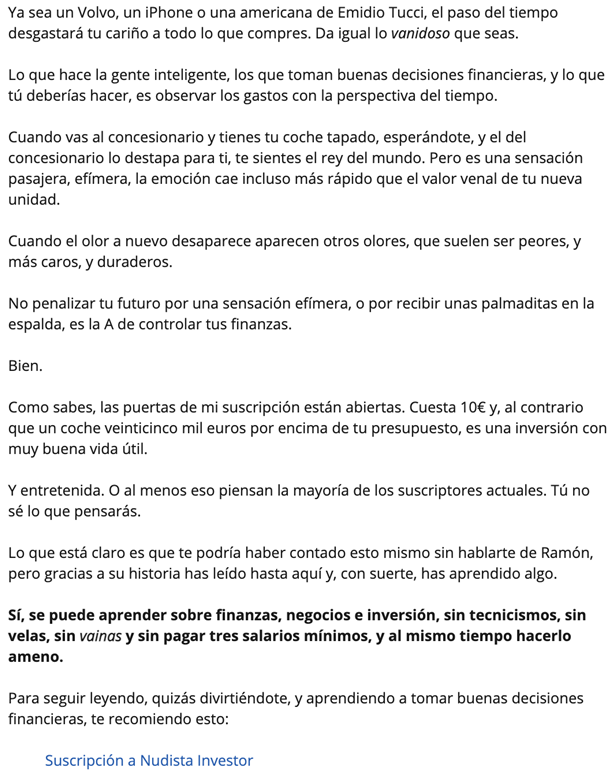
Here’s another copywriting example from Nudista Investor, because he nails it: a friend of his buys a car and he sends this message, which, by the way, has the unforgettable subject line “Volvo or Dacia, glory or death”.
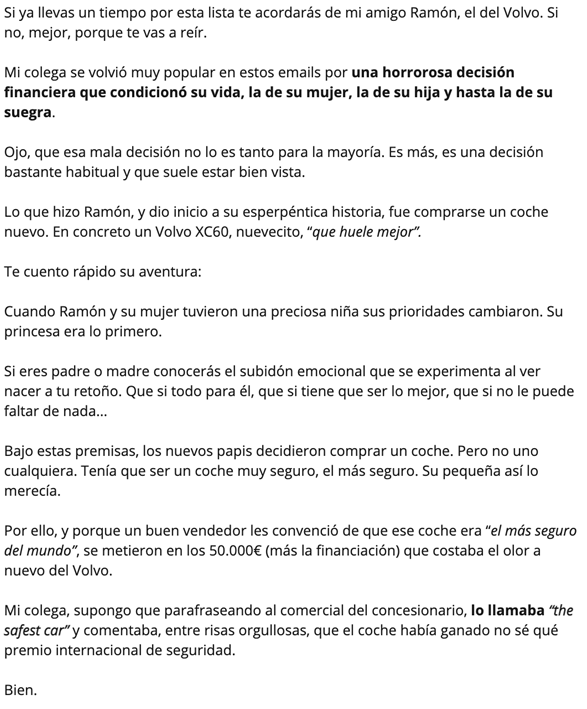
You can probably guess, but the story ends with a mix of financial hardship and small daily miseries, such as the mother-in-law living in the house and the Volvo half dirty and abandoned in the garage because he could barely afford to keep it.
All this serves as the perfect excuse to get across, in the final part of the email, two basic messages in his sales machinery: that «bad financial decisions live a very long life» and that «it doesn’t matter what you spend your money on, you’ll get tired of it soon».
In fact, that’s how the email ends.

#3 CTA
An email always, always, always has to include a CTA (call to action). At least one.
You can include several, but with good judgment, not at random.
You’ll find them as buttons and also as part of the text linking to the landing page, survey, ad or wherever you want your reader to go.
Do yourself a favor, put your thinking cap on and don’t fall for the classic (and ineffective) buttons like “buy now”, “see more products” or “sign up now”. Think of that little button or that sentence as the gateway to your sale.
CTAs in an email are a real copywriting feat, and the best way to see it is with a few examples. Let’s start by analyzing the calls to action in the emails we’ve just seen:
Nudista Investor relies on anchor text integrated naturally into the body. The copy is part of the email’s storyline and very short. What does it achieve? It generates interest, even intrigue.
NH and Declarando opt for a button and conservative copywriting that’s understandable for all kinds of audiences and leaves no doubt about what will happen if you click. And notice something: once again, they address the reader directly.
Here are some other examples of CTA copywriting to inspire you:
Count me in!
I want it!
Perfect!
Show me those boots!
I won’t miss it!
Here I go!

#4 Postscript
One of the copy techniques that has gained the most ground recently has to do with the postscript, that extra bit of communication with the recipient that comes after the signature.
By the way, it’s always better for a person to sign, even if they belong to an organization. Otherwise, you don’t create the closeness we’re looking for with the person reading the email.
With that said, let’s move on to the postscript.
What can you use it for? Take note:
- ● Use it to speak to the reader more intimately, as a personal space reserved for confidences.
- ● You can quickly recap what you told them in the body of the email and include a CTA, as you saw in the earlier examples.
- ● It’s also very useful for adding contact details; especially after an offer, it’s good to provide support or other ways to get in touch, so they feel you’re a solid company.
- ● The postscript is the ideal place to spark curiosity and make them want to read the next thing you send. It has the same effect as the “Next time on…” that appears at the end of TV episodes.
Wrapping up the elements and examples of copywriting
As we said at the beginning, writing is like putting together a puzzle, but much better, because the final picture can be whatever you want.
So use the pieces we’ve given you so you don’t forget anything, but always with your own personality and with your goals in mind. You can move them around as you see fit and use the copy formulas and techniques we’ve explained, such as the PAS formula or storytelling copywriting.
Mind you, you can also invent your own techniques. And keep digging into your customers’ mental triggers to reach the epicenter of their decisions and leave your mark on your readers.
What else is copywriting, after all?
If you want to keep practicing, here’s what copywriting is, and in tips and tools to improve your copywriting you’ll find practical resources to keep improving.