At its core, marketing is simple. Basically, it’s about making a business succeed by meeting its customers’ needs.
But just because its basic principle is simple doesn’t mean developing and implementing it is simple too. Marketing (and business in general) involves different factors (competition, changes in consumption patterns, technological innovation and so on) that make it complex.
And this is where strategic marketing comes in. What is it? What are its benefits? How is it developed? What tools and techniques does it use?
At Mailrelay, we answer these and other questions below.
What is strategic marketing?
A strategy is a plan that sets out all the actions needed to achieve a goal. Well, that’s essentially what the concept of strategic marketing is based on: planning, implementing actions and evaluating the results.
As a definition, we’ll say:
Strategic marketing is long-term planning that seeks to develop strategies to gain sustainable competitive advantages. It focuses on analyzing the environment, identifying opportunities and differentiating the company to achieve lasting growth.
But strategic marketing means much more. It’s also a vision, or mindset, of marketing grounded in the long term, forward-looking, and with an integrated approach consistent with the company’s overall goals.
Too abstract? Another way to understand it is to ask yourself the four questions posed by José Luis Munuera and Ana Isabel Rodríguez in their classic Marketing estratégico (1998):
- What are my customers’ needs and wants?
- How do my competitors do it?
- What is my potential as a company?
- How can I do it better than my competitors?
Strategic marketing, therefore, is not limited to designing campaigns or implementing short-term strategies. As we’ll see, it involves all of a business’s goals, resources and processes.
Characteristics of strategic marketing
Strategic marketing focuses on long-term planning and analysis to create sustainable competitive advantages that ensure the company’s growth and success. These are its main characteristics:
- Long-term focus: it is geared toward achieving long-term goals, seeking to develop advantages that keep the company competitive in a sustainable way.
- Environmental analysis: it carries out a detailed study of the external environment (competition, market, trends) and the internal one (resources, capabilities) to identify opportunities and threats.
- Market segmentation: it divides the market into groups of consumers with similar characteristics and needs, allowing a more specific and effective approach.
- Positioning: it defines how the company wants customers to perceive the brand or product compared with the competition, achieving clear differentiation.
- Setting clear goals: it sets concrete goals, aligned with the company’s mission, that guide marketing decisions and actions toward sustainable growth.
- Identifying opportunities: it focuses on discovering new opportunities for growth and expansion within the market.
- Choosing competitive strategies: it develops strategies such as cost leadership, differentiation or a focus on specific niches to compete effectively.
- Building a competitive advantage: it seeks to create advantages that are hard to imitate, such as innovation, quality or superior customer service.
- Planning and monitoring: it includes detailed planning of actions and constant control to adjust strategies based on the results obtained.
- Adaptability: it allows the flexibility to adjust strategies to changes in the environment or in consumer preferences.
- Cross-departmental coordination: it requires collaboration between different areas of the company (finance, production, human resources) to ensure strategies are implemented effectively.
- Focus on differentiation: it strives to highlight the company’s unique value proposition against the competition, standing out in key areas.
- Continuous evaluation: it constantly monitors the performance of strategies and makes adjustments when necessary to achieve the goals.
- Customer-oriented: it puts the customer at the center of decisions, seeking to understand their needs and wants in order to create solutions that deliver value and satisfaction.
Differences between strategic and operational marketing
Strategic marketing and operational marketing are two complementary approaches within marketing, but they have different goals, time horizons and focuses. Here are the key differences in detail:
| Aspect | Strategic marketing | Operational marketing |
|---|---|---|
| Time horizon | Long term (3-5 years or more) | Short and medium term (months or quarters) |
| Objectives | Company positioning, sustainable growth | Meeting specific goals, such as sales or promotions |
| Planning focus | In-depth analysis of the environment and definition of strategies | Execution of concrete marketing actions |
| Decision-making | Conceptual and long-term, such as entering new markets | Operational and tactical, such as campaigns or promotions |
| Analysis and approach | Based on the analysis of opportunities and threats | Focus on short-term performance metrics |
| Flexibility | Less flexible; changes involve major modifications | More flexible and quickly adjustable based on results |
| Examples | Defining long-term positioning or international expansion | Planning an advertising or promotional campaign |
| Cross-departmental collaboration | Collaboration with senior management and key areas (finance, HR, etc.) | Collaboration with sales, advertising and public relations |
| Evaluation | Continuous monitoring for strategic adjustments | Daily tracking of metrics and immediate adjustments |
| Approach | Long-term vision, focused on creating a competitive advantage | Focus on action and executing tactics |

Other articles you may be interested in:
- How to Build Customer Loyalty with Email Marketing
- What Are Noreply Emails?
- 20 Email Marketing Tools to Boost Your Mailings
Benefits of strategic marketing for your company
Implementing strategic marketing in your business is already a benefit in itself. How many companies have the patience and the expertise to do it?
Apart from this (which isn’t as obvious as it seems), betting on strategic marketing will help you:
- Better define your company’s goals
- Get to know your target audience better and identify (new) opportunities
- Get to know your competitors and your market so you can stand out
- Redefine your value proposition (and your competitive advantage)
- Make your different marketing actions consistent
- Better coordinate the different teams in your business (marketing, sales and customer service)
In short, strategic marketing helps you bring all your actions and teams together under the same goals. And, along the way, it puts you ahead of your competitors.
Elements of strategic marketing: development stages step by step
One way to understand the elements that characterize strategic marketing is to learn about its different stages.
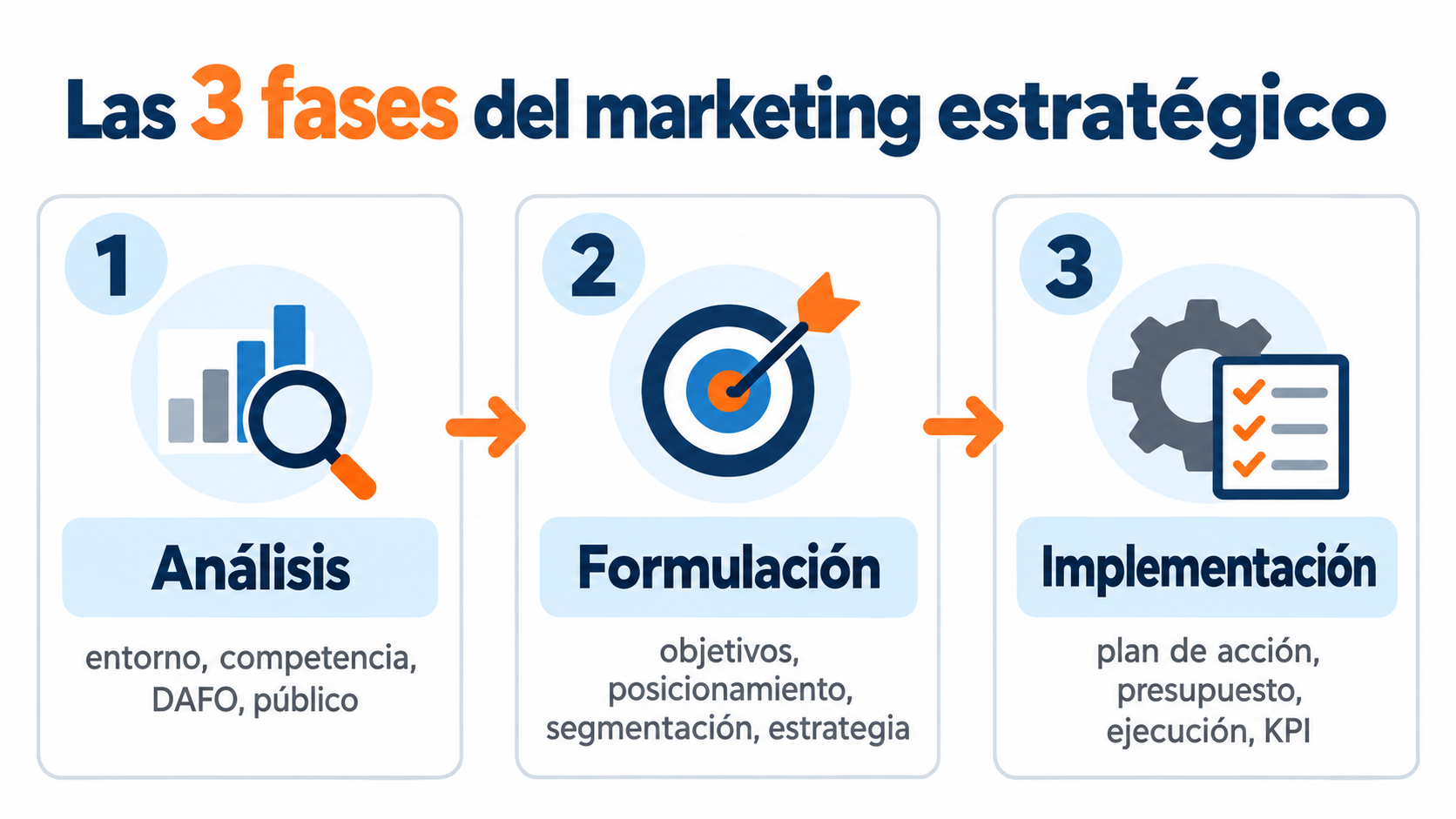
In their study Strategic Marketing (2001), Graeme Drummond and John Ensor identify three basic ones: analysis, formulation and implementation.
Let’s look at them, so they can serve as a map on your long-term marketing journey.
Put your strategy into action with email marketing
Forms, segmentation and automations to turn your plan into campaigns.
Strategic marketing analysis
The first question you should ask yourself is: where are we?
To answer it, you need to know three aspects of your business: what you offer (product or service), who you offer it to (customers) and in what environment you offer it (market and competitors).
This involves the following analyses:
- Analysis of your products or services, to find out how profitable they are.
- Analysis of your target audience. You’ll understand your (potential) customers, their needs, interests and wants, so you know how to reach them.
- Market analysis. It will help you better understand the industry you operate in and its trends. That way you’ll be able to define your goals better.
- Competitor analysis. You’ll learn what your competitors are doing, their position in the market, and their pricing and promotion strategies.
Strategic marketing formulation
With the information you gathered in the first stage, you can now define your goals, your value proposition and your target audience.
These three elements come from the previous analysis: market analysis will help you define your goals, competitor analysis will teach you to stand out with a strong value proposition, and audience analysis will let you build your buyer persona (your ideal customer). The analysis of your products or services, for its part, cuts across the other analyses.
This stage will culminate in your marketing plan, which will include the goals (what you want to achieve), the actions (how the goals will be achieved) and the resources, both material and human (what they’ll be achieved with).
Strategic marketing implementation
Moving from plan to action isn’t easy. What’s more, this transition is often where the strategy runs aground.
In her Principios de marketing estratégico (2015), Teresa Vallet-Bellmunt recommends answering the following questions:
- Who puts the strategy into action, and who will be responsible for each campaign or action?
- When does each action start (its schedule)?
- How will each action be carried out (people, material and financial resources)?
- Where will the actions take place (offline or online, by geographic area, etc.)?
What other elements do you need to take into account when implementing it? Take note of these:
- Corporate culture. If something in your marketing strategy clashes with your company’s culture (rules, beliefs, values), it will probably end up failing.
- The structure and organization of the marketing department, that is, the coordination, specialization and training of the team members.
- People. Those who will implement the strategy and how prepared they are to do it. And whether they need training or reinforcements.
- Management. Those who have the authority to make decisions in the company. Functional leadership, with smooth communication, will help you implement your strategy.
During implementation, it’s a good idea to keep track of the actions. That way you’ll make sure you achieve the different goals. And if you don’t, you’ll be able to step in and make the necessary corrections.
Then, once it’s implemented, comes the review. Strategic marketing is designed to be developed over the long term. And in the long term there may be major changes (in your market, your competitors, your customers) that force you to reshape your strategy.

Strategic marketing tools
What do we mean by tools? Resources such as methods and techniques of analysis, planning and action to develop the different stages of strategic marketing.
Here are a few. They’re not the only ones. But they’ll certainly help you.
SWOT analysis
Because it’s so simple, it’s the go-to tool for diagnosing your starting point. SWOT is an acronym made up of the terms strengths, weaknesses, opportunities and threats.
With a SWOT analysis, you’ll be able to identify the external and internal factors that can influence your strategy. The influence can be positive (strengths and opportunities) or negative (weaknesses and threats).
Positioning map
How do consumers see you compared with the competition? Creating a positioning map will help you find out.
Consumers generally identify brands and their products by attributes or values. For example, BMW positions itself as a high-performance car brand. Hence the slogan: “The Ultimate Driving Machine”. Volvo, on the other hand, puts more emphasis on safety and durability. “Let’s think about the safety of the future” is one of its slogans.
Marketing mix
It’s an essential tool for designing and implementing the marketing plan.
The marketing mix helps you design the different strategies and actions at different levels: price, product, distribution and promotion. That’s why it’s also known as the 4 Ps of marketing (pricing, product, place, promotion)
This is also where strategic marketing and operational marketing meet. For example, once the product or service is launched and the price (or pricing model) is set, a promotional campaign is launched while the product or service is distributed.
KPIs and ROI
To monitor and evaluate the success of your strategy, you need at least two types of tools: one that lets you measure the results of the different actions and another that helps you assess whether your investment is worth it.
The first is called KPIs, short for key performance indicators. As the name suggests, KPIs are a way of knowing (of measuring) whether the actions in your strategy meet the goals of your plan.
A simple example would be the number of leads obtained with a Google ad campaign.
From the KPIs you can estimate the ROI (return on investment), a metric that shows the financial return on your investment. For example, in a Google ad campaign, the KPIs (cost per lead) will let you work out the ROI, that is, the profit you’ve made relative to the cost of getting leads.
Other strategic marketing tools
Since this type of marketing has a long-term vision, you’ll need many tools. Tools based on the initial analysis, for example, are the most common:
- The value chain. This refers to the analysis of the different value-generating processes of your business, such as manufacturing or production, managing its sale, technical support and distributing the product on the market.
- PESTEL analysis. It helps you analyze the impact of your environment based on factors such as political and legal, economic, social and cultural, technological, tax and environmental ones.
- The BCG matrix, very useful if you have several products. It helps you assess which ones are the most profitable and therefore need less investment, and which ones need investment to become profitable.

Examples of strategic marketing
Strategic marketing has marked a turning point for the businesses that, despite its complexity, have taken the plunge and adopted it.
Sainsbury’s
This well-known UK supermarket chain entered a price war with its competitors Tesco and Asda in the 1990s.
It didn’t work out. So after an in-depth analysis, it turned its strategy around and went back to its roots: putting quality before price.
Reebok
The famous sports shoe maker noticed a shift in the market back in the 1980s. Consumers were starting to value design more than the functional aspects of sneakers.
Its competitor Nike, on the other hand, kept betting on functionality and suffered badly (falling sales, layoffs) until it adopted Reebok’s strategy.
The Copenhagen Institute and Danske Bank
Another case that shows the forward-looking vision of strategic marketing is the collaboration between the think tank The Copenhagen Institute and Danske Bank, one of Denmark’s largest banks.
Back in the 1990s, The Copenhagen Institute outlined three future scenarios, over a ten-year horizon, of how the relationship between banks and their customers would evolve. Those three scenarios were the basis of a strategic marketing plan that Danske Bank successfully implemented over the following decade.
Strategic and operational marketing example: a small business step by step
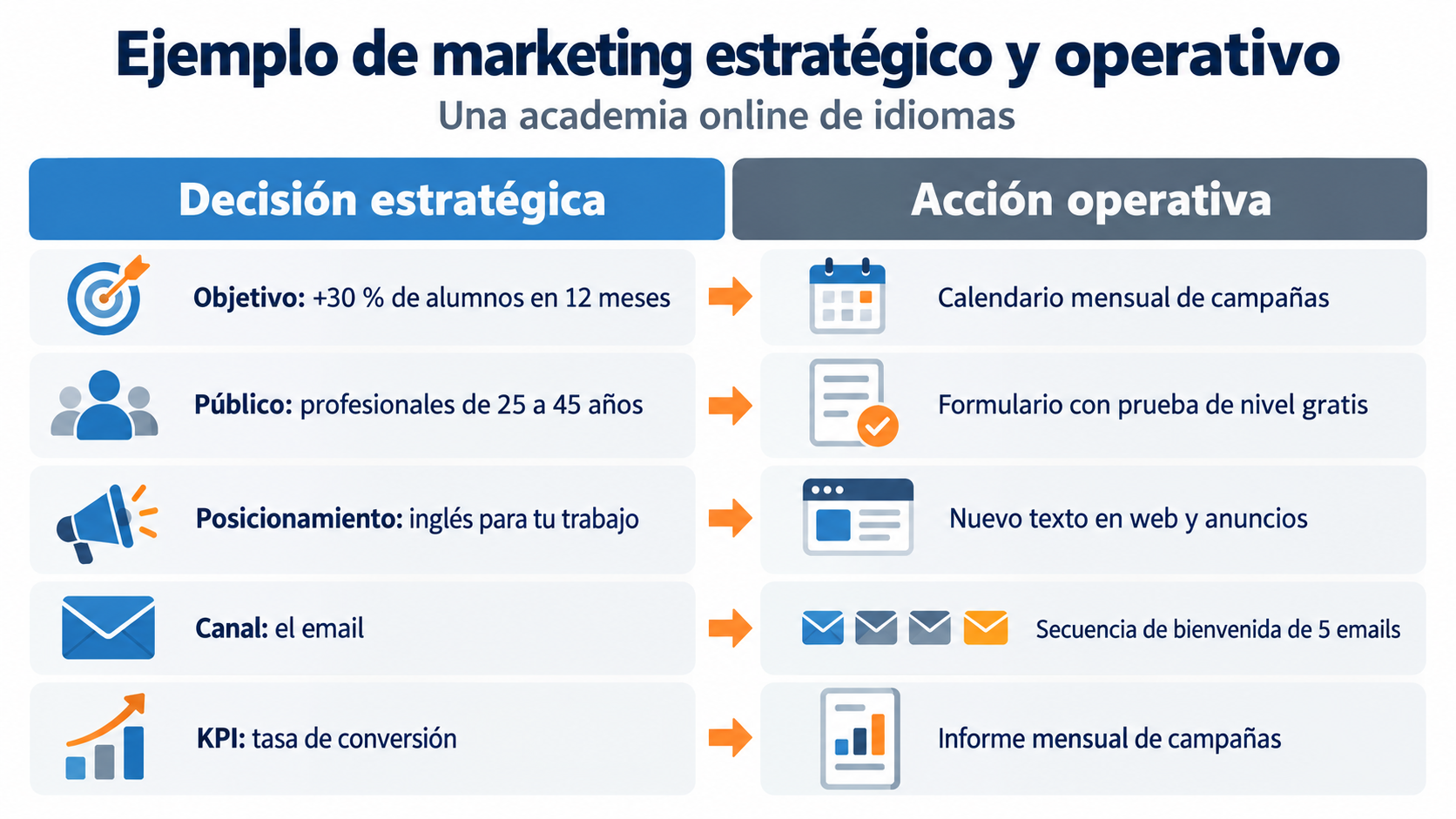
Imagine an online language school with 2,000 students a year that wants to grow without lowering its prices. This is how the strategic side (what it decides) is separated from the operational side (what it does next):
| Step | Strategic decision | Operational action |
|---|---|---|
| SWOT analysis | Strength: native-speaker teachers. Threat: free apps | Email survey of current students |
| Goal | Grow from 2,000 to 2,600 students in 12 months (+30%) | Monthly campaign calendar |
| Audience | Professionals aged 25 to 45 who need English for work | Signup form with a free level test |
| Positioning | “English for your job, with native-speaker teachers” | New copy on the website, in the ads and in the email signature |
| Channel | Email as the main channel to convert interested prospects | 5-email welcome sequence |
| KPI | Cost per student and subscriber-to-student conversion rate | Monthly report with the statistics for each campaign |
The strategic plan is reviewed once or twice a year. Operational actions change every month based on the results. If a campaign doesn’t work, you change the campaign, not the strategy.
Small businesses need two things: a dynamic marketing strategy and well-defined goals. You can’t have a plan set in stone, because a small business’s needs can change very quickly, but medium- and long-term goals shouldn’t change that much. What you adjust is the path, not the destination. Choose actions that fit a small budget, such as a blog and a newsletter, review what works and what doesn’t every few months, and work consistently.
Jose Argudo, CMO at Mailrelay
Measure whether your strategy is working
Opens, clicks and conversions for each campaign, so you can make data-driven decisions.
A few final words on strategic marketing
Many businesses base their marketing strategies on small short-term actions, so the strategic side takes a back seat.
Strategic marketing aims to give meaning and consistency to all those actions and to integrate them into a long-term plan with an eye on the future.
The great success stories show that strategic marketing can be a tool that marks a turning point for many businesses.
And you don’t need to be a large company to adopt it: all it takes is to stop, think, analyze, look far ahead and act accordingly.
At Mailrelay, we offer you an effective way to increase your sales that you can include in your strategic marketing plan.
👉 Try our email marketing service now and turn your strategy into action and your actions into sales.
If you want to start from the basics, we recommend first checking what marketing really is and how it fits into digital marketing.
Create your free account
Up to 80,000 free emails a month, with human support on every plan.
Recommended reading
TOFU, MOFU, BOFU: what they are and examples
The stages of the sales funnel and what content fits each one.
Porter’s 5 forces
How to analyze your competitors and your industry with Porter’s 5 forces.
360º marketing: what it is and how to implement it
How to coordinate all your channels so they pull in the same direction.
50 types of marketing you should know
A look at 50 marketing approaches, from the classics to digital.

Jose Argudo
CMO at Mailrelay. Writes about email marketing, copywriting and conversion for small businesses and entrepreneurs.