Email marketing tools with the best deliverability: 2026 comparison
Which features to compare so your campaigns reach the inbox

Which features to compare so your campaigns reach the inbox
Most email marketing tool comparisons look at the same things: price, templates and automation. But one factor decides whether any of that matters. It’s deliverability, meaning your emails land in the inbox and not in spam.
In this guide we look at which deliverability features are worth comparing and what the most popular ESPs offer. We also cover the tools that help you measure whether your campaigns really get through.
Deliverability is the ability of an email to reach the recipient’s inbox. It isn’t the same as the delivery rate. A server can accept your message and still send it to the spam folder. That’s why there’s another metric, the inbox placement rate.
Your email marketing tool has a big influence on that result. It manages the IPs you send from, helps you authenticate your domain and cleans out contacts that cause problems. If it does that job badly, your good practices lose their effect.
If you’d like an overview first, see what an email marketing tool is and what it should include.
An ESP (email service provider) with good deliverability doesn’t rely on a single trick. It relies on a set of features that work together:
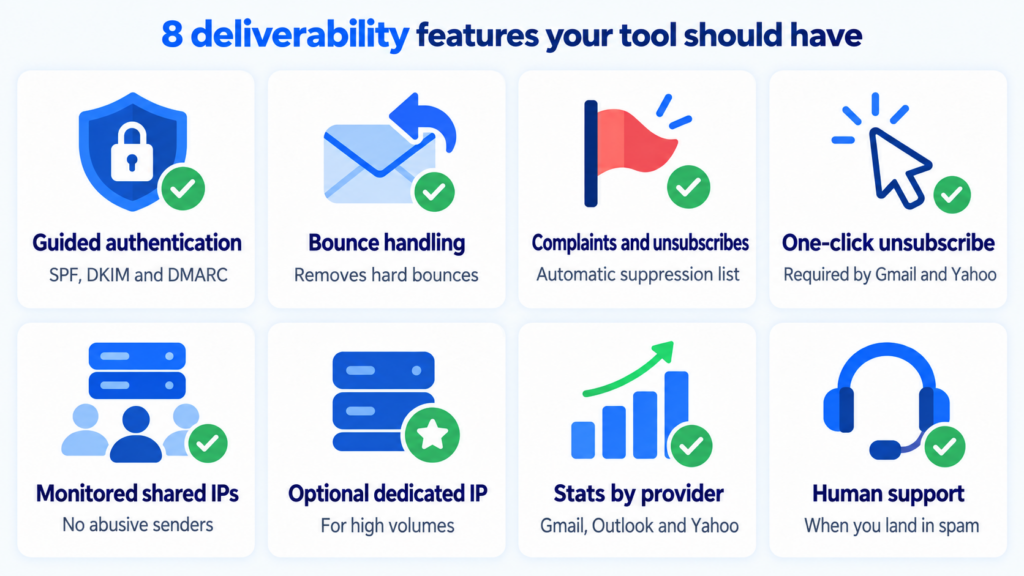
Every serious ESP lets you authenticate your domain and handles bounces. The differences show up in two areas: whether you can get a dedicated IP and what support you get on the free plan. This is what each one offers as of September 2026:
| Tool | Dedicated IP | Support on the free plan |
|---|---|---|
| Mailrelay | Yes, billed annually | Chat, ticket and phone |
| Brevo | Add-on on Professional; included on Enterprise | Email only |
| Mailchimp | Campaigns go out on shared IPs; dedicated IPs are offered in Mailchimp Transactional | Email for the first 30 days only |
| MailerLite | On request, from 50,000 emails a week and with an authenticated domain | Email and chat for the first 14 days only |
| Mailjet | Included on Premium (1 IP) | Online support |
| Acumbamail | Enterprise plan only | No phone support (from the Basic plan) |
| GetResponse | On MAX plans | No support on the free plan |
| SendGrid | Included on Email API Pro and Marketing Advanced | No free plan: 60-day trial |
These details change often, so it’s worth confirming them on each provider’s website before you decide. If you’d rather compare free plans, limits and pricing, see our guide to the best email marketing software.
With a shared IP, your reputation is pooled with other senders on the same provider. If the ESP monitors its customers well, it’s the best option for most businesses. And you don’t need to warm anything up.
A dedicated IP only makes sense with high, steady volume. Its reputation depends entirely on your sends. That’s why you need IP warming at the start. MailerLite, for example, asks for at least 50,000 emails a week before assigning one.
Sending low volume from a dedicated IP can work against you.
A tool built to reach the inbox
Authenticate your domain in minutes, clean your list automatically and get human support on every plan.
Create a free accountYour ESP is only part of the job. These tools tell you how the big mailbox providers see your sends and where the problem is when something goes wrong:
| Tool | What it’s for | Cost |
|---|---|---|
| Google Postmaster Tools | Compliance status with Gmail’s requirements and spam rate | Free |
| Microsoft SNDS | Data on the IPs that send to Outlook and Hotmail | Free |
| Yahoo Sender Hub | Complaint feedback loop (CFL) and Insights dashboard with complaint rate | Free |
| mail-tester | Spam score for a test email | 3 free tests every 24 hours |
| GlockApps | Inbox placement tests by provider | Paid |
| Litmus | Previews across email clients | Paid |
| Email on Acid | Previews and accessibility checks | Paid |
| MXToolbox | DNS, SPF, DKIM and blacklist checks | Free with paid options |
| Spamhaus | Checks whether your IP or domain is on its blacklist | Free |
| dmarcian | Easy-to-read DMARC reports | Free with paid options |
| ZeroBounce | List verification before importing | Paid per credit |
| NeverBounce | Address verification and cleaning | Paid per credit |
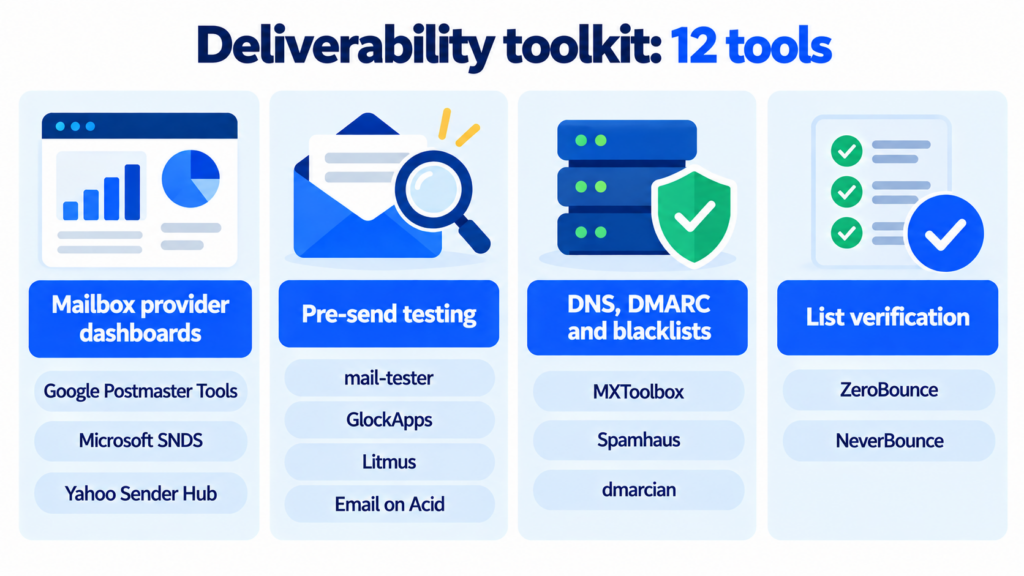
A note on Google Postmaster Tools: since September 30, 2025 it no longer shows IP and domain reputation. It now focuses on whether you meet Gmail’s requirements. And in 2025 Yahoo launched its Insights dashboard, which finally gives senders their own complaint figure.
Deliverability also depends on content. An email built from a single image with hardly any text raises flags with antispam filters. If you design banners or headers with Canva or a similar tool, always pair them with real text and add alt text to every image.
You don’t need to trust any comparison, including this one. You can test it yourself in an afternoon. Create a free account, authenticate your domain and send the same campaign to your own Gmail, Outlook and Yahoo addresses.
Then check which folder each one lands in. Run the email through mail-tester and open the headers to confirm that SPF, DKIM and DMARC show “pass”. Finally, send support a technical question and time how long they take to reply. That tells you a lot about what will happen the day you have a real problem.
At Mailrelay we work with our own IP ranges and algorithms that help prevent blocks. Automatic list cleaning is included on every plan, the free one too. And if your volume justifies it, you can get a dedicated IP billed annually.
Human support by chat, ticket or phone is available on every account —with no time limit—. On top of that, the free account lets you send up to 80,000 emails a month to 20,000 contacts. That’s enough to run the test above with your real list.
See it for yourself with your real list
Up to 80,000 emails a month and 20,000 contacts for free to measure Mailrelay’s deliverability with your own campaigns.
Try Mailrelay for freeWhich email marketing tool has the best deliverability? There’s no universal ranking. It depends on how the provider manages its IPs and, above all, on your own practices: permission-based lists, an authenticated domain and relevant content. The most reliable way is to test untill you’re sure, using your own domain.
Do I need a dedicated IP? Only if you send high, steady volume. For most small businesses, a well-managed shared IP works better.
How do I know if my emails are going to spam? Send tests to your own accounts at several providers and use tools like mail-tester or GlockApps. It also helps to watch opens by provider: a sudden drop usually points to a problem.
Are there free tools to measure deliverability? Yes. Google Postmaster Tools, Microsoft SNDS, Yahoo Sender Hub and Spamhaus are free. mail-tester allows three free tests every 24 hours.