Digital commerce: what it is, how much it costs and strategies to succeed
Everything you need to sell online: models, costs, platforms and how to keep your customers coming back

Everything you need to sell online: models, costs, platforms and how to keep your customers coming back
In recent years, the way we buy and sell has changed significantly, driven by digitalization and the constant evolution of technology.
Understanding these changes helps any business adapt and sell more.
In this analysis, we’re going to explore together the keys and strategies that can help a business thrive in the digital environment.
We’ll go step by step, from the definition of digital commerce to the more sophisticated details of user experience and digital marketing techniques.
All this with the aim of providing as complete a picture as possible of what it means to do business in the digital age.
In simple terms, digital commerce, also known as e-commerce, refers to any business transaction carried out over the internet.
This covers a wide variety of businesses, from sites selling goods and services to auction platforms, and from music services to software.
Digital commerce is a comprehensive ecosystem that includes digital marketing, search engine optimization (SEO), email marketing, data analysis, user experience, and more.
Why does digital commerce matter in today’s market?
The answer is clear and direct: digitalization and the growing use of the internet have profoundly and lastingly changed consumer habits.
Consumers are increasingly drawn to the convenience of shopping from home or the office, with the product delivered straight to their door.
Customer expectations are also evolving, and digital commerce provides a means to meet these growing and changing demands.

Do you have an online store?
With Mailrelay you can capture subscribers in your store and send them your news and offers. The free account includes up to 80,000 emails per month.
Digital commerce isn’t a phenomenon that appeared overnight.
It’s been the result of decades of evolution and technological progress.
Let’s take a brief look at the past to better understand how we got to where we are now.
E-commerce has its roots in the 60s and 70s, when businesses began using Electronic Data Interchange (EDI) to share business documents.
However, the real boom in e-commerce didn’t arrive until the 1990s with the emergence of the World Wide Web.
Amazon and eBay, launched in 1995, are two of the pioneers in this field.
They created an online platform where consumers could buy almost anything from the comfort of their homes.
This marked the start of a revolution in the way people bought and sold goods.
As technology advanced and internet adoption became widespread, more businesses began joining the e-commerce wave, greatly expanding the range and diversity of products and services available online.
While e-commerce laid the groundwork, digital commerce represents an evolution of this initial trend.
Unlike e-commerce, which focuses solely on the online transaction, digital commerce covers the customer’s entire online experience, from initial research through to after-sales and customer service.
This transition has been driven by the rapid adoption of mobile devices, the rise of social media, and the growth of technologies like data analysis and artificial intelligence.
These advances have allowed businesses to interact with their customers in new and exciting ways, offering personalized, user-centered experiences.
The relevance of digital commerce has intensified even further in the pandemic and post-pandemic era.
The restrictions imposed to control the spread of COVID-19 led to an unprecedented increase in online shopping.
Even people who previously resisted shopping online were forced to adapt, accelerating the adoption of digital commerce.
In addition, businesses have had to innovate quickly to stay afloat in a changing business environment, driving the development of new technologies and business practices.
This has led to the emergence of hybrid business models, where online and physical experiences intertwine so that customers can move seamlessly from one to the other.
The post-pandemic era doesn’t seem set to reverse this trend.
Rather, it seems digital commerce will continue to grow and evolve as businesses and consumers embrace the advantages it offers.

To succeed in digital commerce, it pays to choose the right platform.
There are many options available, each with its own advantages and disadvantages.
Some of the most popular are Amazon, Shopify, eBay, and Alibaba, though there are many others. Let’s compare these platforms and discuss what makes them unique.
Advantages: Great reach and customer base, logistics options, wide range of products.
Disadvantages: Intense competition, potentially high fees, little control over store presentation.
Advantages: Ease of use, customization, integration with other platforms.
Disadvantages: Monthly fees, some advanced features require paid apps.
Advantages: Allows auctions, a good platform for unique products.
Disadvantages: Intense competition, selling fees can be high.
Advantages: Great platform for establishing relationships with suppliers, focus on wholesale sales.
Disadvantages: Not ideal for small retailers, possible communication and quality issues.

There’s no single figure. The cost depends mainly on the business model and how much of the work you do yourself.
| Model | What you need | Initial investment |
|---|---|---|
| Your own products | Stock, space to store it, shipping and an online store | The highest: you pay for the stock before you sell |
| Affiliate marketing | A website or blog with content and traffic | Low: you don’t buy any product, you earn a commission |
| Dropshipping | An online store and an agreement with a supplier | Low: the supplier stores and ships the product |
| Marketplace | A seller account and stock | Medium: you pay commissions on every sale |
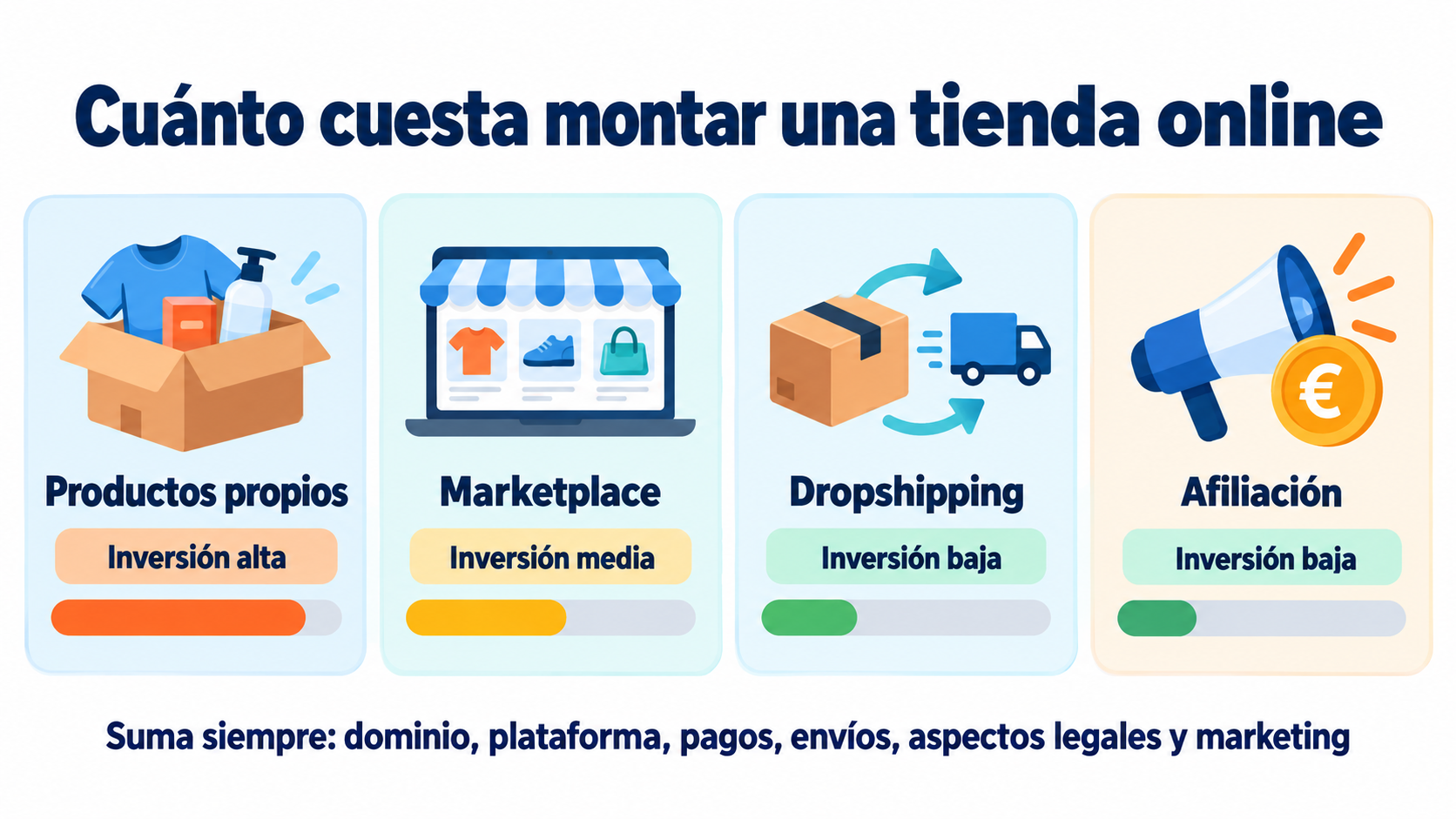
Whatever the model, these are the most common costs when launching an online store:
Domain and hosting. Your website’s name and the server it runs on. They’re paid yearly or monthly.
Store platform. Open-source solutions, such as WooCommerce or PrestaShop, have no fee, but they do have hosting, template and extension costs. Cloud platforms charge a monthly fee and sometimes a commission per sale.
Design. A pre-designed template costs little. A custom design, quite a lot more.
Payment gateway. It usually charges a commission on every transaction.
Shipping and returns. Transport, packaging and handling returns.
Legal matters. Legal notice, privacy policy, terms of sale and GDPR compliance if you process personal data.
Marketing. Ads, SEO, content and email. It’s the cost most often forgotten when doing the math.
Start with the bare minimum. A short catalog, a well-made template and the basic features you need to sell.
Validate before buying stock. Pre-sales or dropshipping let you check what sells without risking money.
Take advantage of free plans. Many design, analytics and email marketing tools have a free version to get you started.
Invest in your own channels. Every newsletter subscriber is a customer you can write to again without paying for another ad.
Getting started in digital commerce can seem complex, but with a clear, step-by-step plan, the path to success can be much more manageable.
Below are some of the essential steps to get started.
First of all, you need a solid, well-thought-out digital commerce strategy.
This is the roadmap that will guide all your actions in the digital world, so it needs to be clear, coherent and adaptable.
To start, define your business goals:
Once you have your goals clearly defined, it will be easier to make decisions and evaluate the success of your efforts.
Next, you need to know your target audience:
By understanding your audience, you can create a strategy that connects with them effectively and authentically.
Your strategy should also include a plan for reaching your customers.
This can include social media marketing, online advertising, email marketing and much more.
Each channel has its own strengths and weaknesses, so it’s important to choose those that align best with your goals and your audience.
Finally, your strategy needs to be flexible.
Digital commerce changes and evolves quickly, and you have to adapt to these shifts to keep up with the competition and customer expectations.
The second step is designing your website.
This will be your business’s home in the digital world, and it will often be customers’ first impression of your brand.
That’s why your website should be appealing, intuitive and user-centered.
A good website design starts with clear, easy-to-use navigation.
Customers should be able to find what they’re looking for quickly and effortlessly. It’s also important to make sure your website is accessible to all users, including those with visual or hearing impairments.
Your website’s look also plays a part in its appeal.
Colors, fonts and images should be consistent with your brand and appealing to your target audience.
Your website should also be optimized for mobile devices.
More and more people shop via smartphones or tablets, and a website that doesn’t work well on these devices can lose a large number of potential customers.
Once you have an appealing, functional website, it’s important to make sure people can find it.
This is where search engine optimization (SEO) comes into play.
SEO involves making adjustments to your website and content to make them more appealing to search engines like Google.
This can include incorporating relevant keywords into your content, optimizing your pages’ meta descriptions and creating internal and external links.
It’s important to remember that SEO isn’t a one-time process.
Search engine algorithms change frequently, so it pays to stay up to date and make adjustments as needed.
It’s also worth remembering that good SEO is based on providing valuable, relevant content, not just manipulating algorithms.
Content marketing and social media can be a powerful tool for increasing your visibility, attracting new customers and building a relationship with your audience.
An effective content marketing plan involves creating and distributing relevant, valuable content that attracts and retains a clearly defined audience.
This can include blogs, guides, infographics, videos, podcasts and much more.
The goal is to provide your audience with something of value, which in turn increases your authority and credibility.
Social media, for its part, is an excellent way to spread your content and interact with your audience in a more personal, immediate way.
Different platforms have different strengths and audiences, so it’s important to choose the right ones for your business.
Email marketing is a powerful tool for keeping customers engaged, encouraging repeat sales and building a long-term relationship with your audience.
An effective email marketing strategy should start with building a mailing list.
This can be done through sign-up forms on your website, special offers and other incentives.
Once you have a list, it’s important to segment it according to your audience’s needs and interests.
This will let you personalize your messages and make them more relevant to recipients.
It’s also worth paying attention to the frequency and timing of your emails.
Too many emails can be intrusive and lead people to unsubscribe, while too few can make them forget about you.
The key is finding a balance.

Digital commerce has opened up a range of possibilities for connecting with customers, and one of the most effective methods is email marketing.
Despite the proliferation of new communication channels, email marketing remains a powerful, effective tool for reaching consumers and fostering a lasting relationship.
Email marketing is one of the most cost-effective tools in digital commerce, for several reasons.
To start, it offers a direct, personalized way to communicate with customers.
Unlike ads or social media posts, which can get lost in the crowd, emails land directly in the recipient’s inbox, increasing the chances of being seen and read.
One of the main benefits of email marketing is its ability to be highly personalized.
Each email can be tailored to meet the recipient’s interests and needs, which can result in higher open and click-through rates.
This is especially useful in digital commerce, where businesses often have large amounts of data on customer behaviors and preferences.
In addition, email marketing offers an excellent return on investment.
According to several studies, email marketing can deliver a return on investment of up to $44 for every $1 spent.
This is due partly to its low cost compared to other marketing methods, and partly to its high effectiveness.
Last but not least, email marketing is measurable.
Businesses can track open rates, click-through rates, conversions and other metrics to evaluate the success of their email campaigns and make adjustments as needed.
Creating an effective email marketing campaign requires a combination of strategy, relevant content and a focus on the customer experience.
Here are some key stages in creating a successful email marketing campaign:
Despite the many advantages of email marketing, there’s a risk: being marked as spam. Here are some tips to help avoid that:
These are just a few tips to help you make the most of your email marketing campaigns and avoid falling into the spam trap.

Send your newsletters with Mailrelay
Up to 80,000 emails a month and 20,000 contacts for free, with human support on every plan.
Digital commerce is constantly evolving, with new technologies and innovations changing the way businesses interact with their customers.
Let’s now explore some of the most exciting innovations shaping the future of digital commerce.
Augmented reality (AR) and virtual reality (VR) are revolutionizing the online shopping experience.
AR lets customers see how products would look in their own environment before making a purchase.
For example, furniture retailers can let customers see how a sofa would look in their living room, while fashion stores can let customers “try on” clothes virtually.
VR, on the other hand, can offer immersive shopping experiences that replicate (or improve on) the experience of shopping in a physical store.
This can be especially useful for retailers selling products that customers want to experience before buying, like cars or appliances.
Artificial intelligence (AI) and machine learning (ML) are enabling businesses to automate processes, improve the customer experience and gain valuable insights from data.
For example, AI chatbots can assist customers instantly, answering questions and resolving issues without the need for human intervention.
This can improve customer satisfaction and free up employees to focus on more complex tasks.
Machine learning can be used to analyze large amounts of data and detect patterns and trends.
This can be useful for predicting customer behavior, optimizing prices and offers, and improving supply chain efficiency.
Personalization is a key trend in digital commerce. Customers increasingly expect shopping experiences that adapt to their individual needs and interests.
This can be achieved through personalized recommendations, targeted communications, and unique shopping experiences.
Personalization is being taken to the next level with predictive commerce.
This is the idea of anticipating customers’ needs and wants before they’re even aware of them.
This can involve predicting fashion trends before they become popular, anticipating when a customer might need to restock a product, or suggesting products the customer might find useful based on their shopping behavior.
These are just some of the innovations changing the face of digital commerce. As technology continues to advance, we can expect to see even more exciting changes in the future.

Digital commerce has undergone rapid evolution over the past decade and continues to innovate at an impressive pace.
Let’s take a look at how emerging trends and developing technologies could shape the future of digital commerce.
One emerging trend in digital commerce is the focus on creating omnichannel customer experiences.
Today’s customers interact with brands through multiple touchpoints – physical stores, websites, social media, mobile apps, etc.
Successful digital retailers will be those that can provide a consistent, seamless experience across all these channels.
Another important trend is the growth of social commerce.
Social media platforms are increasingly incorporating e-commerce capabilities, allowing users to buy products directly through the platform.
This can create a more convenient, frictionless shopping experience for the customer.
Finally, sustainability is becoming an increasing concern for consumers.
Digital commerce businesses that can demonstrate their commitment to sustainability – whether through ethical manufacturing practices, eco-friendly packaging, or promoting sustainable products – will likely have a competitive edge in the future.
5G promises to revolutionize digital commerce. With faster data speeds and lower latency, 5G will enable richer, more immersive digital commerce experiences.
For example, 5G could enable real-time transactions, enhance the augmented and virtual reality experience, and allow high-resolution content to be downloaded in an instant.
In addition, 5G can make new forms of digital commerce possible.
For example, it could allow businesses to use the Internet of Things to track and manage inventory in real time, or to offer personalized customer experiences based on real-time sensor data.
Other emerging technologies that could impact digital commerce include blockchain, which could provide greater transparency and security in transactions, and quantum computing, which could enable even more advanced data analysis and customer personalization.
The future of digital commerce is exciting, with many opportunities for innovation and growth.
Businesses that can adapt to and take advantage of these new technologies and trends will be well positioned to succeed in the years ahead.
If you’re thinking about launching your online store, start with three decisions: what you’re going to sell, with which model and on which platform. Work out the costs before investing and leave room in the budget for marketing.
From day one, ask your visitors for their email. A list of your own is the channel that will do the most to bring your customers back.
Start building your list today
Create your free Mailrelay account: up to 80,000 emails a month and 20,000 contacts, with human support on every plan.
These are the most common questions about digital commerce.
Any buying or selling of products or services over the internet: online stores, marketplaces, apps and social media.
They are used almost as synonyms. Sometimes “digital commerce” is used in a broader sense that includes marketing, payments and customer service online.
It depends on the model. Affiliate marketing and dropshipping require little initial investment. Selling your own products means buying stock before you sell.
It depends on your budget and your know-how. Open-source solutions give you more control, cloud platforms are easier to maintain and marketplaces give you visibility in exchange for commissions.
Because it lets you talk again to people who already know you: recover abandoned carts, announce what’s new and get them to buy again.

Jose Argudo
CMO at Mailrelay. Writes about email marketing, copywriting and conversion for small businesses and entrepreneurs.