Brainstorming: what it is, how to run a brainstorming session and techniques that work
How to come up with lots of ideas in a short time and keep the ones that are really worth it
Brainstorming is a technique for generating lots of ideas in a short time about a specific problem, without judging them as they are put forward.
It can be done in a group or alone. What defines it is not the number of people but the order: first you generate ideas, then you evaluate them.
It was popularized by Alex F. Osborn, an advertising executive at the BBDO agency, in the 1940s. He explained it in his book Applied Imagination (1953).
Since then it has been used in companies, classrooms and teams all over the world.
What does brainstorming mean?
In Spanish it is called lluvia de ideas (literally, “a rain of ideas”). The English word combines brain and storm: using your brain to throw out ideas like in a storm.
Osborn spoke of “using the brain to storm a creative problem”. That is why people often say that a brainstorming session is not about finding the best idea, but many ideas among which to find it.
The 4 rules of brainstorming
Osborn proposed four rules. They are still the foundation of any session:
| Rule | What it means | In practice |
|---|---|---|
| Quantity over quality | The more ideas, the better the chances of hitting on a good one | Set yourself a target: “30 ideas in 15 minutes” |
| No criticism | Ideas are not judged while they are being put forward | No saying “that won’t work” or “we already tried that” |
| Wild ideas are welcome | An absurd suggestion can open up a new path | Set aside a round just for crazy ideas |
| Combine and improve | Building on someone else’s idea is allowed | Ask “what if we combine 4 and 12?” |
The rule that gets broken most often is the second one. A single negative comment is enough for the rest of the group to start filtering what they say.
How to brainstorm step by step
A well-prepared session doesn’t need more than an hour. These are the steps:
- Frame the problem as a question. “How can we get more subscribers in the physical store?” works better than “marketing ideas”.
- Choose the people. Mix profiles: someone from sales, someone from customer service, someone who doesn’t know the subject.
- Allow a few minutes of individual work. Each person writes down their ideas before sharing them.
- Share the ideas without judging them. A moderator writes them all down on a whiteboard or in a document.
- Group and vote. Put similar ideas together and choose the three or four with the most potential.
- Decide the next step. Each chosen idea needs an owner and a date to test it.
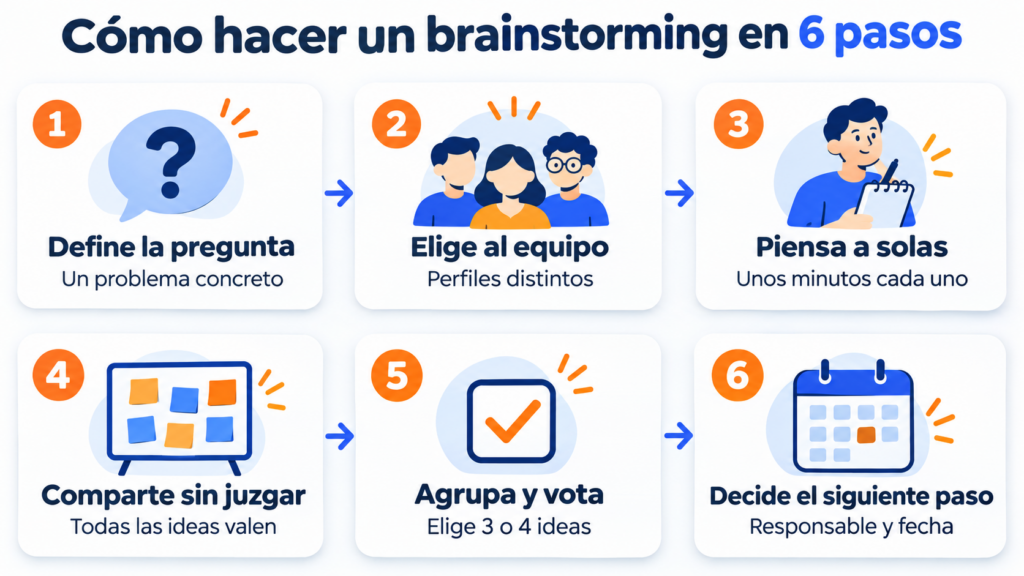
Step 3 may seem like a minor detail, but it isn’t. It stops the first ideas spoken out loud from shaping all the others.
Brainstorming techniques
The classic session is not the only way to brainstorm. These variations solve specific problems:
| Technique | How it works | Useful if… |
|---|---|---|
| Brainwriting (6-3-5 method) | 6 people write 3 ideas in 5 minutes and pass the sheet to the next person | Some people say little in meetings |
| Mind map | You start from a central idea and branch out | You want to organize a broad topic |
| SCAMPER | 7 questions are applied: substitute, combine, adapt, modify, put to other uses, eliminate, rearrange | You want to improve something that already exists |
| Reverse brainstorming | You look for ideas to make the problem worse and then turn them around | The group is stuck |
| Starbursting | You generate questions (what, who, when, where, why, how) instead of answers | You are about to launch something new and want to spot doubts |
| Six thinking hats | Each “hat” forces you to look at the topic from one angle (facts, emotions, risks…) | You need to evaluate an idea, not just generate it |
Brainwriting 6-3-5 was proposed by Bernd Rohrbach in 1968. The six thinking hats come from Edward de Bono (1985).
Does brainstorming really work?
It works, but not always in the way people think.
A classic study by Michael Diehl and Wolfgang Stroebe (1987) compared groups brainstorming out loud with the same number of people working separately.
The people working alone, once their ideas were added together, generated more ideas than the groups.
The main cause is production blocking: in a meeting only one person speaks at a time, and while you wait your turn you forget or discard what you were going to say.
The solution is not to give up on the group. It is to combine the two: think alone first and share afterwards. That is why step 3 and brainwriting work so well.
And if you work alone and the ideas aren’t coming, change your surroundings. In a Stanford University study (Oppezzo and Schwartz, 2014), people gave more creative answers while walking than while sitting.
Out of ideas? A very simple and inexpensive solution is to go for a short walk. It works wonders: movement increases blood flow to the brain, and the relaxed atmosphere of a walk boosts creative freedom. Don’t get frustrated: pressure rarely produces ideas straight away. Keep working, but in a more creative way.
Jose Argudo, CMO at Mailrelay
Brainstorming in marketing and email marketing
In marketing it is used for almost everything: product names, campaigns, slogans or blog topics. If you are looking for a brand name, our naming guide walks you through the whole process.
In email marketing it is especially useful at three moments:
- Email subject lines. Generate 20 or 30 subject lines for a campaign, keep two very different ones and compare them with an A/B test.
- Newsletter content. One session a quarter with sales and customer service gives you topics for months: the questions that come up most often are content your subscribers already want to read.
- Lead magnets. Before creating a downloadable resource, make a list of ideas and ask your list which one they prefer.
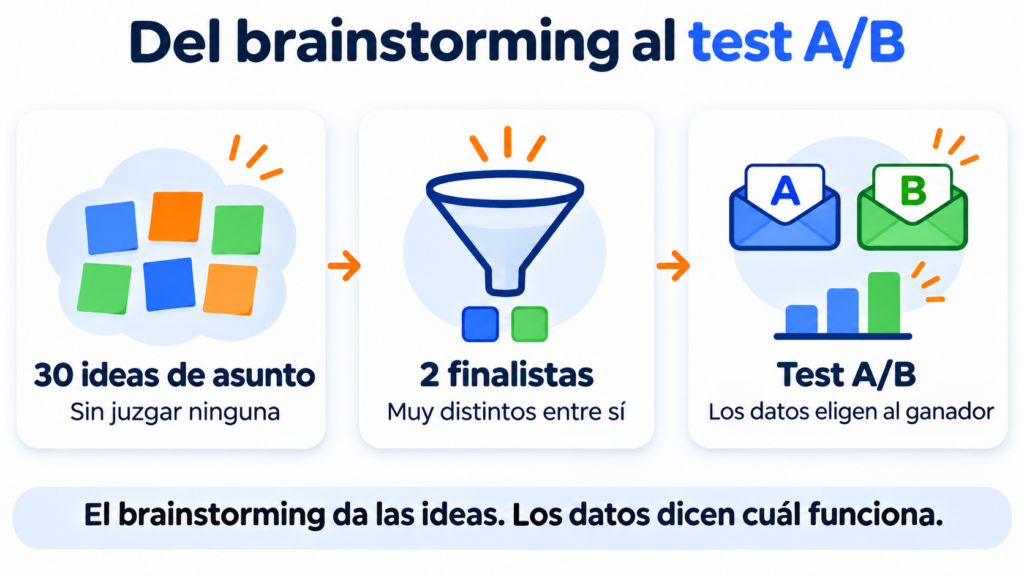
Brainstorming generates ideas, but it doesn’t tell you which one works. The data gives you that answer: which subject line gets more clicks, which topic retains more subscribers.
Turn your best ideas into campaigns
Test your subject lines with an A/B test and find out which one works. With Mailrelay’s free account you can send up to 80,000 emails a month to 20,000 contacts.
Frequently asked questions about brainstorming
These are the most common questions when organizing a brainstorming session.
How many people should take part in a brainstorming session?
There is no official number, but groups of 5 to 10 people are typical. With fewer, you lose variety. With more, it is hard for everyone to take part, so it is best to split the group or use brainwriting.
Can you brainstorm alone or with AI?
Yes. On your own it works well with a time limit and a target number of ideas to reach. Tools like ChatGPT can give you a starting point, but the most useful ideas usually come from what only you know about your business and your customers.