Direct costs: what they are, examples and how to calculate them
What each product, service or campaign costs you, and how to tell whether it pays off
If you run a business, large or small, you know that understanding your costs helps you manage it better and make money.
One of the most important concepts in this area is “direct costs”.
But what exactly are they, and why are they so important?
What are direct costs?
Direct costs are those that are closely linked to production or the provision of a service.
These costs can be easily identified and assigned directly to a particular product, service, or project.
This includes things like materials, labor and any other resources used specifically in production or in delivering a service. In Latin America, Spanish speakers more often call them “costos directos” rather than “costes directos”.
Examples of direct costs
| Type of business | Direct costs |
|---|---|
| Factory or workshop | Raw materials, parts, production labor |
| Online store | Product purchase price, packaging, shipping to the customer, payment gateway fee |
| Restaurant | Ingredients, takeaway packaging |
| Agency or consultancy | Team hours spent on that client, tools hired only for their project |
| Marketing campaign | Campaign design and copywriting, SMS credits, ads, discounts offered |
Difference between direct and indirect costs
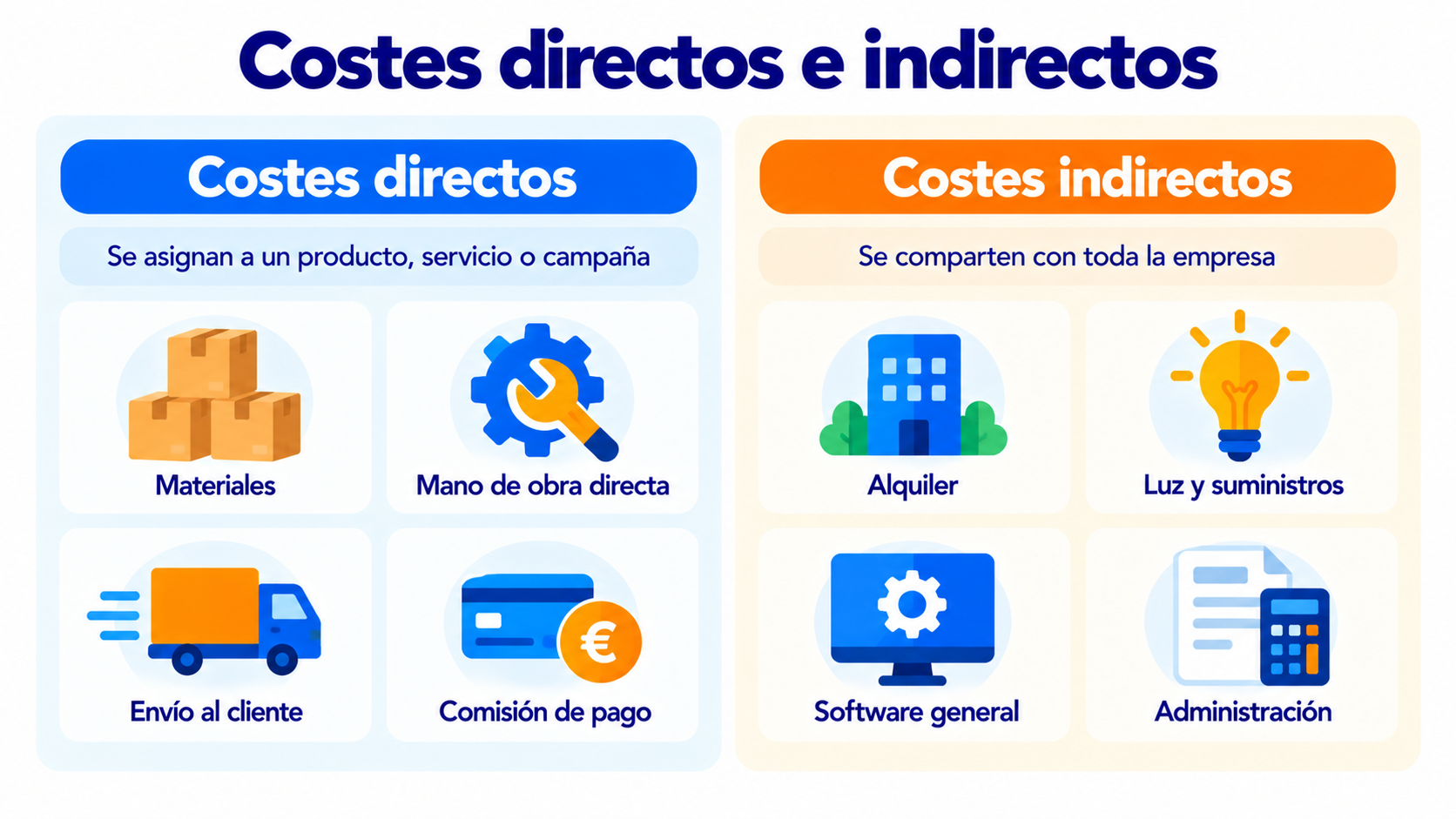
Indirect costs are the other half of the equation. Here is how they differ:
| Direct costs | Indirect costs | |
|---|---|---|
| What they are | Clearly assigned to a product, service or campaign | Shared across several products or the whole company |
| Examples | Materials, production labor, shipping | Rent, electricity, accounting, general software |
| How they are allocated | Added to the cost of each unit | Allocated using a criterion (hours, sales, square meters) |
Reach your customers at a very low cost per send
Send email and SMS campaigns to your list and measure how many sales each one brings in. Get started for free with Mailrelay.
Importance of direct costs
Understanding your direct costs helps you in several ways:
- Pricing: It helps you set the prices of your products or services.
- Profit margin: Knowing your direct costs lets you calculate your profit margin more accurately.
- Performance evaluation: By assigning costs to specific products or projects, you can see what is profitable and what needs adjusting.
How to calculate direct costs
The formula for calculating direct costs is usually quite simple:
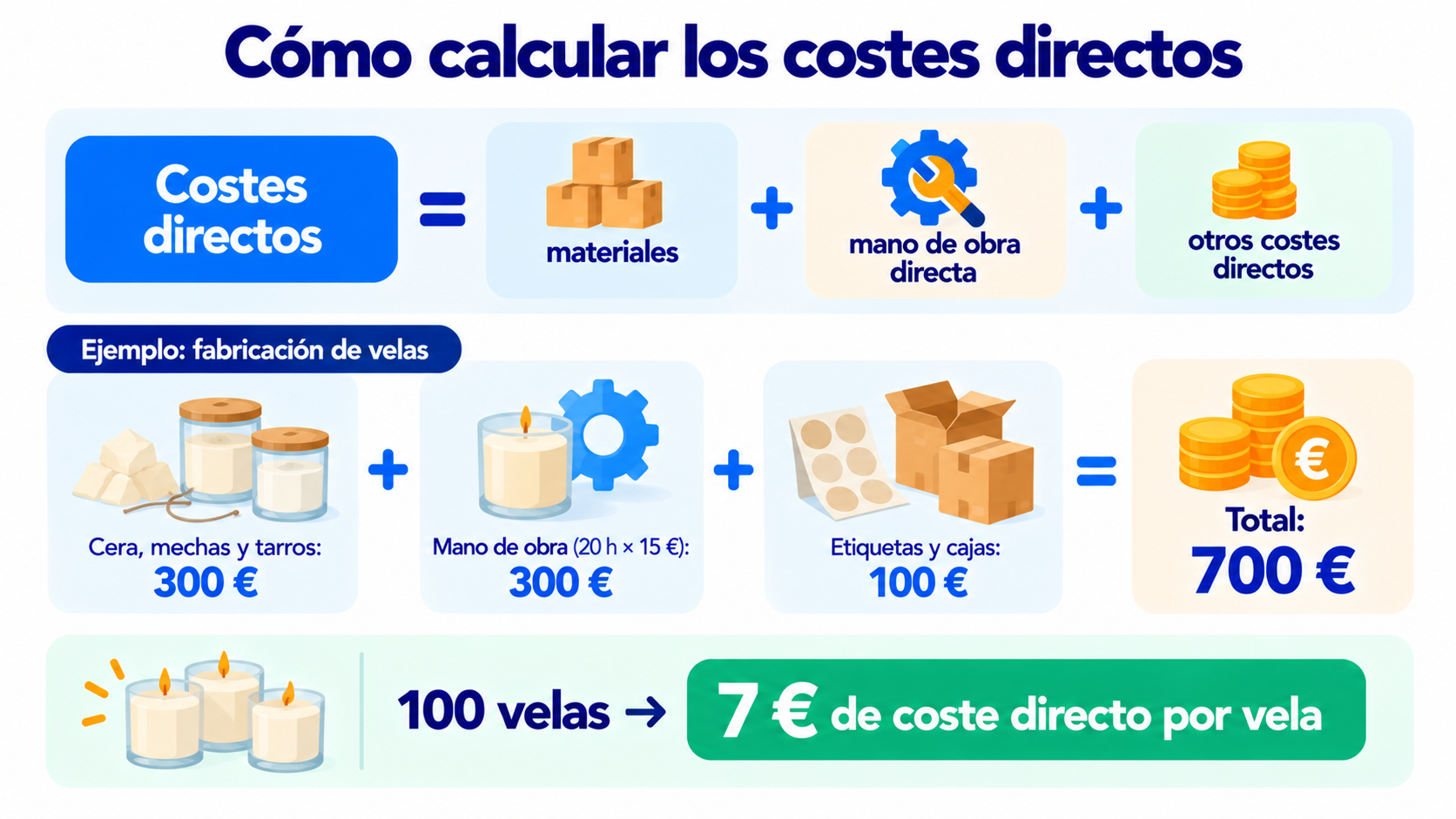
Direct costs = materials + direct labor + other direct costs
For example, a workshop makes 100 candles a month:
| Item | Cost |
|---|---|
| Wax, wicks and jars | €300 |
| Direct labor (20 hours at €15) | €300 |
| Labels and boxes | €100 |
| Total direct costs | €700 |
| Direct cost per candle | €7 |
If each candle sells for €15, that leaves €8 per candle to cover indirect costs (rent, website, electricity) and profit. We explain this in how to set the price of a product.
Strategies to reduce direct costs
- Negotiating with suppliers: Sometimes a simple conversation can get you better prices on the materials or services you buy.
- Automation: Although it requires an initial investment, automation can significantly reduce labor costs in the long run.
- Process optimization: Reviewing your current processes can reveal areas where improvements would reduce costs.
Direct costs and marketing
We can’t talk about costs without mentioning marketing strategies.
General marketing expenses are usually indirect costs, but what you spend on a specific campaign is a direct cost of that campaign. Some methods, such as bulk SMS, can be extremely effective and have a relatively low direct cost.
A good bulk SMS strategy can generate high open and conversion rates, maximizing your return on investment.
The direct costs of an email campaign
| Expense | Direct cost of the campaign? |
|---|---|
| Design and copywriting for that email | Yes |
| SMS credits used in that campaign | Yes |
| Discount or gift you offer | Yes |
| Monthly plan for the email tool | No, if you use it for all your campaigns: it is shared |
| Marketing team salaries | No, unless they work only on that campaign |
With a campaign’s direct costs you can work out what each sale costs you: divide the total by the number of sales it brings in. If a campaign costs you €200 and brings in 40 sales, each sale has cost you €5. That is the CPA, and it helps you measure email marketing profitability.
How Mailrelay helps you
Direct costs are a key part of business management and marketing strategy.
By understanding and controlling them, you put yourself in an excellent position to grow your business profitably.
And speaking of profitable strategies, Mailrelay lets you send email marketing and bulk SMS with a free account of up to 80,000 emails a month. With Mailrelay you can keep track of what each campaign costs you:
- Free account with up to 80,000 emails a month and 20,000 contacts.
- Email and SMS from the same account.
- Click statistics on the free account and on Enterprise, and UTM-tagged links so you know which sales each send brings in.
- Automations that run on their own, without adding team hours to each send.
Cut the cost of every campaign
Automate your sends and measure how many sales each email brings in. Up to 80,000 emails a month for free with Mailrelay.
Frequently asked questions
What are direct costs?
They are the costs that can be clearly assigned to a product, service or project, such as the materials or the labor used to make it.
Is it “costes” or “costos directos” in Spanish?
Both spellings are correct. “Costes” is more common in Spain, and “costos” in Latin America.
What is the formula for direct costs?
Direct costs = materials + direct labor + other direct costs. If you divide it by the number of units produced, you get the direct cost per unit.
Are direct costs the same as variable costs?
Not always. Many direct costs are variable (materials go up if you produce more), but there are also fixed direct costs, such as the salary of someone who works only on one product. We explain it in more detail in fixed and variable costs.
Is advertising a direct or indirect cost?
It depends. General brand advertising is an indirect cost. What you spend on a campaign for a specific product is a direct cost of that product or that campaign.