Marketing budget: how much to invest, how to allocate it and an example for small businesses
How much to spend on marketing, how to split it across channels and an example with figures for a small business
When we talk about a “budget”, we’re not simply talking about a number on paper or a figure in an Excel spreadsheet.
In the context of marketing, the budget is, literally, your roadmap to success.
It is your strategic plan for the effective use of resources that will help your company achieve its objectives.
And yes, this is especially true when it comes to email marketing and SMS marketing, two of the most cost-effective strategies for any business.
Let’s see why.
What is a marketing budget?
A marketing budget is a financial framework that details the allocation of resources for the different marketing strategies and tactics you plan to implement over a specific period.
This framework can include everything from advertising and promotion expenses to investments in technology such as email platforms and SMS marketing.
How much should you invest in marketing?
There’s no single figure, but there is a benchmark. According to Gartner’s CMO Spend Survey (2026), companies spend an average of 7.8% of their revenue on marketing (7.7% in 2025). Keep in mind that the survey was of marketing leaders at large companies, most of them with more than $1 billion in sales. A small business may need a different proportion depending on its industry and the stage it’s at.
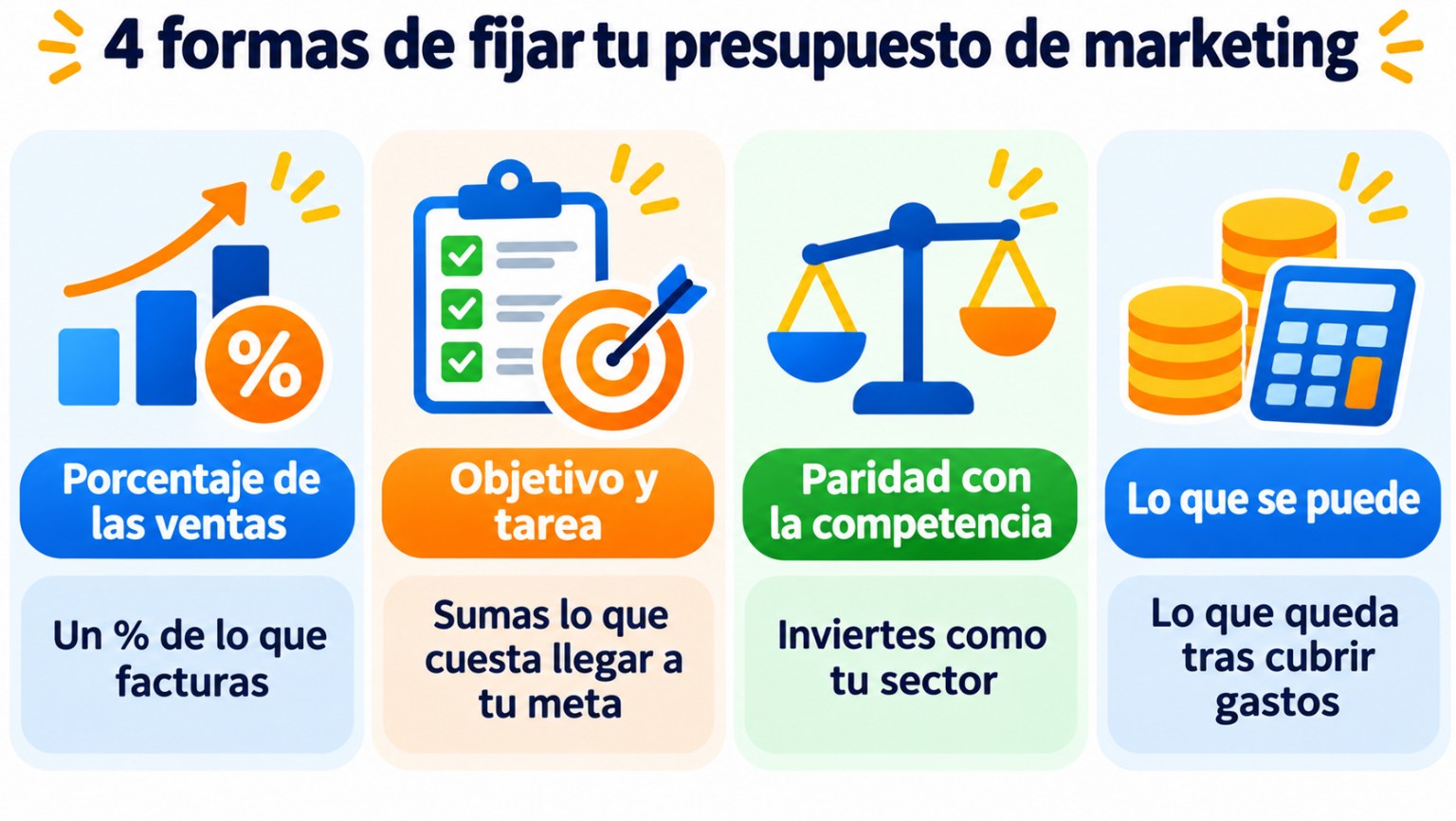
To set your marketing budget, you can use one of these four methods:
| Method | How it’s calculated | When it fits |
|---|---|---|
| Percentage of sales | A % of last year’s revenue or of forecast revenue | Businesses with stable sales |
| Objective and task | You add up the cost of each action needed to reach the objective | Launches and specific objectives |
| Competitive parity | You invest a similar proportion to your industry | Highly competitive markets |
| What you can afford | Whatever is left after covering other expenses | New businesses, as a starting point |
Start with the channel that costs the least
With Mailrelay’s free account, you can send up to 80,000 emails a month to 20,000 contacts without touching your budget.
The importance of a marketing budget
A well-planned budget gives you a clear view of where you’re going and how you’ll get there.
Allocating resources effectively lets you maximize your return on investment (ROI), especially with proven strategies such as email and SMS marketing.
A good budget gives you the freedom to act quickly, make informed decisions and adapt to change.
How to create a marketing budget step by step
Let’s go through the process in five steps. It works just as well for an annual marketing budget as for a specific campaign.
Start from your objectives
Decide what you want to achieve (sales, new customers, subscribers) and how much a customer is worth to you. The customer acquisition cost (CAC) tells you how much you can pay for each one without losing money.
Set the total figure
Choose one of the four methods above. Many small businesses combine two: a percentage of sales as a ceiling and objective and task to check that it’s enough.
Split it across channels and budget items
Separate paid media, tools, content, people and a reserve for testing new things. That way you know where every euro goes.
Give each budget item a metric
Each budget item needs its own KPI: sales, leads, subscribers or cost per customer. Without it, you won’t know whether it’s working.
Review and move the money
Review the results every month or every quarter and shift budget from what doesn’t work to what does. If you’re putting together the full plan, the budget is one of the sections in the marketing plan template.
Marketing budget example for a small business
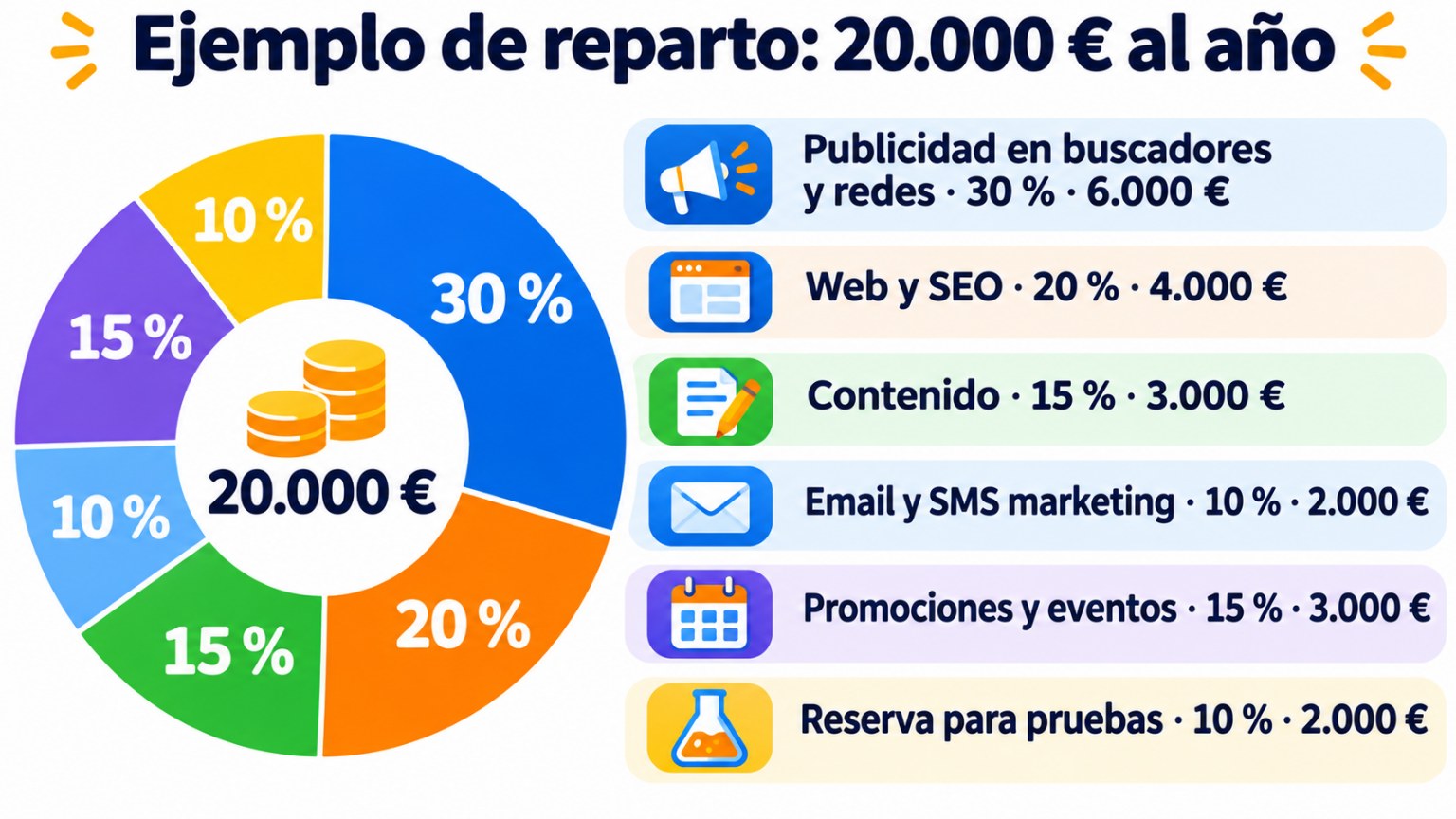
Imagine an online store with €400,000 in annual revenue that decides to spend 5% on marketing: a marketing budget of €20,000 a year. A rough split could look like this:
| Budget item | % | Annual amount |
|---|---|---|
| Search and social media advertising | 30 % | €6,000 |
| Website and SEO | 20 % | €4,000 |
| Content (copy, photos, video) | 15 % | €3,000 |
| Email and SMS marketing | 10 % | €2,000 |
| Promotions and events | 15 % | €3,000 |
| Testing reserve | 10 % | €2,000 |
As you can see, email gets a small share and can still deliver a lot: the tool can be free, and the money goes on design, content and SMS. And one idea worth keeping in mind: what sinks a small business is usually not having a small budget, but spending it copying the competition without measuring what works.
Budget and email marketing
Email marketing is known for delivering one of the highest ROIs in the world of digital marketing.
But to get the most out of it, you need a budget that considers several factors.
These include the cost of the email marketing platform, content creation, audience segmentation and analytics.
At Mailrelay, we make this easy with the most generous free account on the market, which lets you send up to 80,000 emails a month to 20,000 contacts.
And yes, we offer the best support to help you get the most out of your investment.
SMS marketing, a perfect match
Just like email marketing, SMS marketing requires careful budget planning.
From choosing a platform to the cost per message and segmentation, everything should have a place in your budget.
At Mailrelay, we have added a bulk SMS sending service that is as economical as it is effective, giving you the flexibility you need.
Common budgeting mistakes
The first is copying your competitors’ marketing budget: their business, their margins and their objectives aren’t yours.
The second is spending it all on a single channel. If that channel raises its prices or changes its rules, you’re left with no alternative.
It’s also common not to set aside a reserve for testing, not to measure the return on each budget item and not to review anything until the end of the year, when it’s too late to correct course.
Tips for an effective marketing budget
- Set clear objectives: The first step in creating a budget is knowing what you want to achieve.
- Research and analysis: Know your market and your competition. Information is power when it comes to allocating resources.
- Monitoring and adjustments: The best budgets are flexible. Keep an eye on the metrics and adjust when necessary.
How Mailrelay helps you
With Mailrelay, you can start with the free account, which includes automations, and spend your email budget on design and content instead of on the tool. SMS messages are paid per send, so you only spend what you use. And with Google Analytics and UTM parameters, you can see which campaign brings in sales and shift your budget based on data.
The marketing budget is not just a financial tool, it is a strategy in itself.
In the field of email and SMS marketing, a well-designed budget is your best ally for maximizing ROI and reaching your business goals.
And on this path, you can count on Mailrelay to offer you the most effective tools and the best support on the market. Ready to take your marketing to the next level?
We are here to help you.
Better results with the same budget
Put your email budget to work with automations and segments. Up to 80,000 emails a month for free with Mailrelay.
Frequently asked questions about marketing budgets
Is a marketing budget the same as a “mercadotecnia” budget?
Yes. “Mercadotecnia” is the Spanish term used mainly in Mexico and other Latin American countries. In Spain, people say “marketing”.
What does a digital marketing budget include?
The online budget items: search and social media advertising, website and SEO, content, email and SMS marketing, tools, and the analytics to measure each one.
Where does the budget go in the marketing plan?
At the end, after the objectives, the strategy and the actions. That way, each budget item is tied to a specific action and a measurable objective.