Marketing plan template (free PDF) and how to create one in 8 steps
The 8 steps, a real small business example and a PDF template to fill in with your team

The 8 steps, a real small business example and a PDF template to fill in with your team
A marketing plan is the document that sets out what your company wants to achieve with marketing, who it is aimed at, what it will do to get there, how much it will cost and how it will be measured. It is the roadmap that stops you from improvising every month.
It doesn’t need to be long. For a small business, a good plan fits in a few pages. What matters is that it is based on data, has measurable objectives and that someone reviews it every month.
In this guide you’ll find the 8 steps to create one, a complete example from an online store and a free PDF template you can fill in on your computer or print out.
A marketing plan is a working document that turns the company’s objectives into specific marketing actions. It answers five questions: where are we, where do we want to go, who are we targeting, how will we get there and how much will it cost.
It is usually made for one year and reviewed every quarter. Some companies also make shorter plans for a launch or a specific campaign.
It shouldn’t be confused with other similar documents. The business plan covers the whole company: finance, operations, team. The media plan focuses on where and when advertising is published. And the social media plan is just one part of the marketing plan.
A marketing plan helps you make decisions based on sound judgment rather than intuition. In practice, it helps you:
Without a plan, it’s easy to end up doing a bit of everything without knowing what worked.
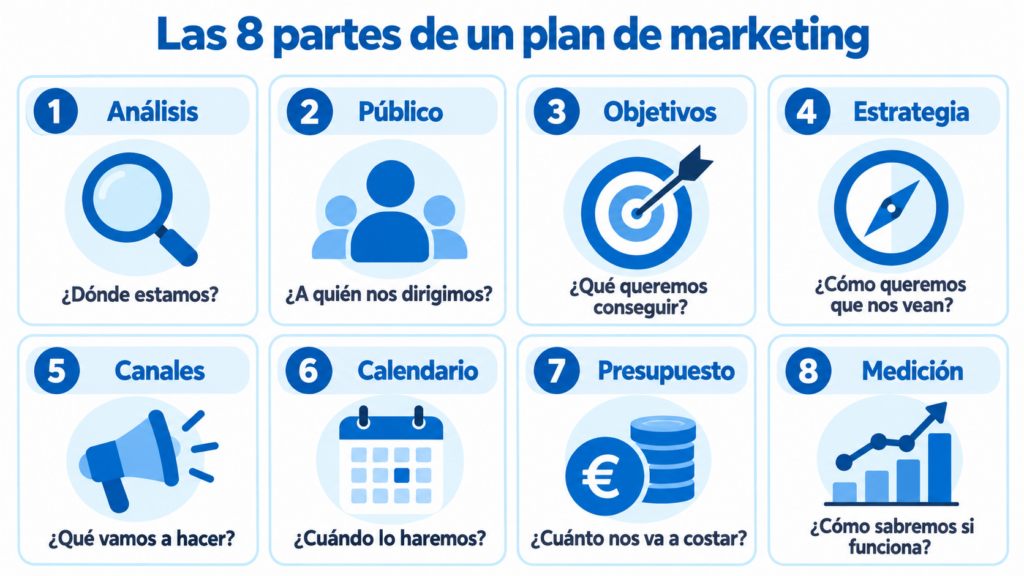
These are the parts of a complete marketing plan. They are the same ones you’ll find in the template.
| Part | What it includes | Question it answers |
|---|---|---|
| Situation analysis | SWOT, competition and market | Where are we? |
| Target audience | Segments and buyer personas | Who are we targeting? |
| Objectives | SMART objectives with their indicators | What do we want to achieve? |
| Strategy | Positioning, value proposition and message | How do we want to be seen? |
| Tactics and channels | Specific actions for each channel | What are we going to do? |
| Schedule | Actions and campaigns by quarter or month | When will we do it? |
| Budget | Allocation of money by item | How much will it cost? |
| Measurement | KPIs, tools and reviews | How will we know if it works? |
Put your plan into action with email marketing
Up to 80,000 emails a month for free for your campaigns.
Follow the steps in order. Each one builds on the previous one: there’s no point choosing channels before you know who you’re targeting.
Start with an honest picture of where you are. The most widely used tool is the SWOT analysis: your weaknesses and strengths (internal) and the market’s threats and opportunities (external).
Complete the analysis with your data: sales over the last 12 months, where your customers come from, which channels bring you the most visits and what your competitors are doing. If you also want to look at the wider environment (economy, laws, technology), you can use a PESTEL analysis.
Describe who you sell to. First the broad segment, your target audience. Then two or three buyer personas that represent your best customers: what they want, what worries them and where they get their information.
This step determines almost everything else: tone, channels and offers.
Objectives should be SMART: specific, measurable, achievable, relevant and time-bound. “Sell more” is not an objective. “Go from 1,200 to 1,600 customers by December 31” is.
For each objective, choose the KPI you’ll use to measure it and the figure you want to reach. Three or four objectives are enough.
The strategy is the idea that guides every action. Define what makes you different (your value proposition or USP), what you want people to remember about you and the tone you’ll use.
An example: “Freshly roasted coffee delivered to your door every month, explained simply.” With that sentence, the team knows which content fits and which doesn’t.
Now it’s time to choose what you’ll do and where. For each channel (email, website, social media, ads, SMS, events), write down the specific action, the frequency and who is responsible.
Don’t try to be everywhere. It’s better to do three channels well than seven badly. Prioritize the ones your buyer personas use and the ones your team can keep up with.
Spread the actions throughout the year. First mark the key dates in your industry (sales, Black Friday, Christmas, back to school) and organize your main campaigns around them.
A quarterly schedule is usually enough for the plan. The weekly detail can go in a separate content calendar.
Split the money among the items: ads, content, tools, design, events. If you don’t know where to start, look at how much you invested last year and what results each channel delivered. You’ll find more ideas in the glossary entry on the marketing budget.
Set aside a portion (between 10 and 15%) to try new things or boost what works.
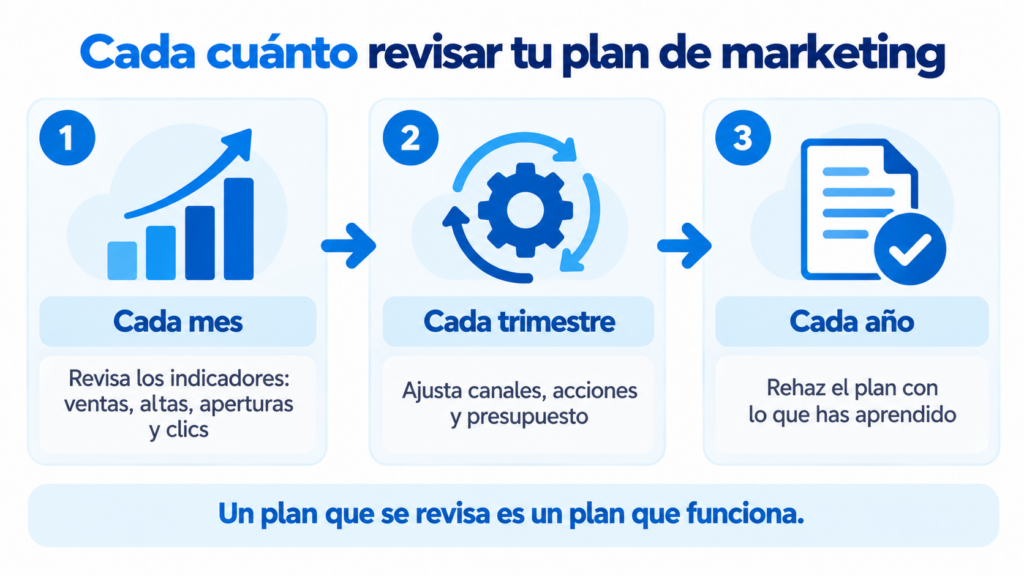
Decide what you’ll measure, with which tool and how often. The usual approach is to review the indicators every month and adjust the plan every quarter. If a channel doesn’t deliver results within three months, change the tactic or move the budget.
Also calculate the ROI of the main actions to know which ones deserve more investment the following year.
We’ve prepared a PDF template with the 8 steps in this guide. You can fill it in on your computer or print it out. It has three pages to complete (analysis and objectives; strategy, channels and schedule; budget and measurement) and a fourth with a summarized example.
Download the marketing plan template
Fillable PDF: 3 pages to complete and a summarized example. Free, no sign-up required.
A tip: fill it in with your team in one or two short sessions. If a section stays empty for lack of data, note it down as a task and complete it later.
This is the summarized plan of a small online specialty coffee store, with 1,200 customers and 4,000 newsletter subscribers.
| Step | Example |
|---|---|
| Analysis (SWOT) | Strengths: coffee roasted every week and loyal customers. Weaknesses: low brand awareness and a slow website. Opportunity: subscription purchases are growing. Threat: big brands with free shipping |
| Audience and buyer persona | People aged 28 to 50 who make coffee at home. Buyer persona: Marta, 34, works from home and wants better coffee without any hassle |
| SMART objectives | Go from 1,200 to 1,600 customers in 12 months. Have subscriptions make up 20% of sales by December. Reach 6,000 subscribers |
| Strategy | “Freshly roasted coffee delivered to your door every month.” Friendly, educational tone |
| Tactics and channels | Weekly newsletter with recipes and one offer a month. 3-email welcome series. Blog with guides. Instagram 3 times a week. SMS only for shipping notifications |
| Schedule | Q1: subscription launch. Q2: Father’s Day. Q3: iced coffee guide. Q4: Black Friday and Christmas |
| Budget | €12,000 a year: 40% ads, 25% content and photography, 20% tools, 15% samples and shipping |
| Measurement | Monthly review of sales, subscriptions, newsletter sign-ups, open rate and clicks. Quarterly adjustment |
Notice that each objective has a figure and a date, and that each channel has a frequency. That way, at the end of the month, you can check whether the plan is on track.
Does your plan include a newsletter?
Create forms, segment by buyer persona and measure every send.
Email is one of the channels that fits best in a marketing plan, because you own it (it doesn’t depend on an algorithm), it’s inexpensive and it can be measured precisely. These are the pieces worth including in the plan:
| Piece | What it’s for | KPI to measure it |
|---|---|---|
| Subscriber acquisition | Grow the list with forms and lead magnets | Sign-ups per month |
| Welcome series | Introduce the brand and lead to the first purchase | Customer conversion |
| Regular newsletter | Keep in touch and drive visits | Open rate and CTR |
| Seasonal campaigns | Sell on key dates | Sales per campaign |
| Automations | Recover carts, send birthday greetings, re-engage inactive subscribers | Recovered sales |
| List cleaning | Protect deliverability | Bounces and unsubscribe rate |
If you want to go deeper, check out the email marketing strategy guide with a 30-day plan.
Copying another company’s plan. The steps work for everyone, but the content has to come from your own data and customers.
Objectives without a figure or a date. If it can’t be measured, you can’t know whether it’s been achieved.
Trying to be on every channel. Focus your effort on a few channels and do them well.
Forgetting the budget. A plan with no money allocated is a wish list.
Writing it and leaving it in a drawer. The plan needs to be reviewed every month. Put the review dates in the calendar from day one.
Leaving no room for change. The market changes and so does the plan. What matters is knowing why you’re changing it, not following it blindly.
Mailrelay helps you put the email and SMS part of your marketing plan into action. You can capture subscribers with forms and pop-ups, organize them into groups and segments based on your buyer personas, and send newsletters and campaigns with the drag-and-drop editor and its AI.
Automations cover the welcome series, abandoned cart or birthday, with emails and SMS. And the statistics give you the data for the measurement step: opens and clicks per link (on the free account and on Enterprise), unsubscribes and bounces.
The free account lets you send up to 80,000 emails a month to 20,000 contacts, with human support on every plan.
From plan to action
Emails, SMS and automations in a single tool.
Situation analysis, target audience, SMART objectives, strategy, tactics and channels, schedule, budget and measurement system. These are the 8 sections of our template.
For a small business, between one and three weeks if you already have the data at hand. The first time takes longer; in the following years, you just need to update it.
The indicators, every month. The full plan, every quarter, and it’s redone once a year.
The strategy is the general idea of how you want to compete. The plan is the document that turns that strategy into objectives, actions, dates and budget.
Yes, even if it’s a simple one. With limited resources, it’s even more important to decide carefully where to invest. One or two pages with objectives, channels and budget already make a difference.