SMART goals: what they are, how to set them and examples for your business
Five letters to go from "we want to sell more" to a goal with a number, a deadline and an owner
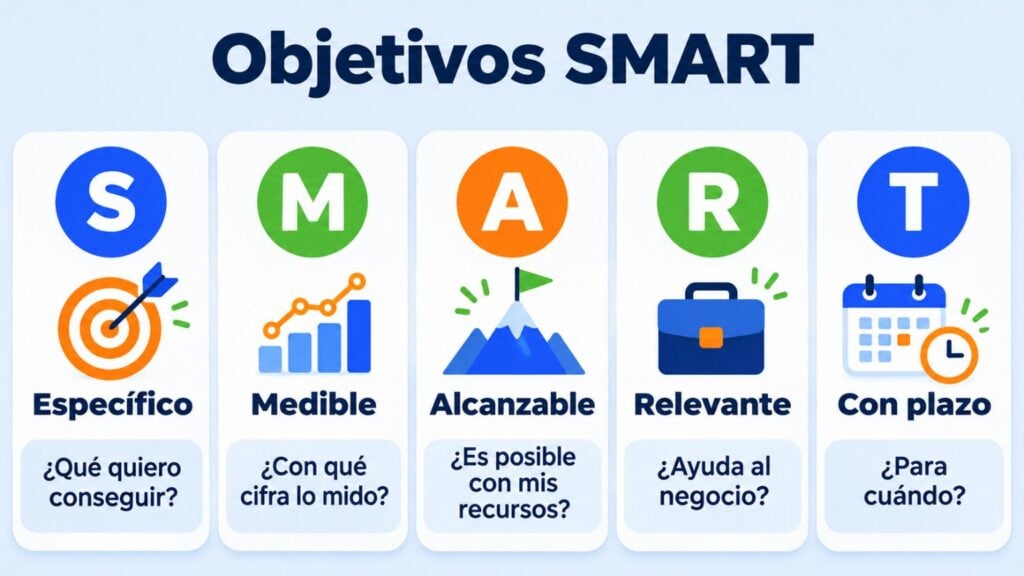
SMART goals are goals that meet five conditions: they are specific, measurable, achievable, relevant and time-bound.
The name comes from the initials of those five words: Specific, Measurable, Achievable, Relevant and Time-bound. And, fittingly, smart means “intelligent”.
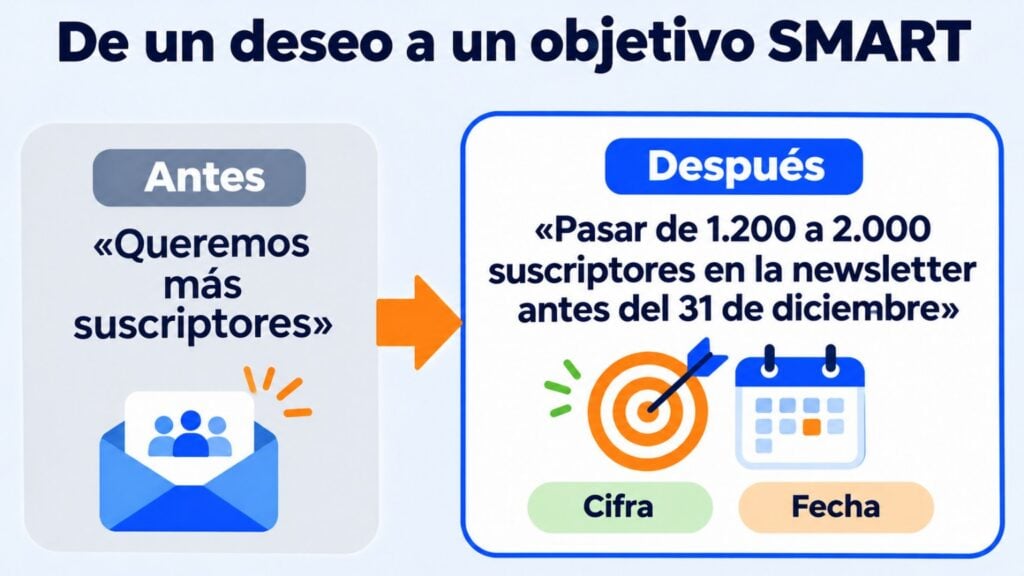
The idea is simple: turn a vague wish into something you can measure and review. “We want to sell more” is a wish. “Increase online sales by 15% before June 30” is a SMART goal.
It is one of the most widely used tools for setting goals in marketing, sales and team management. It fits into any marketing plan or communication plan, whether for a large company or a small business.
What does SMART stand for in goals?
Each letter is a question your goal has to pass:
| Letter | Stands for | Meaning | The question it answers |
|---|---|---|---|
| S | Specific | Specific | What exactly do I want to achieve? |
| M | Measurable | Measurable | What number will tell me whether I’ve achieved it? |
| A | Achievable | Achievable | Is it possible with my resources and my starting point? |
| R | Relevant | Relevant | Does it really help the business? |
| T | Time-bound | Time-bound | By when? |
The method was popularized by George T. Doran in a 1981 article in Management Review. His original version spoke of assignable goals (with someone responsible) and realistic ones. Over the years the letters have been adapted, but the idea is the same.
A vague goal turned into a SMART one
The best way to understand it is to see how a common goal changes as it goes through each letter:
| Step | What the goal looks like |
|---|---|
| Starting point | “We want more subscribers” |
| Specific | “We want more subscribers for the store’s newsletter” |
| Measurable | “…go from 1,200 to 2,000 subscribers” |
| Achievable | Last year about 600 joined with less effort: 800 is demanding, but possible |
| Relevant | The store has seen in its sales that subscribers buy more often than new visitors |
| Time-bound | “…before December 31” |
The result: “Go from 1,200 to 2,000 subscribers to the store’s newsletter before December 31.” Anyone on the team knows what needs to be achieved and by when.
Measure every campaign against your goal
Statistics for every send and A/B tests of subject and sender, in Mailrelay’s free account.
How to set SMART goals step by step
- Start from a business goal. Sell more, win customers, build loyalty. The SMART goal is how you bring it down to earth within your strategic marketing.
- Look at your current data. Without a starting point you won’t know whether the goal is achievable. Check your sales, your email marketing metrics or your Google Analytics.
- Choose a single main metric. And decide how and how often you will measure it.
- Set a number and a date. Ambitious, but something the team believes in.
- Assign an owner and the actions. A goal without an owner usually ends up in a drawer.
- Review it every month. SMART goals are not a snapshot: if you are falling short, adjust the actions; if the context changes, adjust the goal.
Before setting them, it helps to do a SWOT analysis: it tells you where you have room to grow and what is holding you back.
SMART goal examples
These examples work as a template. Swap the numbers for your business’s:
- Sales: “Increase online store revenue by 15% in the second quarter compared with the same period last year.”
- Lead generation: “Get 300 qualified leads a month from the website before September.”
- Email marketing: “Raise the newsletter’s click-through rate from 2% to 3% before March 31, with a subject line A/B test every month.”
- Loyalty: “Get 25% of this year’s new customers to buy again within the following 90 days.”
- Social media: “Drive 500 visits a month from LinkedIn to the website before June.”
- Sales team: “Cut the average sales cycle from 40 to 30 days before the end of the year.”
Notice that all these SMART goals have a starting or target number, a date and a single thing to measure.
SMART goals, KPIs and OKRs: how they differ
These are three concepts that are used together and often confused:
| What it is | Example | |
|---|---|---|
| SMART goal | The specific goal, with a number and a date | “2,000 subscribers before December 31” |
| KPI | The indicator you track to know how you are doing | Number of subscribers and sign-ups per week |
| OKR | A framework that combines an inspiring objective with several measurable key results | Objective: “Make the newsletter our best sales channel.” Key results: 2,000 subscribers, 3% click rate, 10% of sales |
SMART goals tell you where you are going; KPIs, how you are doing. OKRs are used mainly by companies that want to align several teams around ambitious goals.
Common mistakes when setting SMART goals
- Measuring what is easy, not what matters. Likes go up on their own; sales don’t. The goal has to be relevant to the business.
- Numbers without a starting point. “Reach 10,000 visits” means nothing if you don’t know how many you have today.
- Too many SMART goals at once. With fifteen priorities, you have none.
- Setting them and forgetting them. A goal nobody has reviewed in three months is no longer a goal.
- Confusing the action with the goal. “Send a newsletter every week” is an action; the goal is what you want to achieve with it.
SMART goals in email marketing
Email is one of the easiest channels to measure, which is why it fits this method so well. Every campaign gives you figures for deliveries, clicks, unsubscribes and bounces.
These are the metrics that most often become SMART goals:
- List growth: new subscribers per month and where the sign-ups come from.
- Engagement: the click-through rate of each campaign.
- List health: the unsubscribe rate and the bounce rate.
- Business: sales or leads that come from email, measured with UTMs in Google Analytics.
With clear goals, the rest of the decisions get easier: who to write to thanks to segmentation, what to test and how often to send. All of that is part of your email marketing strategy.
How Mailrelay helps you
Mailrelay doesn’t set your goals for you, but it gives you what you need to measure your SMART goals and reach them:
- Statistics for every campaign, so you know how you are doing against your goal.
- A/B tests of subject and sender, to test improvements with data.
- Segmentation and automations, to send each group the message that brings it closer to the goal.
- Forms and landing pages, if your goal is to grow your list.
And you can start with the free account, with up to 80,000 emails per month and 20,000 contacts.
Put your goals to work with email
Segmentation, automations and up to 80,000 emails a month for free, no credit card required.
Frequently asked questions
Two common questions we haven’t answered above.
How many SMART goals should you have?
For a small team or a small business, three to five at a time is usually enough.
If you have more, group them or decide which ones are the priority this quarter.
Do SMART goals also work for personal goals?
The method works the same way for personal goals, like learning a language or getting in shape. For example: “Run 5 kilometers without stopping before May 1, going out three days a week.”