Ansoff matrix
Four ways to grow your business, ranked from least to most risky
The Ansoff matrix is a strategy tool that crosses products and markets, existing or new, to choose between four ways of growing a business. Each option carries a different level of risk.
It helps you answer a specific question: should I sell more of what I already have or venture into something new? And if I do, with which product and to which customers?
What is the Ansoff matrix and who created it?
It was created by Igor Ansoff, a mathematician and business strategy professor. He introduced it in 1957 in the article Strategies for Diversification, published in the Harvard Business Review.
It is also known as the product-market matrix, the growth matrix or, in Spanish, matriz de Ansoff. It is one of the classic tools of strategic marketing, alongside the SWOT analysis and Porter’s 5 forces.
The idea behind it is simple. The further you move away from what you already know, the more you risk.
What are the 4 strategies of the Ansoff matrix?
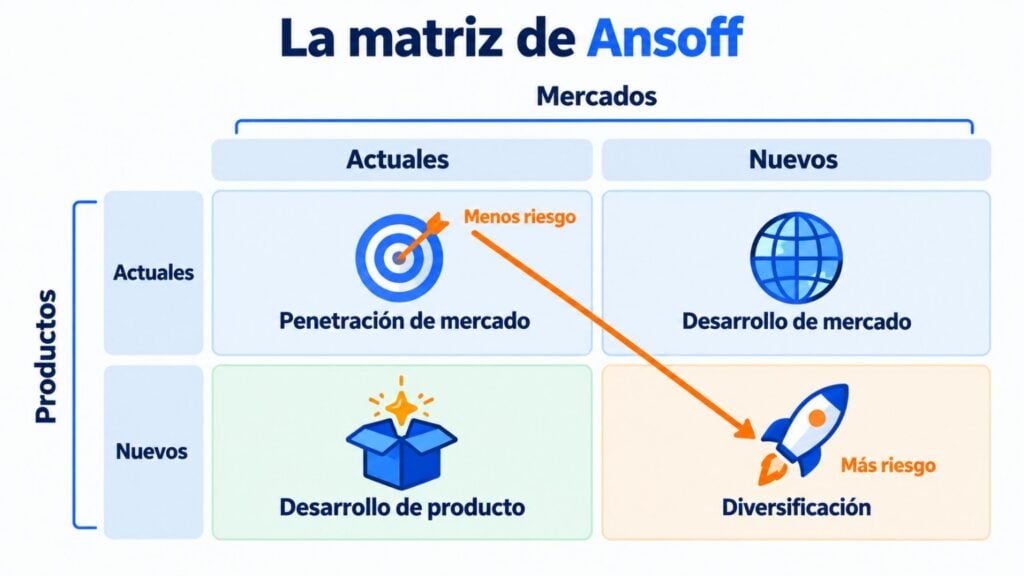
The matrix has two axes: products (existing or new) and markets (existing or new). Crossing them gives you four strategies:
| Existing market | New market | |
|---|---|---|
| Existing product | Market penetration (low risk) | Market development (medium risk) |
| New product | Product development (medium risk) | Diversification (high risk) |
Market penetration
You sell more of the same product to your existing market.
You can do this with promotions, price adjustments, more advertising or upselling so your customers buy more.
It is the least risky option, because you already know the product and your customers.
It is also the most limited: at some point the market has nothing more to give.
Market development
You take your existing product to new customers. That could be another region, another country, another sales channel or another target.
The risk goes up because you don’t know those customers as well. It’s a good idea to carry out a demand analysis first and clearly define your buyer persona.
Product development
You create a new product for the customers you already have. It could be an improved version, an add-on or a new line.
You have a competitive advantage because you know your audience and they know you. The risk lies in development: investing in something nobody ends up wanting. A minimum viable product helps reduce it.
Diversification
You launch a new product in a new market. It is the riskiest strategy, because you start from scratch on both fronts.
In return, it can open up a different source of revenue and reduce your dependence on a single business model.
Ansoff matrix example
Imagine a small online natural cosmetics store. Its best-selling product is a moisturizing cream, and most of its customers are women aged 30 to 50 in Spain. These would be its four options:
- Penetration: a discounted two-cream bundle and a repurchase reminder every two months.
- Market development: selling the same cream in Portugal or creating a line designed for men.
- Product development: launching a serum for its existing customers.
- Diversification: starting a cosmetics line for pets.
As you can see, the risk increases from top to bottom. The sensible approach for this store would be to start with penetration and then try the serum. If you sell online, here are some email marketing for ecommerce ideas for each case.
What is it for and how do you make one?
The Ansoff matrix helps you organize your growth ideas and compare them by risk. It is useful when preparing your marketing plan or before a product launch.
You can build it in three steps:
- Analyze where you are. A SWOT shows you your strengths and a PESTEL analysis shows you the environment. To see your whole business at a glance, use the Business Model Canvas.
- Place your ideas in the matrix. Write the real options you have in each box.
- Evaluate each option. Compare its cost, its risk and what it could bring. Also take into account the life cycle of each product.
Then choose one or two and decide how to measure them.
Differences between the Ansoff matrix and the BCG matrix
Both are 2×2 matrices and are often studied together, but they answer different questions.
The BCG matrix looks at your current products and helps you decide which ones to invest in and which ones to drop. The Ansoff matrix looks ahead: how to grow, with which products and in which markets.
That is why they complement each other. The BCG matrix tells you where your money is today. The Ansoff matrix tells you where to take it. And the 4Ps of marketing help you flesh out each option.
The Ansoff matrix in your email marketing
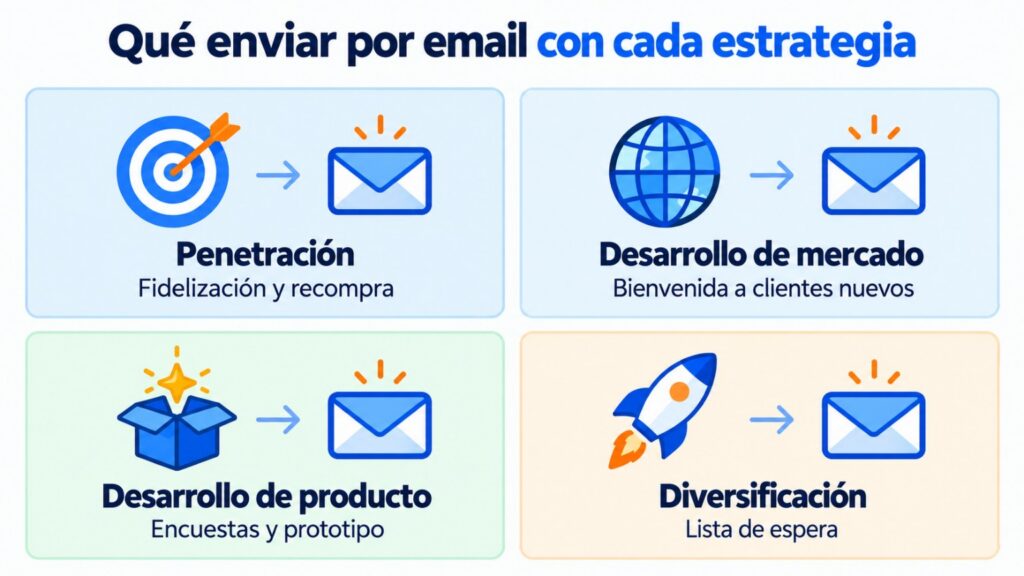
Each strategy calls for a different type of email. Your subscriber list is the cheapest place to start any of them:
| Strategy | What to send by email |
|---|---|
| Market penetration | Loyalty emails, cross-selling and repurchase reminders |
| Market development | Forms and welcome emails to attract and greet new customers |
| Product development | Surveys to your list, invitations to try the prototype and the launch announcement |
| Diversification | A waiting list to gauge interest before investing |
With segmentation, each group receives only what is relevant to them. And with an A/B test you can compare two messages before sending them to your whole list.
Have a new product in mind? Before developing it, you can use email marketing to evaluate it. Ask your list for feedback, directly or indirectly: what they need, what would help them. That way you can draw conclusions before making a big investment. You can even create a small prototype and ask your subscribers to try it before moving forward. My advice: pay attention to what they do, not just what they say. Clicks on an email presenting the idea will tell you a lot about real interest.
Jose Argudo, CMO at Mailrelay
Test your next idea with your own list
Ask your subscribers, segment and measure real interest before investing: up to 80,000 emails a month for free with Mailrelay.
How Mailrelay helps you
With Mailrelay you can put any of the four strategies into action from your own list. You can send your newsletter to your existing customers, create segments for each market and schedule a mailing automation to welcome new ones.
The statistics for each campaign tell you what works.
And the free account lets you test without risking your budget, which fits well with a cautious growth strategy.
Grow your business from your list
Build customer loyalty, welcome new customers and announce your launches, with human support on every plan.
Frequently asked questions about the Ansoff matrix
These are the most common questions about the Ansoff matrix.
What is the Ansoff matrix?
It is a strategy tool that crosses products and markets, existing or new, to choose between four ways of growing: market penetration, market development, product development and diversification.
What is the Ansoff matrix used for?
It is used to organize a company’s growth options and compare them by risk before deciding which one to invest in.
Which strategy is the least risky?
Market penetration, because you sell a product you already know to customers you already know. Diversification is the riskiest.
What is the difference between the Ansoff matrix and the BCG matrix?
The BCG matrix classifies your current products to decide where to invest. The Ansoff matrix suggests how to grow, with existing or new products and markets.
Can a small business use it?
Yes. You don’t need complex data: just write your growth ideas in the four boxes and compare them. For a small business, it is usually a good idea to start with penetration and move forward step by step.