The 4 Ps of the marketing mix: what they are, examples and how to apply them to your business
Product, price, place and promotion explained with real examples and a template to build your own

Product, price, place and promotion explained with real examples and a template to build your own
Have you ever seen a great product fail to sell? Maybe the price didn’t suit its audience. Or it was sold in the wrong place.
Or, quite simply, nobody found out it existed.
That is exactly what the marketing mix, also known as the 4 Ps of marketing, is there to prevent. It sounds like a textbook concept from the sixties. But it is still the simplest way to check whether your offer makes sense from start to finish.
The marketing mix is the combination of four decisions (product, price, place and promotion) that a company adjusts to reach its target audience and sell to it. It was formulated by Jerome McCarthy in 1960 and popularized by Philip Kotler.
Below you’ll see what each P means, examples from brands you know, a template to build your own and how it all fits with your email strategy.
The idea of “mixing” marketing decisions predates the 4 Ps. In 1948, Harvard professor James Culliton described the marketing manager as a “mixer of ingredients”.
His colleague Neil Borden picked up the idea and spread it as the “marketing mix”, especially after his address to the American Marketing Association in 1953.
It still needed structure. That came from Jerome McCarthy in 1960, in his book Basic Marketing. He grouped all those ingredients into four words beginning with P: product, price, place and promotion.
Philip Kotler brought the model into his textbooks, which is why it is taught at every business school today. Kotler himself defended it as a useful learning tool.
That said, the marketing mix is not a strategy in itself. It is the operational part: the specific decisions you make once you know who you’re targeting and how you want to stand out.
If you’re not clear on that yet, start with the types of strategic marketing.
Each P answers a different question. Here’s a summary before we go into detail:
| P | Question it answers | Decisions it includes | Example |
|---|---|---|---|
| Product | What am I selling and what problem does it solve? | Quality, design, range, brand, packaging, warranty, service | An app with a free plan and a paid plan |
| Price | How much does it cost and how is it paid? | Base price, discounts, financing, terms | €9.99 a month or €99 a year |
| Place | Where and how does the customer buy it? | Channels, stores, website, logistics, stock | Online sales with 24-hour delivery |
| Promotion | How do they hear about it and why do they choose it? | Advertising, public relations, promotions, email, social media | Monthly newsletter and launch campaign |
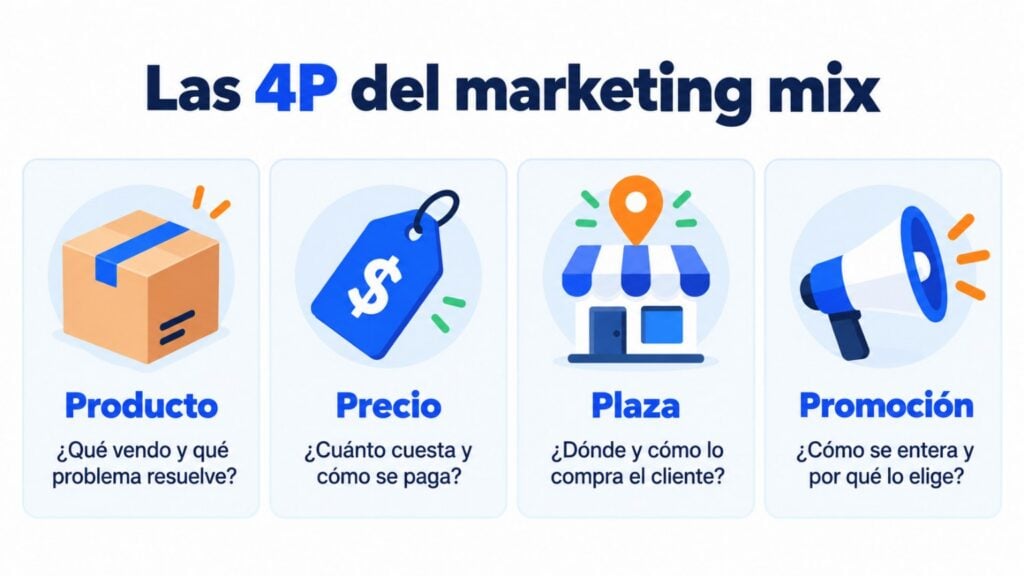
The product is everything the customer receives, not just the item or the service. It includes the quality, design, brand, packaging, warranty and the support that comes afterwards.
Think of a coffee shop. The coffee is the core product. But the venue, the wifi, the speed and the service are also part of what the customer is buying.
To work on this P, ask yourself what makes you different. That difference is your unique selling proposition (USP), and it should show in the name, in the branding and in every detail.
Also consider which stage of the product life cycle you’re at. A launch isn’t handled the same way as a mature product.
Price is the only P that generates revenue. The other three are investments. That’s why a mistake here shows up straight away on your income statement.
You can set it based on your costs, on what competitors charge or on how much your product is worth to the customer. From there, you choose a strategy:
Price also communicates. One that’s too low can raise doubts about quality. And overusing discounts teaches your customers to wait for the next one.
Place (or distribution) determines how your product reaches the customer. It can be direct, like your online store, or indirect, through distributors, marketplaces or third-party stores.
This covers the channel, location, stock and delivery times. An excellent product that takes two weeks to arrive loses out to a decent one that arrives tomorrow.
If you sell in a physical store, it’s worth reviewing what retail is. And if you’re torn between several routes, this guide to distribution channels covers the types and their advantages.
Promotion is everything you do so that your audience gets to know the product, wants it and buys it. It’s the most visible P. That’s why many companies confuse it with marketing as a whole.
Its tools make up your communication mix: advertising, public relations, sales promotion, personal selling and direct marketing, which is where email fits in.
Today you can add content marketing, social media and influencer marketing. You don’t need them all. You need the ones your audience uses and that you can measure.
Looking at the 4 Ps in real companies helps you see that they aren’t separate boxes to tick. They work when all four tell the same story. Let’s look at four cases.
In 1993, Mercadona adopted its “Always Low Prices” strategy. It gave up one-off deals in exchange for low, stable prices, and its entire marketing mix revolves around that decision.
The product is a tight range with private labels such as Hacendado. The price stays stable, with no promotions going up and down. Place means neighborhood supermarkets, close to where customers live.
And promotion? As there are no deals to advertise, it barely invests in advertising. The price does that job. It’s a good example of how one P shapes the others.
Zara bases its product on fast fashion. It refreshes what’s in store often, so customers know that if they like something, they have to buy it now.
The price is mid-range, affordable for its audience. Place means its own stores on shopping streets and online sales.
Promotion is the most striking part: historically, it has invested little in traditional advertising. Its stores, its shop windows and the constant new arrivals act as its ads.
On price, Apple is the opposite of Mercadona. It sells a product with carefully crafted design and an ecosystem that connects all its devices.
Its price is high and it rarely offers discounts, which reinforces its premium image. Place combines its own stores, its website and selected resellers. And promotion relies on product launches that build anticipation and media coverage.
Imagine a small coffee roaster that sells online. Its marketing mix could look like this:
| P | Decision |
|---|---|
| Product | Single-origin coffees, roasted every week, with the roast date on the bag |
| Price | More expensive than supermarket coffee, with a discount for a monthly subscription |
| Place | Its own online store, 48-hour delivery and two coffee shops in its city |
| Promotion | Newsletter with tasting notes and recipes, social media and tastings at the coffee shops |
Notice how the subscription ties together price, place and promotion. It makes the coffee cheaper, secures recurring sales and gives a reason to write to the customer every month.
Put your promotion P to work
Create your newsletter and send up to 80,000 emails a month for free with Mailrelay.
You’ve seen the theory and the examples. Now it’s your turn. These five steps work whether you’re launching something new or reviewing what you already sell.
Before deciding anything, define your target audience and create your buyer persona. A SWOT analysis will help you see your strengths and weaknesses, and a PESTEL analysis, your environment.
To understand what drives your customer to buy, review Maslow’s hierarchy of needs and the difference between needs and wants.
Write in one sentence what problem you solve and why you do it better than others. If you can’t, the problem isn’t your promotion.
Also review your competitive advantage over the competition.
Calculate your costs, look at prices in your industry and decide where you want to position yourself. Keep in mind how much it costs you to acquire each customer.
If your customer acquisition cost (CAC) is higher than what each sale earns you, the price isn’t working.
Decide where you’re going to sell and who handles each step up to delivery. Start with a few channels you can manage well.
One online store that works is better than five half-done ones.
Choose the communication actions that suit your audience and your budget. Give them a goal and measure the results every few months.
If you want to put it all in writing, here’s a free marketing plan template.
Template to copy: your marketing mix on one page. Here’s a table for you to fill in with your team:
| P | Questions to answer | Your answer |
|---|---|---|
| Product | What problem do I solve? What sets me apart? What exactly does what I sell include? | |
| Price | How much do I charge? Why that price? Will there be discounts or plans? | |
| Place | Where does my customer buy? How long does it take to arrive? Which channels do I use? | |
| Promotion | How does my customer find out? What message do they get? How do I measure whether it works? |
McCarthy’s model was designed around physical products, with the company as the starting point. Over the years, two extensions have emerged that are worth knowing.
In 1981, Bernard Booms and Mary Jo Bitner added three more Ps for service businesses. In these, the customer doesn’t take away anything physical:
| Added P | What it means | Hotel example |
|---|---|---|
| People | Who serves the customer and how | The friendliness of the reception staff |
| Process | How the service is delivered step by step | Booking, check-in and check-out with no waiting |
| Physical evidence | What the customer can see or touch | The rooms, the website, the reviews |
If you sell services, the 7 Ps make you look after something the 4 Ps leave out: the customer experience.
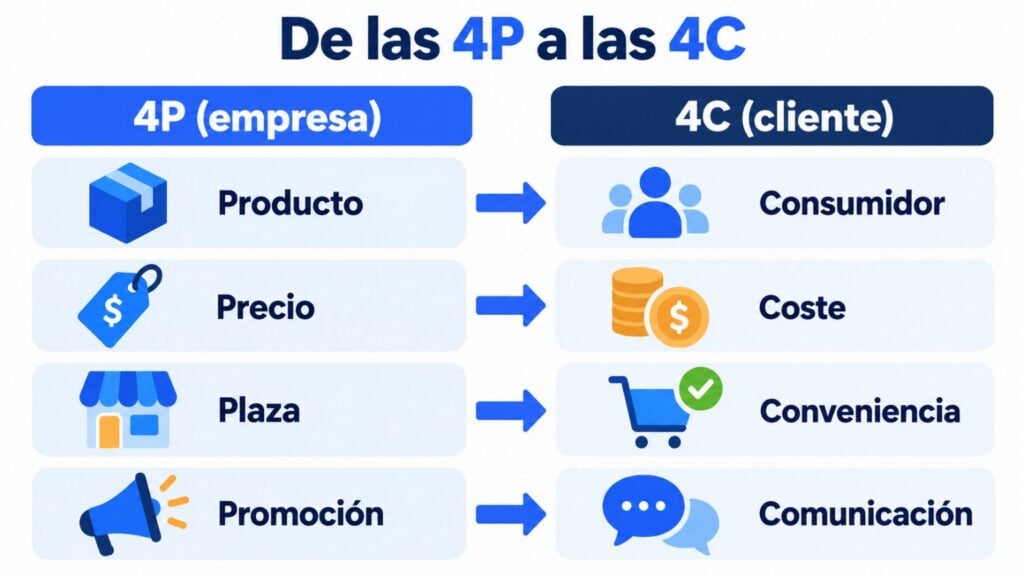
In 1990, Robert Lauterborn proposed turning the model around. Each P becomes a C that looks at things from the buyer’s side:
| 4 Ps (company) | 4 Cs (customer) | Question |
|---|---|---|
| Product | Consumer | What do they need and what do they want? |
| Price | Cost | How much does it cost them in total, including their time? |
| Place | Convenience | Is it easy for them to buy? |
| Promotion | Communication | Is there a dialogue or only one-way messages? |
You don’t have to choose. You can use the 4 Ps to decide and the 4 Cs to check that those decisions make sense for the customer.
Email usually only shows up under promotion. But, used well, it touches all four Ps. Here’s how to make the most of it in each one.
Product: listen before you launch. Your subscriber list is the best test group you have. Send a survey before a product launch and ask for feedback after purchase.
Read the replies. They’ll tell you what to improve before a bad review does.
Price: offers for those who need them. You don’t need to send the same discount to everyone. With segmentation you can save offers for people who haven’t bought in a while.
Place: email is also a sales channel. An email takes the customer straight to the purchase page. In an online store, abandoned cart emails recover sales you’d given up for lost.
If you sell online, here are some ideas for email marketing for ecommerce.
Promotion: a relationship that’s yours. A newsletter lets you talk to your customers whenever you want, without depending on algorithms or paying for every click.
And the list is yours. Use it to build customer loyalty too, not just to sell.
Email marketing is a perfect promotion tool, not only because of its low cost, but because it’s a less noisy medium. In other media, your message appears at the same time as others competing with it. In email, once it’s opened, nothing distracts attention from your product or service. Full attention? A scarce commodity these days. So don’t waste it yourself: focus on a single message and a single call to action, so the reader knows what to do after reading you.
Jose Argudo, CMO at Mailrelay
This is where the shift Kotler himself proposed fits in: moving from product-centric marketing to people-centric marketing. With automation, email allows almost one-to-one personalization.
If you’re starting from scratch, this guide on what email marketing is will help you.
The 4 Ps are more than sixty years old, and it shows in some ways. These are the most common criticisms:
Even so, they’re still useful as a checklist. They make you review the four basic decisions of any business and make sure they fit together.
That’s why it’s worth learning them first and then complementing them with the 7 Ps, the 4 Cs or a personalized marketing approach.
If you only take away one idea, make it this one: the 4 Ps work when they tell the same story.
A premium product at a bargain price is confusing. A low price without an efficient channel leaves no margin. And great promotion can’t save a product nobody needs.
Review your business with four questions: what you sell, how much it costs, where it’s bought and how your customer finds out about it. Then choose a promotion channel you can measure and sustain. Email is one of the most cost-effective ones to start with.
From the marketing mix to your first campaign
Segment your list, automate your sends and measure the results, with human support on every plan.
These are the most common questions about the marketing mix.
They are the four variables of the marketing mix: product, price, place (distribution) and promotion. A company combines them to reach its target audience and sell.
The name comes from the initial letter of each: product, price, place and promotion.
They were formulated by Jerome McCarthy in 1960, in his book Basic Marketing, and Philip Kotler popularized them in his textbooks.
The term “marketing mix” is older: Neil Borden spread it, building on an idea James Culliton had in 1948.
The marketing mix includes all four Ps. The communication mix is just one part of the promotion P: the combination of advertising, public relations, sales promotion, personal selling and direct marketing.
They are the 4 Ps plus three variables for service businesses: people, process and physical evidence. They were proposed by Bernard Booms and Mary Jo Bitner in 1981.
Yes, as a basis for organizing a business’s decisions. But it’s worth complementing them with the customer’s perspective (the 4 Cs) and, for services, with the 7 Ps.

Jose Argudo
CMO at Mailrelay. He writes about email marketing, copywriting and conversion for small businesses and entrepreneurs.