CX (customer experience): what it is and how to measure it
How to measure and improve what your customers experience, from the first email to after-sales
Customer experience (abbreviated as CX) refers to all the interactions a customer has with a brand, and their perceptions of it, throughout the purchase process and after-sales.
In the context of email marketing, CX covers everything from how the design and content of an email are perceived to how easy it is to navigate the website the customer lands on after clicking a link in the email.
This experience can have a significant influence on customer satisfaction and brand loyalty.
Therefore, optimizing CX in your email campaigns is useful for fostering a positive relationship with customers.
Differences between CX, UX and customer service
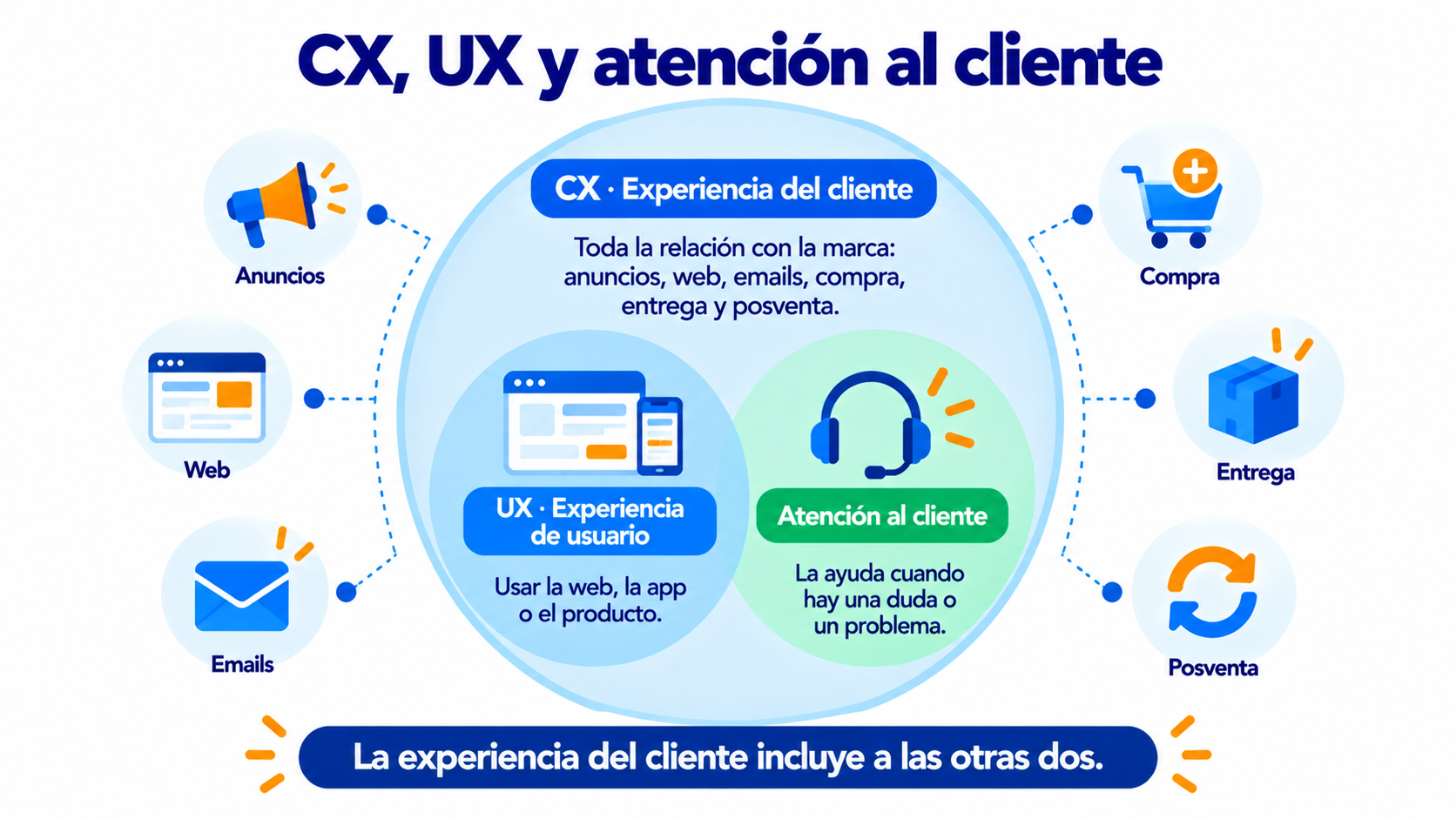
These three concepts are often confused. Customer experience includes the other two:
| What it covers | When it happens | How it’s measured | |
|---|---|---|---|
| CX (customer experience) | The customer’s entire relationship with the brand | At every touchpoint: ads, website, emails, purchase, delivery and after-sales | NPS, CSAT, CES, churn rate |
| UX (user experience) | Using a product, a website or an app | When the customer uses the website, the app or the product | User testing, tasks completed, time taken to complete them |
| Customer service | The help the customer gets when they ask for it | When they have a question or a problem | Response time, issues resolved, CSAT |
An easy-to-use website (good UX) and fast support (good customer service) help, but they’re not enough. If emails arrive late or have nothing to do with what the customer bought, the customer experience still suffers.
Take care of your customers’ experience in every email
Send each customer the message they need at the right time, with segments and automations. Get started for free with Mailrelay.
How the focus on customer experience has evolved
Originally, companies focused mainly on the product or service they offered, without paying much attention to the customer’s overall experience.
Over time, however, this approach has evolved.
Today, especially in the digital age, CX has become a central part of companies’ strategy.
Competition in almost every sector is fierce, and a positive CX can set a brand apart from its competitors.
Companies that have adopted this mindset and started investing in improving CX often see improvements in customer retention, in new customer acquisition and in customer lifetime value.
How to measure customer experience
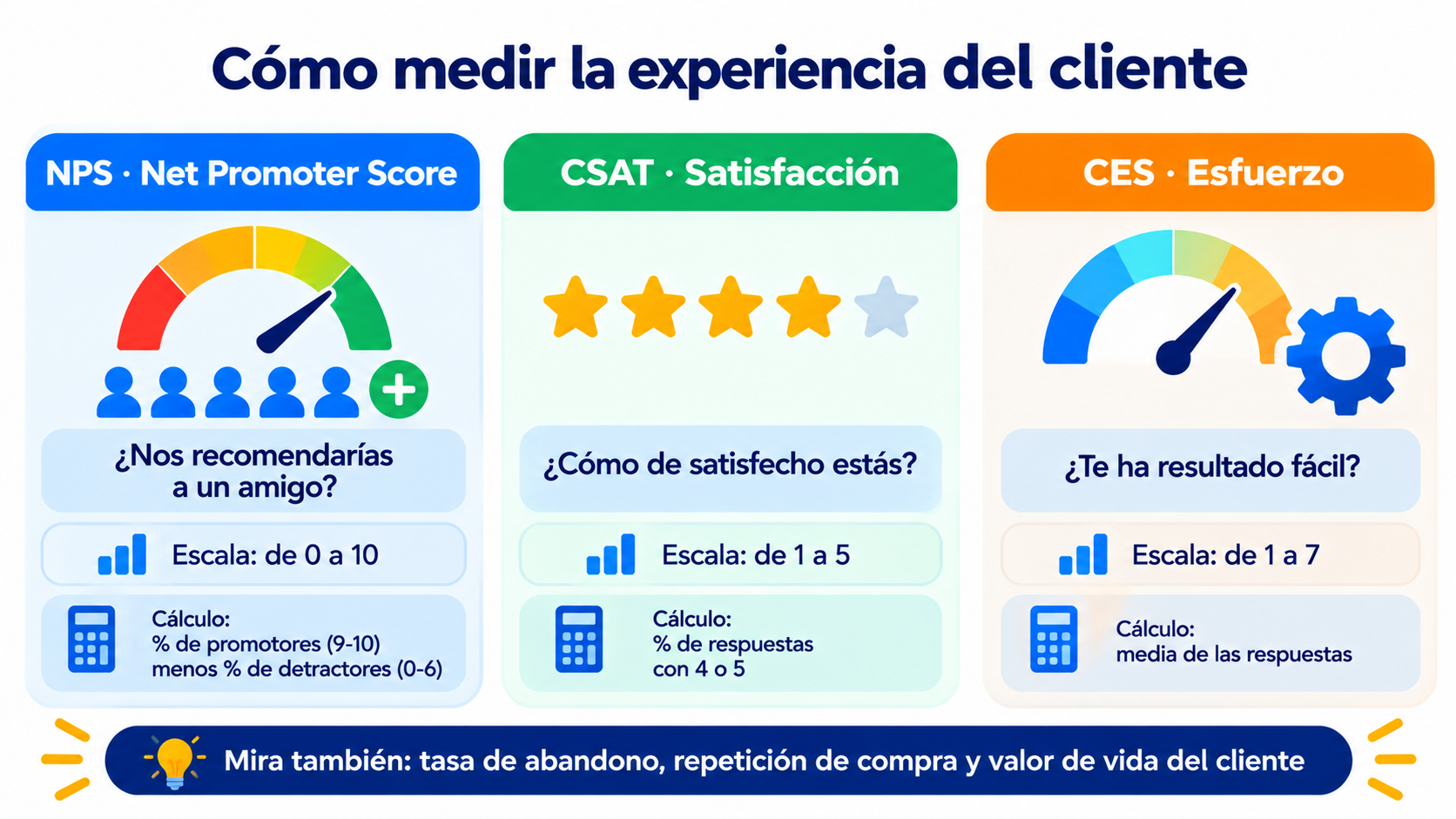
There are three metrics that are used almost every time. All three are measured with a single-question survey:
| Metric | Question | Scale | How it’s calculated |
|---|---|---|---|
| NPS (Net Promoter Score) | “How likely are you to recommend us to a friend?” | From 0 to 10 | % of promoters (9 and 10) minus % of detractors (0 to 6). Ranges from -100 to 100 |
| CSAT (Customer Satisfaction Score) | “How satisfied are you with…?” | From 1 to 5 | % of responses with 4 or 5 |
| CES (Customer Effort Score) | “Did you find it easy to…?” | From 1 to 7 | Average of the responses |
NPS example: 200 customers respond. 120 give a 9 or 10 (60% promoters) and 30 give 0 to 6 (15% detractors). Your NPS is 60 – 15 = 45.
NPS was created by Fred Reichheld (Bain & Company) in 2003, and CES was introduced in 2010 by the consulting firm CEB, now part of Gartner. Besides surveys, it’s worth looking at what customers actually do: the churn rate, how many buy again and customer lifetime value.
Keys to customer experience in email marketing
When working on CX in email marketing, there are several aspects to keep in mind:
- Personalization: it’s not just about including the customer’s name in the email. Advanced personalization means understanding and responding to customers’ specific needs and behaviors. This can include audience segmentation to send more relevant messages that resonate with individual experiences and wishes.
- Clarity and conciseness: emails must be clear and easy to understand. An overly complicated message can frustrate customers or cause them to lose interest.
- Responsive design: emails need to look good on every device, especially smartphones, since a large number of users read their email on them.
- Send time: when emails are sent can affect how customers perceive them. Sending emails based on user behavior, such as a follow-up email right after a purchase, can improve the customer experience.
How to improve customer experience with email
To maximize CX in your email marketing campaigns, consider the following steps:
- Collect and use the right data: use behavioral and demographic data to personalize your campaigns. Analytics tools and platforms can help you better understand your customers and segment your messages effectively.
- A/B testing: running A/B tests on different elements of your emails, such as subject lines, designs and calls to action, can reveal what works best to improve the customer experience.
- Constant feedback: satisfaction surveys and other feedback methods can provide valuable insights into how customers perceive their interactions with your brand through email. Use this information to make ongoing adjustments.
- Integration with other platforms: make sure your email marketing efforts are well integrated with other platforms and customer touchpoints, such as social media and customer service. This can provide a more cohesive and satisfying experience.
Email at every stage of the customer experience
Email accompanies customers through almost their entire journey (you can map it with a customer journey map):
| Stage | What improves | |
|---|---|---|
| Subscribes | Confirmation and welcome | They know what they’ll receive and how often |
| Purchase | Confirmation and follow-up email | Peace of mind and help using what they bought (onboarding) |
| After the purchase | NPS or CSAT survey | Tells you what to improve |
| Stops opening | Winback campaign | You give them a reason to come back |
| Wants to receive less | Preference center and easy unsubscribe | They choose what they receive instead of marking you as spam |
Difference between CX and CXA
CX is what customers experience with your brand. CXA (customer experience automation) means automating parts of that experience with data, for example, sending a help email when a customer hasn’t used what they bought. CXA is a way to improve CX, not the same thing.
How Mailrelay helps you
Customer experience is more than just a component of modern marketing.
It can make or break your email marketing campaigns.
By focusing on delivering an exceptional experience at every touchpoint, you’ll not only increase customer satisfaction but also build greater loyalty and appreciation for your brand.
As we move further into the digital age, a company’s ability to constantly adapt and improve CX will determine its ability to stand out in a competitive market.
Focusing on the customer doesn’t just improve your results. It also keeps your customers coming back.
With Mailrelay you can take care of the customer experience in every email:
- Automations for the welcome, the post-purchase follow-up and the email with your survey, by email or SMS.
- Segments and custom fields so each customer receives what interests them.
- Subscription forms with double opt-in for every sign-up.
- A/B tests to find out which subject line or content works best.
- Click statistics in the free account and in Enterprise.
The free account includes 80,000 emails a month and up to 20,000 contacts.
Automate the emails that improve the customer experience
Welcome, post-purchase follow-up and satisfaction survey on autopilot. Up to 80,000 emails a month for free with Mailrelay.
Frequently asked questions
What is CX?
It’s the customer experience: everything a customer experiences and feels in their relationship with a brand, from the moment they discover it until after they buy.
What does CX stand for?
It stands for customer experience.
What’s the difference between CX and UX?
UX is the experience of using a product, a website or an app. CX is broader: it includes UX as well as advertising, emails, purchase, delivery and customer service.
How is customer experience measured?
With single-question surveys such as NPS, CSAT and CES, and with behavioral data such as churn rate and repeat purchases.
How does CX help build customer loyalty?
A customer who has a good experience buys again and recommends the brand. That’s why improving CX is one of the most direct ways to build customer loyalty.