Customer onboarding: what it is and how to do it by email
From signup to first result: the email sequence that turns a new customer into an active customer
Customer onboarding is the process that guides a new customer from the moment they sign up or buy until they get their first result with your product or service. Its goal is to get them using it early and to keep them from dropping out in the first few weeks.
The term comes from the phrase on board. It is also known as customer welcoming or new customer integration.
Email is the channel most commonly used for it. It arrives at the right moment, it can be automated and it shows which steps each customer takes.
“A series of introductory emails helps your customers get to know your product or service: it answers their usual questions, shortens the learning curve and makes it easier for them to adopt it. You can think of it as support in small doses that keeps helping your users and, at the same time, gives them a channel to talk to you. My advice: end each email by inviting them to reply. Many of the replies you get will tell you which email in the series you need to improve.”
Jose Argudo, CMO at Mailrelay
How is it different from a welcome email?
The welcome email is a single message sent right after signup. Onboarding is a sequence of several emails with a specific goal: getting the customer to actually use what they have signed up for.
| Welcome email | Customer onboarding | |
|---|---|---|
| What it is | One email | A sequence of emails and actions |
| When | Right after signup | First few days or weeks |
| Goal | Say hello and share the first details | Help the customer get value |
| Adapts | The same for everyone | Based on what each customer does |
It should also not be confused with employee onboarding, which is how a company welcomes a new hire. We cover it in our post on employer branding.
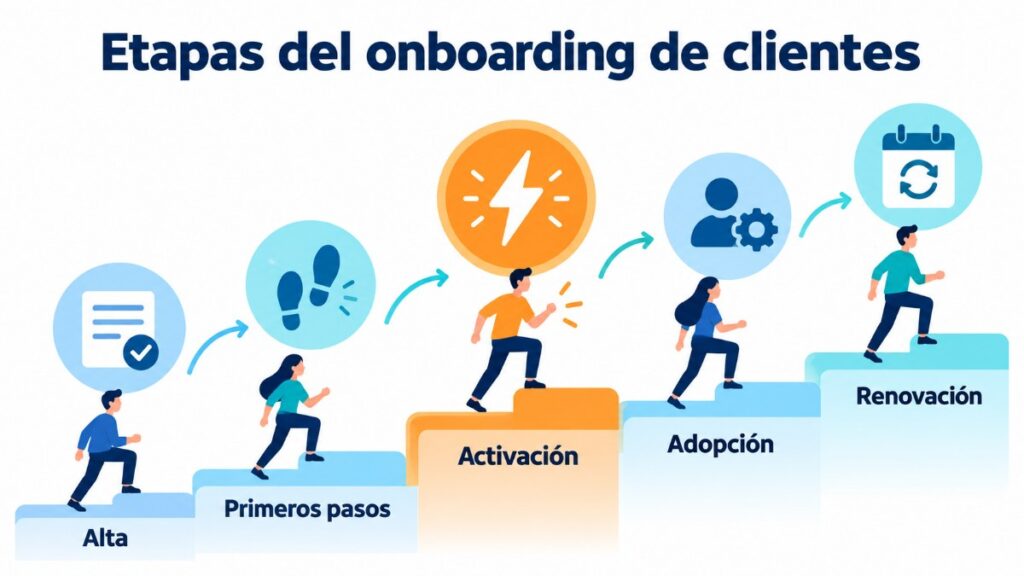
Stages of customer onboarding
1. Signup. The customer signs up or makes a purchase. They receive the confirmation and the welcome message.
2. First steps. They set up their account or prepare what they need. Many customers are lost here if nobody guides them.
3. Activation. They get their first result: they send their first campaign, use the product for the first time or receive the service. This is the most important moment.
4. Adoption. They start using other features or buying again.
5. Renewal. They pay again, upgrade their plan or recommend your brand.
Which emails should you send during onboarding?
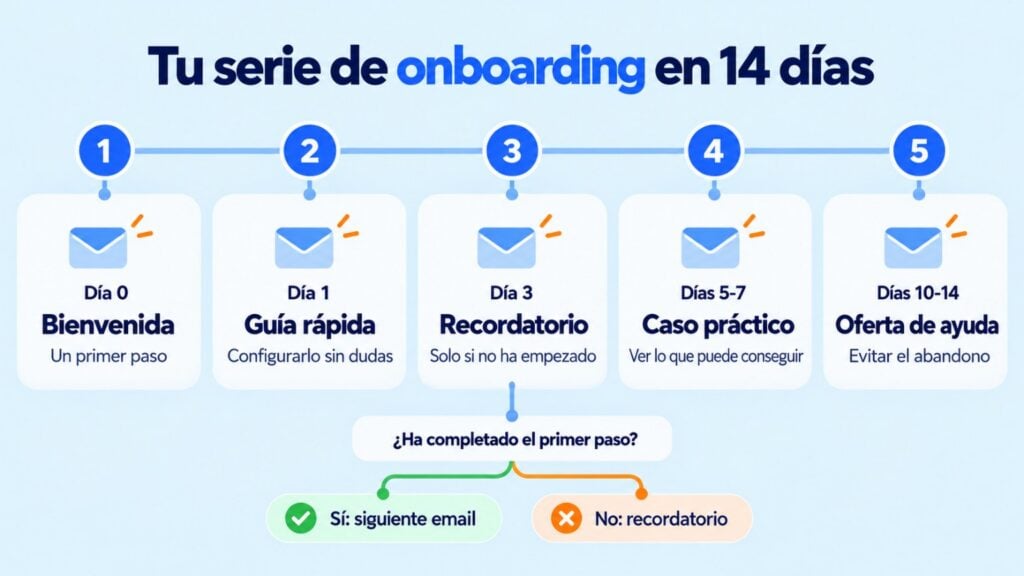
A simple sequence for the first few days:
| When | Goal | |
|---|---|---|
| Day 0 | Welcome with a single first step | Get off to a good start |
| Day 1 | Quick guide or short video | Sort out the setup |
| Day 3 | Reminder if they have not completed the first step | Win back those who get stuck |
| Days 5-7 | Case study or advanced tip | Show what they can achieve |
| Days 10-14 | Offer of personal help | Prevent drop-off |
| Day 30 | Summary of what they have achieved and next step | Move on to adoption |
What works best is a sequence driven by behavior. If the customer has already completed a step, do not remind them of it: move on to the next one.
How do you create automated onboarding series?
To automate an onboarding series, define the first result the customer should achieve, write an email for each step and create a workflow that is triggered by the signup. Then add waits and conditions based on what each customer does, and check where they stop so you can improve that email.
- Define the first result. This is the moment the customer sees the value of what they have signed up for, for example sending their first campaign or receiving their first order.
- Break the path into steps. One email per step, with a single button.
- Choose the trigger. Joining a subscriber group, a purchase or a form.
- Add waits and conditions. If the customer has already completed a step, move on to the next one. If not, they get a reminder.
- Measure and adjust. Look at the activation rate and the clicks on each email, and change the message where customers stop.
For the email series, an autoresponder or a mailing automation tool is all you need. In-app guides, such as Userpilot or Appcues, are something else and can be combined with the emails.
5 onboarding emails to copy
Here is a template for each email in the calendar. Change what’s in square brackets and adapt the tone to your brand.
Email 1. Day 0: welcome with a first step
Subject: Welcome to [product]: your first step
Hi [Name],
Thanks for joining [product]. To get started, you only need to do one thing: [first step, for example, import your contacts]. It will take you about [X] minutes.
[Button: Take the first step]
If you have any questions, just reply to this email. A real person from our team will get back to you.
Email 2. Day 1: quick guide
Subject: How to [achieve the result] in 5 minutes
Hi [Name],
We have put together a short guide so you can [achieve the result] without any hassle:
1. [Step 1]
2. [Step 2]
3. [Step 3][Button: See the guide]
Email 3. Day 3: reminder (only if they have not completed the first step)
Subject: Did you get stuck halfway?
Hi [Name],
You haven’t [completed the first step] yet. It’s what will help you most to [benefit].
If something is stopping you, let us know and we’ll help.
[Button: Finish now]
Email 4. Days 5-7: case study
Subject: How [customer] achieved [result]
Hi [Name],
[Customer or type of business] started out just like you. In [time frame], they achieved [specific result] using [feature].
These were their steps: [summary in two or three sentences].
[Button: Try it in your account]
Email 5. Days 10-14: offer of help
Subject: Shall we talk for 15 minutes?
Hi [Name],
You’ve been using [product] for two weeks. How is it going?
If you like, we can go over your account together and help you with the next step.
[Button: Ask for help] or reply to this email.
If your business is an online store, the first result will be the second purchase, not the setup. Adapt emails 2 and 4 to what your customer needs to buy again.
Automate your customer onboarding
Welcome and activation sequences with automations and statistics for every send.
Examples by type of business
Software or app (SaaS). The goal is for the customer to complete the setup and use the main feature. Each email shows a single step, with a button that takes them straight to that screen.
Online store. After the first purchase, onboarding explains shipping, how to use the product and which products go well with it. The goal is the second purchase.
Professional services. A consultancy, a school or a gym explains what will happen in the first few weeks, what they need from the customer and who to contact. The goal is for the customer to feel that the service has already begun.
Metrics to measure customer onboarding
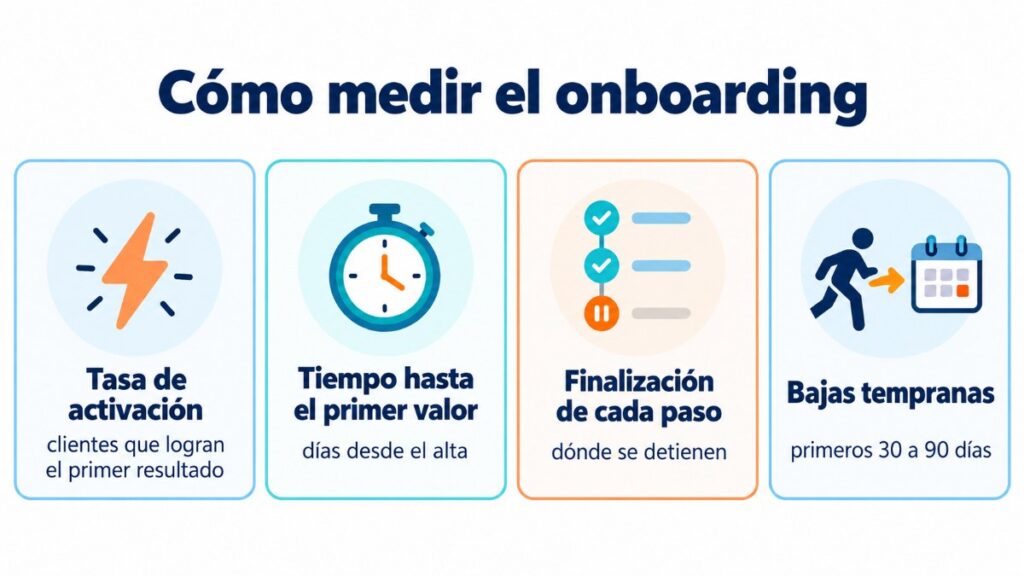
Activation rate. Customers who reach their first result out of total signups.
Time to first value. Days between signup and activation. The shorter, the better.
Step completion. Which part of the sequence makes customers stop.
Early cancellations. Customers who leave within the first 30 or 90 days. This is the part of the churn rate that depends most on onboarding.
Clicks per email. Which messages really help and which ones can be removed.
Common mistakes
Explaining everything in the first email. A new customer cannot learn ten features at once. One step per email is enough.
Sending the same sequence to everyone. Someone who has already started does not need the same reminders as someone who has never logged in.
Selling too soon. Before you offer a higher plan, the customer needs to have seen the value of the one they already have.
Not leaving a human way out. A link to support or a direct reply to the email prevents many cancellations.
Not reviewing the sequence. Every few months, check where customers stop and adjust that email.
How Mailrelay helps you
With Mailrelay, you create the onboarding sequence with automations, segment customers based on what they have done and see the opens and clicks of each email. That way, you know which step needs a better message.
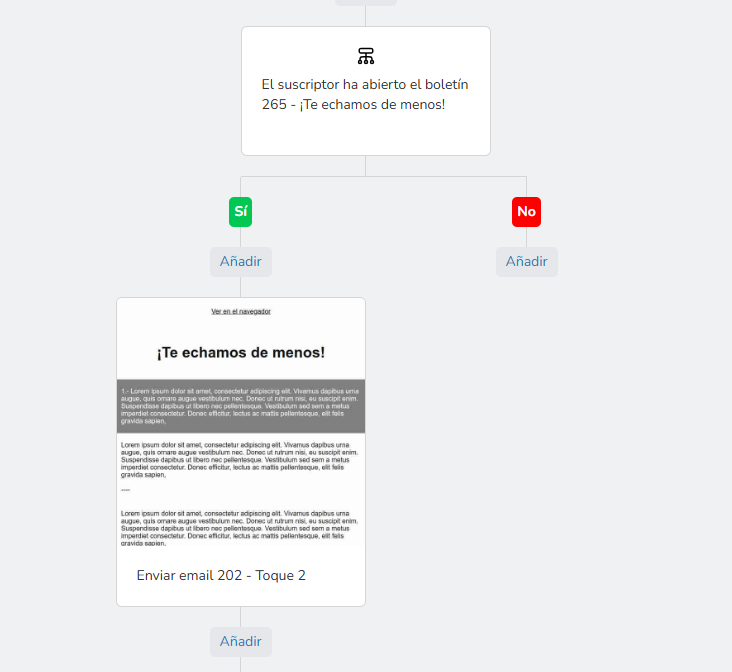
In Mailrelay, you build the series with an automation that is triggered when the contact joins a group, for example when they subscribe through your form. You add waits between emails, conditions with two paths (for example, whether or not the contact opened the previous email) and group changes, and you can include an SMS in the same workflow. If your website or app moves the contact to another group when they complete a step, through the API or with Make, the workflow stops sending them the reminder. You’ll find it step by step in our automation tutorial.
The free account includes up to 80,000 emails a month and 20,000 contacts, with human support on every plan. If you then want to keep those customers, read our post on customer loyalty.
Start your onboarding sequence for free
Up to 80,000 emails a month and 20,000 contacts, with human support on every plan.
Frequently asked questions
These are the most common questions about onboarding new customers.
What is customer onboarding?
The process that guides a new customer from signup until they get their first result with your product or service.
What does onboarding mean?
Bringing a new customer on board and welcoming them. It comes from the phrase on board.
How many emails should an onboarding sequence have?
Four to six in the first month is usually enough. What matters is that each one has a single goal.
What is the difference between onboarding and a welcome email?
The welcome email is a single message sent after signup. Onboarding is the full sequence until the customer gets value.
How do you know if onboarding is working?
Measure the activation rate, the time to first result and cancellations in the first few months.
What tool do I need to automate onboarding?
An email marketing platform with automations: a signup trigger, waits and conditions. If you want in-app guides, you can add a tool such as Userpilot or Appcues.
How often should I send onboarding emails?
More frequently at first (days 0, 1 and 3) and further apart later on (once a week). If the customer completes a step, send the next email sooner.