Winback campaign
How to win back customers and subscribers who have drifted away
Six months ago, a customer was buying from your store every few weeks and opening all your emails. Today she doesn’t open anything or buy anything. She hasn’t unsubscribed, but she has disappeared. Should you write her off? Not yet. That’s what winback campaigns are for.
What is a winback campaign?
A winback campaign, also called a win-back, recovery or reactivation campaign, is a marketing action. Its goal is to win back customers or subscribers who have stopped interacting with your brand.
It usually takes the form of an email sequence, sometimes backed up by SMS. The idea is to rekindle their interest and remind them of the value you offer. And, if possible, to get them buying again.
The name comes from the English phrasal verb win back, which literally means “to regain”.
Why it’s worth it
The first reason is financial. A well-known Harvard Business Review analysis sums it up like this: acquiring a new customer can cost 5 to 25 times more than retaining an existing one. Winning back someone who already knows you is usually cheaper than starting from scratch.
What’s more, these contacts trusted you once before. They know your brand, they have tried your products and they are easier to convince than a stranger. Every customer you win back improves your customer lifetime value and reduces your churn rate.
And there’s a third reason many companies forget: the health of your list. Contacts who haven’t opened anything for months hurt your deliverability. Mailbox providers take it as a sign that your messages aren’t interesting.
When is a contact considered inactive?
There is no single rule. It depends on your industry and on how often your customers usually buy.
A good benchmark is to take the normal interval between purchases and multiply it by two or three. If your customers usually buy again every month, someone who hasn’t bought anything in three months is already a candidate. In a furniture store, on the other hand, that period could be one or two years.
For newsletter subscribers, inactivity usually means three to six months without clicks. It’s better to look at clicks than at the open rate. The privacy features of some email clients record opens that aren’t real.
An RFM analysis helps you identify these contacts accurately.
How to design a winback campaign step by step
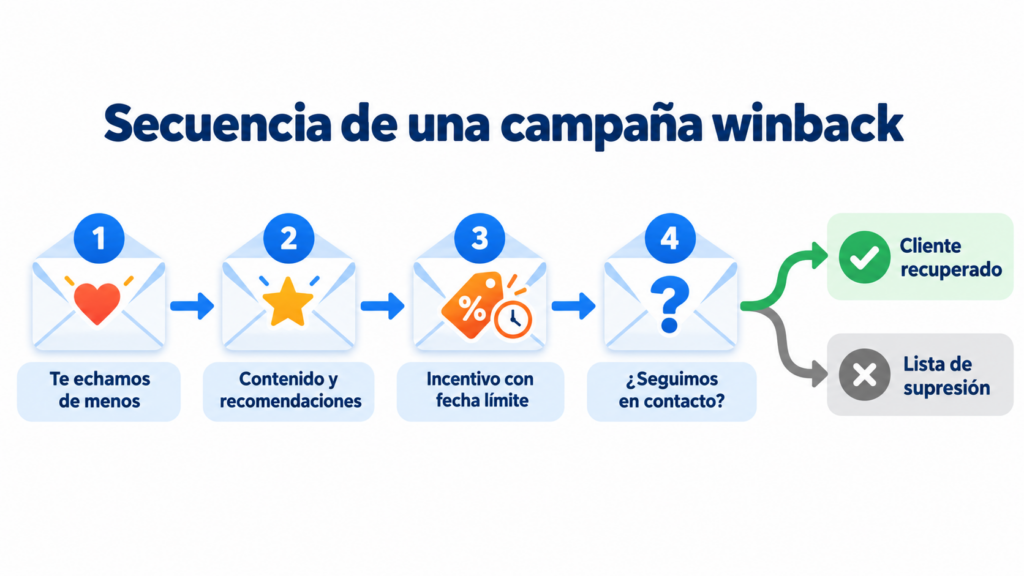
A good reactivation campaign usually follows a sequence of three or four emails:
- The reminder: a friendly first email, along the lines of “We miss you”. Remind them what you offer and what’s new that they’ve missed.
- The added value: a second email with useful content or products recommended based on their purchase history.
- The incentive: a discount, free shipping or a gift with a deadline. Here, urgency helps them decide.
- The last chance: a final message that honestly asks whether they want to keep receiving your emails. Give them the option to reduce the frequency or unsubscribe with one click.
Leave a few days between each email. And automate it. With email marketing automation, the sequence is triggered automatically when a contact becomes inactive.
Tips to make it work
Pay attention to the email subject line. It’s your only chance to catch the attention of someone who has been ignoring you for a while. Personal, direct subject lines usually work better than generic ones.
Personalize as much as you can. Use their name, mention their last purchase or recommend related products. Personalization in email marketing makes a big difference in this type of campaign.
Test different versions. An A/B test will tell you whether people respond better to a discount or to an emotional message.
And combine channels. A short SMS with the incentive can reach people who no longer check your emails. But only if they have given you permission to contact them that way.
What to do with those who don’t respond
Not everyone will come back, though, and that’s normal.
If someone doesn’t react after the whole sequence, the most sensible thing is to stop sending them campaigns. You can move them to a suppression list or unsubscribe them.
It may seem like you’re losing contacts. In reality, your list gains quality: your metrics improve, you protect your reputation and you focus on the people who are genuinely interested. It’s part of good list hygiene.
How to measure the results
To find out whether your campaign is working, look at these metrics:
The reactivation rate, that is, the percentage of contacts who click or buy again. The revenue generated by the customers you’ve won back. And the unsubscribes the campaign triggers, which are also useful: they help you clean up your database.
Compare these results with what it costs you to acquire a new customer. That way you’ll know how much value it really brings.
How we help you at Mailrelay
At Mailrelay, we make it easy for you to win back your inactive contacts. You can segment your list by activity and create automations that launch your winback sequence at the right moment. You can also combine it with SMS sending from the same platform.
All of this on a free plan of up to 80,000 emails a month and 20,000 contacts. If you want to try it, you can create your email marketing account at Mailrelay today.
Frequently asked questions about winback campaigns
What is the difference between winback and re-engagement? They are used almost as synonyms. Winback mainly applies to customers who have stopped buying; re-engagement, to subscribers who have stopped opening or clicking.
Do you always have to offer a discount? No. Sometimes it’s enough to remind them of your value or ask what they’re interested in. Save incentives for the customers with the most potential.
How often should you launch a winback campaign? Ideally, you should keep it permanently automated. That way each contact receives it right when they become inactive.
In conclusion
A winback campaign lets you recover sales at a low cost while keeping your list healthy. It’s one of the most profitable automations you can have running.
Clearly define when a contact is inactive, prepare a sequence that offers value and respect the decision of those who no longer want to hear from you. That way you protect both your results and your reputation.