RFM
Segment your customers by when they buy, how often they buy and how much they spend
Two customers have spent €300 in your store. One bought last week and does so every month. The other placed a single order two years ago and hasn’t come back. In your database they look the same, but they need very different messages. RFM analysis helps you see that.
What is RFM analysis?
RFM is a segmentation method that classifies customers based on their purchasing behavior. The acronym stands for three variables:
- Recency: how much time has passed since the last purchase.
- Frequency: how many purchases the customer has made in a given period.
- Monetary: how much money they have spent in total in that period.
The model was born in direct mail marketing, long before email existed. It became popular in the nineties thanks to authors such as Arthur M. Hughes, and today it is still one of the most widely used segmentation techniques in ecommerce.
Its great advantage is its simplicity. All you need is your order history: date, customer and amount.
Why it works
The three variables are strong predictors of the next purchase.
A customer who bought recently is more likely to buy again than one who hasn’t shown up in months. Someone who buys frequently already has the habit. And how much someone spends tells you which customers bring the most value to your business.
Combined, they give you a fairly accurate picture of each person’s relationship with your brand. They also help you estimate their customer lifetime value.
How to calculate RFM step by step
First, choose an analysis period. For most online stores, one year works well, although it depends on your purchase cycle.
Next, calculate three figures for each customer: the days since their last purchase, the number of orders and the total amount spent.
Then assign a score from 1 to 5 for each variable. The usual approach is to rank customers and divide them into five equally sized groups, called quintiles. The 20% with the most recent purchase gets a 5 for recency; the 20% with the oldest purchase gets a 1. The same goes for frequency and monetary value, where 5 goes to those who buy the most and spend the most.
Finally, combine the three numbers. A customer with 5-4-5 bought recently, buys again often and spends a lot. One with 1-1-2 hasn’t come back in a while and has barely bought anything.
Let’s look at an example. Laura bought 10 days ago, has placed 8 orders this year and has spent €640: her score could be 5-5-5. Marcos bought 9 months ago, placed 2 orders and spent €90: his score would be 1-2-1.
You can do this calculation in a spreadsheet without advanced knowledge. If you have a large volume of data, your ecommerce platform or your CRM can automate it.
The most common RFM segments
With five levels for each variable, you get 125 combinations. In practice, they are grouped into a few named segments.
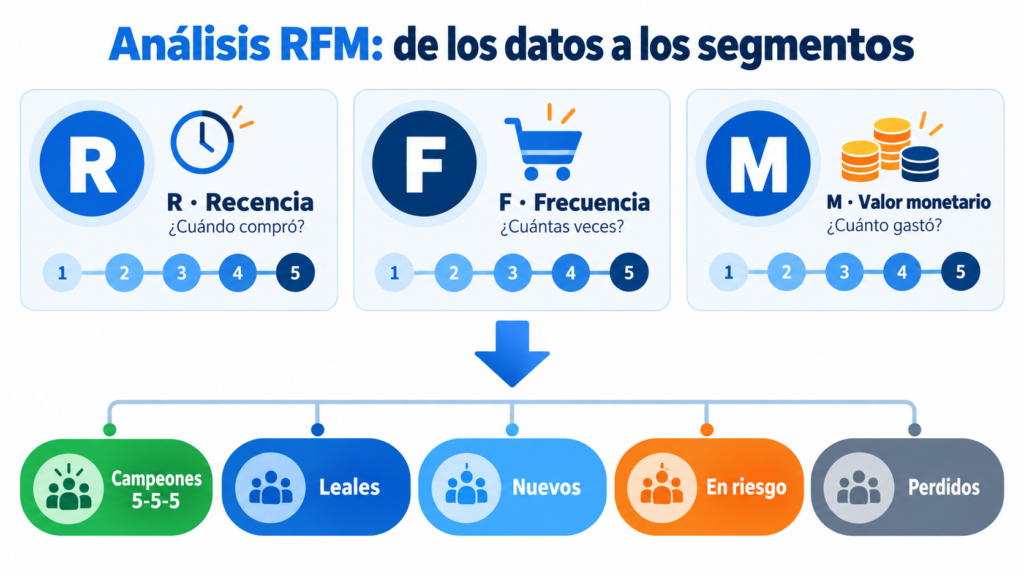
Champions. High scores in all three variables. They are your best customers. Look after them with early access to new products, exclusive perks or a customer loyalty program.
Loyal customers. They buy frequently, even if their spending is average. They are good candidates for upselling and cross-selling.
New customers. High recency, but low frequency. They have just arrived. A good welcome sequence can turn them into regulars.
At risk. They used to buy a lot and often, but haven’t come back for a while. They are a priority: if you don’t act, you could lose them.
Lost or hibernating. Low scores across the board. It’s worth one last try with a winback campaign before you stop sending them campaigns.
How to use RFM analysis in your email marketing
This is where segmentation pays off. Instead of sending the same email to your whole list, you tailor the message to each group.
You can email your champions to ask for reviews or invite them to an ambassador program. Send new customers content that helps them get the most out of their purchase. Send at-risk customers a personalized offer or a reminder of what they’re missing out on.
RFM also helps you spend your incentives more wisely. If you send a discount to someone who was going to buy anyway, you cut your margin for no reason. Saving it for the segments that need it is more profitable.
To get the most out of it, combine RFM with segmentation in email marketing and automations. That way, when a customer moves from one segment to another, they automatically receive the right message. Measure each group’s results with an A/B test to find out what works best.
Limitations of the model
RFM only looks at the past. It doesn’t take into account how the customer interacts with your emails, which products interest them or which channel they came from.
Nor does it work the same way in every industry. In businesses where purchases are far apart, such as furniture or cars, frequency provides little information. In those cases, some teams use only recency and monetary value, or complement it with a cohort analysis.
And it’s a good idea to update it regularly. A score from six months ago no longer reflects your customers’ situation.
How we help you at Mailrelay
At Mailrelay, we make it easy to turn your analysis into campaigns. You can import your contacts with any fields you want, such as their RFM segment, and create groups to send each one its own message. You can also automate email sequences for each type of customer.
All of this on a free plan of up to 80,000 emails a month and 20,000 contacts. If you want to try it, you can create your email marketing account at Mailrelay today.
Frequently asked questions about RFM analysis
What does RFM stand for? Recency, Frequency and Monetary: the recency, frequency and monetary value of each customer’s purchases.
How often should you recalculate RFM? It depends on your sales volume. For most online stores, once a month is enough.
Does it work for B2B or subscription businesses? Yes, although it may need some adjustments. In a subscription model, for example, frequency is sometimes replaced by customer tenure or service usage.
In conclusion
RFM analysis is a simple and effective way to get to know your customers using three pieces of data you already have. It tells you who your most valuable customers are, who is just getting started and who is about to leave.
Calculate the scores, group your customers into segments and send each one the message it needs. Your campaigns will be more relevant and your results better.
Related entries
- Neuromarketing
- Newsletter
- Social norms
- Push notifications
- Brand awareness
- NPS (Net Promoter Score)
- Omnichannel
Find out how Mailrelay can help you with your email marketing strategy.