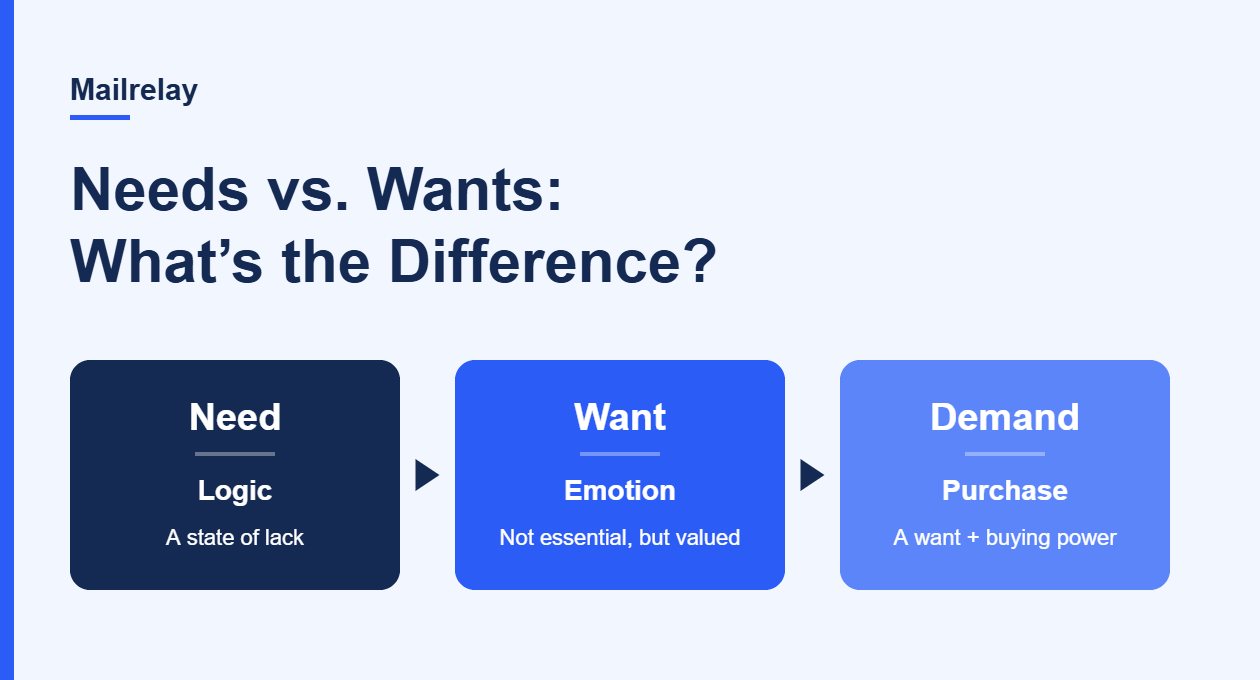
To build an effective marketing strategy, you need to understand the difference between consumers’ needs and wants. The approach you take will shape the actions you propose and the results you get.
For example, selling a car by appealing to the desire for recognition or status is not the same as selling it to someone who needs transport to do their job.
As you can imagine, the actions, conversations and sales arguments won’t be the same. That’s why knowing what drives the purchase, and therefore the difference between wants and needs, is key.
In B2B businesses, strategies usually focus on needs that justify a company’s profitability. In B2C, everything revolves around consumers’ wants.
At Mailrelay, we explain it all in detail.
Why it matters to tell needs and wants apart
Designing and implementing a marketing strategy is hard work. It takes a significant investment of time and effort. If you don’t work with the right approach, the consequences can include:
● Missed opportunities. If the strategy isn’t properly aligned, you may be missing business opportunities every day. The approach determines your messaging and actions, and if they aren’t right, you’ll struggle to reach the right audience.
● Higher CAC. As a result, your customer acquisition cost will be higher. In other words, each lead will cost more than if you had built the strategy on the right need-or-want approach.
● Poorly qualified leads. The leads you get this way won’t be well qualified. If your messaging and actions are off, you’ll attract the wrong audience, and those leads won’t be ready to convert.
● Lower conversion rates. Another consequence of not understanding the difference between wants and needs is very low conversion rates.
● Lower ROI. Finally, as you can imagine, the return on investment, whether in email marketing or any other strategy, will be very low. And that hits the business directly.
That’s why you need to be clear about the basis you’ll work from. This approach also influences aspects such as:
Connect with your customers’ real needs
Email marketing lets you speak to each subscriber based on what they really need. See how with Mailrelay.
Discover MailrelayTone of voice
Talking about a need and a want usually calls for a different tone of voice. For example, talking to an individual about gaining status by buying a car is not the same as talking to a business owner who wants a fleet of vans to make operations more profitable.
Sales arguments
Clearly, in this example, the two customers have different reasons for buying. So you can’t use the same sales arguments.
Knowing the difference between needs and wants, in the first case (an individual’s want) the argument could be social status, and in the second (a business owner’s need) it could be fuel savings.
Psychological biases
This is more closely linked to want-based selling, since psychological biases are mental triggers that lead people to make a decision.
Take scarcity, for example. When you introduce scarcity into an email marketing strategy, you encourage readers to act. The thought of missing out on a great opportunity makes them decide quickly.
There are many biases like this. Others include reciprocity, authority, social proof, price anchoring, the sunk cost fallacy and the halo effect.
Email marketing setup
Finally, if you’re going to run an email marketing strategy, knowing whether you’re focusing on a need or a want will help you decide how many emails to send, what kind of emails to create and what time of day to send them.

Understanding the difference between needs and wants
Now that we’ve seen why the difference between needs and wants matters, it’s time to define each concept.
Let’s start with another practical example: bottled water. At the supermarket, there’s a whole shelf of water bottles in different sizes.
There are many brands and prices are very affordable. You could say they all meet a need: quenching the consumer’s thirst.
However, in upscale restaurants you may find premium water, such as the Bling H2O brand. In this case, it clearly satisfies a want.
Do you think the sales strategy is the same? Of course not. Neither is the target audience or the price of the product.
What is a need?
When we talk about needs in terms of Maslow’s hierarchy of needs, it’s important to stress that we mean the needs of the customer or consumer, not business needs (as in B2B).
In this sense, a need is a personal state of deprivation or lack. In other words, needs are people’s natural requirements. Maslow classifies them as follows:
● Physiological: breathing, eating, resting…
● Safety: physical safety, employment, resources, morality, health and family.
● Social: intimacy, friendship, love and affection.
● Esteem: for example, success or respect.
● Self-actualization: feeling useful at work or in society…
In B2B businesses, that is, companies that sell products or services to other companies, needs change. Maslow’s pyramid is adapted as follows:
● Basic: infrastructure, technology or raw materials.
● Business security: such as maintaining revenue and resources.
● Social: belonging to groups, attending events, networking…
● Esteem: market positioning.
● Self-actualization: such as growth and diversification.
To these we can add more specific ones such as profitability, productivity, decision-making capacity, talent retention and financial stability. These keep the company going and drive its growth.
Today there are many products and services focused on them, such as tax and financial advisory services or digital solutions for time tracking and invoicing.
As you can see, when planning a sales strategy, it’s essential to distinguish between B2C and B2B. The first targets end consumers, while the second targets companies of every type and size. So the type of need changes.
Segment by needs and wants
With Mailrelay, you can personalize your campaigns based on each subscriber’s profile.
Get started with MailrelayWhat is a want?
In marketing, a want or desire is the result of an emotion. In other words, different stimuli create a need that isn’t real, but that our brain treats as if it were.
Thanks to wants, many brands have increased the value of simple products or services so they can sell them at a higher price.
These are specific solutions or offers, such as the premium bottled water we mentioned earlier or luxury cars.
Here’s another example: what’s the difference between a BIC pen and a Montblanc fountain pen? In terms of price, the first costs around a dollar, while the second can cost hundreds.
They meet the same need, but not the same want. To sell a Montblanc pen, you have to focus on the want. That way, you set aside people who only want to meet a need as cheaply as possible and target those who want to hold a luxury pen.
What is the difference between needs and wants?
In short, the difference between needs and wants lies in the motivation and justification behind a purchase.
● Needs always appeal to logic.
● Wants involve an emotional impulse.
With wants, decisions are made first from emotion and later justified with reason. Let’s look at some other key differences between the two concepts:
Importance
From the definitions above, we can see that a need matters more than a want. If a want isn’t satisfied, there are no real consequences to worry about.
With a need, however, the picture changes completely. For individuals, if it’s a physiological need (the most urgent kind), the consequences can affect their quality of life.
On the other hand, it’s no big deal if we can’t buy the latest smartphone. And the same applies to companies.
For businesses, needs such as increasing profitability or maintaining revenue can’t be ignored. More superficial wants, however, can.
Questionability
Another important difference between needs and wants is whether they can be questioned. Would anyone question buying food? What about buying a sofa with the latest relaxation system on the market?
A need is never questionable, while a want is. Wants are worth whatever value each person gives them, but needs are vital.
The same happens in companies. None would question buying raw materials, but they probably would question spending on meals or luxury items.
Limits
Finally, wants are unlimited. Throughout our personal or business lives, we can have countless wants, and they change over time along with our interests.
An 18-year-old doesn’t have the same wants as a 50-year-old. They’re at different stages of life, and so are their wants.
Nor does an entrepreneur have the same wants as a company that has been on the market for 10 years.
Needs, on the other hand, may vary depending on a person’s or company’s situation, but they are limited. Some appear as others are satisfied, and some are always present.
Conclusion on the difference between needs and wants
In the end, it’s a matter of thinking about what’s essential and what isn’t. A need is essential; a want isn’t, although it does make us happier.
There’s something we haven’t mentioned yet: the difference between needs, wants and demand. Briefly:
● A need is a state of lack.
● A want is the result of an emotion.
● Demand is a want backed by buying power.
A want becomes demand when a person or company channels a need through a want and expresses it as a purchase.
For example, we all need to get around. We can do it by public transport, bike, a basic car or a Ferrari. The Ferrari would be the want, and when the person goes through the buying process and places a specific order, it becomes demand.
In other words, a want is a more general concept, while demand is more specific. That specificity comes from the stimuli used in marketing strategies.
To sum up, to understand these concepts properly and build the right strategy, ask yourself two questions:
● Can the consumer or company live and/or keep operating without this product or service?
● Does having this product or service add value for the customer?
In the second case, it’s essential to highlight the benefits and what sets this solution apart from the rest. So, if you’re about to launch an email marketing campaign, keep this in mind!
So, highlight the strengths of your offer in your emails to get better results. What matters is finding the essence and focus of your business and working in that direction. Are you doing it?
Use Mailrelay as your email marketing service and save money while you sell with the free account, which includes up to 80,000 emails a month.
Turn wants into customers
Design email marketing campaigns that spark the desire to buy. Try it with Mailrelay.
Try Mailrelay for free