Sensory marketing: what it is, how to work with each sense and how to bring it into your emails
A scent, a song or the feel of paper can decide a purchase without the customer noticing
Sensory marketing uses sight, hearing, smell, taste and touch so that customers remember a brand and feel comfortable with it.
It is the scent you recognize when you walk into a store, the music playing while you shop or the short sound that accompanies a logo.
What is sensory marketing?
Short answer: it means designing what customers see, hear, smell, taste and touch to spark an emotion and earn a place in their memory.
It almost always works without the person noticing, which is why it is closely linked to neuromarketing.
It does not replace a good product or a good price. What it does is make the experience memorable and link it to your brand.
The five senses in marketing
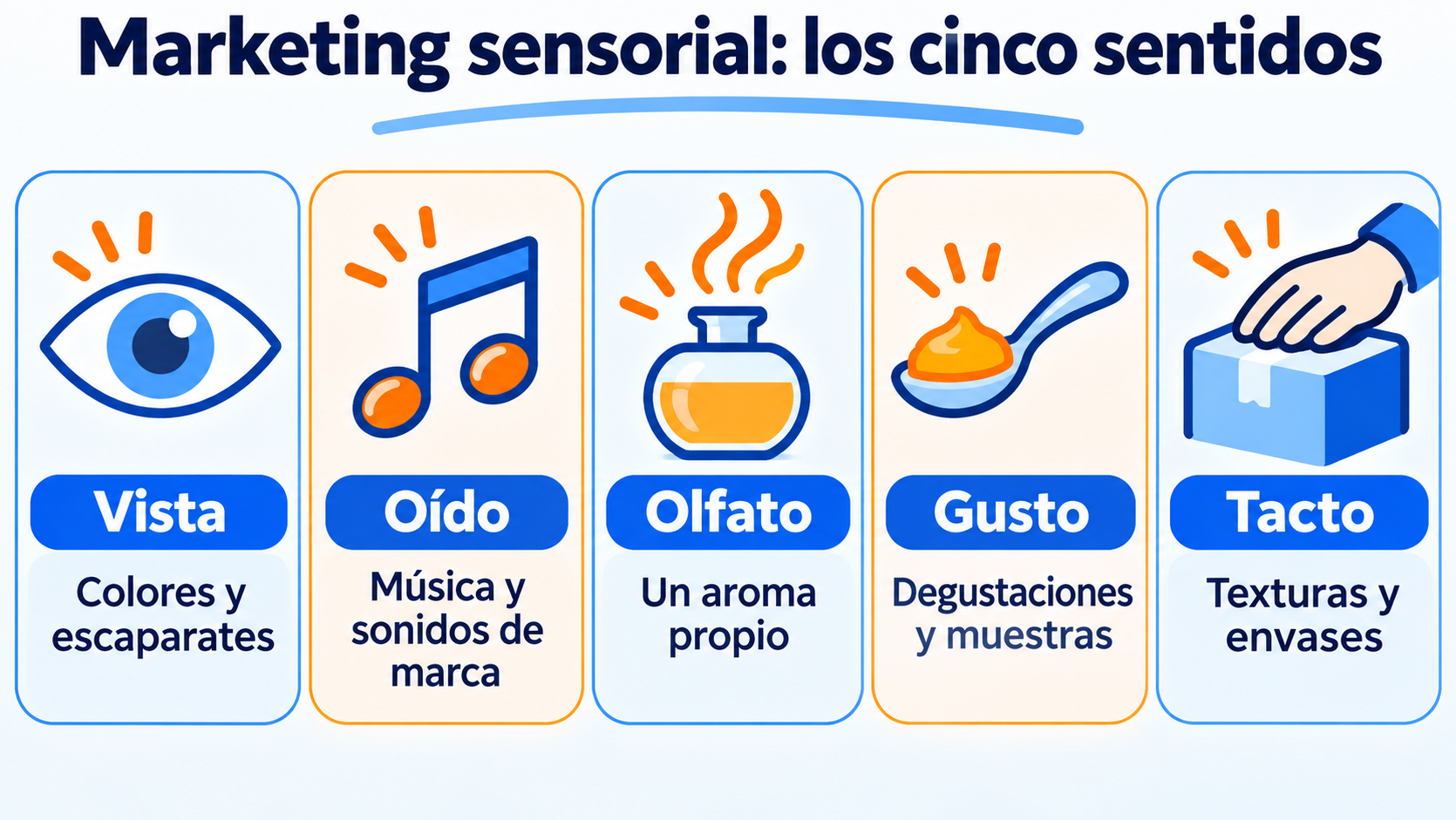
Each sense is used in a different way. The table sums it up with examples:
| Sense | How it is used | Example |
|---|---|---|
| Sight | Colors, logo, shop windows, lighting, packaging | A brand that always uses the same color, so you recognize it from afar |
| Hearing | In-store music, sonic logos, the sound of the product | A few notes that identify a brand at the end of every ad |
| Smell | A signature scent in stores, hotels or shipments | A clothing chain that smells the same in all its stores |
| Taste | Tastings, samples, pairings | A product tasting at the supermarket |
| Touch | Textures, packaging weight, catalog paper | A box that feels heavy and opens slowly, as if it were a gift |
The most effective approach is to combine several senses that tell the same story. If the music, the lighting and the scent all convey calm, the brand comes across as calmer and more carefully crafted.
What the studies say
Two classic experiments with in-store music show how much a single sense can influence buying:
- The tempo of the music. In a US supermarket, sales were 38% higher on days with slow music than on days with fast music. With slow music, shoppers also walked through the store more slowly (Milliman, Journal of Marketing, 1982).
- Music that matches the product. In an English supermarket, French wine sold more on days with French accordion music, and German wine on days with German beer-hall music. When asked, shoppers did not believe the music had influenced them (North, Hargreaves and McKendrick, Nature, 1997).
Later studies have qualified the numbers, but the idea holds: what we perceive without realizing it changes what we buy.
Benefits and risks
Done well, sensory marketing makes a brand memorable and sets it apart from the competition, and it makes the visit or purchase last longer and feel more enjoyable.
Done badly, it becomes tiring. Music that is too loud, a strong scent or too many stimuli at once have the opposite effect.
On top of that, some people are sensitive to smells or have impaired vision or hearing: what works for some can bother others.
Make your emails look like your store
Templates, images and animated GIFs in Mailrelay’s free account: up to 80,000 emails a month.
Sensory marketing in email
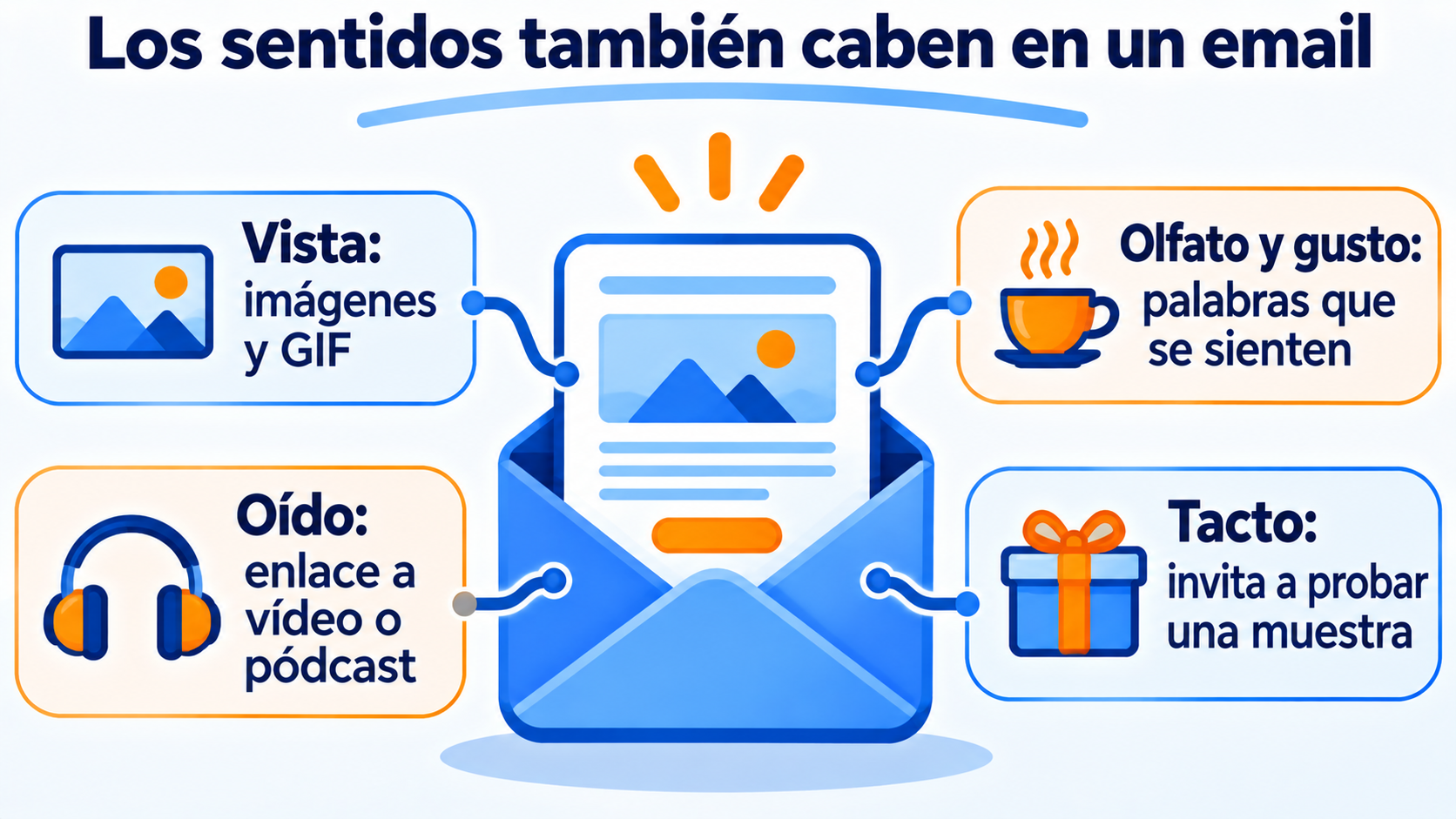
An email only reaches the eyes. Even so, it can awaken the other senses:
- Sight. Pay attention to images, your brand colors and white space. A short GIF showing the product in use is worth more than three paragraphs.
- Words you can feel. “Fresh out of the oven”, “crunchy”, “soft as cotton”: sensory language makes readers imagine the smell, taste or texture. Use it in the subject line and the first few lines.
- Hearing. Link to a video, a podcast or your store’s playlist. An email cannot play sound on its own, but it can lead to it.
- Taste and touch. Invite people to try: offer a free sample, an in-store tasting or a shipment with a physical extra. The email is the door; the experience happens afterwards.
- Consistency. The email has to look like the store and the product: the same colors, the same tone and the same photos.
How Mailrelay helps
With Mailrelay you design your emails with responsive templates, images and animated GIFs, so that what people see in the email looks like what customers find in your store.
With automations, included in the free account, you can send an invitation to a tasting or a follow-up to a sample at just the right moment.
The free account lets you send 80,000 emails a month to 20,000 contacts, with human support on every plan.
Invite them to try it, by email
Automate the invitation to a tasting or the follow-up to a sample, with human support on every plan.
Frequently asked questions
If you still have questions, you may find the answer here.
What is scent marketing?
It is the part of sensory marketing that works with smell: a signature scent in stores, hotels, cars or shipments that customers associate with the brand. It is the hardest sense to bring into the digital world.
What is the difference between sensory marketing and neuromarketing?
Neuromarketing studies how the brain reacts to an ad, a price or a product. Sensory marketing applies part of that knowledge to design stimuli for the five senses.
And experiential marketing?
Experiential marketing aims to give customers a firsthand experience with the brand, such as an event, a product trial or a special store. Sensory marketing is one of its tools: the senses make that experience memorable.
Related posts
If you found this useful, here are some other related reads: