Fixed and variable costs: definition, differences and examples
How to split your expenses to know how much you need to sell to avoid losing money
Fixed and variable costs are the two categories a company’s expenses fall into, depending on how they change with its level of activity.
Fixed costs stay the same whether you sell a lot or a little. Variable costs go up or down with what you produce or sell.
You’ll also see them called fixed and variable expenses. It’s the same thing.
Knowing how to separate them tells you how much you need to sell to avoid losing money, what price you can charge and which expenses you can cut when sales drop.
What are fixed costs?
They’re expenses that don’t depend on your level of activity. They arrive every month, even if you don’t sell anything.
The most common ones are rent, salaries, insurance, accounting fees, software licenses and machinery depreciation.
Being fixed doesn’t mean they never change. Your rent may go up every year and you may hire one more person. But they don’t change because you sell more or less this month.
And they have a curious effect: the more you sell, the less they weigh on each unit.
If you pay €1,000 in rent and sell 100 products, each one carries €10. If you sell 500, only €2.
What are variable costs?
They’re expenses that grow when your activity increases and fall when it decreases. If you don’t sell anything one month, they’re close to zero.
For example, raw materials, packaging, shipping, sales commissions or what the payment gateway charges for each transaction.
Here the opposite of fixed costs happens. The variable cost of each unit stays more or less the same, but the total grows with every sale.
Differences between fixed and variable costs
This table sums up how they differ:
| Fixed costs | Variable costs | |
|---|---|---|
| Relationship with sales | They don’t change whether you sell more or less | They go up and down with what you sell |
| If there’s no activity | You still have to pay them | They’re close to zero |
| Cost per unit | Falls the more you sell | Stays about the same |
| Examples | Rent, salaries, insurance, software | Raw materials, shipping, commissions |
| How to control them | Negotiating contracts or dropping them | Adjusting suppliers, processes and prices |
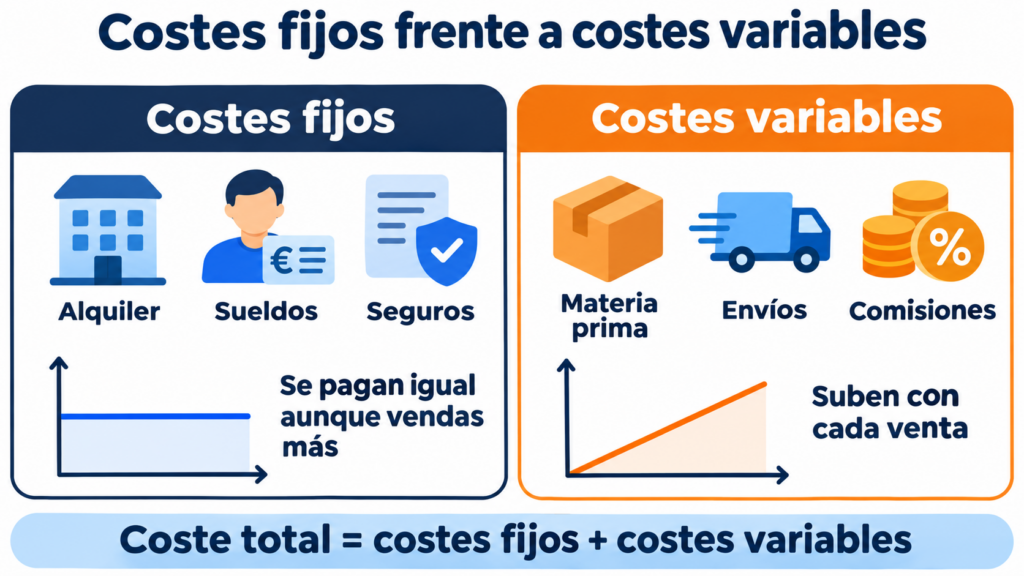
The difference matters most when sales drop. Variable costs fall on their own, but fixed costs are still there.
That’s why a company with high fixed costs carries more risk, although it also earns more when sales go up.
Examples of a company’s fixed and variable costs
The same types of expense change category depending on the business. Here are some examples:
| Business | Fixed costs | Variable costs |
|---|---|---|
| Restaurant | Rent, kitchen and dining room salaries, insurance, licenses | Food and drinks, gas for the stoves, napkins and takeaway containers |
| Hotel | Reception staff, maintenance, building depreciation | Laundry, bathroom amenities, breakfasts, booking site commissions |
| Online store | Ecommerce platform, hosting, salaries, warehouse | Product, packaging, shipping, payment gateway fees |
| Transport company | Insurance, vehicle taxes, fixed salaries, parking | Fuel, tolls, tire wear, per diems |
| Consultant or freelancer | Self-employed social security contributions, software, coworking, accountant | Travel to clients, per-project subcontracting |
And transport? It depends on how you pay for it. Leasing a van is a fixed cost. Fuel or what a courier charges per package are variable.
What are semi-variable costs?
Not every expense fits into one of the two categories. Semi-variable costs, also called mixed costs, have a fixed part and a variable part.
The electricity bill is the typical example: you pay a fee for the contracted power and then for what you use.
The same goes for the salary of a sales rep who earns a base salary plus commissions.
To do the math, the practical approach is to separate the two parts and add each one to its group.
Fixed and variable costs vs. direct and indirect costs
They’re two different ways of classifying the same expense, and they can be combined.
The first looks at how the cost behaves when sales change. The second looks at whether you can assign it to a specific product. We explain this in detail in direct costs and indirect costs.
| Fixed | Variable | |
|---|---|---|
| Direct | Salary of a worker who only makes one product | Raw materials for that product |
| Indirect | Rent of the facility where everything is made | Electricity for shared machines |
That’s why they aren’t synonyms. A direct cost doesn’t have to be variable, and an indirect cost doesn’t have to be fixed.
How to calculate fixed and variable costs
Start by listing all your expenses for one month. For each one, ask yourself: if I sell twice as much this month, will I pay the same?
If the answer is yes, it’s fixed.
Once you have the list, the formulas are simple:
- Total cost = fixed costs + variable costs.
- Unit variable cost = variable costs ÷ units sold.
- Unit total cost = total cost ÷ units sold.
Here’s an example. A natural cosmetics online store pays €3,000 in fixed costs every month: warehouse, salary, insurance, accountant, software and hosting.
Each order costs it €15: €10 for the product, €4 for shipping and €1 in payment gateway fees.
If it sells 200 orders in a month, its variable costs are €3,000 and its total cost is €6,000. Each order costs it €30 on average.
What is the break-even point?
It’s the number of sales at which you cover all your costs, fixed and variable. Below it you lose money, and above it you make a profit.
It’s also known as the break-even threshold or profitability threshold.
To calculate it you need the contribution margin: what you have left from each sale after paying its variable costs.
Break-even point (units) = fixed costs ÷ (unit sale price − unit variable cost)
In the example store, the average order is €40. Each sale leaves €25 after paying its €15 in variable costs.
To cover the €3,000 in fixed costs, it needs 3,000 ÷ 25 = 120 orders a month.
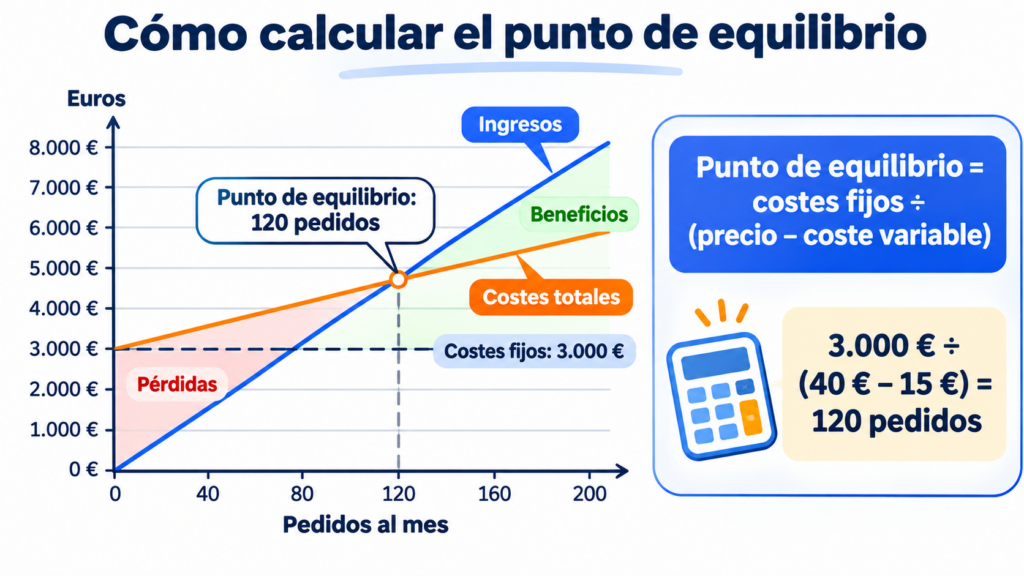
This calculation helps you set the price of a product, plan a realistic marketing budget or decide whether a new fixed expense is worth it.
If you hire someone for €1,500 a month, you’ll need 60 more orders to stay at break-even.
Fixed and variable costs in your email marketing
Your email campaigns also have both types of cost. Knowing them lets you calculate how much each send costs you and its profitability.
| Expense | Type | Why |
|---|---|---|
| Monthly or annual fee for the tool | Fixed | You pay the same whether you send one campaign or ten |
| Credits on a prepaid plan | Variable | You pay for the emails you send |
| Dedicated IP | Fixed | It’s contracted for a period, whether you send more or less |
| Salary of the person who manages the campaigns | Fixed | It doesn’t depend on the number of sends |
| External design or copywriting for each campaign | Variable | It’s paid per campaign |
A fixed fee works just like rent: the more you send, the less each email costs you.
With prepaid, spending follows the pace of your activity, which is useful if you send few campaigns or send them irregularly.
With Mailrelay you can choose between a monthly or annual subscription and prepaid, depending on how you send.
And if your list has up to 20,000 contacts, you can start with the free account: up to 80,000 emails a month without adding another fixed cost to your business.
Is your email marketing adding fixed costs?
With Mailrelay’s free account you can send up to 80,000 emails a month to 20,000 contacts, with human support on every plan.
Frequently asked questions about fixed and variable costs
Here are some questions that come up when classifying expenses.
Is it fixed costs or fixed expenses?
Both are used. “Costs” is the more common term in accounting, but you’ll also see “fixed and variable expenses”, which in practice means the same thing.
Are salaries a fixed or variable cost?
They’re usually fixed, because they’re paid the same even if sales drop. Commissions, production bonuses and overtime, however, are variable.
Can fixed costs become variable?
Yes, and many companies aim for this to reduce risk.
For example, by replacing their own warehouse with a logistics service that charges per order, or an annual license with a pay-as-you-go plan.