Programmatic advertising: what it is, how it works and when it makes sense for you
How ads are bought in milliseconds and why your first-party data is worth more and more
Programmatic advertising is the automated buying and selling of online ad space, using software that decides in milliseconds which ad to show each user and at what price. It is also known as programmatic buying (programmatic media buying).
Instead of negotiating with each website by phone or email, the advertiser defines who they want to reach and how much they want to pay. The platforms do the rest.
What is programmatic advertising?
It is a way of buying ads, not an ad format. It is used to buy banners, videos, native ads, audio or digital out-of-home screens.
What sets it apart is automation: the decision is made impression by impression, with data on who is viewing the page, in what context and on what device. It is mainly used in display advertising: ads on websites and apps.
How programmatic advertising works
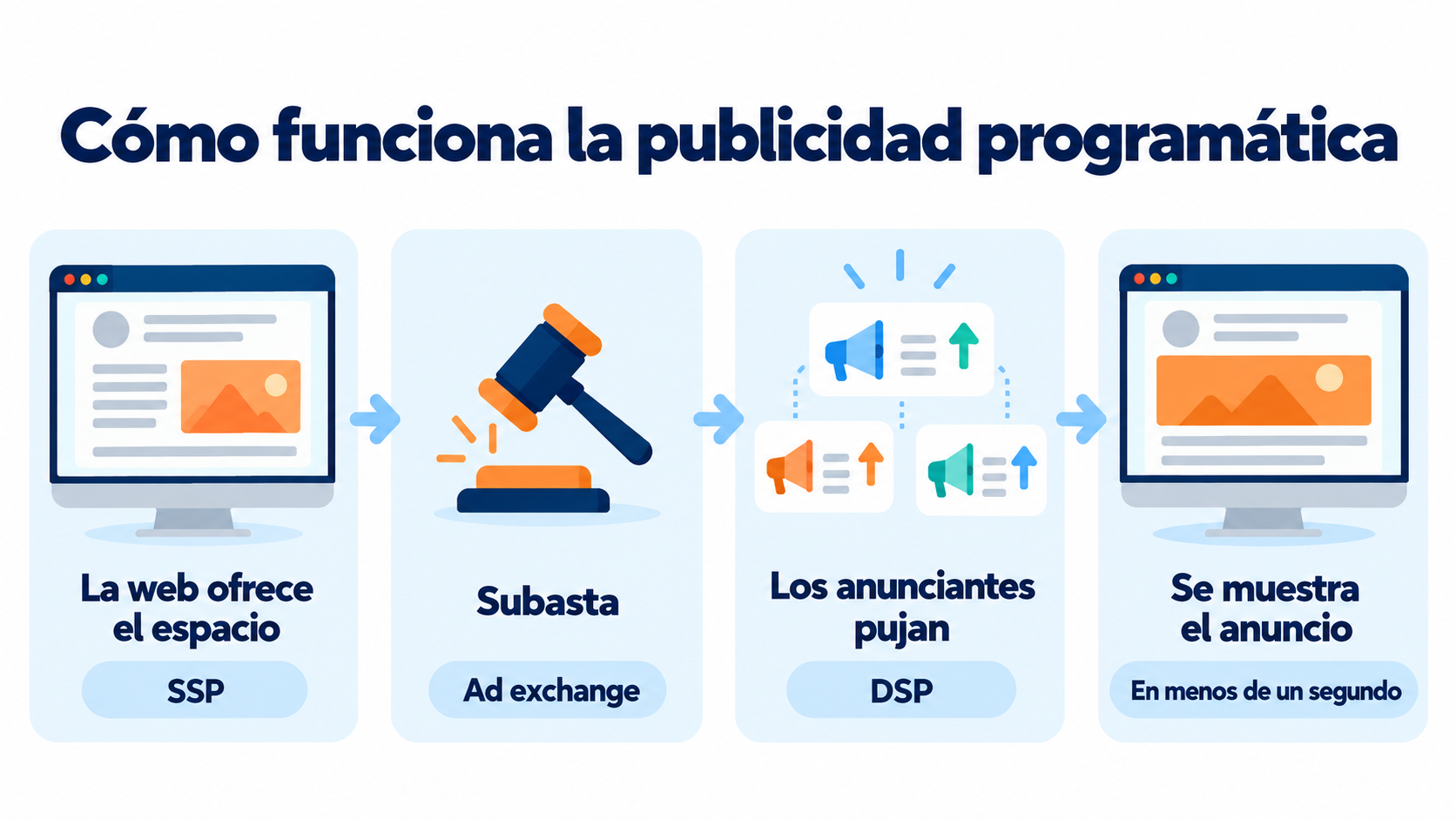
When someone opens a website with ad space, this happens in less than a second:
1. The website offers the space. Its sell-side platform (SSP) announces that an impression is available, with data about the context and the user.
2. Advertisers bid. Their demand-side platforms (DSPs) assess whether that person fits their campaign and how much to pay.
3. The best offer wins. The ad exchange awards the space.
4. The ad is shown. The user sees it when the page loads, without noticing the process.
| Element | Who uses it | What it’s for |
|---|---|---|
| DSP (Demand-Side Platform) | The advertiser or their agency | Buying impressions based on audience and budget |
| SSP (Supply-Side Platform) | The website or publisher | Selling its ad space at the best price |
| Ad exchange | Both | Marketplace where bids and offers meet |
| DMP or CDP | The advertiser | Organizing data to segment the audience |
Types of programmatic buying
| Type | How it works | Who it is for |
|---|---|---|
| RTB (real-time bidding) | Open real-time auction | Advertisers looking for reach at a good price |
| Private auction (private marketplace) | Auction only for invited advertisers | Brands that want specific publishers and more control |
| Preferred deals (PD) | Fixed price, with priority before the auction | Advertisers with a trusted publisher |
| Programmatic direct (programmatic guaranteed) | Impressions reserved at a fixed price | Campaigns with guaranteed volume and publishers |
The further down the table, the more control over where the ad appears and, usually, the higher the price.
Advantages of programmatic advertising
Precise targeting. You show the ad to people who match your customer, not to a website’s entire audience.
Real-time adjustments. You can change bids, audiences or creatives while the campaign is running.
Reach. You reach thousands of websites and apps from a single platform.
Detailed measurement. Impressions, clicks, conversions and cost per result at any time.
Risks of programmatic advertising
Brand safety. Your ad can appear next to content you don’t want to be associated with if you don’t use exclusion lists.
Ad fraud. Impressions or clicks generated by bots that you pay for without anyone seeing them.
Intermediaries. Each platform takes a share of the budget.
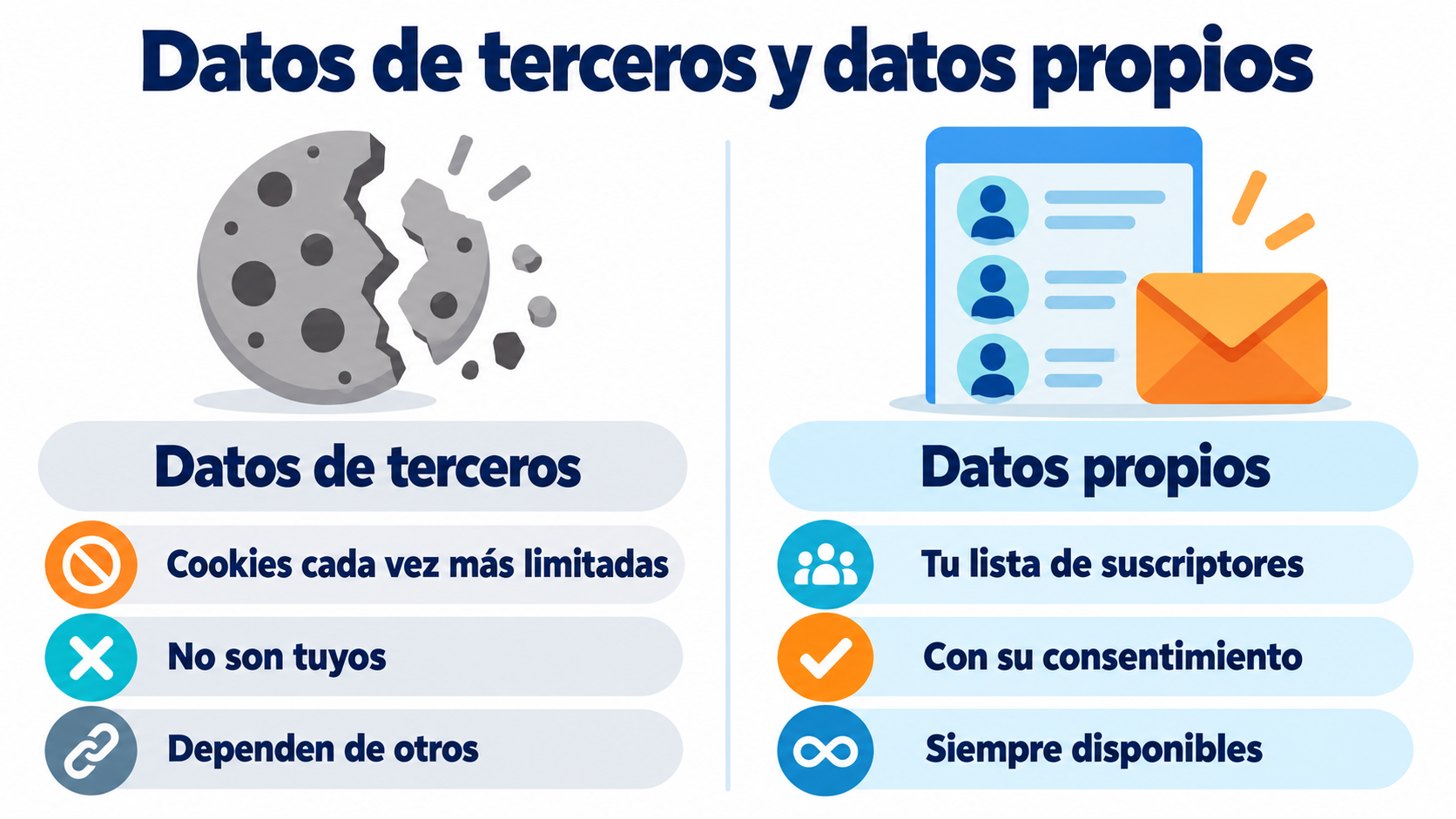
Privacy. Several browsers block third-party cookies and data protection laws require consent. Targeting with third-party data is getting harder and harder. Find out what cookies are and what a cookieless environment means.
Complexity. Without experience or an agency, it is easy to spend a lot on programmatic advertising without control.
Build your own audience
Turn the visits you pay for into subscribers with Mailrelay forms and talk to them without relying on cookies.
First-party data and email marketing
With fewer third-party cookies, programmatic advertising relies more on the data your brand collects directly and with permission: purchases, subscriptions and preferences. This is where email has a clear role:
Your list is your first-party data. Subscribers have given you their email address and their consent. You don’t depend on a browser or a third party.
More reliable audiences. Many advertising platforms let you create audiences from your customer lists, always with a legal basis for that use.
Combine channels. Programmatic advertising attracts new users. A form turns them into subscribers and email accompanies them all the way to purchase.
Declared data. Asking at sign-up or in a preference center what each subscriber is interested in generates zero-party data that helps you segment better.
Common mistakes
Starting without a goal. Without a clear KPI, the platform optimizes for things you don’t care about.
Over-segmenting. A tiny audience makes each impression more expensive and limits reach.
Not checking where the ads appear. Placement reports show which websites the money was spent on.
Measuring only clicks. What matters are conversions and the cost of each one.
Forgetting the user who already knows you. Capturing their email costs less than paying again to show them another ad.
How Mailrelay helps you
With Mailrelay you can turn the visits coming from your ads into subscribers, segment them by their interests and send them campaigns with their consent. Your list becomes a channel you own that doesn’t depend on third-party cookies.
The free account includes up to 80,000 emails a month and 20,000 contacts, with human support by chat, ticket and phone.
Send your newsletters with Mailrelay
Up to 80,000 emails a month and 20,000 contacts for free, with human support on every plan.
Frequently Asked Questions
These are the most common questions about automated ad buying.
What is programmatic advertising in a nutshell?
The automated buying of online ads, impression by impression, based on audience and price.
What is the difference between a DSP and an SSP?
The DSP is used by the advertiser to buy ad space. The SSP is used by the website to sell it.
What is RTB?
The real-time auction of each ad impression, open to all advertisers bidding on it.
Is it the same as Google Ads?
Not exactly. Google Ads includes programmatic buying in its display network, but programmatic advertising covers many other platforms and publishers.
Is it suitable for a small business?
Programmatic advertising can work, but it requires budget and control. Many small businesses start with search or social media ads and their own subscriber list.