Email parsing: what it is, how it works and tools
How to automatically extract data from your emails and connect it to other apps
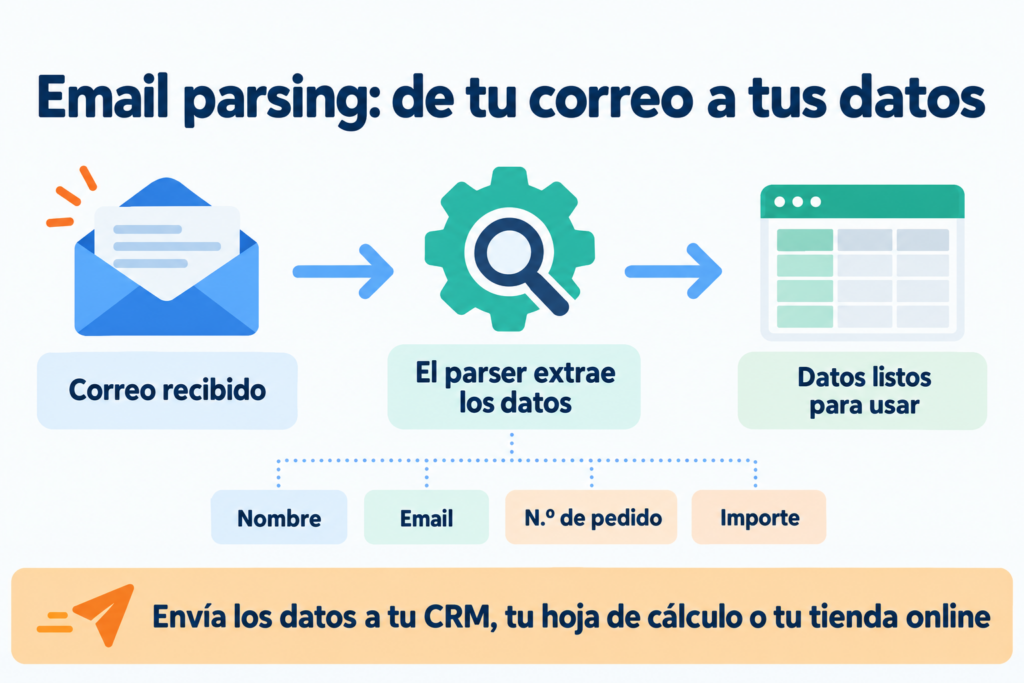
Put simply, we can think of email parsing as the process of extracting specific information from emails.
This technique involves analyzing and converting the content of an email, which may be free-form text, into structured, useful data.
This automated process lets businesses classify and organize the information contained in emails in a more efficient and accessible way.
Relevant historical data
The concept of email parsing is not new.
In fact, its history is tied to the development of email as a means of communication.
Since the early days of email in the 1970s, there has been a constant effort to improve the way we handle and process this information.
With the rise of the internet in the 1990s and the resulting explosion in the use of email for business communications.
The need for email parsing tools became increasingly evident.
The evolution of natural language processing and machine learning technology over the last two decades has taken this capability to a new level, enabling more sophisticated and accurate data extraction and analysis.
Connect your data to your email campaigns
Import your contacts and automate your sends from a free account.
Key considerations
When approaching email parsing, it is essential to consider several aspects.
First, the accuracy of the extraction process is critical.
This means understanding and correctly configuring the tools so that they identify and extract the relevant information without errors.
Second, privacy and data security are of the utmost importance.
Businesses must make sure they comply with data protection regulations such as the GDPR.
Finally, integrating email parsing with other data management and marketing systems is key to maximizing its effectiveness.
Why it matters: benefits
Email parsing is more than a simple data processing tool.
It is a strategic asset in digital marketing.
It lets businesses automate the collection of valuable data from emails, such as customer preferences, purchase history and feedback.
This, in turn, enables more precise audience segmentation and more personalized marketing campaigns.
In addition, in the context of bulk email programs such as those offered by platforms like Mailrelay, email parsing can be a very valuable addition.
It lets you analyze responses to these campaigns at scale, extracting key insights that help improve the effectiveness of future communications and fine-tune marketing strategies.
What features email parsing tools offer
These programs are designed to automate and simplify the process of extracting and analyzing information from emails.
Below, we highlight some key features of this software:
→ Automation of the extraction process:
Email parsing software is designed to automate the identification and extraction of relevant data from emails.
This includes information such as names, email addresses, dates, phone numbers and other specific data.
→ Integration with other systems:
These programs usually offer integration options with other customer relationship management (CRM) tools, content management systems (CMS) and email marketing platforms.
This integration enables a smooth transfer of data and makes processes such as customer follow-up and marketing campaign personalization easier.
→ Natural Language Processing (NLP):
Many email parsing tools use advanced NLP technologies to interpret and understand the text of emails.
This allows them to extract not only structured data, but also understand the context and tone of messages.
→ Analysis and reporting:
In addition to extracting data, many programs offer analysis and reporting capabilities, allowing businesses to obtain valuable information.
And make informed decisions based on the data collected.
→ Ease of use and customization:
Although these tools are technically advanced, they are designed to be accessible to users with different levels of technical skill.
In addition, they offer customization options to adapt to each business’s specific needs.
Examples of email parsing software
There are several examples of popular email parsing software.
Below, we will share some of them with you:
→ Parseur:
This is a powerful and easy-to-use email parsing software.
Ideal for small and medium-sized businesses.
Parseur is known for its ability to extract text from emails and attachments, converting it into structured data.
It also offers integrations with a variety of third-party apps.
Below, we will share some of them with you:
→ Mailparser:
Mailparser lets users extract data from incoming emails and automate workflows.
It is a popular tool for automating business processes such as order entry and lead management.
→ Zapier Email Parser:
Zapier offers a free email parsing service that integrates with its automation platform.
This lets users create automated workflows that connect their email to other apps and services.
→ Extract Email Data (EED):
This program focuses on extracting specific data from emails, such as contacts and events, and can be particularly useful for sales and marketing teams.
→ G-Lock Email Processor:
This software is designed to handle large volumes of email and is particularly useful for email marketing and transaction management.
Conclusion
In conclusion, email parsing is not just a tool for handling large volumes of email.
It is an essential component in the digital marketing strategy of any company looking to remain competitive in an increasingly data-driven market.
By automating the extraction of valuable information from emails, businesses can significantly improve the efficiency of their marketing operations.
And offer more personalized and effective experiences to their customers.
In a world where data is the new gold, email parsing is the tool that helps businesses mine it.
Automate your emails too
Create welcome, follow-up or re-engagement automations without coding.