Communication media: what they are, types and examples
What the main media are, how they are classified, what functions they serve and how brands use them to reach their audience.
Communication media are the channels used to convey information, ideas and messages to other people, from a single recipient to millions at once. The press, radio, television, the internet and social media are some of the best known.
When a medium reaches a very large audience at the same time, we talk about mass communication media, or mass media. When it connects just a few people, like a phone call or a letter, it is an interpersonal medium.
What are the main communication media?
| Medium | Format | How it reaches the audience |
|---|---|---|
| Press: newspapers and magazines | Print and digital | Text and images people read whenever they want |
| Radio | Audio | Live or recorded shows, also as podcasts |
| Television | Audiovisual | Live or on-demand programming |
| Cinema | Audiovisual | Films and documentaries in theaters or on streaming platforms |
| Outdoor advertising | Print and screens | Billboards, posters, bus shelters and street screens |
| Internet and digital media | Digital | Websites, search engines, video platforms and podcasts |
| Social media | Digital | Content posted by people and brands, with interaction |
| Email and messaging | Digital | Direct messages to each person or to a list |
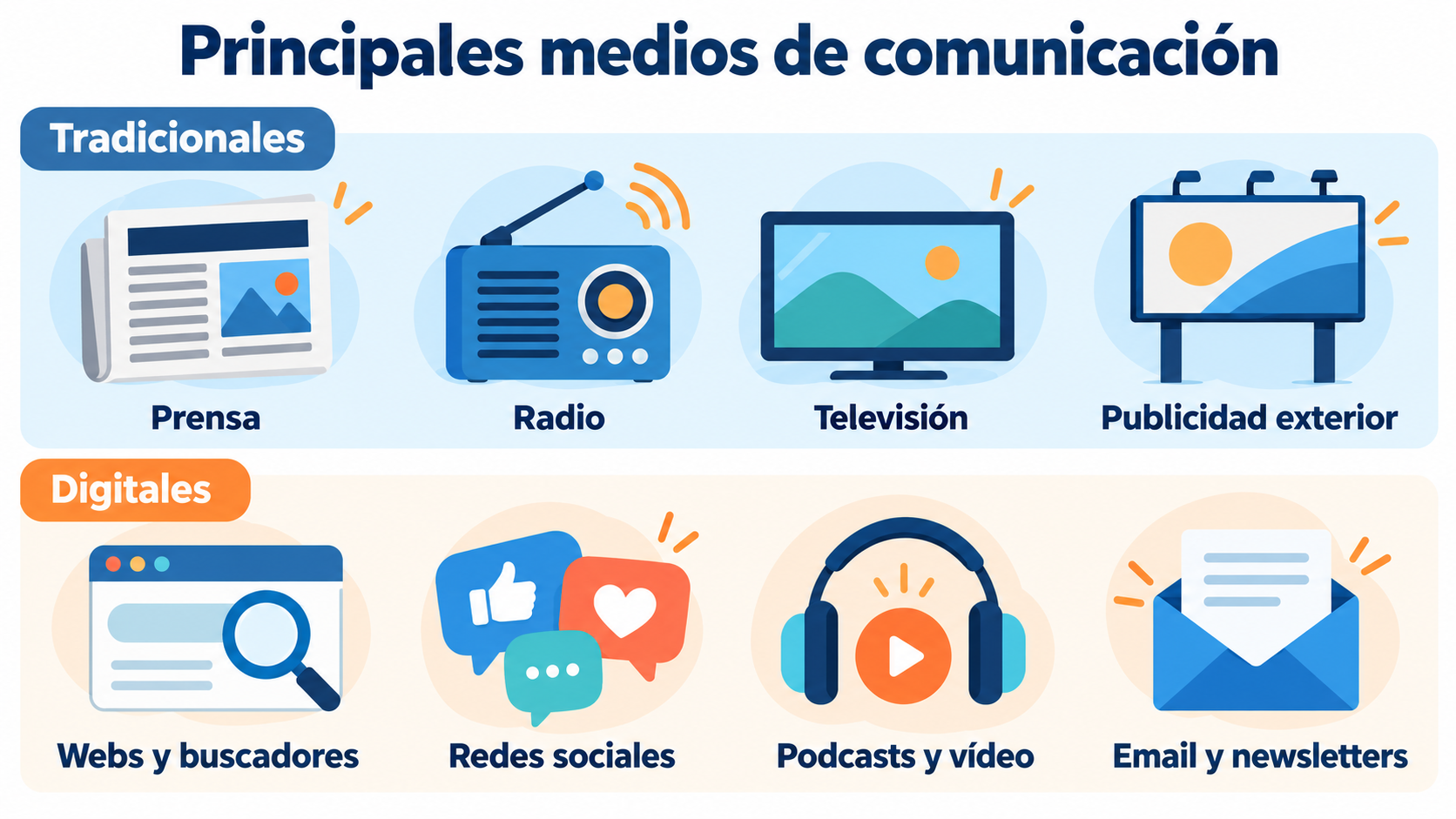
Types of communication media
They can be classified in several ways. These are the three most common.
By reach
Mass. They reach a large audience at once with the same message: television, radio, the press or major websites.
Interpersonal. They connect one person with another or with a small group: phone, postal mail, email or instant messaging.
By format
Print. Newspapers, magazines, books, brochures or posters.
Audio. Radio and podcasts.
Audiovisual. Television, cinema and video platforms.
Digital. Everything consumed over the internet: websites, social media, newsletters or apps.
Traditional and digital
| Traditional media | Digital media | |
|---|---|---|
| Examples | Press, radio, television, cinema, outdoor advertising | Websites, search engines, social media, email, podcasts |
| Direction of communication | One-way: from the medium to the audience | Two-way: the audience replies, comments and shares |
| Segmentation | By area, network, program or publication | By interests, behavior, location or list |
| Measurement | Audience estimates | Accurate data on visits, clicks and conversions |
| Cost of advertising | High on television and in the national press | Starting from small budgets |
Today the line is blurred: almost every newspaper, radio station and TV network also has a digital version.
Functions of communication media
Inform. Report what is happening in the world, the country or the city.
Educate. Share knowledge about science, culture, health or the economy.
Entertain. TV series, music, sports, comedy or game shows.
Shape opinion. Analyze current events and give a voice to different points of view.
Persuade. Advertising uses the media to make products known and convince people to buy them.
A brief history of the media
The first printed newspapers appeared in Europe in the 17th century. Radio became popular in the 1920s, and television from the 1950s onward.
With the internet, from the 1990s, came digital media: websites, search engines and email. The 2000s saw the rise of social media and, later, mobile consumption, video platforms and podcasts.
The big difference is that now anyone can publish. Brands, companies and individuals no longer depend only on the major media to reach their audience.
Communication media in marketing
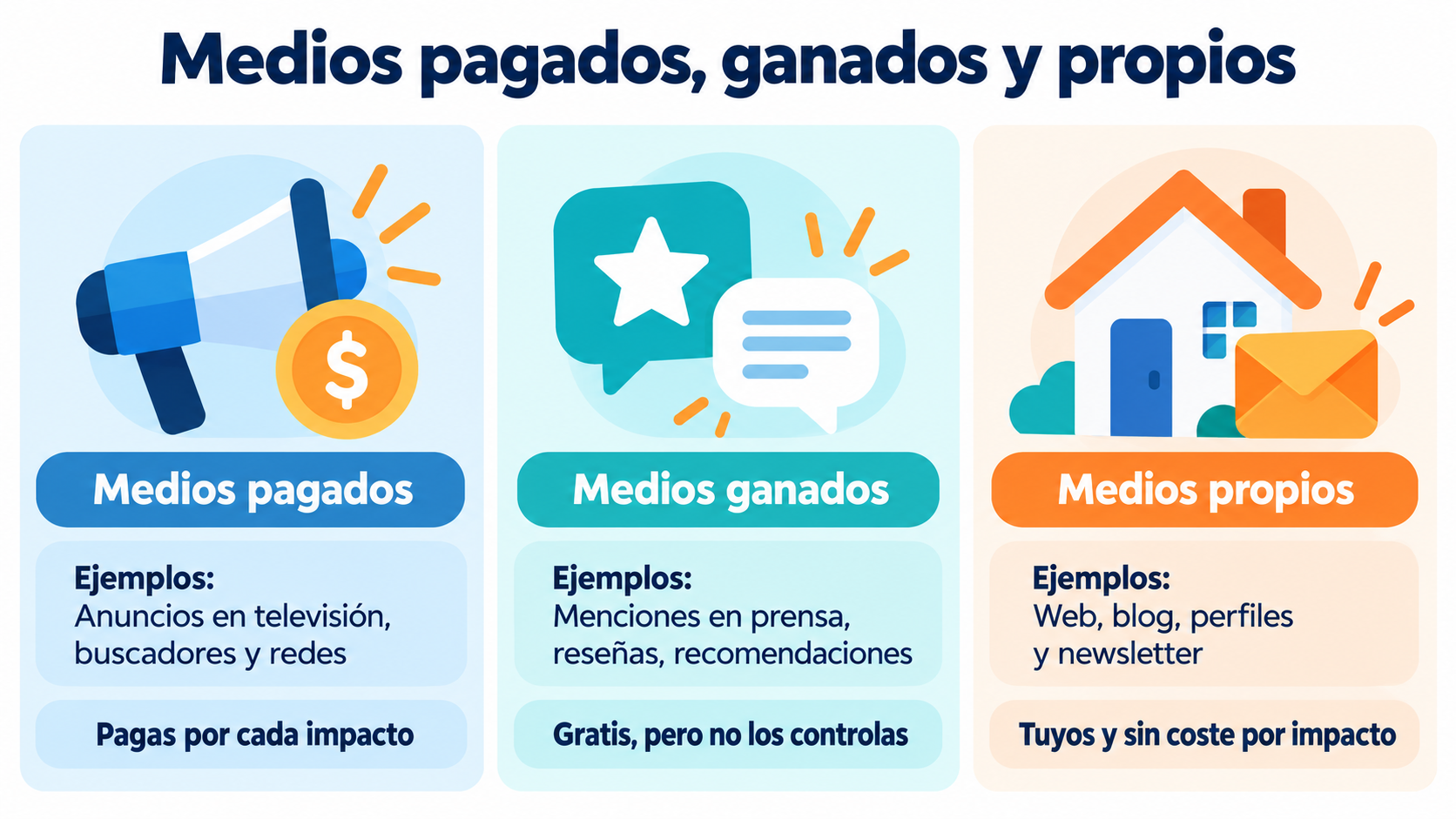
In marketing, media are usually divided into three groups:
Paid media. Ads on television, radio, in the press, on search engines or on social media. You reach a lot of people quickly, but you pay for every impression.
Earned media. Press mentions, often from a press release, reviews, shared content or recommendations. They are free, but you don’t control them.
Owned media. Your website, your blog, your social media profiles and your newsletter. You control them and don’t pay for every impression.
Most campaigns combine all three. For example, a social media ad promotes an offer, the interested person subscribes to the newsletter and email marketing turns them into a customer. To decide which media to use, when and with what budget, you put together a media plan.
Email, your own communication medium
Social networks change their algorithms and decide how many of your followers see each post. That doesn’t happen with email: the message lands in each subscriber’s inbox.
Plus, the list is yours. You can create a newsletter, send news and offers, and measure the opens and clicks of every campaign.
Email, your own communication medium
With a newsletter you talk directly to your audience, without depending on algorithms. Get started for free with Mailrelay.
With Mailrelay you can start for free, with up to 80,000 emails a month and 20,000 contacts, plus human support via chat, ticket and phone.
Send your newsletters with Mailrelay
Up to 80,000 emails a month and 20,000 contacts for free, with human support on every plan.
Frequently Asked Questions
These are the most common questions about this topic.
What are communication media?
The channels used to convey information and messages to other people, such as the press, radio, television, the internet or social media.
What are the most important communication media?
Television, radio, the press and the internet, which includes websites, search engines, social media and email.
What is the difference between traditional and digital media?
Traditional media, such as the press, radio or television, communicate in one direction only. Digital media let the audience reply, share and choose what they consume, and their results can be measured more accurately.
What are mass media?
Media that reach a very large audience with the same message at the same time, such as television, radio or the press.
What are the functions of communication media?
To inform, educate, entertain, shape opinion and persuade, for example through advertising.