Social norms: what they are, types and everyday examples
Why we stand in line, say hello when we walk in or say thank you, and how brands take advantage of it
Social norms are the rules, written or unwritten, that tell us how we’re expected to behave in a group or in society. For example, saying hello when you walk into a place, waiting your turn in line or not talking loudly in a library.
No law forces us to follow them. But those who don’t usually get a reaction from others, such as a look, a comment or rejection by the group.
They are patterns of behavior that a group shares and considers correct. We learn them from childhood, in our family, at school and from the people around us, and we almost always follow them without thinking.
Their purpose is to make living together easier: they make other people’s behavior predictable and reduce conflict.
A social norm is also known as a social rule or a norm of social conduct. They change from one culture to another and from one era to another. What is polite in one country may seem strange in another.
| Feature | What it means |
|---|---|
| They are shared | Most of the group accepts them, not just one person |
| They are learned | They are passed on through upbringing and example; nobody is born with them |
| They are usually unwritten | People know them through custom, without needing a rulebook |
| They carry a social sanction | If they’re broken, the response is criticism or rejection, not a fine |
| They depend on context | They change depending on the country, the era, age or group |
| They are voluntary | Nobody can force you to follow them |
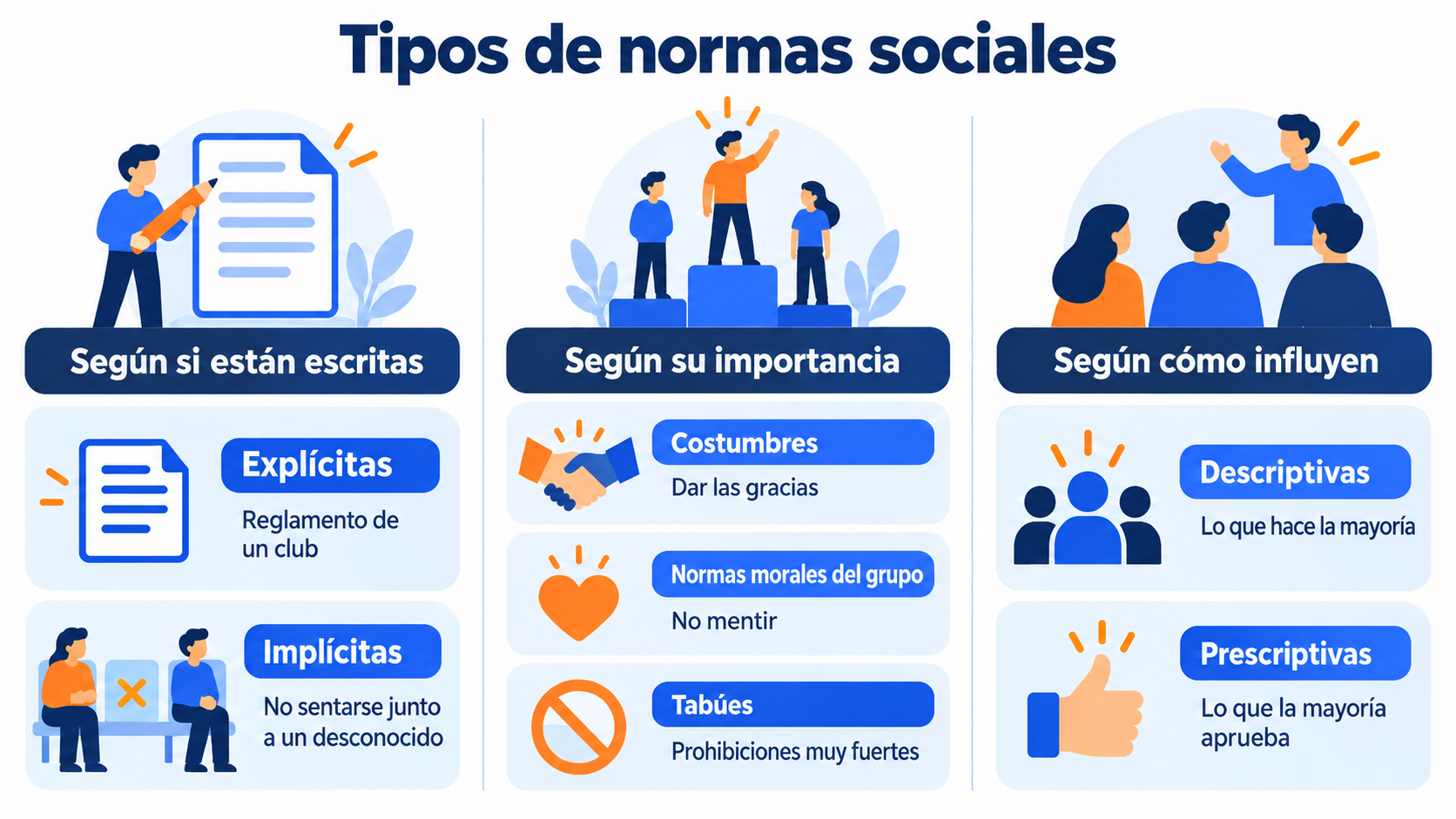
Social norms can be classified in several ways. These are the most common ones.
Explicit and implicit
- Explicit: they are written down or stated out loud, such as a company’s dress code or a club’s rules.
- Implicit: nobody states them, but everyone knows them, such as not sitting next to a stranger on an almost empty bus.
Folkways, mores and taboos
This classification comes from sociologist William G. Sumner and ranks norms by how important they are to the group.
- Folkways or social customs: everyday habits that are considered rude to break, such as not saying thank you.
- **Group moral norms (mores):** they are considered important for the common good, such as not lying or helping those in need.
- Taboos: prohibitions so strong that the group harshly rejects anyone who breaks them.
Descriptive and prescriptive
This distinction comes from psychologist Robert Cialdini and explains how norms influence behavior.
- Descriptive norms: what most people do. “Almost everyone in this neighborhood recycles.”
- Prescriptive or injunctive norms: what most people approve or disapprove of. “Littering is wrong.”
Social, moral, legal and religious norms
Social norms are one of the four types of rules of conduct that are usually distinguished:
| Type of norm | Who sets it | What happens if it’s broken | Example |
|---|---|---|---|
| Social or of social conduct | The group, through custom | Social criticism or rejection | Saying hello when you arrive |
| Moral | Each person’s own conscience | Guilt or remorse | Not lying to a friend |
| Legal | The State, written into law | Fine, penalty or sentence | Paying taxes |
| Religious | A religion or faith community | Spiritual or community sanction | Fasting on certain dates |
Sometimes they overlap.
Stealing is frowned upon by the group, goes against almost everyone’s morals and is also a crime.
These are examples of social norms in different areas of everyday life:
| Area | Examples |
|---|---|
| On the street and on public transport | Waiting your turn in line, giving up your seat to older people, letting people off before getting on |
| At the table | Not talking with your mouth full, waiting until everyone is served, not using your phone |
| At school | Raising your hand to speak, being on time, waiting your turn to speak |
| At work | Greeting your colleagues, dressing appropriately, replying to emails |
| On the internet | Not writing in capital letters (it’s like shouting), not sharing other people’s data, citing sources |
| In communication | Saying thank you, saying please, apologizing when you make a mistake |
Some norms vary a lot from country to country. In Spain, people usually greet each other with two kisses in informal settings. In Japan, the norm is a bow of the head, with no physical contact.
Social norms in marketing
We tend to do what others do, especially when we’re not sure. That’s why social norms influence what we buy and the brands we choose.
The most cited example is a 2008 experiment by Noah Goldstein, Robert Cialdini and Vladas Griskevicius in a hotel.
A sign saying that most guests reused their towels got more guests to do so than the usual message about protecting the environment.
This is how social norms are applied in marketing:
- Social proof. Showing how many people use your product, their reviews or their ratings. We explain it in our post on psychological triggers.
- Recommendations. What friends and acquaintances say carries more weight than an ad. It’s the foundation of word-of-mouth marketing.
- Role models. Content creators set what’s trendy in their community, as you’ll see in influencer marketing.
- Shared values. Many consumers expect brands to act responsibly, toward the environment or toward their employees. You can see this in corporate social responsibility.
There’s a limit: a message that exaggerates or makes up what others do loses the audience’s trust.
If you want to dig deeper, read our article on Robert Cialdini’s principles of persuasion.
Want your customers to speak for you?
Add real reviews and your best-selling products to your newsletters with the Mailrelay editor.
Social norms in email marketing
Email has its own social norms too. These are the guidelines your subscribers expect you to respect.
- Only email people who have given you permission and let them unsubscribe with one click.
- Identify yourself clearly in the sender name and subject line.
- Don’t send more than you promised. If you announced one newsletter a month, don’t send one every day.
- Use a tone that suits your audience, without overusing capital letters or exclamation marks.
You can also take advantage of descriptive norms in your campaigns. For example:
- Say how many people receive your newsletter: “Join the 5,000 professionals who read it every week.”
- Include real customer reviews alongside your offers.
- Highlight the month’s best-selling products or most-read articles.

How Mailrelay helps you
With Mailrelay you create your subscription forms so that you only get contacts who have given their permission, and every email includes an unsubscribe link.
You design your newsletters with the drag-and-drop editor, add customer reviews or your best-selling products and send yourself a test before each send.
Then you see the opens and clicks for each campaign in the statistics.
The free account lets you send up to 80,000 emails a month to 20,000 contacts, with chat, ticket and phone support.
Send your newsletters with Mailrelay
Up to 80,000 emails a month to 20,000 contacts with the free account, with chat, ticket and phone support.
What are social norms? They are the rules, written or unwritten, that indicate how people are expected to behave in a group or in society, such as saying hello or waiting your turn in line.
What is a social norm? Give an example. It is a pattern of behavior that the group considers correct. For example, giving up your seat to an older person on the bus.
What are the types of social norms? They are divided into explicit and implicit; folkways, mores and taboos; and descriptive and prescriptive.
What is the difference between a social norm and a legal norm? A legal norm is set by the State, and breaking it carries a legal penalty. A social norm arises from custom, and breaking it only leads to rejection or criticism from the group.
Why are social norms important? Because they make living together easier, make other people’s behavior predictable and prevent many conflicts.