Cold email: how to write one, templates and examples that sell
A first email to someone who doesn’t know you gets read in seconds. Here’s how to write it so they open it, understand it and reply

A first email to someone who doesn’t know you gets read in seconds. Here’s how to write it so they open it, understand it and reply
A cold email is the first sales message you send to someone who doesn’t know you yet, to introduce your product or service.
It works when it’s short, personal and useful to the person who receives it. And when it’s sent to someone who is allowed to receive it.
Here you’ll find when you can send one, its structure, 3 templates, sample subject lines and how to follow up.
It’s a one-to-one email, written for a specific person, that opens a sales conversation.
It’s also called cold outreach email.
It isn’t a bulk send. If you send the same message to hundreds of strangers, it’s no longer a cold email, it’s spam.
You’ll find the full definition in the glossary entry on cold outreach mail. Here we focus on how to write one.
In Spain, article 21 of the LSSI prohibits sending commercial emails that haven’t been requested or authorized beforehand.
It applies to individuals and businesses alike.
The exception is when there’s already a contractual relationship and the email is about products or services similar to the ones that person bought.
That’s why these are the most common cases where it does make sense:
Other countries have different rules. Check the law in the recipient’s country and, if in doubt, ask a lawyer.
Turn interest into subscribers
When someone shows interest, invite them to your list with a Mailrelay form and double opt-in.
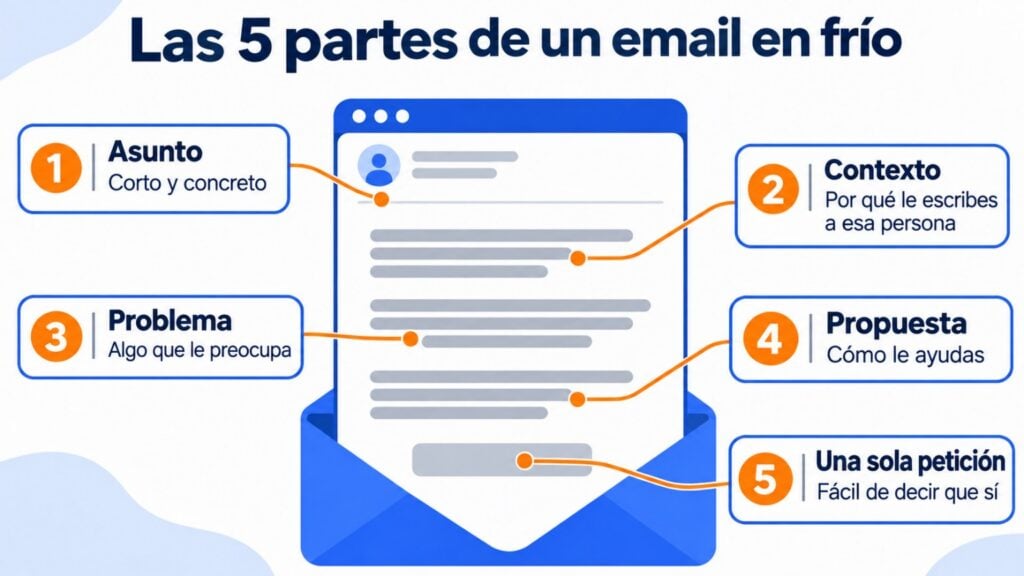
Close with a full signature: name, job title, company and phone number. An anonymous cold email breeds distrust.
If you want to strengthen your writing, here are 5 copywriting formulas that work well in a short email.

Subject: An idea for [company]’s monthly report
Hi [name],
Since you started using [service], we’ve noticed your team spends a lot of time putting together the monthly report. We’ve launched [new service], which generates it in a few minutes.
Would a 15-minute call on Thursday work for you so I can show it to you?
[Firma]
Subject: What we discussed at [trade show] about [topic]
Hi [name],
Thanks for stopping by our booth at [trade show]. You mentioned your team was looking for [need] to [goal].
Here’s a one-page summary of how we do it: [link]. If it’s a good fit, shall we go over it on a call next week?
[Firma]
Subject: Your inquiry about [product]
Hi [name],
Thank you for writing to us. From what you’ve told us, what would help you most is [solution], because [specific benefit].
Would you rather I send you a quote, or shall we go over it on a short call?
[Firma]
You’ll find more first-contact examples in how to introduce yourself to a client by email.
From first contact to your newsletter
Anyone who agrees to receive your emails joins your list and gets your automated welcome email.
| Type | Example |
|---|---|
| Specific reference | “What we discussed at [trade show] about [topic]” |
| Idea for their company | “An idea for [company]’s monthly report” |
| Direct question | “Still looking for [need]?” |
| Recommendation | “[Name] suggested I get in touch” |
| Follow-up | “About my email on Tuesday” |
Avoid capital letters, exclamation marks and words like “free” or “urgent”. They make the email look like mass advertising.
Many replies arrive after the first reminder. A good pace is this:
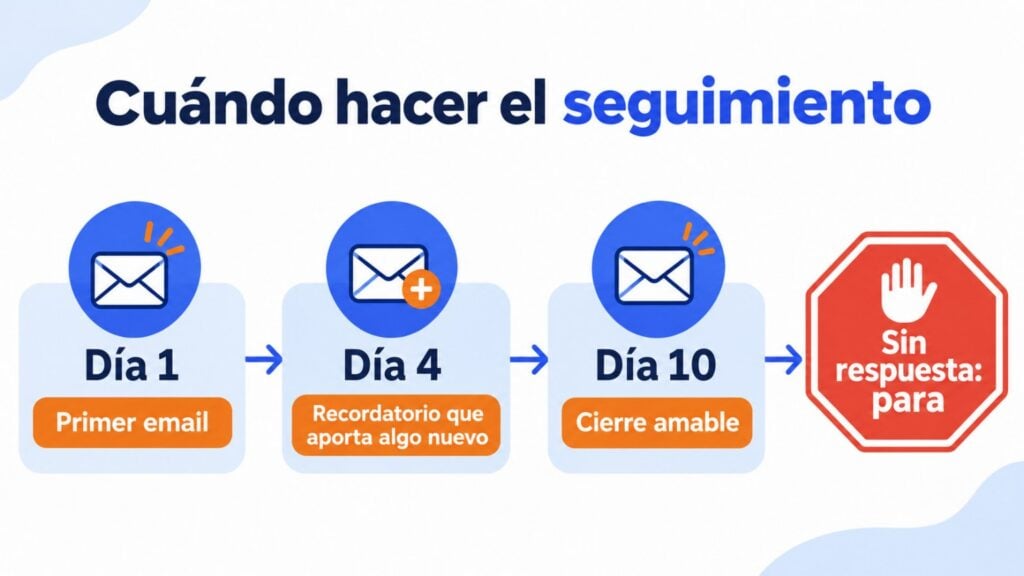
If there’s no reply after the third one, stop. Pushing further damages your image. You’ll find more ideas in the glossary entry on the follow-up email.
Mailrelay isn’t designed for sending cold emails. It works with double opt-in and its anti-spam policy doesn’t allow sending to contacts without permission.
Where it does help is the next step, when the contact shows interest:
The free account lets you send up to 80,000 emails a month to 20,000 contacts.
If what you want is to sell by email to people already on your list, here’s the guide to writing a sales email.
Start sending today
Free account: up to 80,000 emails a month to 20,000 contacts, with human support.
A first one-to-one sales email to someone who doesn’t know you yet, to introduce your product or service.
Only with restrictions. The LSSI prohibits unsolicited commercial emails, unless there’s a prior contractual relationship or the recipient has authorized them.
Between 80 and 150 words. It should be readable on a phone without scrolling.
Two at most, for example after 4 and 10 days. If there’s no reply, stop.
Not with Mailrelay: it only lets you send to contacts who have given their permission. A cold email is sent one to one, from your own inbox.
Cold outreach mail
What it is, how it differs from email marketing and what the law says.
How to introduce yourself to a client by email
9 tips and 10 examples to copy.
Sales prospecting
How to find and reach your potential customers.
Follow-up email
When to send it and what to write to get a reply.

Jose Argudo
CMO at Mailrelay. Writes about email marketing, copywriting and conversion for small businesses and entrepreneurs.