Sales prospecting: what it is, stages and techniques for finding customers
How to find the people who could buy from you and start talking to them
Sales prospecting consists of searching for and contacting people or companies that could become customers. It is also called business prospecting.
This process focuses on identifying prospects, qualifying their interest in the product or service and guiding them through the sales funnel.
Prospecting helps you build a contact list that your sales team can work with, helping to generate revenue and grow the business.
Stages of sales prospecting
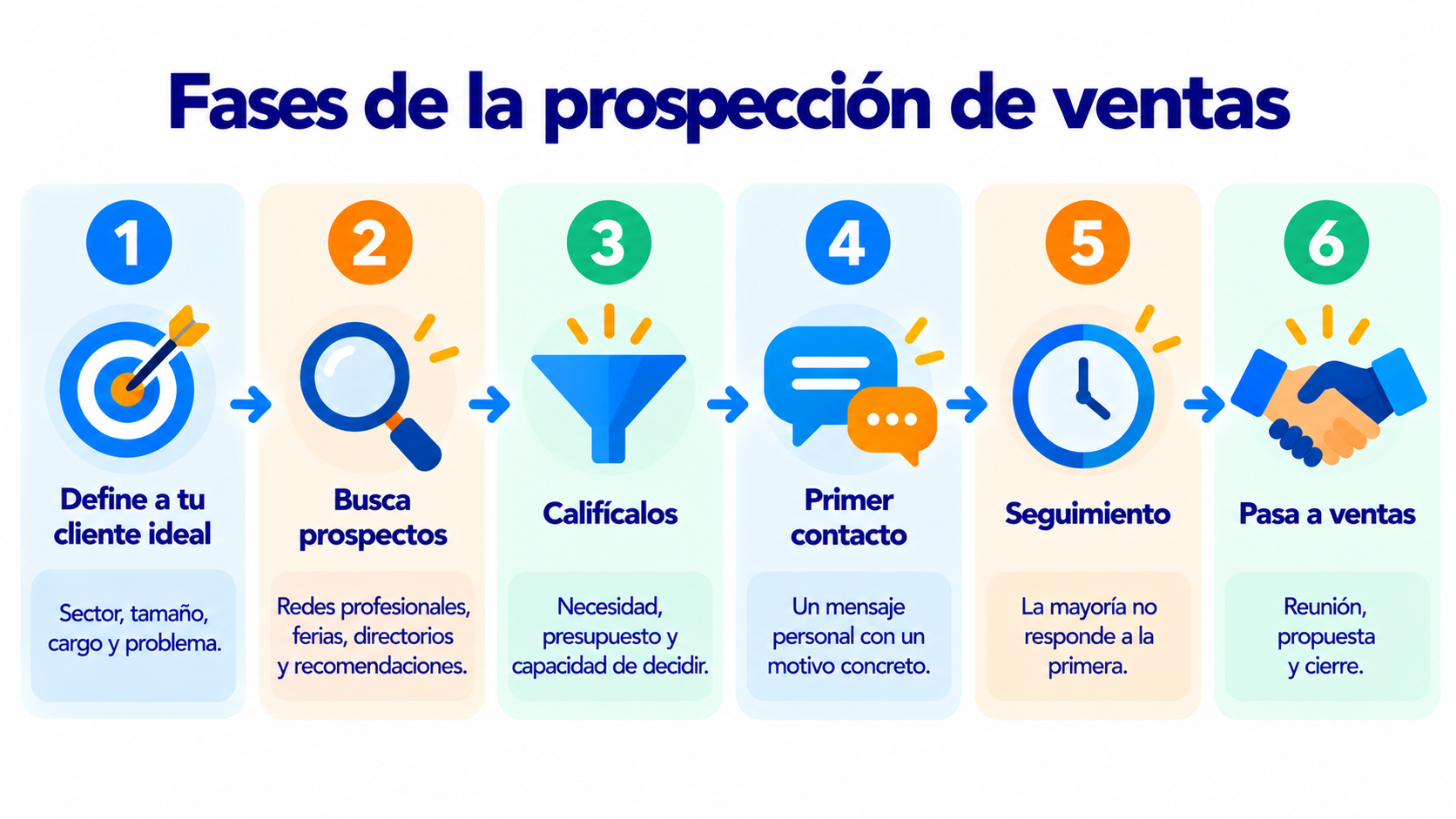
Prospecting almost always follows the same steps, whether you sell to businesses or to consumers:
- Define your ideal customer. Industry, company size, job title and the problem you solve. Your buyer persona helps here.
- Find prospects. On LinkedIn, at trade shows, in industry directories, among the people who download your content or through referrals from your customers.
- Qualify them. Check whether they have the need, the budget and the authority to decide.
- Make the first contact. With a personal message and a specific reason for writing or calling.
- Follow up. Most people don’t reply to the first contact.
- Hand interested prospects over to sales. When the prospect asks for a meeting or a proposal, the work of closing the sale begins.
Turn your prospects into subscribers
Capture interested contacts with double opt-in subscription forms and send them your emails automatically. Get started for free with Mailrelay.
Importance of sales prospecting in the sales process
Why is prospecting so important?
No prospects, no sales.
Here are the main benefits of proper sales prospecting:
- Increased flow of potential customers: effective prospecting generates quality leads that are more likely to become real customers.
- Better use of the sales team’s time: with qualified prospects, the sales team can focus on people with real interest and avoid wasting time on unpromising contacts.
- Higher conversion rate: a well-executed prospecting process filters and targets the most interested customers, increasing the likelihood of closing sales.
How do you identify the best prospects?
Sales prospecting is not just about contacting anyone.
It’s about finding people who need what you offer.
This is where the concept of “lead qualification” comes in.
This process helps determine which prospects have the potential to become high-quality customers.
Some criteria for qualifying leads can be:
- Demonstrated interest: has the person or company shown interest in your product or industry?
- Need: do they need what you offer?
- Budget: can the person or company afford your product or service?
- Decision-making power: is the person the one who makes decisions, or influences them, within the company?
- Timeline: when do they plan to buy?
These four criteria make up the BANT method (Budget, Authority, Need and Timeline), which is attributed to IBM.
Sales prospecting techniques and strategies
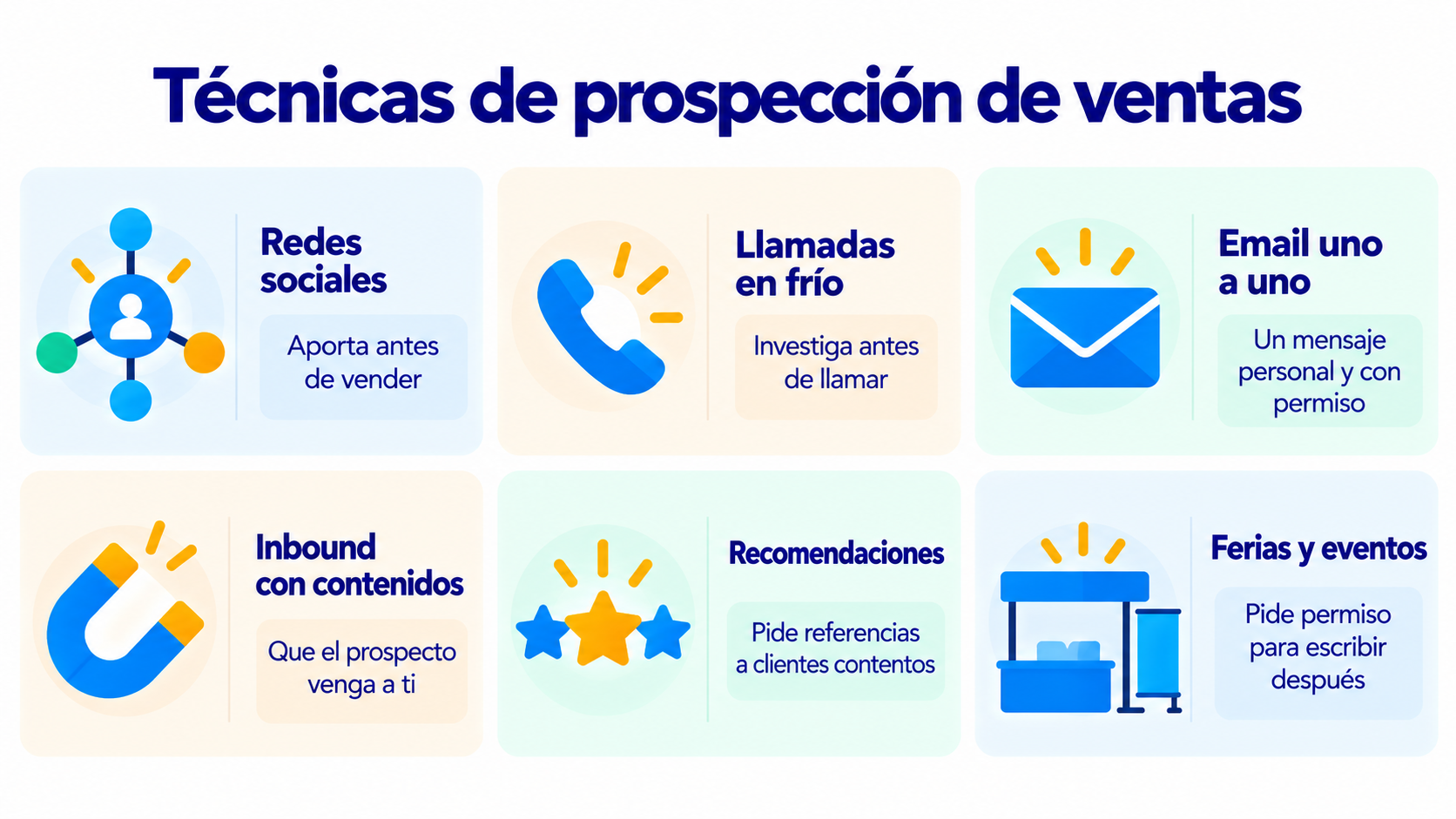
Now that we understand the importance of prospecting and how to qualify leads, let’s look at some of the most effective techniques and strategies for carrying it out.
| Technique | When to use it | What to keep in mind |
|---|---|---|
| Social media (social selling) | B2B sales, when the decision-maker is on LinkedIn | Give before you sell: comment, share and then write |
| Cold calling | High-value sales and short lists | Do your research before calling and respect the Robinson List |
| One-to-one email | To open a conversation with a specific company | You need permission to send advertising (LSSI) |
| Inbound with content | When you want the prospect to come to you | A lead magnet and a double opt-in form |
| Referrals | If you already have happy customers | Ask for the referral right after a good result |
| Trade shows and events | Industries with their own events | Get permission to write to them after the event |
Before calling, check that the number isn’t on the Robinson List. And for inbound prospecting you need a lead magnet and a subscription form.
Social media is an excellent place to identify and connect with potential customers.
Here, you can get to know your audience informally and start a genuine conversation.
Platforms like LinkedIn are especially useful for connecting with businesses and professionals. This is what’s known as social selling.
Cold calling and phone prospecting
Although not everyone’s favorite technique, cold calling is still effective if done correctly.
To succeed at phone prospecting, it’s important to do some quick research on the person or company before calling and to personalize the message as much as possible.
Prospecting through email marketing
Email marketing helps you throughout the prospecting process.
Through personalized emails, you can present your products or services, show the value of your proposal and guide the prospect in their buying decision.
The advantage of email marketing in prospecting is that you can segment your contacts, sending specific messages to each segment to maximize their effectiveness.
Be careful with permission. In Spain, article 21 of the LSSI prohibits sending advertising by email to anyone who hasn’t asked for it, businesses included. A personal email to a specific company to open a conversation is a different matter: we explain it in cold outreach mail. Email marketing campaigns, on the other hand, are only sent to people who have subscribed.
Some tips for integrating email marketing into your sales prospecting strategy are:
- Personalize your emails: use the prospect’s name and refer to their company or specific interests. Generic messages are unlikely to be successful.
- Offer value from the start: share relevant information, offer free guides or invite the prospect to webinars or events they’ll find useful.
- Use clear calls to action: help your prospects understand the next step. Whether it’s scheduling a meeting or downloading a free resource, make sure they know how to move forward.
Inbound prospecting with content
In inbound prospecting, the prospect comes to you. You publish a guide, a template or a webinar, and whoever wants it leaves their email address in a subscription form.
From then on you have permission to write to them, and you can do lead nurturing until they’re ready to talk to sales. You’ll find ideas in lead magnet ideas.
How do you integrate sales prospecting with your email marketing strategy?
By combining prospecting with email marketing, you not only build relationships, but also improve the efficiency of the sales process.
Here’s how you can effectively integrate both processes:
Build a segmented contact list
Use prospecting techniques to identify contacts and group them into segments based on their interest, industry and stage in the sales funnel.
Design email marketing campaigns for each stage
Customize messages for each stage of the sales funnel.
At the beginning, you could send educational content, while at advanced stages you can offer discounts or specific promotions.
Automate your responses
Use automation tools to respond to specific interactions.
If someone often clicks on your emails, it could be a good sign to take the next step.
Measure and adjust your strategy
Analyze key metrics of your email marketing campaigns, such as open and click-through rates.
This will help you understand which messages work best and which prospects are most interested.
Example of permission-based email prospecting
Let’s say you run an accounting firm and offer a free tax guide for freelancers. The figures are made up. Everyone who downloads the guide receives this sequence:
| Day | Goal | |
|---|---|---|
| 0 | The guide, with a welcome line | Deliver what was promised |
| 3 | The 3 most common mistakes in the quarterly tax return | Provide value |
| 7 | A case study: how a freelancer avoided a fine | Build trust |
| 12 | Invitation to a no-obligation 15-minute call | Hand over to sales |
Whoever clicks on the invitation is passed on to the sales team. Everyone else keeps receiving your newsletter. You’ll find more ideas in from first contact to closing.
Tips for effective sales prospecting
Successful sales prospecting requires strategy, focus and patience:
Listen to your prospects
Instead of selling, listen and understand their needs.
This will help you fine-tune your proposal and build a relationship of trust.
Use a CRM to organize your work
CRM tools such as HubSpot or Salesforce make it easier to manage contacts and follow up on each prospect. In addition, many of these tools offer integration with email marketing, making prospecting even easier. If your sales process is simple, an email marketing tool can act as a basic CRM.
Set goals and track your progress
Set specific goals and regularly review your progress.
This will help you understand which techniques are working and in which areas you need to improve.
Stay up to date
Sales prospecting is dynamic.
Techniques and tools change over time, so stay updated and be willing to adapt your strategies.
Common mistakes in sales prospecting
Despite its advantages, it’s easy to make mistakes in sales prospecting.
For example:
Not qualifying prospects properly
Instead of contacting everyone, make sure each prospect has real potential.
Contacting uninterested people only wastes time and resources.
Lack of follow-up
Most prospects don’t become customers after the first contact.
A good follow-up email is key to keeping their interest and guiding the prospect toward closing the sale.
Being too pushy or impersonal
No one wants to feel pressured.
Show genuine interest in helping, rather than just looking for a sale.
Not measuring results
Without metrics, it’s hard to know whether your prospecting is working.
Analyze the results and adjust your approach as needed.
How Mailrelay helps you
Sales prospecting is a key part of any marketing and sales strategy.
It allows you to build relationships with potential customers, understand their needs and guide them toward a purchase. Integrating email marketing techniques, such as personalized campaigns, can significantly improve your prospecting results.
Mailrelay isn’t meant for sending cold emails: it always works with double opt-in. Where it helps is in turning people who show interest into customers:
- Subscription forms with double opt-in to capture prospects with a lead magnet.
- Automations that send the email sequence to every new contact.
- Custom fields and segments to store each prospect’s industry, job title or stage.
- Click statistics on the free account and on Enterprise, so you know who’s ready to talk to sales.
The free account includes 80,000 emails a month and up to 20,000 contacts.
Take every prospect all the way to the sale
Automate your follow-up emails and see who clicks on each one. Up to 80,000 emails a month for free with Mailrelay.
Frequently asked questions
What is sales prospecting?
It’s the process of finding and contacting people or companies that could become customers. It is also called business prospecting.
What does prospecting mean in sales?
Prospecting means finding potential customers, checking whether they fit what you sell and making first contact with them.
What’s the difference between a prospect, a lead and a customer?
A prospect fits your ideal customer profile but hasn’t shown any interest yet. A lead has already given you their details or asked for information. A customer has already bought from you.
What’s the difference between inbound and outbound prospecting?
In outbound, you find and contact the prospect (calls, messages, trade shows). In inbound, the prospect finds you through your content and leaves you their details. More in outbound marketing.
Can I do email prospecting in Spain?
You can write to anyone who has given you permission. Sending advertising by email without prior consent is prohibited by the LSSI, businesses included, unless the person is already a customer and you’re telling them about products similar to the ones they bought.