Closing the sale: what it is, types and techniques with examples
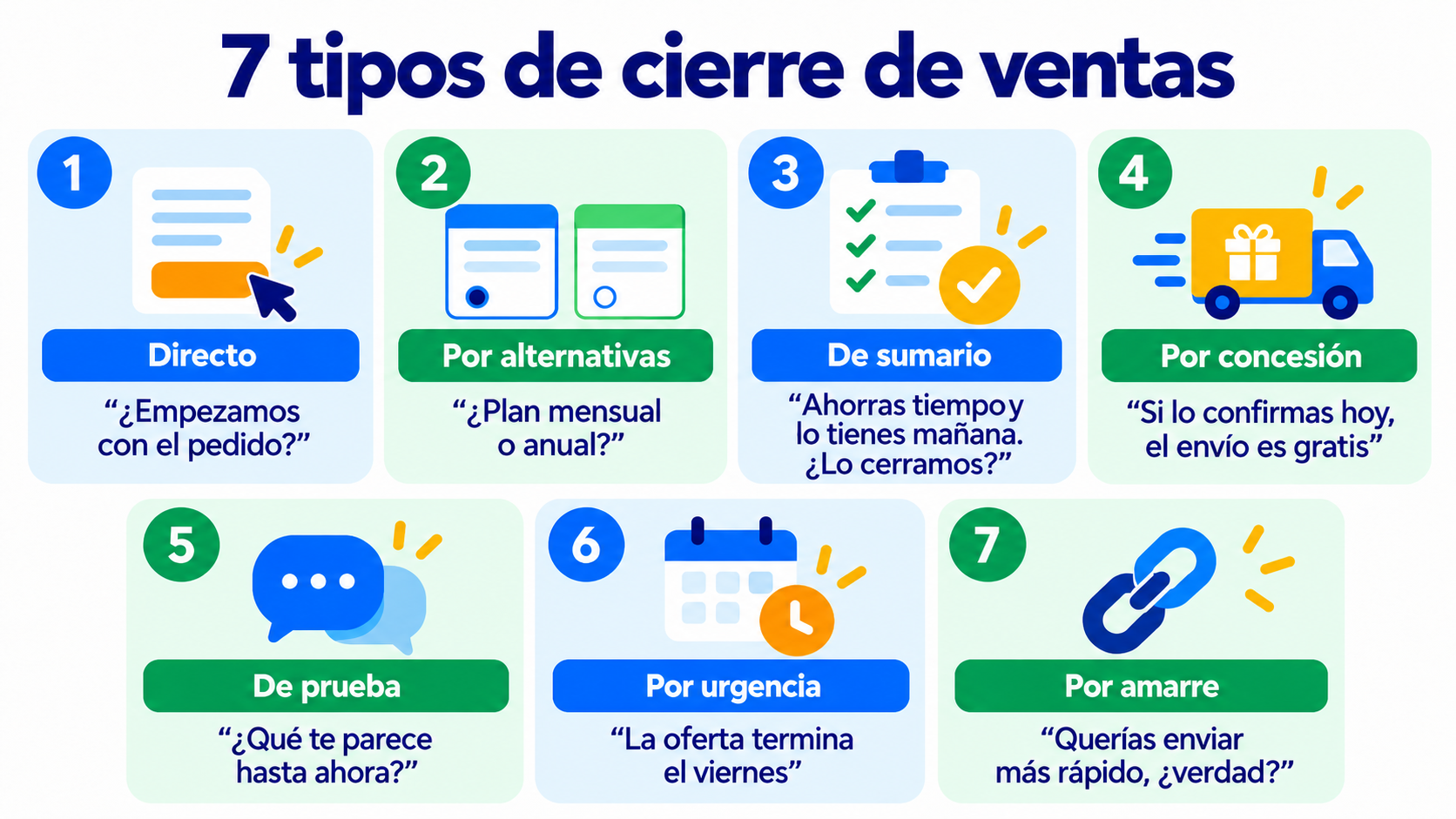
7 closing techniques, with an example phrase for each one
Closing the sale is the culminating point in the sales process, where a potential customer decides and commits to buying a product or service.
It is the transition from having a “prospect“ to having a “customer”.
Why is it so important?
The success of a salesperson, whether a person or a website, is not measured only by how they present a product, but by how they manage to turn those presentations into actual sales.
In practice, an effective close means that all the earlier stages of the sales process (such as prospecting, presenting and negotiating) have been successful.
Types of sales closes and closing techniques
Here are some common sales closing strategies:
| Type of close | What it means | Example phrase |
|---|---|---|
| Direct | Ask plainly whether they want to buy | “Shall we get the order started?” |
| Alternative | Offer a choice between two options, not between yes and no | “Monthly or annual plan?” |
| Summary | Sum up the benefits they care about before asking for the yes | “You save time and you’ll have it tomorrow. Shall we go ahead?” |
| Concession | Offer something extra in exchange for deciding now | “If you confirm today, shipping is free” |
| Trial | Ask for their opinion to find out if they are ready | “What do you think so far?” |
| Urgency | Mention a real deadline that is running out | “The offer ends on Friday” |
| Tie-down | Ask questions that confirm what they have already said | “You wanted to send faster, right?” |
Close more sales with your emails
Follow up with your prospects using automated emails. Get started for free with Mailrelay.
Direct close
In the direct close, after presenting the features and benefits of a product or service, the salesperson asks the customer directly if they wish to proceed with the purchase.
This strategy is particularly effective when the customer shows clear signs of interest or in situations where the purchase is an impulse buy.
However, its application requires tact.
Although it is a technique that aims for clarity and can speed up the process, it should be used carefully so the customer does not feel pressured.
The salesperson’s ability to read the customer’s signals and handle the situation with confidence, but without being aggressive, will largely determine the success of this type of close.
Alternative close
The alternative close focuses on presenting options to the customer instead of a simple decision to buy or not to buy.
In this technique, the customer is presented with a choice, such as “Do you prefer the red model or the blue one?”
This strategy aims to get the customer more involved in the decision-making process by considering the available options.
By offering alternatives, it is implicitly assumed that the customer is ready to make a purchase and just needs to define the details.
This technique can be especially effective in steering the conversation toward a final decision and avoiding objections based on indecision.
However, the options you present must be relevant and beneficial to the customer to ensure a positive experience and an informed decision.
Summary close
In the summary close, the salesperson summarizes and highlights all the important benefits and features for the customer.
It is like a review of the key points that align the product or service with the customer’s needs or interests.
This technique aims to reinforce the value of the product in the customer’s mind, reminding them why they showed interest in the first place.
By summarizing and reaffirming, the goal is to build trust with the customer and motivate a positive purchasing decision, assuring them that their choice is backed by solid and beneficial reasons.
Concession close
The concession close is based on offering something extra or making a concession to stimulate and speed up the customer’s buying decision.
This technique can take forms such as discounts or special conditions.
A classic example would be: “If you decide now, I can offer you a 10% discount.”
This strategy seeks to create a sense of urgency or a unique opportunity for the customer, making them feel they are getting a special or advantageous deal.
This doesn’t just encourage an immediate decision.
It also strengthens the relationship with the customer, showing them that the salesperson is willing to make an extra effort to satisfy their needs or desires.
However, it is important to use this technique sincerely so that it is not seen as a pressure tactic.
Trial close
It does not ask for the sale yet. It is a question to find out whether the customer is ready, such as “What do you think so far?”. If the answer is positive, you can move on to a direct close. If a doubt comes up, it is time to address it.
Urgency close
It reminds the customer of a deadline that is running out: an offer, limited places or a launch price. It only works if the deadline is real. Making up urgency damages trust and, in an online store, can be a misleading practice.
Tie-down close
It consists of asking questions that confirm what the customer has already said, such as “You wanted something easy to use, right?”. Each yes reinforces the decision. Use it naturally so it does not feel like an interrogation.
Overcoming objections
Before the close, customers often raise objections.
These may be concerns about the price or the product’s features, among other things.
A skilled salesperson knows how to address these objections effectively, offering solutions or clarifying misunderstandings.
If you want to prepare, take a look at the types of objections with example answers and the techniques for overcoming sales objections.
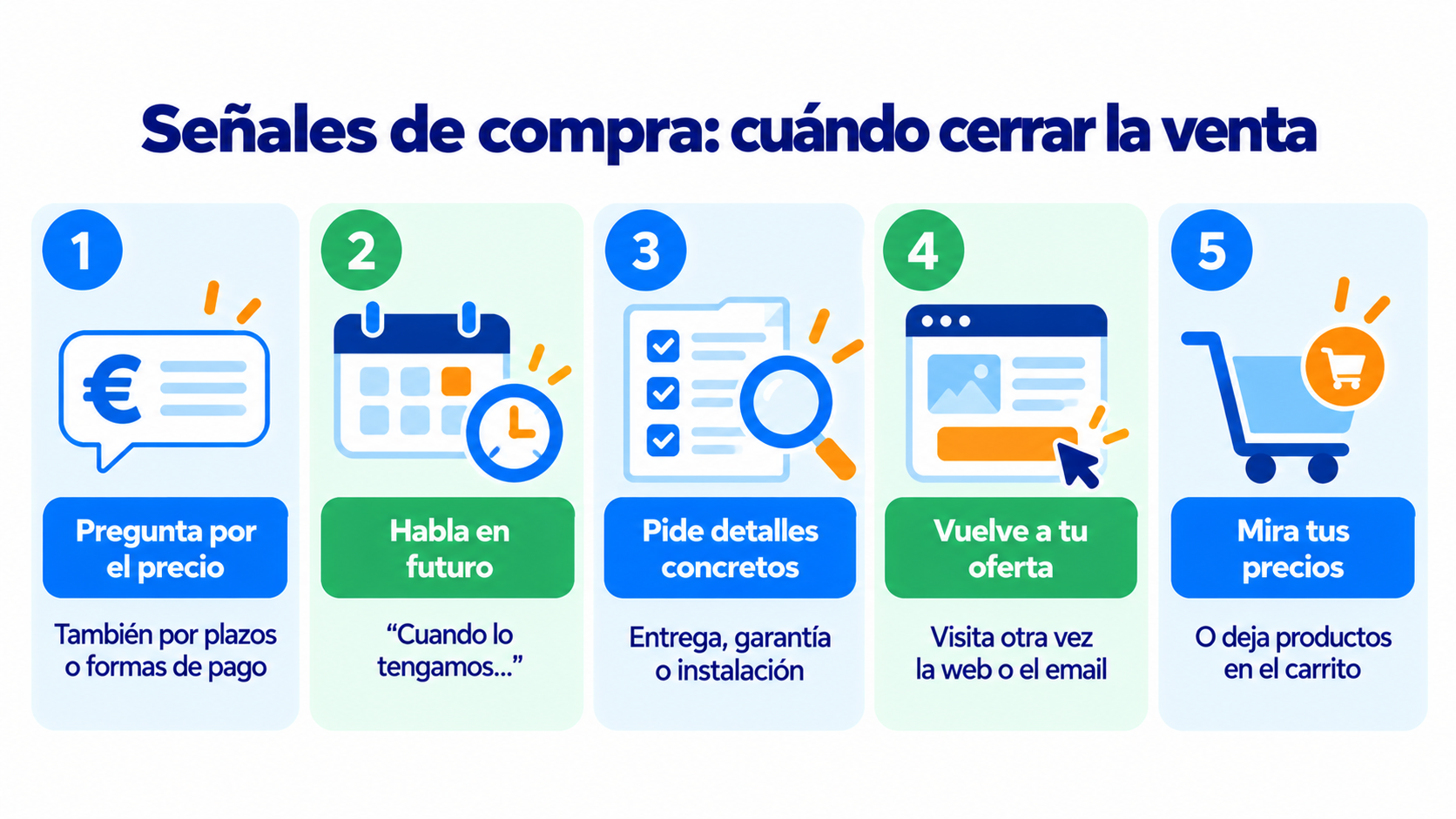
Buying signals
These are clues that the customer is ready to close:
- They ask about the price, timelines or payment methods.
- They talk in the future tense: “when we have it…”.
- They ask for specific details, such as delivery, warranty or installation.
- They come back to the website or open your email with the offer several times.
- They visit the pricing page or leave products in the cart.
Common mistakes when closing a sale
- Pushing too hard. The customer feels cornered and puts off the decision.
- Talking too much. Once the customer has said yes, there is no need to keep arguing your case.
- Not asking for the sale. Many salespeople present the product well, but never ask whether the customer wants to buy it.
- Making up urgency or discounts. They work once and then cost you credibility.
- Not following up. An “I’ll think about it” without a second contact is usually a lost sale.
Closing sales by email and online
With the rise of online sales, the closing process has evolved.
Now, there may not be a “salesperson” in the traditional sense, but the closing techniques remain the same.
For example, thanks to email marketing, you can send a reminder email about an abandoned shopping cart or a special limited-time discount.
In online sales, much of the closing is done by email:
| When to send it | Closing technique it uses | |
|---|---|---|
| Follow-up email | 2-3 days after sending a quote | Trial or direct |
| Abandoned cart | A few hours after they leave the cart | Summary |
| Offer with a deadline | The last days of a real promotion | Urgency |
| Customer testimonials | When they are torn between several options | Alternative or summary |
To see how to go from first contact to the sale, read from first contact to closing: how to turn cold leads into warm leads.
Closing a sale is more than “sealing the deal”.
It is the art of understanding the customer’s needs, presenting a solution that aligns with those needs and overcoming any barrier that prevents the purchase.
Mastering the art of closing makes the difference for anyone who wants to succeed in sales.
How Mailrelay helps you
With Mailrelay you can guide your customers all the way to the close without missing a single follow-up:
- Automations that send the follow-up email or the reminder at the right time.
- Abandoned cart emails with WooCommerce, also by SMS.
- Segments to send the right offer to those who have already shown interest.
- A/B tests to find out which subject line or offer is most convincing.
- Click statistics (opens and clicks on the free account and on Enterprise) to know who has visited your pricing page from an email.
The free account includes 80,000 emails a month and up to 20,000 contacts.
Recover the sales that stall halfway
Automate follow-ups, reminders and abandoned cart emails. Up to 80,000 emails a month for free with Mailrelay.
Frequently asked questions
What is closing a sale?
It is the moment when a potential customer decides to buy and commits to doing so. It is the last stage of the sales process, after prospecting, presenting and negotiating.
What are the types of sales closes?
The most widely used are the direct, alternative, summary, concession, trial, urgency and tie-down closes.
What is the alternative close?
It means letting the customer choose between two purchase options, for example two models or two plans, instead of asking them whether they want to buy or not.
How do I know a customer is ready to buy?
By the buying signals: they ask about the price, timelines or payment method, ask for specific details or talk as if they already had the product.
Can you close a sale by email?
Yes. A follow-up email, an abandoned cart reminder or an offer with a deadline use the same closing techniques as a conversation.