In this article, I want to teach you how to write effective responses to objections, because it helps sales a lot and is also something people usually don’t pay much attention to.
Perhaps the most important thing to start with is the need for a change of mindset. Responding to objections is important. Would you negotiate a sale in person without trying to resolve all your customer’s doubts? Well, that’s what you’re doing if you don’t work on objections in your emails or sales pages; it’s the same thing.
If you’ve worked hard on the rest of your sales copy, one final effort is what can bring you conversions. It doesn’t make much sense to waste the effort you’ve made.
Stay with me: the following practical tips will help you a lot.
If you don’t read to the end, you’ll miss out.
· Don’t be afraid to repeat yourself, it’s fine
This is a common concern. Since most of us don’t like people repeating things to us in a conversation, we think repetition is tiresome or annoying. However, in sales copy, repetition is quite necessary, for several reasons:
1) We can’t be sure they’ll read the whole text. They may well skip parts, because they’re in a hurry, not interested or out of habit. That’s why whatever we consider important has to be repeated.
2) Repetition builds credibility. Ideally, repetition should happen across several touchpoints with the potential customer, but we shouldn’t miss the chance within the same message either.
3) Sales resistance. In every sale we’ll encounter some resistance. One of the best ways to deal with resistance is through repetition.
This last point, (3), is very interesting, so I’ll cover it separately. It’s important.
· Willpower and sales resistance
You know that willpower isn’t infinite, and you’ve probably seen it for yourself more than once.
Diets would be a clear example. When you start a diet, you have plenty of willpower to stick to it. But little by little, your willpower fades. There are many external stimuli that make it hard (on top of how hard the goal itself is).
You’ll probably stand firm on the first day. But two weeks later? External stimuli will wear down your willpower, and you’ll very likely find yourself gradually thinking of ways to “justify” breaking your diet somehow.
And that may well happen even if you’re making progress toward your goal. Why does that happen? Because willpower gradually fades:
· Through the wear and tear of time, the more sacrifice your goal requires
· Because of repeated exposure to external stimuli that work against your goal
Repetition plays a very important role in persuading people to buy. I think by now you’ve clearly seen why, and before the end of this post you’ll know how to use it for your calls to action.

· What happens when willpower runs out? That’s where you come in
Let’s go back to the diet example; it’s very representative.
Imagine you’ve reached a point where you’ve lost all willpower to keep dieting, and you head to the vending machine at your office to buy something with:
· Chocolate
· Sugar
· Flavor and empty calories
And then, when you get to the machine, you see it’s out of order. Oops. It looks like fate wants you to stick to your diet, even though, if it had depended on your willpower, you wouldn’t have.
Exactly the same thing happens with your sales emails or any other sales copy.
Throughout the text, you gradually reduce the resistance, the willpower not to buy, but if the call to action isn’t effective at the last moment, it’s as if the vending machine were switched off. You can’t sell like that.
So you have two options: hope your customer wants chocolate so badly that they break the vending machine, or have a vending machine that works. Which of the two options do you think will get you more sales?

· The most common types of objections and responses
Knowing your enemy is essential to defeating it, so the first thing we need to do is make sure we understand our target customers’ objections well. The most common objections are the following:
· Time
· Money
· Understanding
· Suitability
Remember: objections, not frictions; they’re different things. If they aren’t answered, objections can stop the customer from making the purchase decision. Frictions only make it slightly harder. They’re similar concepts, but objections carry more weight.
Which of these four matters most to your customer?
Even if you’ve answered these objections throughout your email or sales copy, it’s better to repeat the answer in your call to action.
► An example of responding to objections
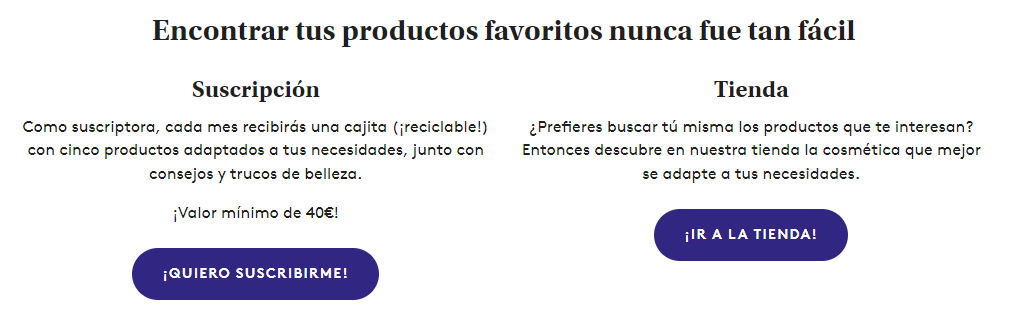
This example is quite interesting because it answers several objections in a small space:
· Suitability: it puts a lot of emphasis on the products being tailored to the customer’s needs
· Price: a minimum value of €40! For a subscription that costs €16 or less, that’s a pretty good justification
Can we add anything else to this example?
It isn’t really necessary, but we could add something like this below the “I want to subscribe!” button:
· Go out more with what you save on cosmetics!
This would be a way to further reduce the price objection by helping the customer see the possible benefits of signing up for the service.
► Another example of responding to possible objections

In this case, we could face an understanding objection. Managing your own company’s accounts is great, but what if you come across something you don’t understand or have a question? In that case, the tool wouldn’t be much use to you, unless, as in this case, you have “support from economists”.
That way, the objection can be resolved easily.
· Understand objections and address them directly
Something that can bring more problems than sales is not addressing objections directly, head-on. Keep in mind that, in the end, it’s most likely that:
· The customer will become suspicious, thinking they’ll run into some problem
· Sooner or later, the customer will come up against the objection
This may be true in 99% of cases, at a rough guess (I don’t have a real statistic), but you’ve very likely been in a similar situation yourself and caught yourself thinking, before a purchase, “there must be some catch or drawback”.
And it’s normal to think that way: nothing is perfect.
In that case, it’s more effective to acknowledge the objection and answer it, either with a possible solution or by downplaying its importance. Either of those options is better than ignoring the issue, because by acknowledging the objection you show your potential customer several things:
· That you’ve analyzed the problem
· Not only that, but that you’ve analyzed it from the customer’s perspective
· That you understand the impact it can have on the customer’s needs
· And that you’ve established the most effective and efficient solution
In short, you become more credible and your product more reliable.
► A simple structure: “we know… and that’s why”
Answering objections doesn’t have to be complex. You can use the structure in the heading:
· “we know problem X exists, and that’s exactly why we have solution Y”
It’s a very simple structure; you can see it used in the following example:
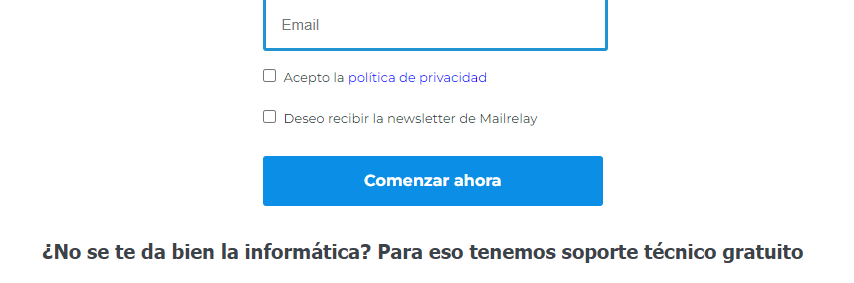
You can see the objection and the response we give to it. There are clearly other ways to do it, but this one usually works quite well and is quite effective. Here you can see it used after the button, as reinforcement after the call to action.

Related posts:
- 4 Bulk Follow-Up Email Templates
- The Art of War in Marketing: Competitive Strategies
- Metaverse: Advantages in Digital Marketing
- What is the best time of the day to send newsletters?
- Product Launch: Best Practices
· Call to action + response to the objection
You can apply this structure at various points on your sales pages to make them more effective. Either interspersed throughout, or at the end. Here’s an example from Asana:
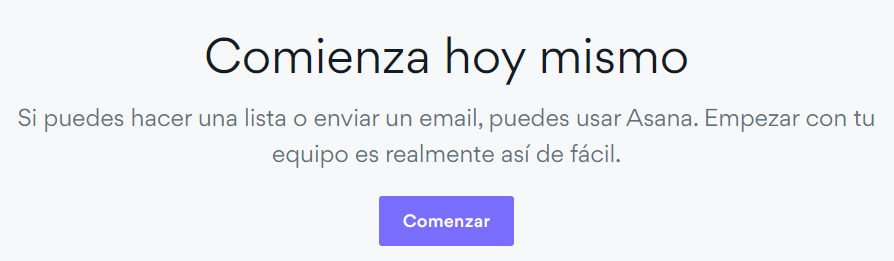
This structure tries to include:
· A call to action: Get started today
· A response to the objection (understanding): If you can make a list or send an email, you can use Asana
· A button to take the action: Get started
This block sits on a page where many arguments, benefits and so on have already been shown, so it can be the final element that overcomes the resistance and gets the reader to take action. That’s exactly what we want.
· Remember
The most important things are:
· Knowing and understanding the customer’s objection
· Answering it
· Repeating it in different ways and from different perspectives
· The call to action
This is how you can get better results. Try it and see for yourself.