What is the best time and day to send email marketing (and newsletters)
What the studies say, what works in Spain and how to find the time that works best for your list

What the studies say, what works in Spain and how to find the time that works best for your list
Quick answer: The best time to send email marketing is usually between 9:00 and 11:00, and the best days are Tuesday, Wednesday and Thursday. For sales, Friday and the afternoon also work. Use this as a starting point and run tests with your list, because every audience has its own habits.
Choosing when you send a campaign seems like a minor detail. It isn’t.
The same email can end up buried under twenty others or arrive just when your subscriber is calmly going through their inbox. That difference shows in opens, in clicks and, in the end, in sales.
The bad news is that there is no magic time that works for everyone.
The good news is that there are clear patterns and a simple way to find the moment that works best for your list.
In this guide you’ll find what the big studies say, how to adapt it to Spanish schedules and a five-step method to find your best time.
Take it all as a starting point and always test with your own data.
Your email doesn’t land in an empty inbox. It competes with work messages, notifications, other newsletters and promotions from dozens of brands.
If it arrives when your subscriber has time, it sits at the top of the inbox and gets attention. If it arrives in the middle of a meeting or in the early hours of the morning, it will most likely get buried and never be seen again.
The send time affects three things:
| What improves | Why |
|---|---|
| Opens | The email appears at the top when the person checks their inbox |
| Clicks and sales | The reader has time to read, think and act |
| Deliverability | More engagement improves your reputation with Gmail or Outlook |
This last point is often forgotten. Email providers watch how your subscribers respond. If they open and click, the providers understand that your emails are of interest, and that helps your deliverability.
The time slot that works best in most studies is mid-morning, between 9:00 and 11:00. That’s when many people have already arrived at work, cleared the urgent tasks and go through their inbox a little more calmly.
But it’s not the only good time slot. Each time of day has its own audience:
| Time slot | Why it works | Who it suits best |
|---|---|---|
| 6:00 to 8:00 | Read on mobile, before the day starts | News newsletters, B2C, early-rising audiences |
| 9:00 to 11:00 | It’s the time people check their email at the office | B2B, most newsletters and promotions |
| 12:00 to 14:00 | Break before lunch | B2C, short offers, reminders |
| 16:00 to 18:00 | Back from lunch and end of the workday | B2B in Spain, content to read at leisure |
| 20:00 to 22:00 | Free time, sofa and mobile | Ecommerce, leisure, online training, NGOs |
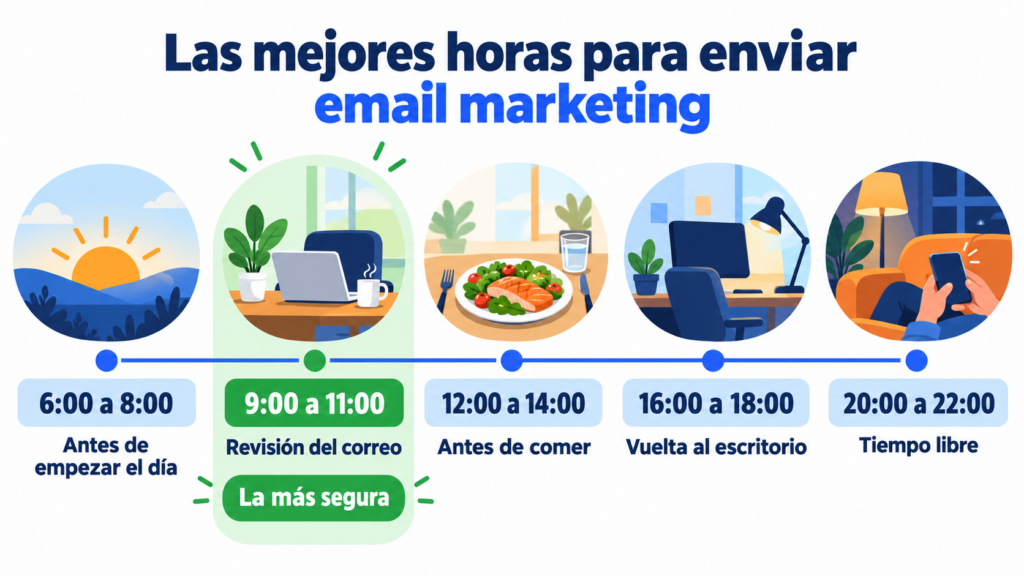
Note that clicks and purchases don’t always follow opens. According to Omnisend’s 2026 study, opens are concentrated between 9 and 11. Clicks, on the other hand, peak at 7-8 in the morning and at 16:00.
That’s why you should choose the time slot based on what you want to achieve. Getting read is not the same as getting a purchase.
Tuesday, Wednesday and Thursday are the safest days. The week is already underway, the inbox isn’t overflowing like on Monday and the Friday wind-down hasn’t arrived yet.
This is how each day generally performs:
| Day | How it usually performs | What to use it for |
|---|---|---|
| Monday | Inboxes full after the weekend | Useful content for planning the week |
| Tuesday | The day with the most opens and clicks in many studies | Newsletters, launches and important campaigns |
| Wednesday | Similar to Tuesday, sometimes with more clicks in the afternoon | Long-form content, webinars, B2B |
| Thursday | A good day to get ready for the weekend | Promotions, events, bookings |
| Friday | Fewer opens, but good conversions | Offers, impulse purchases, ecommerce |
| Saturday | The weakest day on almost every metric | Only if your data says otherwise |
| Sunday | Better than expected in mid-morning | B2C, leisure, inspirational content |
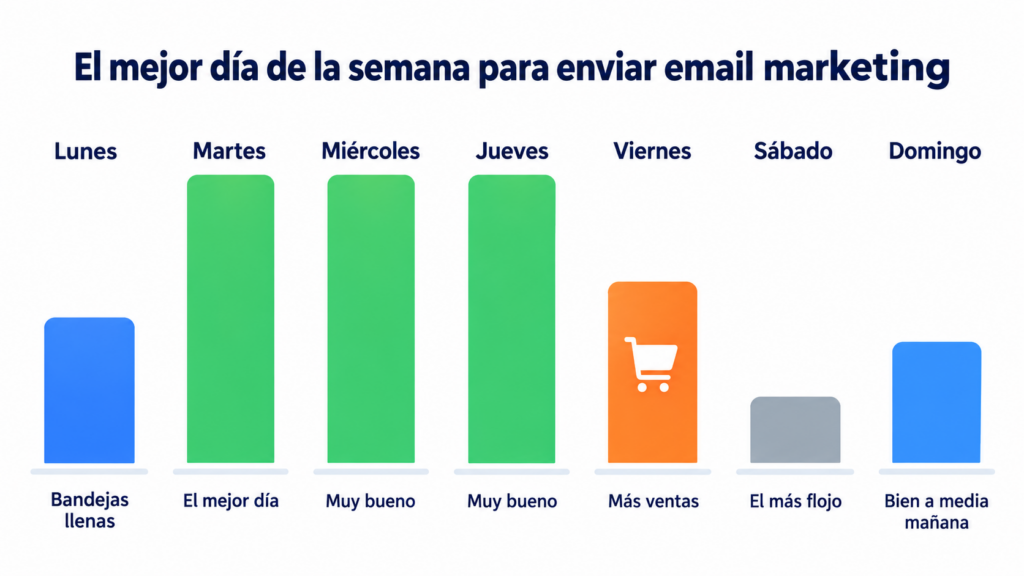
A day having a worse average doesn’t mean it’s bad for you. A garden shop or an online academy may have its best moment on Sunday morning.
These are the most cited figures. Keep in mind that they measure mixed audiences from many countries and industries.
| Source | What it analyzes | Main conclusion |
|---|---|---|
| Omnisend (2026) | Around 26 billion emails | Tuesday has the most opens (31.27%) and clicks (0.81% of emails sent). Friday is the day with the most conversions and Saturday the weakest. |
| Mailchimp | Data from its send time optimizer | The best time is 10:00 in each recipient’s time zone, Tuesday to Thursday. Sunday is the day with the least engagement. |
| MailerLite | Recommendations on its Spanish-language blog | 10:00 to 11:00 as the safest time slot, 13:00 to 14:30 for B2C and 20:00 as an alternative. |
| Teenvio | Its customers’ campaigns in Spain | Tuesday, Wednesday and Thursday, first thing in the morning or between 12:00 and 16:00. |
The Omnisend study reveals a couple of interesting details. The peak in opens comes on Tuesday at 7:00, with 33.41%, and the peak in clicks on Wednesday at 16:00. The best conversion rate appears on Friday at 7:00.
Mailchimp adds a breakdown by industry. In retail and ecommerce, late morning and early afternoon work well, especially from Thursday to Saturday. In B2B, Tuesday and Wednesday mornings. And NGOs get more engagement in the afternoon and at the weekend.
They all agree on one thing: general data is a clue, not a rule. Your list has its own habits.
International studies are designed mainly around English-speaking countries’ schedules. In Spain we have lunch later and the workday runs longer, so it’s worth adjusting them.
These three moments usually work well with Spanish audiences:
Between 9:00 and 11:00. The classic office slot is still the safest bet for B2B.
Before lunch, between 12:30 and 14:00. Many people use those minutes to check their email or shop online.
After lunch, between 16:00 and 17:30. It’s when people get back to their desks. In B2B it can perform as well as the morning.
At night, between 21:00 and 23:00, email competes with TV series and social media. Even so, it can work for ecommerce and leisure, because that’s when people shop from the sofa.
If your list mixes countries, the send time changes completely. When it’s 10:00 in Madrid, it’s 2:00 or 3:00 in Mexico City, depending on the time of year.
The solution is to segment by country and schedule a send for each time zone. That way, each subscriber receives the email mid-morning in their local time.
Your industry matters more than any average. These are good time slots to start testing:
| Type of business | Days to test | Times to test |
|---|---|---|
| B2B and professional services | Tuesday to Thursday | 9:00 to 11:00 and 16:00 to 17:30 |
| Ecommerce and retail | Thursday to Sunday | 12:00 to 14:00 and 20:00 to 22:00 |
| Restaurants and leisure | Thursday and Friday | 11:00 to 13:00, before people plan their weekend |
| Training and online courses | Sunday and Monday | 18:00 to 21:00 |
| Software and SaaS | Tuesday to Thursday | 9:00 to 11:00 |
| NGOs and associations | Weekend | Late afternoon, 17:00 to 20:00 |
If you work in B2B, the best time to send email marketing is usually during office hours. Avoid the weekend unless your data says otherwise. In B2C, on the other hand, Saturday and Sunday can surprise you.
In the big campaigns of the year, timing matters even more, because every brand is sending at the same time.
For Black Friday and Cyber Monday, give your subscribers a heads-up a few days in advance. Send the main email first thing on the day of the offer, between 7:00 and 9:00. That way you get there before most brands.
A final reminder in the afternoon, before the promotion ends, usually brings a second sales peak.
At Christmas, bring your campaigns forward. Purchases with home delivery are concentrated in the first weeks of December. Last-minute emails work best with gift cards or digital products.
In the January and July sales, the first day is the one that drives the most traffic. Prepare the campaign in advance and schedule it for first thing in the morning.
Not all emails are scheduled the same way. Some have to go out at the exact moment the user does something:
| Email type | When to send it |
|---|---|
| Newsletter | Always on the same day and at the same time, to build a habit |
| Promotion or offer | Depends on your industry; for sales, try Friday or the weekend |
| Welcome email | Right after signing up, within the first few minutes |
| Abandoned cart | Between 1 and 24 hours after the cart is abandoned |
| Transactional email | Instantly: confirmations, invoices and passwords can’t wait |
| Event reminder | One a few days before and another the day before or that same morning |
Emails that respond to a user action are handled with an automation. With these, the subscriber sets the time, not you.
Schedule your campaigns for the time that works best
Prepare your emails whenever you like and schedule them for the day and time you choose. With the free account, up to 80,000 emails a month to 20,000 contacts.
Since 2021, Apple Mail Privacy Protection has been preloading email images. This means many opens are recorded even if the person never actually read the email.
As a result, the open rate is inflated, especially if a large part of your list uses an iPhone. And a time can look good just because it coincides with those automatic opens.

To decide on the best time, look mainly at clicks and conversions. CTR and conversion rate reflect what your subscribers really do.
Opens are still useful for comparing subject lines or spotting sudden drops, but they shouldn’t be your only metric.
The reliable way to find your best moment is to test methodically. These are the steps:
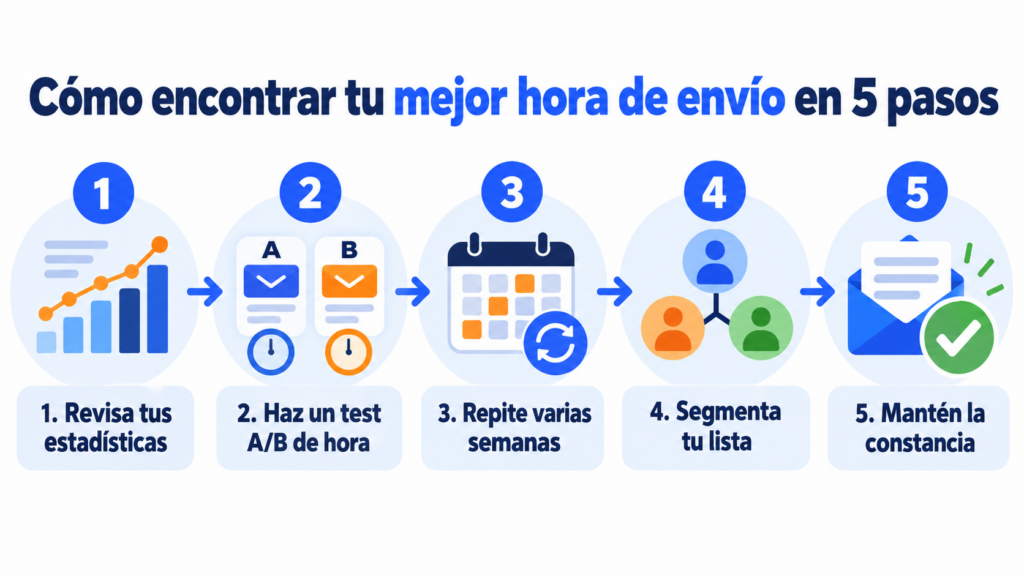
Look at the statistics from your latest campaigns. At what times are clicks concentrated? Do any days stand out? That pattern is already a first clue.
Split your list into two similar groups and send the same campaign to each one in a different time slot. Change only the time: same subject line, same content and same day.
You’ll find how to set it up in our A/B testing guide.
A single send proves nothing. A news story, a public holiday or a bad day can skew the results. Repeat the test three or four times before drawing conclusions.
If you have consumers and professionals, or subscribers in several countries, each group may have its own best time. In that case, schedule one send per segment.
Imagine an online store that tests two time slots for four weeks with the same newsletter:
| Time slot | Opens | Clicks | Sales |
|---|---|---|---|
| Tuesday, 10:00 | 34 % | 1,1 % | 12 |
| Thursday, 20:30 | 29 % | 1,6 % | 19 |
If you looked only at opens, you’d choose Tuesday morning. But Thursday night gets more clicks and more sales. For that store, the best time to send email marketing is the second one.
The figures are only illustrative; what matters is the method. Always compare the metric that measures your goal.
Once you find your time slot, stick with it. Your subscribers will get used to hearing from you on that day and at that time. Review the data every few months, because habits change.
Timing is only one part. How often you send also matters: you’ll find ideas in our guide on the ideal sending frequency.
The most common one is copying the time from a study and never looking at it again. What works on average may not work with your list.
Other mistakes to avoid:
In Mailrelay you can prepare your campaign whenever you like and schedule it for the day and time you choose. That way you don’t have to be at your computer at 7 in the morning or on a Sunday.

To find your best moment, you have real-time statistics with opens, clicks and a click map. You can also run A/B tests and create segments by country, interests or behavior to send to each group in its time slot.
Emails triggered by an action, such as the welcome email or the abandoned cart email, are sent automatically with automations.
With the free account you can send up to 80,000 emails a month to 20,000 contacts. And if you have any questions, support helps you via chat, ticket or phone on all plans.
Find your best time with Mailrelay
Real-time statistics, click map, A/B tests and segments to send to each group in its time slot. With support via chat, ticket or phone.
These are the most common questions about when to send your campaigns.
Tuesday is the day with the best results in most studies, followed by Wednesday and Thursday. But what matters is choosing a fixed day and sticking to it to build a habit.
For opens, mid-morning usually wins. For clicks and sales, the afternoon also works, especially around 16:00. Run an A/B test with your list to find out for sure.
In B2B, usually not. In B2C it can work: Sunday mid-morning gets good open rates, and Friday and the weekend account for a lot of purchases.
Between 9:00 and 11:00, before lunch, and after lunch between 16:00 and 17:30. For online stores and leisure, the evening can also work.
Segment by country or time zone and schedule a send for each group. That way everyone receives the email at a reasonable time of their day.
Every three to six months, or when you notice a clear drop in clicks. Habits change with the seasons, holidays and the type of content you send.

Jose Argudo
CMO at Mailrelay. Writes about email marketing, copywriting and conversion for small businesses and entrepreneurs.