Sales email: how to write an email to offer a product or service
Subject line, benefits, social proof, offer and guarantee: the 9 steps of an email that sells without making anyone uncomfortable

Subject line, benefits, social proof, offer and guarantee: the 9 steps of an email that sells without making anyone uncomfortable
A sales email is an email that presents a product or service and asks the reader to buy it, try it or book it.
Many businesses find it hard to write because they’re afraid of sounding pushy. But if your list signed up to hear from you, a good offer isn’t a nuisance.
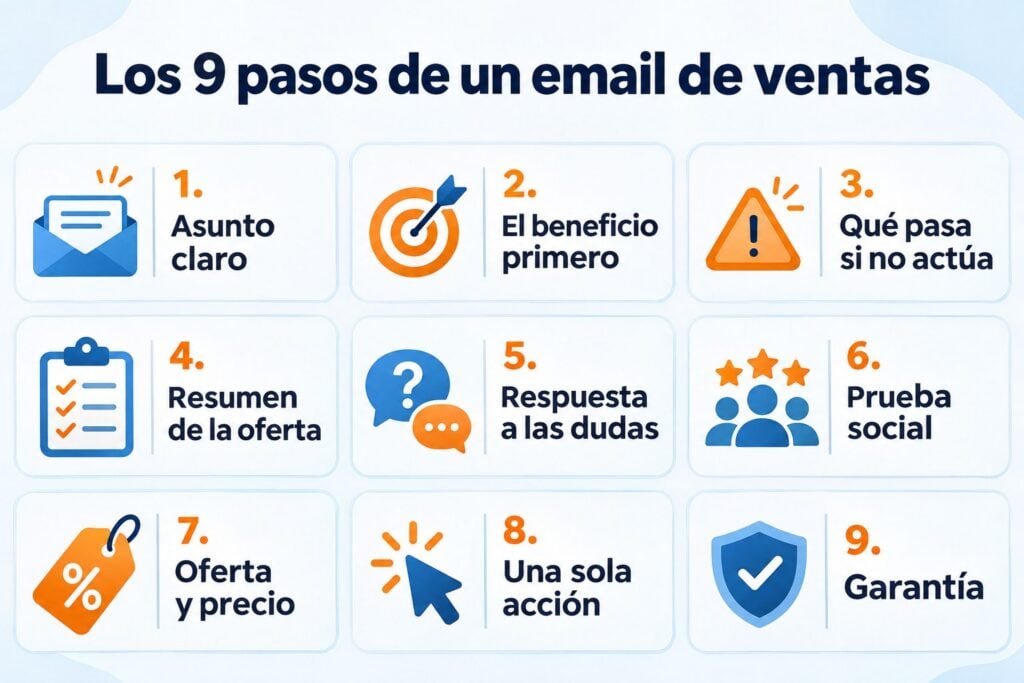
Here you have the 9-step structure, sample subject lines, templates by type of business and the mistakes worth avoiding.
It’s an email whose main goal is to get the reader to make a purchase or take the step before it, such as requesting a quote or a demo.
Unlike a newsletter, it talks about a single offer and has a single call to action.
It works best with people who already know you: subscribers, customers or contacts who asked for information.
To write to someone who doesn’t know you, see the guide to the cold email. The rules and the tone are different.
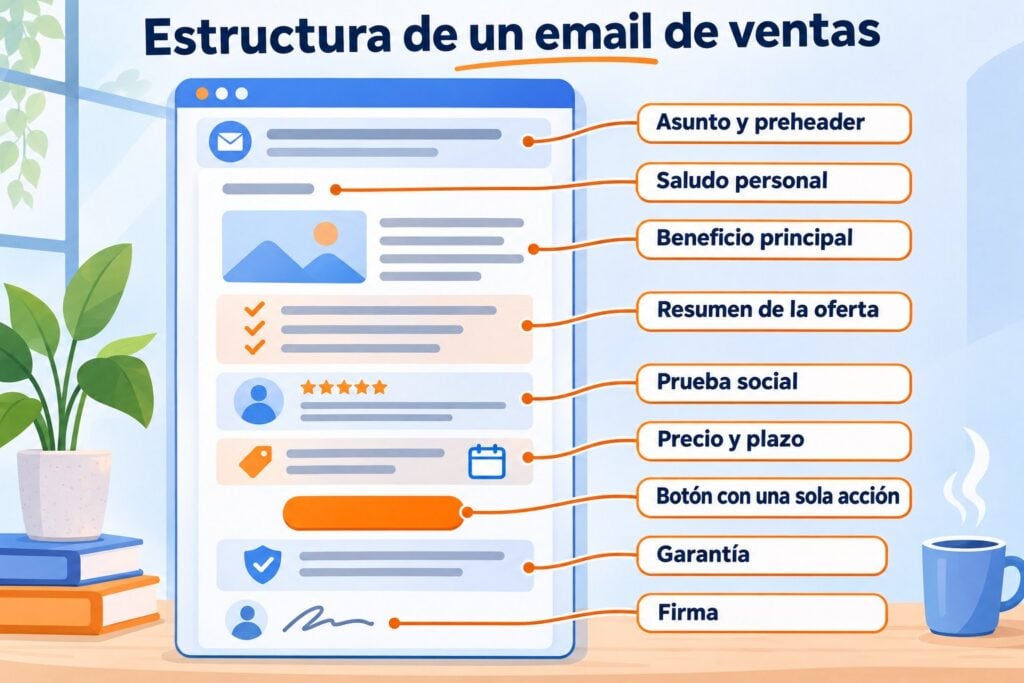
The subject line decides whether the email gets opened. Make it specific and lead with the benefit, with no tricks or capital letters.
Complete it with a good preheader, the text shown next to the subject line in the inbox.
The first sentence should answer the reader’s question: what’s in it for me?
Talk about the result, not the product. “Do your payroll in 10 minutes” sells more than “New payroll module”.
Describe the problem that stays there if they don’t act: the time they lose, the extra money they spend or the opportunity that slips away.
Do it with facts, without dramatizing. The reader should recognize their situation, not feel pressured.
A short list of what the offer includes. Three or four points are enough.
If there’s a figure to back it up, such as the time it saves or what it costs per month, put it here.
Think about the usual objections: the price, the time it takes to get started, whether it works for their case.
Answer the two or three most common ones in one sentence each. You’ll find ideas in how to overcome sales objections.
A real customer review, a number of users or a specific case reduce distrust.
Only use real testimonials, with the permission of the people who give them. One good one is worth more than five generic ones.
Say clearly what it costs and what the terms are. If there’s a discount or a deadline, explain how long it lasts.
A real deadline helps people decide. A made-up deadline that renews every week hurts your credibility.
A single button with a clear verb: “Book your spot”, “Request your quote”, “Start your trial”.
If you give three options, the reader hesitates and often chooses none.
A refund, a free trial or cancellation with no commitment make it easier to say yes.
Close with your name and a way to reply. A sales email that lets people reply builds trust.
Send your sales email to your whole list
Design the campaign with the Mailrelay editor and see who opens and who clicks.
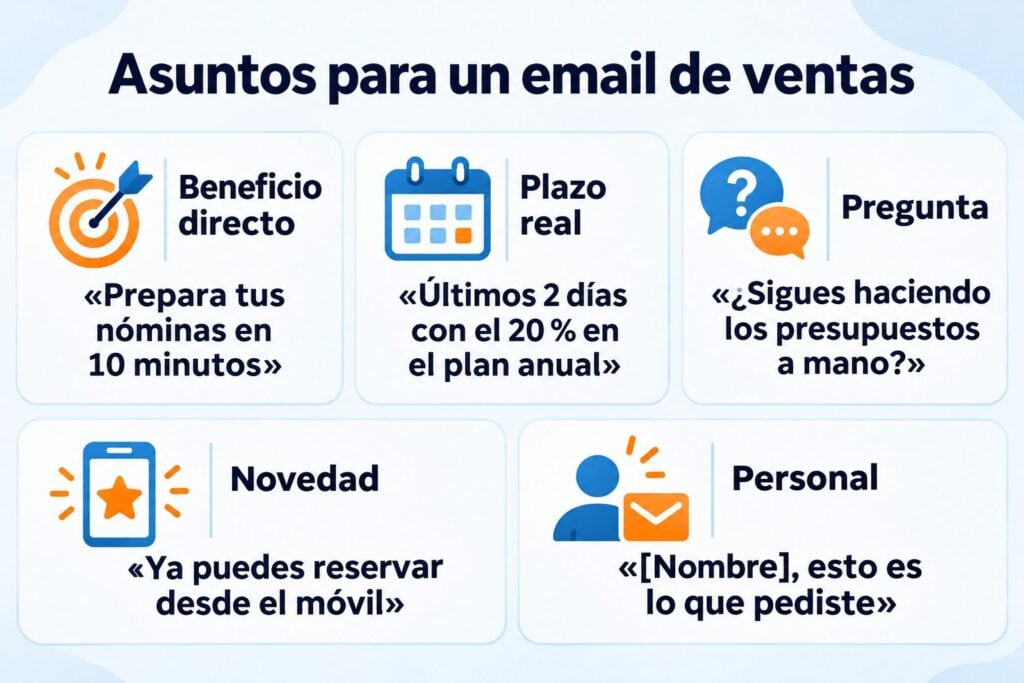
| Type | Example |
|---|---|
| Direct benefit | “Do your payroll in 10 minutes” |
| Real deadline | “Last 2 days with 20% off the annual plan” |
| Question | “Still doing your quotes by hand?” |
| What’s new | “You can now book from your phone” |
| Personal | “[Name], here’s what you asked for” |
Avoid capital letters, too many exclamation marks and exaggerated promises. They undermine trust and can send the email to spam.
You’ll find more ideas in the glossary entry on the email subject line and in these original subject lines for newsletters.
Subject: The backpack you asked for is here
Hi [name],
Many of you wrote to us asking for a backpack that could stand up to the rain and fit in the cabin of a plane. Now we have it.
It’s waterproof, weighs less than a kilo and has a pocket for laptops up to 15 inches.
Until Sunday, shipping is free.
[Ver la mochila]
Subject: Can we help you close the fiscal year without the rush?
Hi [name],
Every December, many of our clients tell us the same thing: they don’t have enough time to review their accounts.
This year we’re opening 10 spots for an early review in November. We’ll give you a report on what’s worth adjusting before year-end closing.
[Reservar mi revisión]
Subject: Your trial ends on Friday
Hi [name],
In these two weeks you’ve created 12 quotes with [product]. To keep using it, all you have to do is choose a plan.
If you sign up before Friday, you get 30% off the first month. You can cancel whenever you want.
[Elegir mi plan]
Subject: Registration is open for the January course
Hi [name],
The [topic] course is back in January. It’s 6 weeks, with live classes and graded exercises.
The first 50 registrations get a reduced price. If you’re not convinced after the first week, we’ll refund your money.
[Reservar mi plaza]
You’ll find many more in the 31 email templates to sell more.
Test two subject lines before sending
With Mailrelay’s A/B tests you find out which subject line sells more, on the free account too.
A sales email is convincing when the reader feels the decision is theirs.
Cialdini’s principles of persuasion help: reciprocity, social proof, authority or scarcity. Use them with true facts.
If you want to improve your writing, go over the basics of copywriting. Short sentences, one message per paragraph and action verbs.
The free account lets you send up to 80,000 emails a month to 20,000 contacts.
If you want your newsletter to sell too, there’s the guide to email sales. And for the last step, the glossary entry on closing the sale.
Start selling by email today
Free account: up to 80,000 emails a month to 20,000 contacts, with human support.
An email that presents a product or service and asks for a specific action, such as buying, booking or requesting a quote.
Start with the benefit, sum up what it includes, answer doubts, add social proof, present the price and ask for a single action.
A short, specific one that leads with the benefit or a real deadline. For example: “Do your payroll in 10 minutes”.
A sales email goes to people who already know you. A cold email goes to strangers and has more legal restrictions.
It depends on your business, but it’s a good idea to alternate them with content emails. If unsubscribes go up, you’re selling too much.
From first contact to closing
How to turn a cold contact into a customer, step by step.
How to introduce yourself to a client by email
Introduction email examples and templates.
Sales inaction
Why customers don’t buy and what to do to get them to take the step.

Jose Argudo
CMO at Mailrelay. Writes about email marketing, copywriting and conversion for small businesses and entrepreneurs.