Performance marketing: what it is, how it works, types and examples
How much each customer costs you and which channel brought them in: marketing that is measured down to the last euro
How much each customer costs you and which channel brought them in: marketing that is measured down to the last euro
Performance marketing, or results-based marketing, is digital marketing that is measured and paid for by specific results: a click, a sign-up or a sale.
Instead of investing in advertising and waiting to see what happens, you know how much each customer costs you and which channel brought them in.
Claude Hopkins was already calling for it in “Scientific Advertising” (1923): measure what every dollar spent on advertising returns. The internet made it possible.
Here’s how it works, its metrics, the channels that use it and some examples.
Performance marketing (also called results-based marketing) is a type of digital marketing based on actions with measurable results.
It is aimed at specific goals: selling a product or service, getting sign-ups, increasing website traffic or social media engagement.
Campaigns involve different channels (search engines, social media, email), and each one has its own measurement indicators, the KPIs. The idea is to measure the performance of each channel and optimize it.
It is sometimes confused with other forms of marketing, such as growth marketing, or set against brand marketing. We clear this up below.
Brand marketing aims to make a brand’s identity and values known. Performance marketing focuses on actions that are easier to measure, such as the sale of a product.
They are not rivals. Performance marketing works better when the brand is already known: people click more readily on an ad from a brand they recognize.
For example, a performance campaign can start after a brand campaign and use that awareness to get more conversions with the same budget.
You’ll find more detail in the post on brand marketing.
Both rely on measuring results in order to optimize, but they differ in focus and scope.
Performance marketing pursues very specific goals, such as getting leads or sales, with equally specific actions: Google ads or promotional emails.
Growth marketing has a broader focus. It covers the whole customer journey, from discovering the problem to buying and buying again, and combines SEO, product, email and retention.
A channel where every result is measured
Clicks, bounces and unsubscribes for every campaign, plus UTM tags to track sales in your analytics.
A campaign can have different goals: building brand awareness, attracting traffic, getting leads or selling.
Performance marketing sticks to the ones with a clear, measurable result:
Results-based marketing rests on three decisions:
The goal comes first because it determines the indicators. If you’re after sales, you’ll look at cost per acquisition. If you’re after sign-ups, cost per lead.
Then you launch the campaign, measure the results and shift the budget towards what works best. It’s an ongoing cycle, not a one-off action.
KPIs are measurable values that tell you whether a campaign is meeting its goal. In performance marketing they are very clear, because every action leaves a trace.
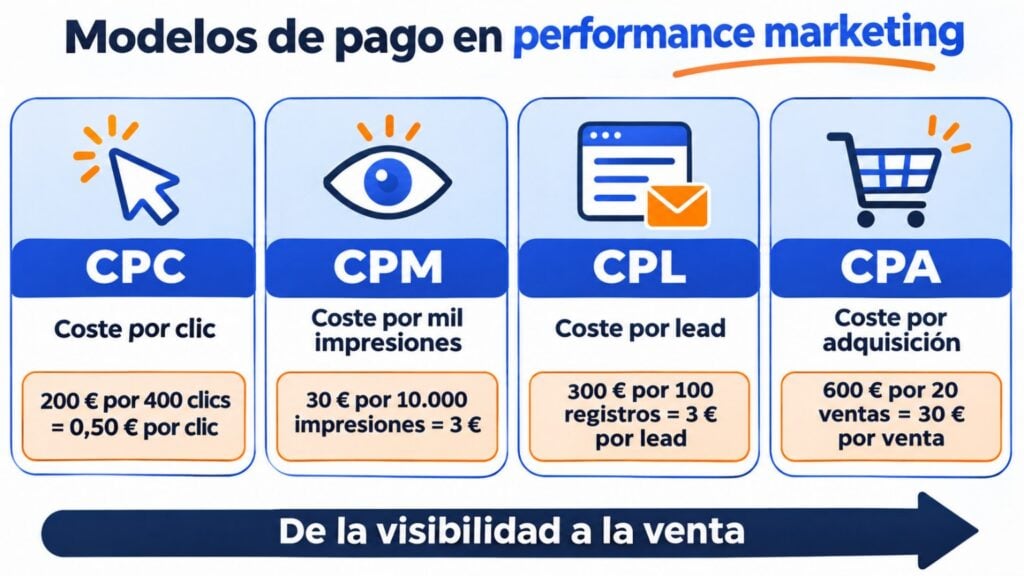
These are the most common payment models and metrics:
| Model | What you pay | When it makes sense | Example |
|---|---|---|---|
| CPC | Each click on the ad | Driving traffic to a page | €200 for 400 clicks = €0.50 per click |
| CPM | Every thousand impressions | Giving an offer visibility | €30 for 10,000 impressions = €3 CPM |
| CPL | Each sign-up obtained | Attracting subscribers or contacts | €300 for 100 sign-ups = €3 per lead |
| CPA | Each sale or conversion | Selling a product | €600 for 20 sales = €30 per sale |
It shows what it costs you to bring someone to your website from an ad on Google, Instagram or any other platform.
If the ad connects with your audience, you’ll get more clicks and, on many platforms, each click will cost you less. That’s why CPC helps you see which ads work best.
CPM stands for cost per mille (thousand). It’s what you pay each time an ad is shown a thousand times, whether people look at it closely or not.
It is used to measure the visibility of a brand or an offer on a specific channel. It’s the model closest to brand advertising.
You pay for each person who signs up: to receive a newsletter, download an ebook or create an account.
It’s more demanding than CPC, because the lead has already shown interest. They haven’t bought yet, but you have their permission to stay in touch.
It’s also called cost per conversion. It is perhaps the most important metric, because it tells you how much it costs you to get a customer to buy.
Google Ads calculates it by dividing the total cost by the number of conversions. If you get two conversions, one for €5 and another for €7, the average CPA is €6.
One of the advantages of performance marketing is that ROI (return on investment) is easy to measure, because you know the cost and the result of every action.
ROI is calculated like this: (profit − investment) / investment. If you invest €1,000 and earn €1,500, the ROI is 50%.
Alongside ROI, there are three other metrics worth tracking:
The rule of thumb is simple: if LTV is several times higher than CAC, you can invest more in acquisition. If they are close, each new customer leaves you with a thin margin.
This is where email carries a lot of weight: it doesn’t lower acquisition costs, but it does increase LTV, because it gets customers to buy again without you paying to reach them a second time.
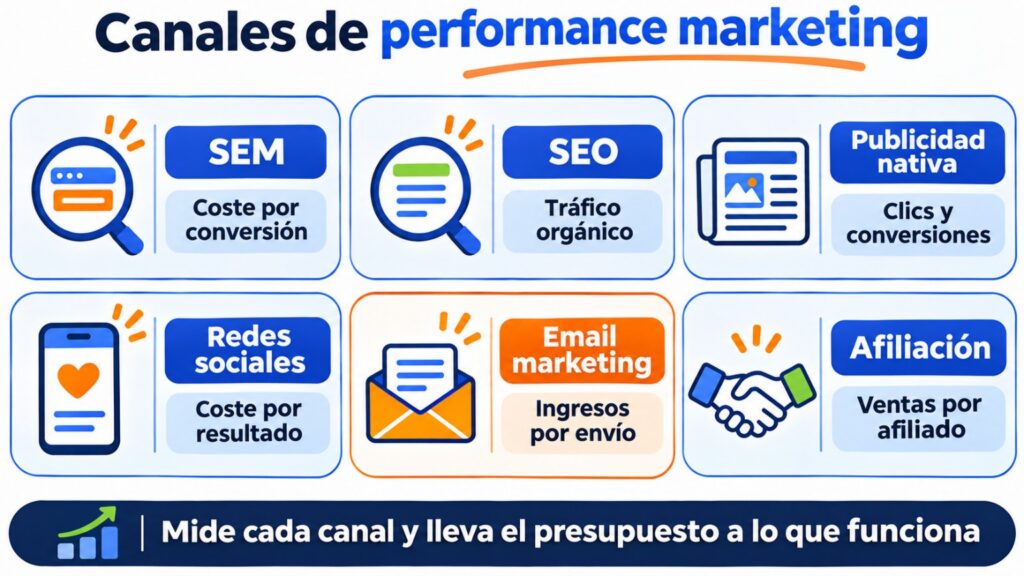
There are as many types of performance marketing as there are channels. These are the most common:
| Channel | How you pay | Main metric |
|---|---|---|
| SEM (search engine ads) | CPC or CPA | Cost per conversion |
| SEO | No pay per click; you invest in content | Organic traffic and conversions |
| Native advertising | CPM or CPC | Clicks and conversions |
| Social media | CPM, CPC or CPA | Cost per result |
| Email marketing | Cost of the tool, not per impression | Clicks, conversions and revenue per send |
| Affiliate marketing | CPA or commission per sale | Sales per affiliate |
Search Engine Marketing (SEM) means attracting traffic with paid ads on search engines such as Google or Bing.
An SEM campaign is organized around keywords. Depending on the goal, it is measured with CPC, CPL or CPA.
Today bidding is automated with AI: Google Ads adjusts each bid according to the likelihood of conversion. That’s why the goal you give the campaign matters more than ever.
SEO shares its goal with SEM: appearing in search engines. The difference is that you don’t pay for each click; instead, you invest in content and in your website.
It aims to attract organic traffic, the kind you don’t pay for, with articles, videos or images that answer what people are searching for.
It fits with performance marketing because it can be measured: visits, conversions and cost per piece of content. That said, results take months, not days.
It’s the same old sponsored content, but online. In exchange for payment, a media outlet publishes an article or video that talks about your services.
Because you pay for it, you control the message. In Spain it has to be identified as advertising, just as in print media.
Facebook, Instagram, LinkedIn, TikTok and X let you target by interests and pay per result: impressions, clicks, sign-ups or sales.
Almost all usage is on mobile, so ads and the pages they lead to need to be designed for it.
Email is one of the most profitable performance marketing channels, because you don’t pay per impression: you write to a list that is yours.
Promotional emails are measured by clicks, conversions and revenue per send. Regular newsletters are measured too, and they help bring customers back to buy again.
Email also collects what the other channels capture: an ad brings in a visitor, a form turns them into a subscriber and the emails guide them through to purchase.
Email marketing is one of the most effective marketing tools: all the effort you put in builds a contact list that belongs to you and that you can reach whenever you want. You can send not only sales emails, but also emails that keep up the relationship with your customers. That’s useful because keeping a loyal customer is usually more profitable than investing in winning new ones, although you have to do that too, of course. My advice: don’t just measure the sales from each send. Also look at how many customers come back to buy again thanks to your emails.
Jose Argudo, CMO at Mailrelay
It involves promoting products or services through third parties, such as bloggers, media outlets or content creators.
The affiliate receives a tracking link and earns a commission for each sale or agreed action.
The advantage for the company is that it only pays for results. The risk is control: your brand appears on sites you don’t manage.
Turn your campaigns into measurable results
Test subject lines and content with A/B tests and keep what works best.
Pay-per-click was born in the late 1990s, and Amazon’s affiliate program launched in 1996. Today almost all digital marketing is measured this way.
Just search Google for a service, such as car rental in Mallorca, and you’ll see paid ads like these:

Clicking the ad takes you to a page on the advertiser’s site. From there, every step is tracked, from the click to the booking, and the advertiser knows how much each rental cost.
Sticking with the same example, the organic results, the ones that aren’t paid, appear below the ads.
If a rental company appears there, it gets visits without paying for each click. It then measures which pages bring in the most bookings and which content is worth investing in.
Each email has a button with a call to action, and every click can be tracked through to the purchase. Here are two emails from Decathlon and On promoting their products:


With the clicks on each button, the company knows which product attracts the most interest, which subject line works best and how much each send has sold.
Today it’s hard to imagine a digital strategy that doesn’t measure its results. But measuring is getting harder.
Safari and Firefox block third-party cookies by default, and GDPR consent reduces the data that can be tracked across websites.
That’s why first-party data is gaining value: your email list, your customers and what they do on your website. It’s data that doesn’t depend on any platform.
AI is also changing the work. Ad platforms decide bids and audiences on their own, so what makes the difference is the goal, the creative and the quality of the data you give them.
Mailrelay is an email marketing tool for the side of performance marketing that doesn’t depend on paying per impression:
The free account lets you send up to 80,000 emails a month to 20,000 contacts.
Measure, learn and improve with every send
Create your free account and send up to 80,000 emails a month to 20,000 contacts.
It’s digital marketing that measures every action by a specific result, such as a click or a sale. That data is then used to optimize.
Performance marketing seeks measurable short-term results, such as sales or sign-ups. Brand marketing builds the brand image over the long term. They complement each other.
The most common are CPC, CPM, CPL and CPA, along with ROI, ROAS, CAC and LTV.
Yes. Each send is measured by clicks, conversions and revenue, and because the list is yours, you don’t pay per impression.
They plan campaigns around results, choose channels and budgets, measure every action and shift investment towards what works best.
Brand marketing
What it is, how it differs from performance marketing and how to combine them.
Types of marketing
The main types of marketing and when to use each one.
What is direct marketing
How to reach your customers without intermediaries, with email as the main channel.
Email marketing metrics
What to measure in each send and what each figure tells you.

Jose Argudo
CMO at Mailrelay. Writes about email marketing, copywriting and conversion for small businesses and entrepreneurs.