
Display advertising is one of the first digital formats implemented on websites, yet it has remained relevant over time thanks to its effectiveness.
On websites, display advertising takes the form of banners strategically placed on the site’s different pages. They can be animated or not, include only text or combine images and keywords.
In this article we’ll tell you everything you need to know about display advertising, along with some examples you can use in your projects.
Stick around and we’ll tell you all about it.
What Is Display Advertising?
Display advertising is a form of digital marketing that uses banners and other visual ads to promote brands, products or services on websites. It’s one of the oldest formats in the digital world, but it has evolved to remain relevant and effective.
Display advertising comes in the form of graphic ads, which can include images, text and interactive elements. In addition, these ads can be static or animated, and their design must be attractive enough to capture the user’s attention within seconds.
What Is Display Advertising Used For?
Display advertising is mainly used to promote a brand, product or service on a website frequented by the target audience you want to reach.
What do we mean by that?
If your key audience is young athletes, it would be ideal for your brand to pay for display advertising on sports websites or on news outlets related to that area.
For example, if you want to advertise in the online space of your city’s newspaper or news channel, the relevant section for you will be the sports page or the home page. This will let you reach the right audience.
Once you’ve established the ideal space for your ad, it’s essential to craft the perfect message to capture users’ attention. This is where creativity and strategy come together to achieve the best results.
Keep in mind that the banner must be eye-catching enough to grab attention and that you’ll only have a few seconds to get your message across. It’s also key to add a link to the destination site you want readers to land on when they click your ad.
A great tip is to start with keyword research to find the most effective keywords for your industry and draw up a short list. That way you can boost your content.
In addition, display advertising can also help you get leads thanks to the CPA or CPL format (cost per action or cost per lead). We’ll give you more details about this type of display advertising in the following lines.

Types and Examples of Display Advertising
As we mentioned earlier, display advertising has been used for years. But like everything digital, it has evolved, allowing us to adapt to different platforms and audiences.
You used to be able to use it only as banners, mostly rectangular, either vertical or horizontal.
Nowadays there are different models and sizes, which we’ll cover below. We’re going to show you the types of display advertising that exist and some examples.
It tends to be one of the most effective formats, but also one of the most expensive. It’s placed at the top of websites and gives you the option to make it expandable when the cursor hovers over it.
Because of its position, it ensures a very high level of effectiveness, since any user will see it as soon as they land on the home page of a website.
Its size is usually 728×90 px, but since it has the option to expand, it can reach up to 728×180 px.
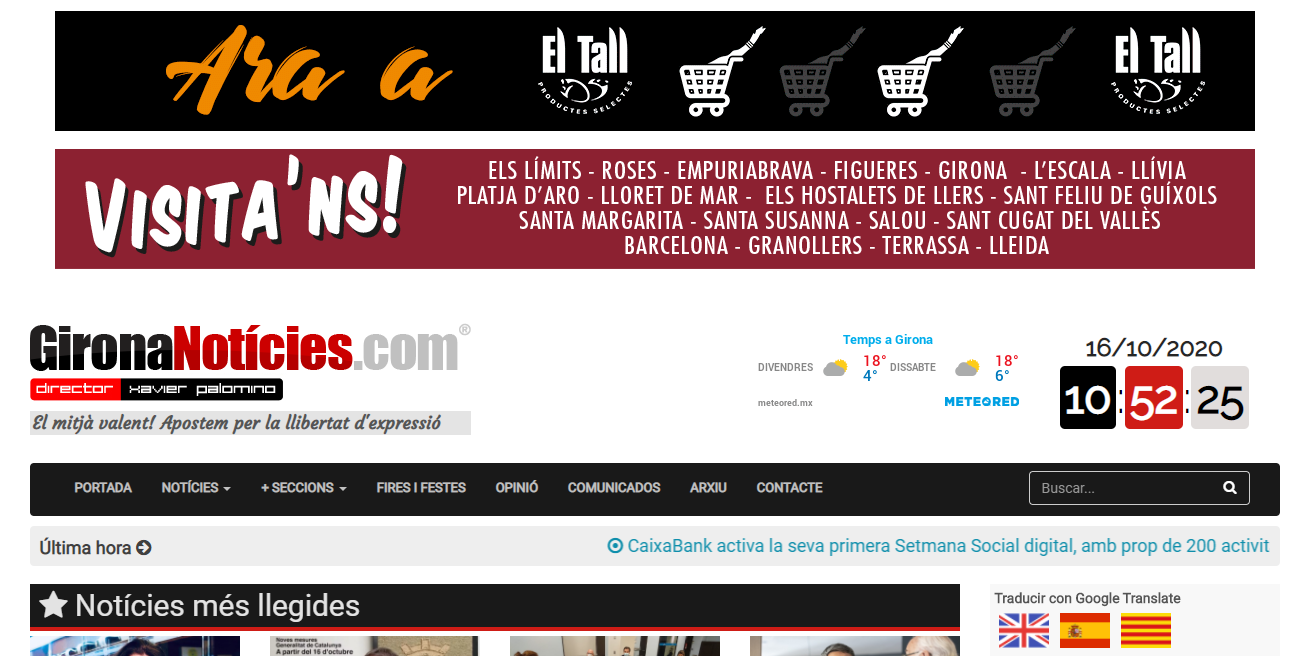
2. Skyscraper
This format is also popular and is usually placed on the sides of websites. Because of its position, it’s usually shaped like a vertical rectangle.
It’s important to keep in mind that if you share the space with other advertisers, not every new visit to the website means that user will see your ad.
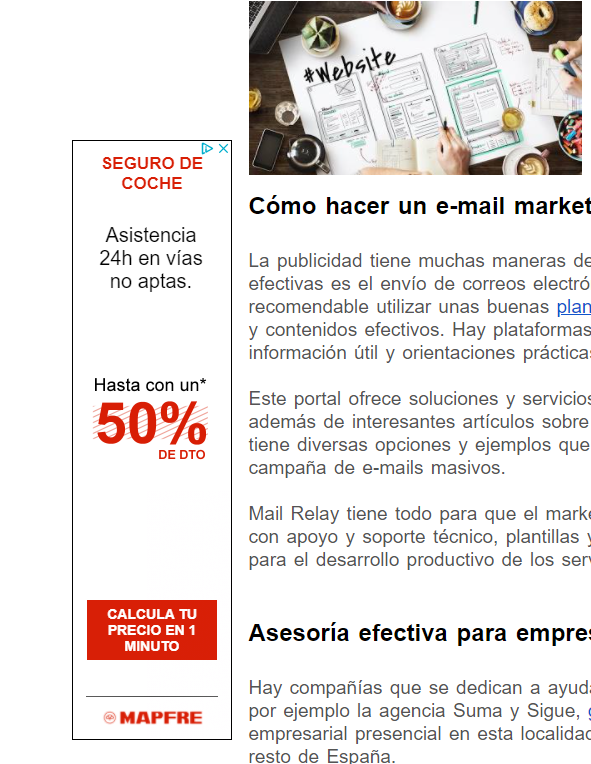
3. Pop-up
It’s a high-impact format, but at the same time it can be unpleasant for users, since it appears over the text or the screen.
If it’s attractive enough, the user will stop to look at it; otherwise, they’ll find it annoying and click the “X” to close it.
Another common situation with this format is that, since it appears over all the text of the website, the user may click on it by mistake.
This is a golden opportunity to grab their attention right away when they reach your page or landing page.

4. Skin
With this format, the sides and the header of the website are customized with your ad, allowing it to be viewed in two ways and in two different directions.
You can create one ad spanning the three spaces or place different ads with different calls to action in each of them.

5. Floor
As its name suggests, this format is placed at the bottom of websites. Its size is usually 700×200 px.
Its main drawback is that, being at the bottom of the page, it may get less exposure than other ads.
We recommend that you always ask for a statistics or metrics report on the results you can get depending on your ad’s position, and based on that decide which one will be best for your strategy.


Payment models and metrics for display advertising
1. Cost per thousand impressions (CPM)
With this model, you’ll pay a set amount each time the ad reaches one thousand impressions, that is, when it has been shown a thousand times on the website. It’s worth mentioning that here it makes no difference whether or not the user clicks the banner.
Another point to consider is that impressions can be used up by the same user: it’s not only a website’s unique visits that count, but also returning ones.
If the same user visits the page 10 times and sees your ad all 10 times, you’ll be reaching only that person despite having used up ten impressions.
2. Cost per click (CPC)
Unlike CPM, the cost of this type of ad will vary according to the clicks it receives.
However, as in the previous case, that doesn’t mean all the clicks you receive will come from new visitors.
The same user can click your ad from different devices and it will still use up part of your budget.
When you measure results or effectiveness metrics, you should note how many clicks you received from unique users and how many from returning users.
This will help you get a more detailed view of how your ads perform on the website.
3. Cost per lead (CPL)
A lead is a user who has provided some kind of contact information through a form or registration. They usually do so in exchange for a download or information they’re interested in.
With this format, the idea is to get those leads, either to build a database or to convert them into customers through a specific strategy.
That is, your ad will include a link that takes them to that form or registration page, and they’ll get the information they need once they’ve filled in the fields the advertiser requires.
One of the drawbacks of this model is that users may mistype their information or provide data such as a fake or unused email address.
It’s important to always clean and verify this information before adding it to your database or making it part of your sales funnel.
4. Flat rate
With this model, the price is fixed regardless of how many times the ad is shown or how many clicks it receives. Before choosing this option, we recommend analyzing the expected results.
Lastly, we’d like to share a clear example of display advertising:

The highlighted spaces you see would be the display ads on a web page. We took this example from Google AdSense, the tool Google provides.
Remember that the effectiveness and cost of the ad will vary depending on the website and its position within it. Before deciding to advertise on a given outlet, make sure you know the metrics or results it can offer you.
Benefits of Display Advertising and Ads
- Increased Brand Visibility: Display ads let brands present themselves in a visual and appealing way, which helps increase brand awareness among consumers.
- Precise Targeting: It lets you target specific audiences based on their behavior, interests, demographics and location. This ensures the message reaches the right people.
- Traffic Generation: Display ads can drive traffic directly to the company’s website, which can result in more visits and potential conversions.
- Building Credibility: Placing ads on relevant, respected websites can increase the perceived credibility and trustworthiness of the brand among consumers.
- Creative Flexibility: They offer a variety of formats (banners, videos, interactive ads) that let businesses be creative and stand out from the competition.
- Retargeting: It lets you win back users who have previously interacted with the brand, showing personalized ads that can turn these visitors into customers.
- Improved Engagement: Visual ads tend to have a greater impact and can capture users’ attention better than text ads, which increases the chances of interaction.
- Measurable Results: Display advertising platforms offer detailed analytics on ad performance, allowing businesses to adjust their strategies based on hard data.
- Cost Efficiency: Depending on the payment model (CPM, CPC, CPL), businesses can optimize their investment and adjust their budget according to how effective their ads are.
- Increased Conversions: By using display ads strategically, businesses can encourage direct action, such as subscribing to newsletters, downloading content or making purchases.
- Adaptability: Display ads can be easily modified or adjusted to fit new campaigns, promotions or changes in marketing strategy.
These benefits make display advertising a valuable tool within a broader digital marketing strategy, helping businesses reach their visibility and conversion goals.
With this type of advertising, knowing the performance of each ad in detail is key so you can always reinvest strategically.
This is especially true when it’s used with links to landing pages that kick off a successful sales funnel.
In this article, we’ve covered the most important points about display advertising and how to use it effectively, and we’ve offered some examples, including the use of keyword research as a tool.
Make sure you know how many unique and returning visits you get, see which format or position gives you the best results, and always keep in mind that you only have seconds to capture the reader’s attention.
Investing in the most expensive format doesn’t guarantee success. The quality of your ad does.
Finally, we’d like to invite you to share this article with your team so everyone can work in synergy and create the best display advertising for your brand.

This format often pairs very well with remarketing, since both rely on programmatic digital advertising.