The Social Media Manager role is increasingly in demand among companies.
Social media has changed how we interact, how we search for information, and even our buying habits.
That’s why having a strong social media presence is essential.
In this article, we’ll look at what a Social Media Manager is, their functions and salary, the differences with a Community Manager, and the tools they use.
Ready?
What Is a Social Media Manager
A Social Media Manager is a digital marketing professional who creates a brand’s social media strategy.
In fact, they’re the person responsible for creating the company’s social media marketing plan.
The Social Media Manager has to keep control of the campaigns. Analyzing, interpreting, and evaluating the ROI of the actions carried out.
Functions of a Social Media Manager
Depending on the company and its Digital Marketing team, the Social Media Manager usually performs the following functions:
Understanding the Company’s Business Model
It’s essential to have a defined business model that the SMM is familiar with. They need to take into account aspects such as:
- What products or services the company sells
- What channels they use
- What resources they have
- What the added value of their products or services is
- The value proposition
Analyzing the Competition
This determines where the competition stands after conducting thorough benchmarking.
Social Media Audit
They’ll need to analyze the brand’s and the competition‘s different social media channels to find out which content performs best, whether advertising campaigns have been run, how often they post, the traffic coming from social media, the conversions achieved, among other tasks.
Defining the Target Audience
All actions carried out on social media should be aimed at the ideal customer or buyer persona.
For this reason, the Social Media Manager must know this persona inside and out.
Conducting a SWOT Analysis in Social Media
Social media professionals need to have strong marketing knowledge. Conducting a SWOT analysis is one of their functions and is essential for developing the social media plan.
They’re responsible for choosing which social media platforms the brand will use. Depending on the business model, target audience, budget, and prior analysis, they’ll choose one platform or another.
Defining the Objectives
They define the social media objectives they want to achieve. These could be brand visibility, increasing traffic, growing subscribers, etc.
Developing the Strategy
They’re responsible for developing the strategy to achieve the set objectives.
Creating a Content Plan
Content is fundamental in the world of social media. That’s why they’re responsible for creating a social media content calendar. Afterward, the Community Manager will manage and publish the content.
In some cases, it’s the Community Manager who creates the content calendar.
Planning Collaborations
They’re responsible for planning and overseeing all collaborations with brands or influencers.
Analyzing and Creating Reports
The SMM will determine the main KPIs and monitor whether the actions being carried out are meeting the objectives.
Creating a Contingency Plan
Another of their functions is creating a social media crisis reputation plan. They create possible crisis scenarios and define the type of action for each communication channel.
Overseeing the Community Manager’s Work
This professional is in charge of the Social Media department. They have to supervise and outline the steps the Community Manager should take.

Differences Between the Social Media Manager and the Community Manager
Many people confuse these two terms. But the SMM and the CM are two different professionals.
The Social Media Manager plans and designs, while the Community Manager executes and manages.
NOTE: When you work at a marketing agency, these two roles are very clearly differentiated. However, many entrepreneurs handle both the SMM and CM functions.
There are many myths about the functions of a community manager, so I’ll tell you the main tasks they carry out:
- Monitoring and actively listening, communicating relevant information to the company
- Responding to the online community
- Building relationships with influencers in the industry
- Content curation
- Scheduling content on social media
- Interacting with followers and building a relationship of trust with them
- Often creating designs or taking photographs
What to Study to Become a Social Media Manager
There’s no degree called Social Media Manager, but I think it’s essential to have a background in Digital Marketing.
Above all, having knowledge of online advertising, strategy, and marketing techniques.
Content on social media is very important, but if you want to guide users to take action and support them throughout the buying process, you need advanced knowledge of online strategy.
Some of the skills of a Social Media Manager could include the following:
- Strategic vision
- Analytical ability
- Being a good communicator
- Extensive knowledge of social media and all its tools
- Creativity
- Extensive knowledge of Marketing and Advertising
- Staying up to date on industry news and pursuing continuous training
- Business vision
How Much Does a Social Media Manager Earn
Saying how much an SMM earns isn’t easy. It depends on many factors, such as the tasks they perform, the size of the company, the strategy, or the cost of the tools.
But according to a 2020 study by INESDI Digital Business School, a Social Media Manager can earn a gross annual salary of between €35,000 and €50,000.
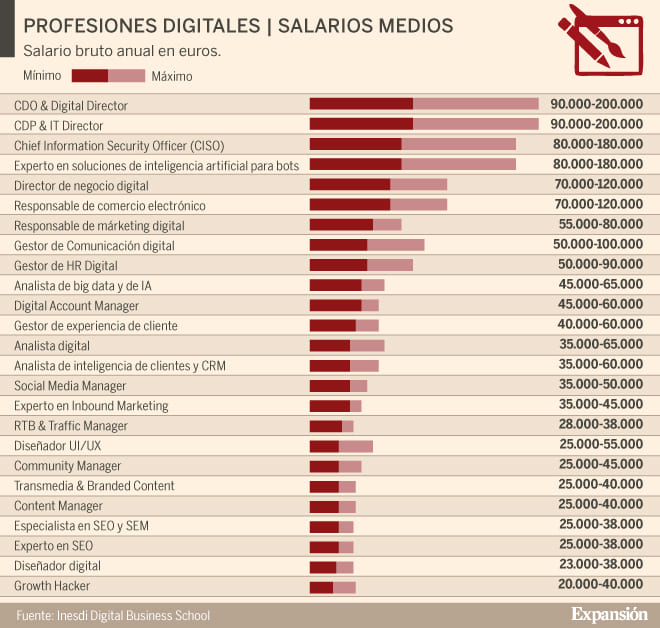
Image: Expansión, source: Inesdi Digital Business School
Social Media Manager Tools
There are plenty of tools that help implement a social media strategy.
Here’s a list of the best-known ones, though that doesn’t mean an SMM uses all of them. This depends on the company, the team, the budget, or each person’s specific role.
Metricool
It’s a very comprehensive tool used by a large number of professionals.
You can create reports, analyze, plan, monitor your website’s data, analyze any hashtag, or create and manage Google Ads and Facebook Ads campaigns.
Comprehensive, right? It can also be integrated with Twitter, Facebook, Instagram, Google, YouTube, and LinkedIn.
SocialGest
It’s a tool similar to Metricool.
It has a very intuitive interface where you can schedule, analyze, reply to comments, plan, create contests, monitor keywords, and work in teams.
Mention
It’s a social listening platform that identifies conversations about your brand or the keywords you choose.
It analyzes what’s said about you across all sources: social media, forums, blogs, and websites.
Google Analytics
It’s a web analytics tool. With it, you can find out your website’s visitors, how many come from social media, and exactly which social networks they come from.
You can also find out which pages have been the most visited from social media and create specific events.
Google Data Studio
With this platform, you can create a social media dashboard. In other words, it lets you bring together various data sources and statistics from your projects in one place.
In conclusion, a Social Media Manager‘s role is to develop the social media strategy in order to achieve the defined objectives.
Because without a strategy, there are no results.
I hope you enjoyed the article. If you have any questions, write to me in the comments. And if you found the article interesting, share it 🙂
Her work usually starts with a good social media plan and a clear understanding of the buyer persona she’s targeting.