Blue Monday: what it is, who invented it and how to use it (well) in your email marketing
The story of “the most depressing day of the year”, which began in a press release, and 8 email ideas for the third Monday in January

The story of “the most depressing day of the year”, which began in a press release, and 8 email ideas for the third Monday in January
Have you ever woken up on a Monday in January feeling like the whole world was against you? It’s cold, it gets dark early, your card is still feeling the Christmas spending and your resolution to go to the gym is already a memory.
The media have a name for that day: Blue Monday, “the most depressing day of the year”. Every January it turns up on the news, on social media and in inboxes. The funny thing is that no scientist discovered it. A travel agency invented it to sell vacations.
In this article we explain what Blue Monday is, who invented it and how much truth there is in its famous formula. We also look at why it is one of the most successful PR campaigns in history.
And, since you’ll be tempted to use it every January, we’ve included 8 Blue Monday email ideas with subject lines you can copy, along with the lines you shouldn’t cross.
Blue Monday is the third Monday in January, popularly known as “the most depressing day of the year”. In 2027 it falls on Monday, January 18.
In English, blue is a color, but it also means sad or melancholy, as in blues music. The idea is that several things that bring us down all come together on that day: bad weather, holiday debts, the end of the holidays and the New Year’s resolutions we have already given up on.
It sounds reasonable, but no study has ever shown that people are sadder on that Monday than on any other winter day.
Blue Monday first appeared in a press release from Sky Travel, a British travel agency, on January 24, 2005. The release presented a “formula” for calculating the most depressing day of the year, credited to Cliff Arnall, who was introduced as a psychologist from Cardiff University.
The media ran it without a second thought. It had everything a January news story needs: a specific date, a scientific-looking formula and a problem everyone can relate to.
It soon emerged that there was little academic about the story. Cardiff University clarified that Arnall had been a part-time tutor at a center linked to the university and no longer worked there.
Science writer Ben Goldacre later revealed that the press release arrived already written by the PR agency Porter Novelli, which was looking for academics willing to put their name to it. According to Goldacre, Arnall’s equations “don’t even make mathematical sense on their own terms”.
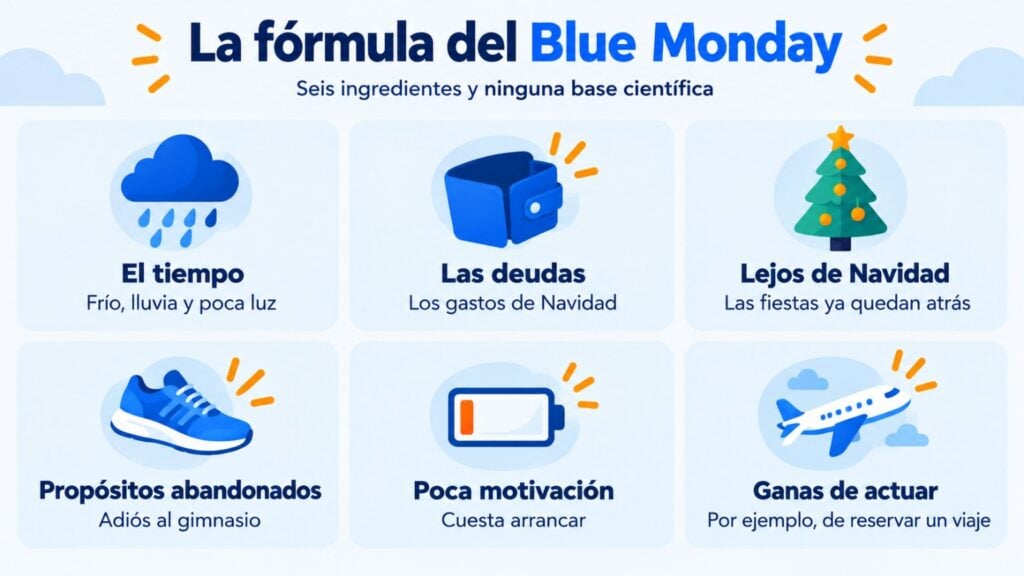
These are the variables the famous formula combined:
| Variable | What it claimed to measure |
|---|---|
| Weather | Cold, rain and few hours of daylight |
| Debt | What you owe after Christmas, compared with what you can pay |
| Time since Christmas | How far behind you the last celebration is |
| Abandoned resolutions | How long ago you gave up the gym or the diet |
| Motivation | How keen you are to start something new |
| The need to take action | The urge to change something… for example, to book a trip |
As you can see, the last variable fits a travel agency’s business perfectly. The formula’s conclusion was, basically, that you needed a vacation.
Years later, Arnall himself calculated the “happiest day of the year” for an ice cream brand: a day in June, close to summer. And in 2016 the Canary Islands hired him to “debunk” his own theory with a trip to the islands. The campaign, called “Stop Blue Monday”, won an award in 2017.
In 2018, Arnall told The Independent that he never intended the day to sound negative. His idea, he said, was to encourage people to take action.
Get your January campaigns ready now
Schedule your Three Kings’ Day, January sales and Blue Monday emails today, with up to 80,000 emails a month for free.
Not really. No study proves it: it is just another example of something being repurposed as a marketing tool. In fact, neuroscientist Dean Burnett called it a “farce” in 2013.
That doesn’t mean winter has no effect on mood.
The clock change, the lack of daylight or getting back into the routine can weigh on people. And some people with seasonal depression struggle for weeks, not just for one Monday. That is precisely why mental health organizations such as the UK’s Samaritans criticize reducing something serious to a date on the calendar.
Their response was to turn it around: every third Monday in January they hold “Brew Monday” (from brew, as in making a cup of tea), an invitation to have a cup of tea with someone and really ask them how they are.
A 2005 press release that still appears in the media around the world every January is a public relations success few campaigns ever achieve. Why did it work so well?
It names something we all feel. Nobody needs a formula to know that Mondays in January are hard. Blue Monday just gave it a name and a date.
It arrives at just the right time. January is a slow month for news, with a big appetite for light stories. A fixed date becomes an annual fixture.
It has a formula. Even if it makes no sense, an equation gives an air of rigor and makes the story easier to tell.
It invites people to join in. Any brand, media outlet or person can jump on the bandwagon, from a coffee shop to an airline. It’s the recipe behind many viral marketing examples.
What it doesn’t teach is to make up data. Blue Monday worked as PR, but today a baseless formula gets picked apart on social media in minutes. Just as with subliminal advertising, what remains is a good story, not a fact you can use in your email marketing strategy.
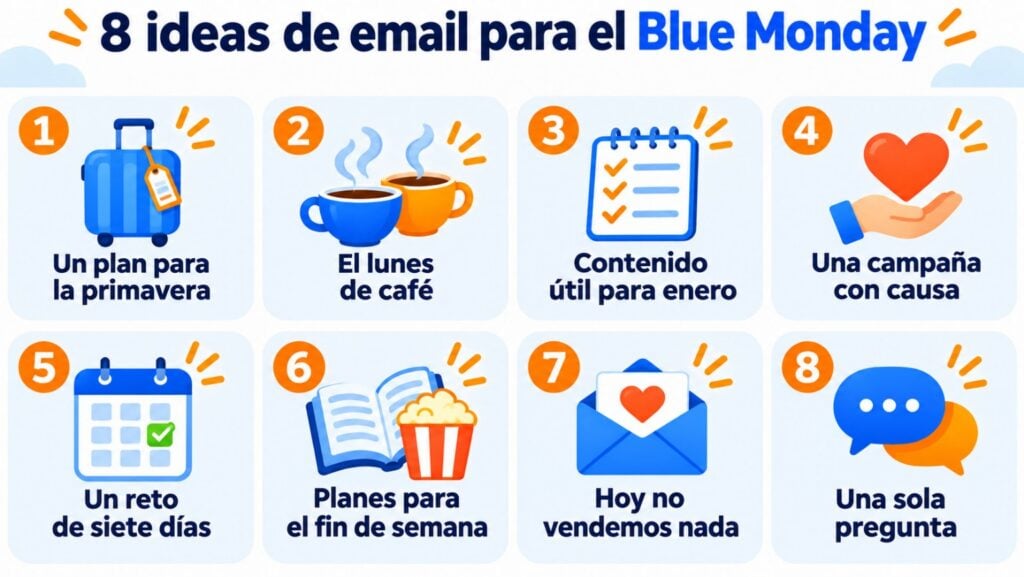
Blue Monday can be a good excuse to write to your list in a difficult month. The key is to offer something that makes the day easier, not to remind readers how sad they are. Here are eight ideas, each with the type of business it suits best and an email subject line for inspiration.
For: travel agencies, hotels, rural tourism, leisure.
Do what Sky Travel did, but honestly: don’t sell a cure for sadness, suggest a plan for the spring. If you work in tourism, you’ll find more ideas in our guide to email marketing for tourism and hotels. A getaway with a date, an early booking discount or a destination guide.
Subject: “Today we’re dreaming of April (and booking it)”
For: coffee shops, restaurants, bakeries, grocery stores.
Take inspiration from “Brew Monday”: a half-price coffee to share with someone, or a two-for-one designed for meeting up. The message isn’t “cheer up” but “meet up with someone”.
Subject: “This Monday, the second coffee is for someone else”
For: consultancies, banks, schools, any business with its own content.
A short guide to saving money, sorting out your finances or getting back into a routine is worth more than a discount. It’s content marketing in its purest form. It’s the kind of newsletter people save and forward.
Subject: “5 ideas to reach February with a calmer wallet”
For: any brand, especially if it already works with a charity.
Donate part of the day’s sales to a mental health or emotional support organization, and be transparent about it. If you’re interested in this format, you’ll find examples in our post on GivingTuesday.
Subject: “Today, every purchase helps someone not feel alone”
For: gyms, apps, training, healthy food.
Instead of bringing up abandoned resolutions, suggest a small, realistic challenge: seven days, one minute a day, no guilt. With an automation, each participant gets an email every day.
Subject: “A 7-day challenge you’ll actually finish”
For: bookstores, streaming platforms, media, leisure, fashion.
A selection of books, series, plans or recipes for the coming weekend. If you have data on each subscriber, personalization makes sure everyone gets what they like.
Subject: “What we’re watching, reading and cooking this weekend”
For: brands with a close relationship with their list.
Counter-programming works too. A short email, with no offers, that simply says thank you, tells a story with good storytelling or shares something nice. It’s a simple form of emotional marketing that strengthens customer loyalty.
Subject: “We’re not here to sell you anything today”
For: any business that wants to get to know its list better.
Ask what content they would like to receive this year, or what you could improve. A one-question survey, answered in one click, gets more responses than you might think and gives you data to segment your next campaigns.
Subject: “Can you help us with just one question?”
As you can see, none of these ideas promises to cure sadness. They all offer a small plan, some help or a gesture. If you can’t decide between two subject lines, run an A/B test and let your subscribers decide.
Blue Monday is a marketing device, but it touches on a sensitive subject. Before sending your campaign, check these points:
| Avoid | Do this instead |
|---|---|
| Talking lightly about depression or mental health | Talking about the cold, Mondays or the January slump |
| Promising that your product will make sadness go away | Suggesting a plan, some help or a small treat |
| Presenting the formula as if it were science | Telling the story with humor and admitting it was made up |
| Using fear or guilt to sell | Using a friendly, positive tone |
| Sending the same campaign to your whole list | Segmenting by interests and by how each group has responded to other campaigns |
If your brand works in a sensitive sector, such as health or social services, consider not using the date at all, or only using it to raise awareness of support resources. A clumsy message can do more damage to your image than any benefit from a campaign.
And in case something slips into your campaign, remember that Murphy’s law doesn’t take January off: check the subject line, the links and the segmentation before you hit “Send”.
January has a lot of dates in a row: Three Kings’ Day, the January sales, Blue Monday and getting back into the routine. With Mailrelay you can prepare them all in advance:
All of this in the free account, with up to 80,000 emails a month and 20,000 contacts, and human support on every plan. If you want to see the rest of the year’s key dates, check out our 2027 marketing calendar.
Let Monday the 18th work for you
Scheduled sending, segments and A/B tests in the free account, with human support on every plan.
Blue Monday is not the most depressing day of the year. It’s just another Monday: nobody likes Mondays, but this one isn’t special. It’s a Monday in January that a travel agency turned into news twenty years ago and that is now part of the calendar in much of the world.
That makes it an opportunity for your brand, as long as you use it wisely: offer something useful, don’t make light of sadness and think about the person who is going to read your email. Prepare the campaign before Christmas, schedule it for January 18 and, when the day comes, have a coffee with someone. Just in case.
These are the questions that come up most every January about Blue Monday.
Blue Monday 2027 is on Monday, January 18. It falls every year on the third Monday in January, although some media put it on the second or fourth.
Because in English blue is a color, but it also means sad or melancholy. Blue Monday means “sad Monday”.
It was made popular in 2005 by a press release from the British travel agency Sky Travel, with a formula credited to Cliff Arnall, who had been a tutor at a center linked to Cardiff University.
No, it isn’t: the Blue Monday formula has no scientific basis and there is no data showing that people are sadder on that Monday than on other winter days.
According to Cliff Arnall himself, in a calculation for an ice cream brand, it’s a day in mid-June, close to the start of summer. It has the same scientific basis as Blue Monday: none.
2027 marketing calendar: key dates and ready-to-copy email subject lines
Every date of the year so you can prepare your campaigns in good time.
Subliminal advertising: what it is, real examples and why it’s banned
Another famous advertising myth, debunked.
Murphy’s law: what it is, where it comes from and 20 laws that come true in your email marketing
So your January campaign doesn’t come with any surprises.
Funny emails: 15 examples and how to use humor in your campaigns
Ideas to raise a smile in the middle of January.

Jose Argudo
CMO at Mailrelay. Writes about email marketing, copywriting and conversion for small businesses and entrepreneurs.