Email marketing for tourism, hospitality and leisure
From booking to the next visit: which emails to send each season to fill places and build loyalty
Email marketing for tourism is the use of email by hotels, travel agencies, restaurants, parks and other leisure businesses to get bookings, keep their customers informed and encourage them to come back. It combines seasonal offers with booking-specific messages.
For many tourism businesses, it is the most direct way to sell without relying on intermediaries. Every direct booking saves commissions and leaves you with a customer you can keep talking to.
What makes email marketing in tourism different?
Seasonality. Demand rises and falls with holidays, long weekends and the weather. Your sends need to get ahead of each season.
Early decisions. Many people book weeks or months in advance. Email keeps them engaged during the wait and prepares their arrival.
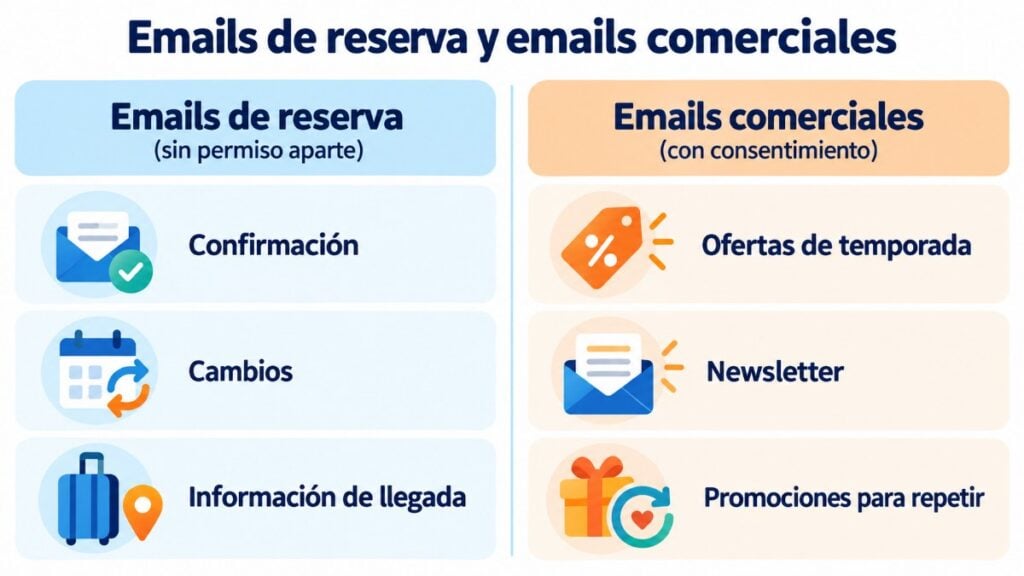
Two types of message. Transactional emails, such as the booking confirmation, must always arrive. Promotional emails aim for new sales and require permission.
Different audiences. Families, couples, business travelers, groups and agencies don’t expect the same messages.
Which emails should you send at each stage of the trip?
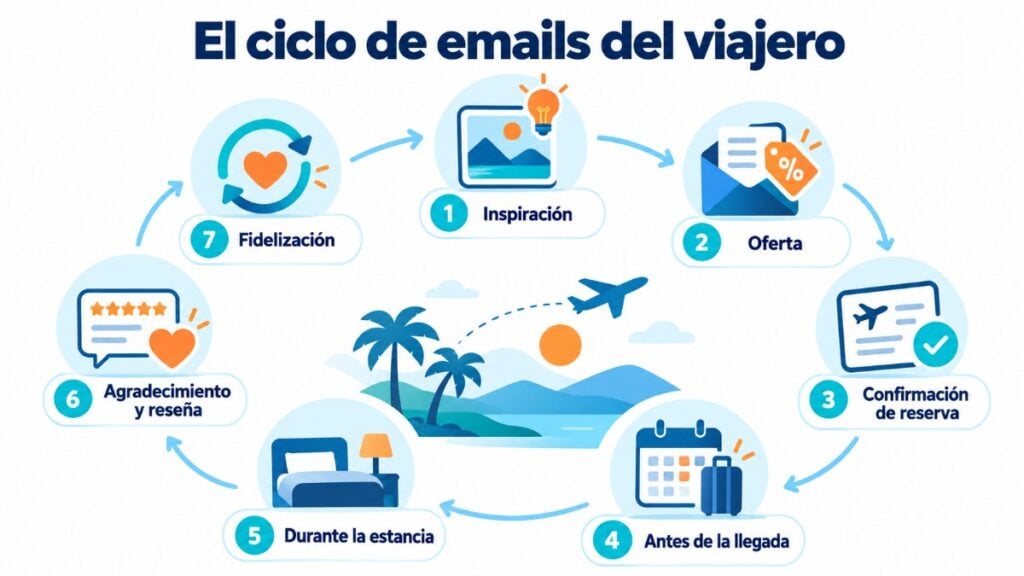
Each stage of the trip calls for a different email:
| Stage | Goal | |
|---|---|---|
| Inspiration | Newsletter with destinations, plans and news | Spark interest |
| Offer | Seasonal promotion or early-booking sale | Secure the booking |
| Booking | Confirmation with all the details | Provide reassurance |
| Before arrival | Practical information and extra services | Prepare the visit and sell more |
| During the stay | Welcome message and SMS alerts | Answer questions on the spot |
| After | Thank-you and review request | Improve your reputation |
| Loyalty | Offer to come back or on the anniversary date | Secure the next visit |
The pre-arrival email is one of the most useful. The customer has already bought and is looking forward to the trip, so they read carefully. It’s a good moment to offer transfers, dinners, tickets or a room upgrade.
For that email, you can start from our booking confirmation template. And for seasonal campaigns, from our ski week template. You’ll find more in Mailrelay’s free email templates.
Seasonal calendar for a tourism business
This calendar helps you plan your sends around each season:
| When to send | For which season | Typical message |
|---|---|---|
| January and February | Summer | Early-booking sale with a discount |
| February and March | Easter | Getaways and family plans |
| April and May | Spring long weekends | Last-minute deals |
| September | Autumn | Off-season getaways |
| November | Black Friday | Vouchers and discounted bookings |
| November and December | Christmas | Dinners, gift vouchers and New Year’s Eve |
Adapt the dates to your destination. A mountain hotel, a water park and a city restaurant don’t share the same peak seasons.
Get more direct bookings
Seasonal offers, confirmations and alerts by email and SMS from a single platform.
How do you segment the customers of a hotel or tourism business?
Segmentation is what separates a useful offer from an email that gets ignored. These are the criteria that work best:
Type of traveler. Families, couples, business travelers or groups.
Origin. Country, language and distance. A local customer responds to weekend getaways; a foreign one, to long stays.
History. Visit dates, spending, services booked and rating.
Booking channel. Direct, through an agency or through a booking platform.
Stage. A prospect who hasn’t booked yet, a customer with an upcoming booking or a customer who has already visited.
Consent: booking emails and commercial emails
Emails needed for the booking, such as the confirmation, changes or arrival information, don’t require separate permission. They are part of the service purchased.
To send offers, you need the customer’s consent. In Spain, the law allows you to write to customers with offers for services similar to those they already purchased, as long as they could opt out when giving you their details and in every send.
Be especially careful with bookings that come through intermediaries. That data usually has usage restrictions: invite the customer to subscribe to your newsletter during their stay or in the thank-you email.
Read our post on the GDPR and, if in doubt, consult your legal advisor.
A real example: Meliá Hotels International
Meliá Hotels International uses Mailrelay to manage its offers, exclusive packages and newsletters. The company highlights how quickly sends can be prepared and the help from the support team on projects across several countries.
You can read the full case in email marketing in the hotel sector: the Meliá case.
Metrics to measure tourism email marketing
Direct bookings. How many bookings come from each email.
Revenue per campaign. What each send generates compared with what it costs.
Extra services sold. Transfers, dinners or tickets sold from the pre-arrival email.
Repeat rate. Customers who come back in the following months.
Reviews obtained. Responses to the review request after the stay.
Common mistakes
Sending only in high season. If you only write in summer, customers forget about you the rest of the year.
Sending the same offer to everyone. A romantic getaway doesn’t interest a family with children.
Mixing the confirmation with advertising. The booking email must be clear: the details first, everything else afterwards.
Forgetting about mobile. Many travelers check their booking and arrival time on their phone.
How Mailrelay helps you
With Mailrelay, you create your seasonal newsletters with the editor, segment by type of traveler and schedule each offer for the right date. You can also send SMS alerts from the same platform.
The Instituto Tecnológico Hotelero (ITH), for example, simplified its sends to the industry with designs that are quick to create and statistics to measure the impact of each campaign (see the ITH case).
Iberocruceros, for its part, was looking for attractive newsletters, a competitive cost per email and advanced statistics (see the Iberocruceros case).
The free account includes up to 80,000 emails a month and 20,000 contacts, with human support on every plan. If you organize trade fairs or activities, also check out email marketing for events.
Start free with your hotel or tourism business
Up to 80,000 emails a month and 20,000 contacts, with human support on every plan.
Frequently asked questions
These are the most common questions about email marketing in the tourism sector.
What is email marketing for hotels?
The use of email to get direct bookings, inform guests before and during their stay and encourage them to come back.
When should you send summer offers?
Between January and March for early-booking sales, and in May and June for last-minute deals.
Can I send offers to people who booked through a platform?
It depends on that platform’s terms and on the customer’s consent. The safest option is to invite them to subscribe during their stay.
What should you include in the pre-arrival email?
Check-in time, directions, parking, available services and an offer of extras.
How can you get more reviews by email?
Send the thank-you email one or two days after check-out, with a single button to leave a review and a short message.
Related entries
If you found this useful, here are some other related reads: