Owned, paid and earned media: why your email list is the channel no one can take away from you
Algorithms change and accounts get shut down. Your subscriber list is still yours
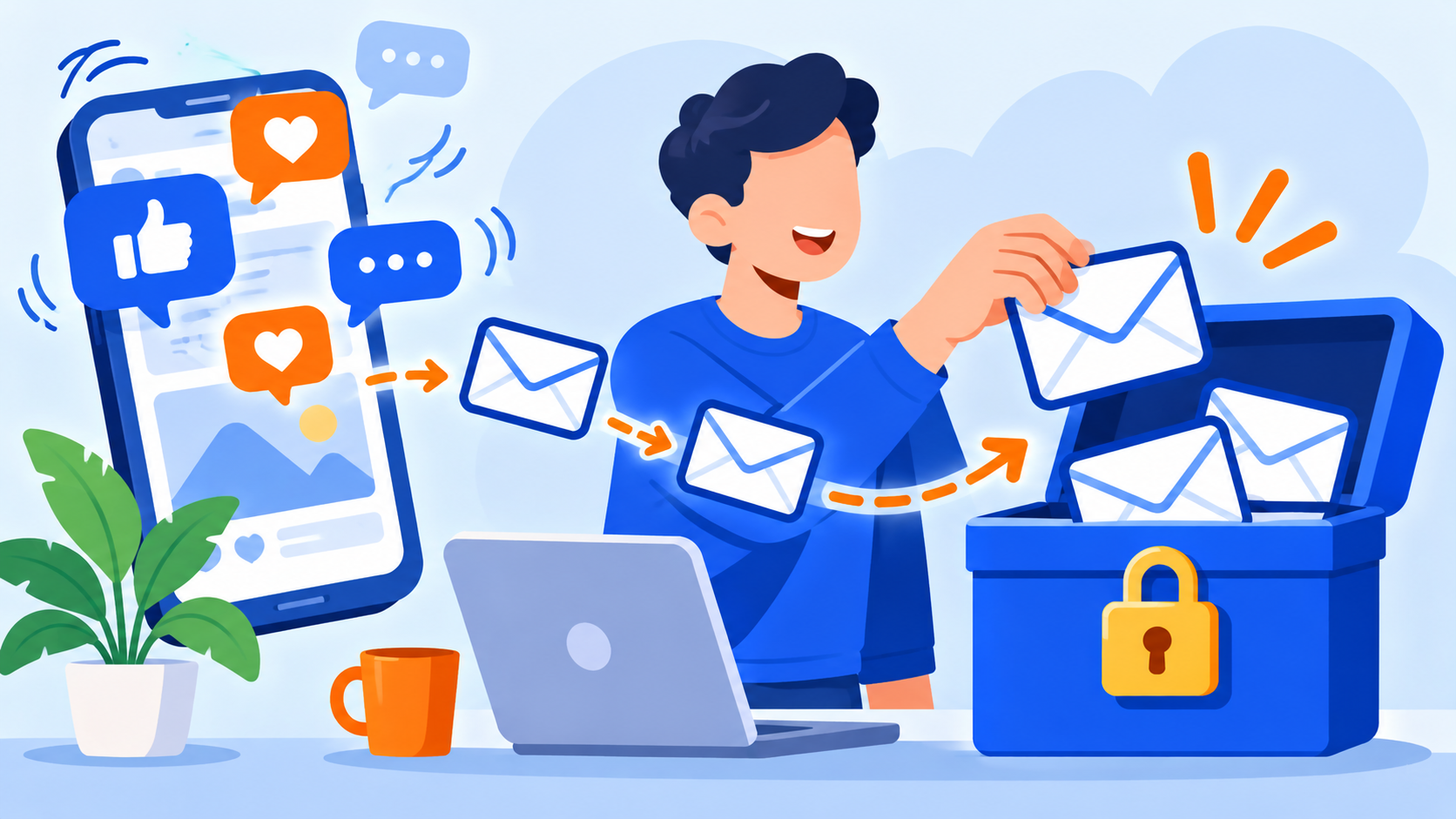
Algorithms change and accounts get shut down. Your subscriber list is still yours
How many of the people who follow you on Instagram saw your last post? If you don’t know, the platform does. And it’s the one that decides.
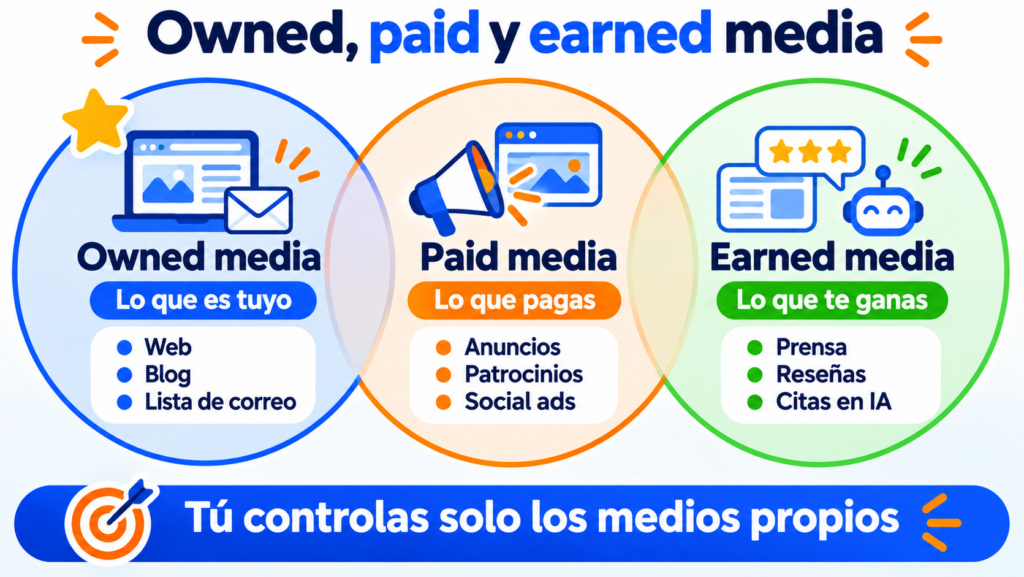
That’s the difference between the channels you control and the ones you rent. Owned media are your own channels (your website, your blog, your email list). Paid media are the ones you pay for (ads). Earned media are the ones you earn (press, reviews, recommendations).
Of the three, the email list is the only owned channel that lets you talk to your audience whenever you want, without depending on an algorithm.
Let’s look at what each type of media is, the risks of relying only on rented channels, and how to move your followers to a list that is yours.
The owned, paid and earned media model classifies a company’s channels by who controls them and how much they cost.
It’s used to plan marketing and to split the budget.
| Type | What it is | Examples | Who controls it | Cost | Main risk |
|---|---|---|---|---|---|
| Owned media | Channels your company owns | Website, blog, email list, app | You | Time and tools | Nobody visits them if you don’t feed them |
| Paid media | Spaces you pay to appear in | Google Ads, social ads, sponsorships | The platform | Every impression or click | They disappear when you stop paying |
| Earned media | What others say about you without you paying | Press, reviews, mentions, AI citations | Third parties | Indirect (quality and relationships) | You can’t control it |
Social media sits in a middle ground. Your profile looks like your own, but the rules belong to the platform. That’s why many experts call them “rented channels”.
Owned media are the channels you control from start to finish. You decide what you publish, when and for whom. Nobody can change the rules overnight.
Your website and your blog attract visits. Your newsletter lets you talk again to people who already know you.
And the data you collect (who opens, who buys) is yours too, something increasingly valuable with the disappearance of third-party cookies and the rise of data customers share with you directly.
Paid media is everything you pay for to reach someone: ads on search engines, on social media, in the media or on other websites.
It works fast and can be measured in detail, as you’ll see in any guide to digital advertising. You’ll find the types and how each one is paid for in the paid media entry.
Its limit is obvious. When you stop paying, the reach ends. Every new customer costs money again, and that pushes up your customer acquisition cost (CAC).
Earned media is the visibility others give you: a press article, a Google review, a customer who recommends you or a creator who talks about you.
It’s usually the result of doing things well and working on your public relations. We explain it with examples in the earned media entry.
In 2026 there’s a new form of earned media: being cited as a source by ChatGPT, Gemini or Google’s AI summaries. Nobody can buy that mention, but you can work towards it with good content.
Do you already have a channel of your own?
Create forms and landing pages for free with Mailrelay: 80,000 emails a month and 20,000 contacts on the free account.
Social media and search engines are useful for getting discovered. The problem arises when your whole business depends on a channel whose rules you don’t control.
These are the four most common risks.
Someone following you doesn’t mean they see what you post.
According to Socialinsider‘s latest reach study, in 2026 a Facebook post reaches on average less than 2% of the page’s followers, and Instagram reach fell 14% in a year.
In other words: out of every 1,000 followers, fewer than 20 people see your post on Facebook.
With a well-managed email, the message reaches the inbox of your entire list.
In June 2025, thousands of Facebook groups were suspended or deleted worldwide. Some had millions of members. Meta acknowledged a “technical error”, according to TechCrunch.
If your community lives on only one platform, someone else’s mistake can leave you without a channel. Getting the account back can take weeks, and it doesn’t always happen.
SEO is still an excellent channel, but it has changed too.
A Pew Research study of searches from March 2025 found that when an AI summary appears, users click on a result in 8% of visits, compared with 15% without a summary, as reported by Search Engine Roundtable.
More visibility doesn’t guarantee more visits. That’s why every visit that does arrive should have a way to stay with you, and a subscription form is the simplest one.
Paid media is like renting a shop on the best street. It works as long as you pay.
The day you stop paying, traffic goes back to zero and you’re left with nothing that keeps working for you.
Ads make sense for acquisition. The smart move is to use them to bring people to your list, not just to a one-off sale.
The website, the blog and the email list are all owned media.
But they don’t work the same way: the website and the blog wait for the reader to come back; the list lets you go and find the reader.
| Owned channel | Needs people to look for you | You can start the contact | You measure each person |
|---|---|---|---|
| Website | Yes | No | A little (cookies and consent) |
| Blog | Yes | No | A little |
| App | It has to be installed | Yes (notifications) | Yes |
| Email list | No | Yes | Yes |
Email is also used by almost everyone. 89.1% of internet users in Spain sent or received emails in 2025, according to the INE ICT-H survey.
And an email address doesn’t depend on any trendy social network.
But there’s an important detail. A list is only worth as much as the permission of the people who sign up. Buying databases or adding contacts without consent breaks the GDPR and damages deliverability. You’ll find the rules step by step in the guide to legal email marketing.
Double opt-in is the best guarantee that every contact wants to hear from you.
Social media helps people discover you. Your list makes sure they don’t lose you.
Here are seven ways to move people from one to the other, each with a text you can adapt.
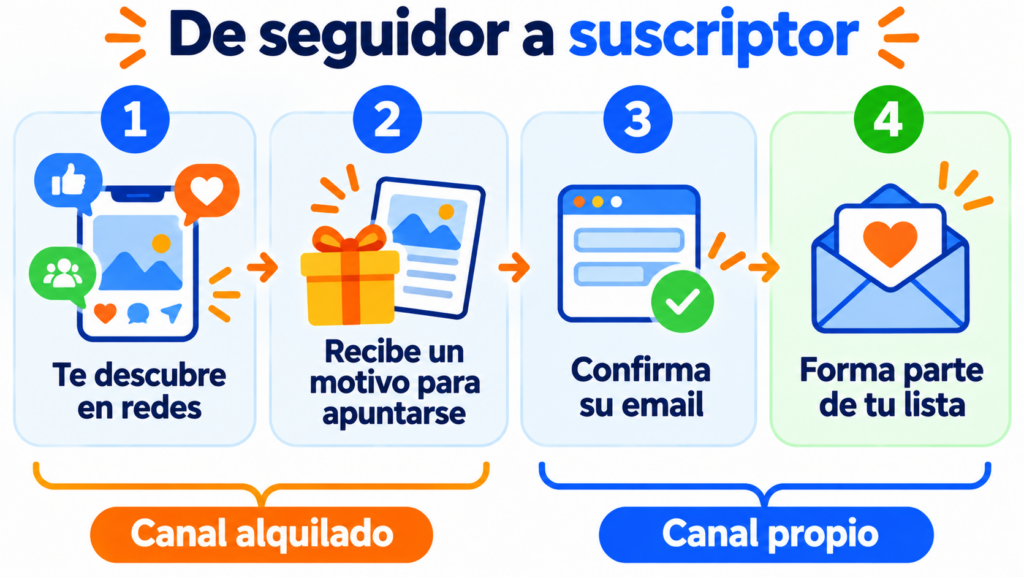
Your bio is the only fixed link you have on Instagram or TikTok. Use it to send people to a simple subscription page with a clear benefit.
Text to copy: “Every Tuesday, a practical tip for your business in your inbox. Sign up for free 👇”
Many people don’t subscribe because they don’t know what they’ll receive. A pinned post explains it in 10 seconds: frequency, topic and an example.
Text to copy: “What’s in our newsletter? One email every two weeks with offers before anyone else and a practical guide. No spam: unsubscribe with one click. Link in bio.”
A lead magnet is something of value you give away in exchange for an email address: a template, a guide, a discount.
The more specific it is, the better it converts. You’ll find plenty of options in these lead magnet ideas.
Text to copy: “Download for free the template we use to plan a month of content. We’ll send it to you by email.”
The end of a video is when someone who has watched it all trusts you most. Use it for a short call to action, with the link in the description or in a pinned comment.
Text to copy: “If this helped, I send a tip like this every week in my newsletter. The link is in the description.”
Giveaways attract lots of people, but also prize hunters. Ask for the email with double opt-in and explain that they’re subscribing to your list. That way you comply with the law and keep contacts who actually read you.
If you run them on Instagram, check out these giveaway and contest ideas.
Text to copy: “To enter, sign up for our newsletter and confirm your email. We’ll announce the winner there on the 30th.”
LinkedIn lets you publish newsletters within the platform, but those subscribers still belong to LinkedIn.
Use your posts to invite people to a list of your own, with content you don’t publish there.
Text to copy: “Every month I send my list a longer analysis that I don’t publish here. If you’re interested, the link is in the first comment.”
If you serve customers on WhatsApp, you already have conversations with interested people.
A WhatsApp link leads to the conversation; email lets you stay in touch in an organized way. Always ask for consent separately.
Text to copy: “Would you like to get our news by email once a month? If so, leave your email address here: [link]”
If you want to compare which channel to use for each message, there’s a guide on email, SMS or WhatsApp.
There’s no perfect split. It depends on your company’s stage. This table is guidance for management, not a fixed rule.
| Stage | Paid media | Owned media | Earned media | List goal |
|---|---|---|---|---|
| Starting out | A lot: you need people to know you | Basic website and a form from day one | Reviews from your first customers | Get your first 500 subscribers |
| Growing | Medium: ads that lead to your list | Regular newsletter and welcome automation | Local press, partnerships | Have email bring in sales every month |
| Established | As much as needed for acquisition | Segmentation and your own content | Mentions, AI citations, public relations | Reduce dependence on ads |
Notice that paid media appears at every stage, but its role changes. At first it buys reach. Later, it buys subscribers who then cost you nothing.
If you want to see how it fits into your communication plan, the post on the media plan will help you organize it.
Management understands an asset better when it has a price. A simple way to calculate it: divide the revenue email brings you in a year by the number of subscribers.
If email brings you €18,000 a year and you have 6,000 subscribers, each subscriber is worth about €3 a year.
With that figure, acquiring a subscriber for €1 with ads is a good investment.
To connect that value with customer lifetime value and defend it in a meeting, you’ll find arguments, an ROI calculation and a template in the benefits of email marketing.
Mailrelay gives you everything you need to turn visitors and followers into a list of your own. Every plan, including the free one, includes:
| To… | With Mailrelay |
|---|---|
| Capture subscribers | Signup forms and landing pages with templates |
| Welcome them | Automations with a signup trigger |
| Send each person what interests them | Groups, tags, segments and custom fields |
| Measure | Campaign, conversion and unsubscribe reports |
The free account includes 80,000 emails a month and 20,000 contacts, with human support on every plan. You can start your list today without paying for a license.
Start your own list today
Signup forms, welcome automation and segmentation on every plan, with human support.
Social media, search engines and ads will remain the gateway for many customers. Use them.
But every follower who stays only on a platform is a contact you don’t control.
The plan is simple: invest in paid media to get discovered, work on earned media to get recommended, and turn that attention into owned media.
Start by putting a form on your website and a link in your bio. The rest comes with consistency.
These are the most common questions about the three types of media.
Owned media are a company’s own channels: the ones it controls and doesn’t pay third parties to appear on.
The most common are the website, the blog, the email list and the app.
Paid media is what you pay to appear (ads). Owned media is what’s yours (website, blog, email list).
Earned media is what others say about you without you paying (press, reviews, recommendations).
Not entirely. You manage your profile, but the platform decides who sees your posts and can change the rules or close your account.
That’s why they’re considered rented channels. What others post about you on social media, however, is earned media.
A press article, a Google review, a mention by an influencer, a customer who recommends you, or an AI like ChatGPT citing you as a source.
What they all have in common is that you don’t pay for them directly.
Appeal through the platform’s official process and keep all the evidence. In the meantime, let your customers know through the channels you do control, like your email list or your website.
That’s why it pays to have your own list before you need it.

Jose Argudo
CMO at Mailrelay. Writes about email marketing, copywriting and conversion for small businesses and entrepreneurs.