Paid media: what it is, types of paid media and how to make the most of them
Ads bring visits for as long as you pay. Here's how to use them to win customers who stay
Paid media is all the visibility a company buys to reach its audience: ads on search engines, social networks, websites, videos or sponsorships.
It is also known as paid advertising. It is one of the three types in the owned, paid and earned media model.
The other two are owned media (your website, your email list) and earned media (press coverage, reviews, recommendations).
What is paid media?
It’s the part of marketing where you pay a platform to show your message to people who don’t know you yet.
You can pay per impression, per click or per result, depending on the channel.
Its big advantage is speed. A well-built campaign can bring in visits the same day. Its big limitation is just as clear: when you stop paying, the reach ends.
That’s why it works better as an accelerator than as a foundation. It attracts people; owned media makes sure they come back.
Types of paid media
Paid channels differ in where the ad appears and how you’re charged. These are the most common:
| Type | Where it appears | How you usually pay | What it works best for |
|---|---|---|---|
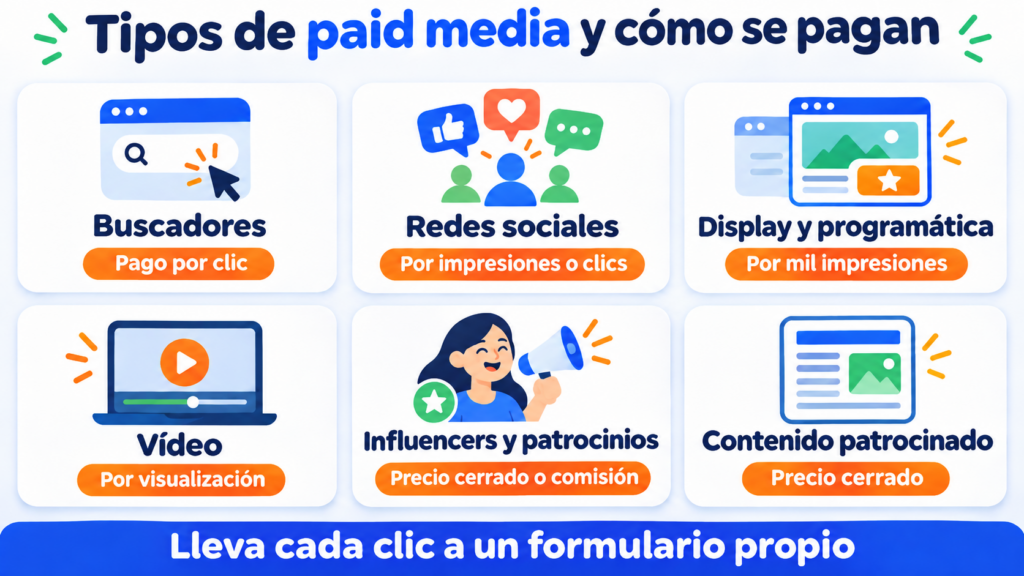
| Search engine advertising (SEM) | Google or Bing results, Google Shopping | Per click (CPC) | Reaching people already searching for what you sell |
| Social media ads (social ads) | Instagram, Facebook, TikTok, LinkedIn | Per thousand impressions (CPM) or per click | Building awareness and generating demand |
| Display and programmatic | Banners on websites and apps | Per thousand impressions | Keeping your brand top of mind and retargeting |
| Video | YouTube, streaming platforms | Per view | Explaining a product or a brand |
| Influencers and sponsorships | Creator profiles, events, media outlets | Fixed price or commission | Reaching a community that already trusts them |
| Sponsored content | Paid articles in media outlets, branded content | Fixed price | Telling a story in more depth |
Collaborations with influencers are paid media when there’s payment or a product in exchange. If the creator talks about you on their own initiative, it becomes earned media.
Paid media examples
Here are three simple cases of how a small business uses paid advertising:
- An online coffee shop invests in Google Shopping to show up when someone searches for “specialty coffee beans”.
- A language school runs Instagram ads offering a free level test in exchange for an email address.
- A B2B consultancy promotes a downloadable guide for finance directors on LinkedIn.
Notice that the last two aren’t after an immediate sale. They use the ad to get a contact of their own, whom they can then write to without paying again.
Advantages and disadvantages of paid media
| Advantages | Disadvantages |
|---|---|
| Fast results, from day one | Reach disappears when you stop paying |
| Very precise targeting by interests, location or age | Cost per click rises with competition |
| Everything is measurable: impressions, clicks, conversions | The platform sets the rules and can change them |
| Scalable: more budget, more reach | People trust an ad less than a recommendation |
The metric most worth watching is ROAS, which tells you how much revenue you get for every euro spent on ads. Alongside it, track cost per acquisition (CPA) or cost per lead.
Differences between paid media, owned media and earned media
The three types of media complement each other. The difference lies in who controls the channel and how much each contact costs, something worth being clear about when you prepare your media plan.
| Paid media | Owned media | Earned media | |
|---|---|---|---|
| What it is | What you pay for | What you own | What you earn |
| Examples | Ads, sponsorships | Website, blog, email list | Press coverage, reviews, mentions |
| Control | The platform’s | Yours | Third parties’ |
| Cost per contact | You pay every time | Almost zero once created | Indirect |
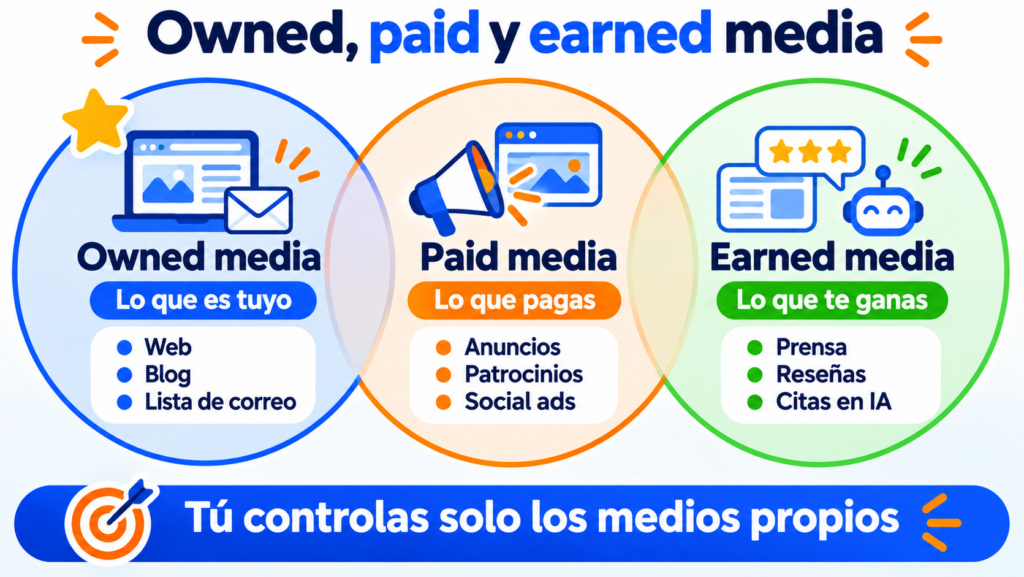
Ads generate the first visit. Earned media builds trust. And owned media, especially an email list, turns that attention into a relationship that doesn’t depend on continuing to pay.
How to build a paid media strategy
A strategy like this doesn’t have to be complex. For a small business, these five steps cover what matters:
- Define your goal: sales, contacts or awareness. Each one is measured differently.
- Choose one or two channels where your customers already are, instead of spreading a small budget across many.
- Set a test budget and a maximum cost per result. The marketing budget guide helps you fit it in.
- Send the traffic to a page of your own: a landing page with a form converts better than the home page.
- Measure and adjust every week using your KPIs: switch off what doesn’t work and scale up what does.
The fourth step is the one most often forgotten. If you also offer a lead magnet, even better. An ad that ends in a subscription form keeps delivering results months later, because that contact is now yours.
What does a paid media specialist or paid media manager do?
They’re the professional who plans, launches and optimizes paid campaigns. They choose the channels and allocate the budget.
They also prepare the ads with the creative team and analyze the results with tools such as Google Ads.
In small companies, it’s usually the same person who handles digital marketing. In agencies and large companies, there are separate roles per channel: search, social or programmatic.
If you want to see how it fits with the other channels, you’ll find an overview in these digital marketing strategies and in the digital advertising guide.
Turn your clicks into a list of your own
Create forms and landing pages for free with Mailrelay and email those contacts without paying for them again.
Frequently asked questions about paid media
Two questions that often come up when searching for this term.
Not exactly. Paid social refers to ads on social networks, and it’s only one part of paid media, which also includes search engines, display, video and sponsorships.
How much should you invest in paid media?
It depends on your industry and your goal. The sensible approach is to start with a test budget, set a maximum cost per contact or per sale, and increase spending only on the ads that meet it.