One of the purposes of marketing in the business world is the plain, straightforward promotion of products or services to get more sales for a business.
However, for some years now, new terms have been appearing with the aim of reaching the audience in a distinctive way. And that’s what I want to talk to you about.
“It is true that, nowadays, many companies worry about competing and making big profits. But, curiously, what really concerns more and more of them is bringing about social change and raising awareness.”
We tell you all about it at Mailrelay.
What Is Social Marketing and What Is Its Purpose?
“Social Marketing is the design, implementation and control of programs that seek to increase the acceptance of a social idea or cause among specific target groups. – Philip Kotler”
Based on this definition, it should be pointed out that this type of marketing uses the same resources as traditional marketing.
What changes here are its goals, which are not focused exclusively on selling products or services, but on stirring society’s conscience and encouraging the public to act for a greater common good, such as reducing pollution, protecting flora or promoting recycling.
Unlike traditional marketing, this kind doesn’t have to keep up appearances. What companies that apply social marketing do have to do is be consistent with the values they convey (and lead by example).

Goals of Social Marketing
With so much competition, where more and more importance is given to online presence and reputation, brands should consider building these highly effective social initiatives into their overall marketing strategy.
In fact, the benefits companies gain can be divided into three, depending on each one’s goals:
Social benefit
This is the approach of companies that don’t seek to generate a direct financial gain, but to position themselves as socially responsible brands. In doing so, they seek to promote social change by doing their bit for a social cause related to issues such as the environment, education or inequality.
Commercial benefit
Here we are talking about social marketing actions whose goal is purely financial. And to that end, they work on normalizing the use of a little-known or seasonal product (such as those that sell more in summer, like ice cream).
Mixed benefit
Thirdly, we have companies that see social change as a business opportunity. Therefore, they aim to change society’s behavior for their own benefit (selling their products), as well as to help build a better place.
How to Apply Social Marketing in Your Business?
Taking into account everything explained so far, you have probably come to see this type of marketing as a strategic tool for your own business. And you’re right, since we brands influence society and, therefore, we have a responsibility in that regard.
But before taking the step and implementing social marketing, don’t forget to take note of a few tips to help you establish yourself as a socially responsible brand:
Identify a cause that matters
Identify a social problem where you think you can help people feel better collectively. From there, it will be easier to follow a plan and set a goal.
Look for partners, grants or public funding
Find other companies and collaborators who share your values so you can reach your goals faster. Alliances open up endless possibilities.
Define actions linked to your business
Use common sense to carry out actions that have to do with your business. You’re not going to give away cosmetics if your business is in the automotive sector.
Communicate your values to the public to encourage them to take part
Keep at it until your audience understands the value of your actions and is encouraged to take part.
Create and design ads and content that represent your philosophy
The more people you reach with a direct, clear message, the better, since more of them will realize the value of your actions. For this, an email campaign strategy can be very effective, since it will let you stay in constant contact with your target audience.

Other articles you may be interested in:
- 15 Methods to Grow Your Subscriber List
- Learn to Sell by Email Step by Step
- How to Write a Welcome Email
Examples of Social Marketing Strategies
After a theoretical review of the basics of social marketing, it’s time to give this article a more practical touch.
So, let’s look at some examples to give you an idea of how some powerful brands have included social marketing in their strategies, achieving something that no other type of marketing can reach… an incredible social transformation!
► The basics of Social Marketing for your own benefit
When a company applies social marketing for its own benefit, whether to improve its brand image, its online reputation or to get more sales, one of the most widely used techniques (and the one that generates the greatest impact) is persuasion applied in texts and branding elements.
Be careful not to apply persuasion as a manipulation technique, since the two terms tend to get confused. Remember that the latter seeks to influence other people by distorting information with lies for its own benefit.
To avoid mixing up these two concepts and to use persuasion properly in your social marketing campaigns, I recommend you read this article so you can clearly tell the difference between persuading and manipulating.
► Examples of Social Marketing based on alternative uses
Some brands apply social marketing to encourage the consumption of a specific product that is out of season. For example, Magnum sometimes encourages people to eat its ice creams in winter too.
In fact, at Christmas this brand launched the gourmet product “Magnum Mini Baileys”, a treat to enjoy after a meal during the holidays.

As you can see, this is an example where a new product is launched to promote it during special dates, when consumers are precisely more inclined to eat sweets and don’t deny themselves anything.
► Examples of Social Marketing for raising awareness
There are also brands that are looking, precisely, for a change in habits and to make people aware that a better world can be built. Their goal is for the public to identify with the marketing campaign.
Specifically, today we are seeing this with many supermarkets and the issue of plastic bags.
For example, at Mercadona, Lidl or Día, we see how, to contribute to protecting the environment, they are encouraging consumers to bring reusable bags from home to do their shopping. If they don’t, they will have to buy them in the store (they used to be free).
A second example I want to present under this point is a government campaign that promotes the use of cloth or raffia bags instead of plastic.

Right now, social media, and even television, are giving a lot of attention to the damage plastic is doing to our ecosystem, especially in the seas and oceans, where thousands of marine species are dying (along with other important repercussions).
Continuing with the topic of plastic use, a recent study concluded that men don’t use, and don’t want to use, cloth bags. This is one of the reasons why there is more activity in this campaign, and why every effort is being put into raising awareness about this cause that affects us all.
Another example that seeks social change is the awareness campaign run by WWF (the independent nature conservation organization), which set itself the goal of reducing paper consumption in all areas to prevent trees from being cut down.
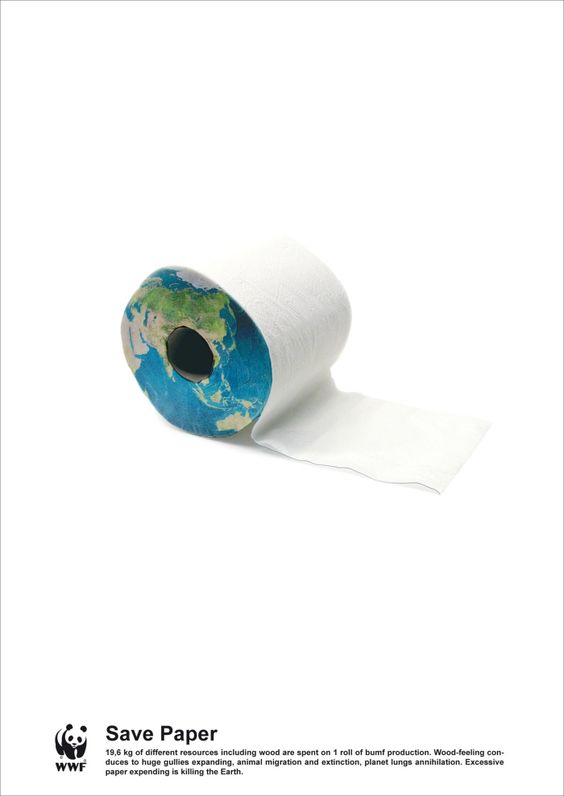
In its campaign, WWF offered solutions for not using paper. These include using online tools, not printing emails, reusing paper and other alternatives to help make the planet more sustainable.
► Examples of Social Marketing based on normalization
Another success story, in which we can see how social marketing is applied to normalize the presence in the market of an unknown product, is Roll’eat.
This company’s philosophy is to bet on smarter consumption and to promote environmental education through its use. To do so, they use original, functional materials that don’t have a harmful environmental impact, steering clear of others like aluminum or plastic, which are increasingly damaging the planet.
Roll’eat’s range consists of sandwich pouches, snack pouches and food-container pouches, which are very well known locally. But to reach more consumers, they work on normalizing these terms so that other users find them more familiar (bags for food containers or lunch boxes).
It is, without a doubt, an example that also serves environmental awareness, since the materials they use are reusable, adjustable and easy to wash.
CONCLUSION
Social marketing is a technique used by many brands, but not all of them apply it for the same purpose. In fact, the main problem is that sometimes the actions carried out are not consistent with the company’s real values.
And that is the first thing they need to be clear about: the cause they are going to defend and its purpose, if they don’t want to throw it all away.
If consumers perceive that a brand doesn’t look after those interests or values, and that it has taken on a strategic role solely to boost its sales at a specific moment, this will work very much against the brand. And, what is worse, it will hurt its reputation, through word of mouth, criticism on social media, a reputation crisis and the loss of customers.
What other social marketing campaigns do you know of that have influenced consumers and brought about a change in society?