How to start a business from scratch: 10 steps to get started on a small budget
Validate your idea before you invest, work out how much you need and win your first customers without risking your savings

Validate your idea before you invest, work out how much you need and win your first customers without risking your savings
Has a business idea been going around in your head for months, but you don’t know where to start?
I get it. Almost everyone who wants to start a business gets stuck at the same point: there are so many things to do that they don’t know which comes first.
The good news is that to start a business from scratch you don’t need a lot of capital or an 80-page plan. What you need is the right order. Validate before you invest, spend only on what brings you closer to your first customers and measure what works.
In this guide you’ll find the 10 steps I would follow if I had to start over today. You’ll also see how to start a business on a small budget or from home, and the mistakes that cost the most at the beginning.
Starting from scratch means launching a business with no customers, no brand and, often, no previous experience as a business owner. You’re not starting from a business you bought, a franchise or an inherited customer base.
That has one clear disadvantage: everything depends on you. But it also has an advantage. You can start small, test things and change course without it costing you a fortune.
That’s why the goal of the first few months isn’t to “set up the company”. It’s to prove that someone is willing to pay for what you offer. Everything else comes later.
Before you touch a single number, spend an afternoon honestly answering these three questions:
For the third question, it will help to analyze your strengths and weaknesses as an entrepreneur. It’s the second part of this series and helps you see where you’ll need support.
These steps are in order for a reason: each one reduces the risk of the next. You can move faster on some of them, but don’t skip validation.
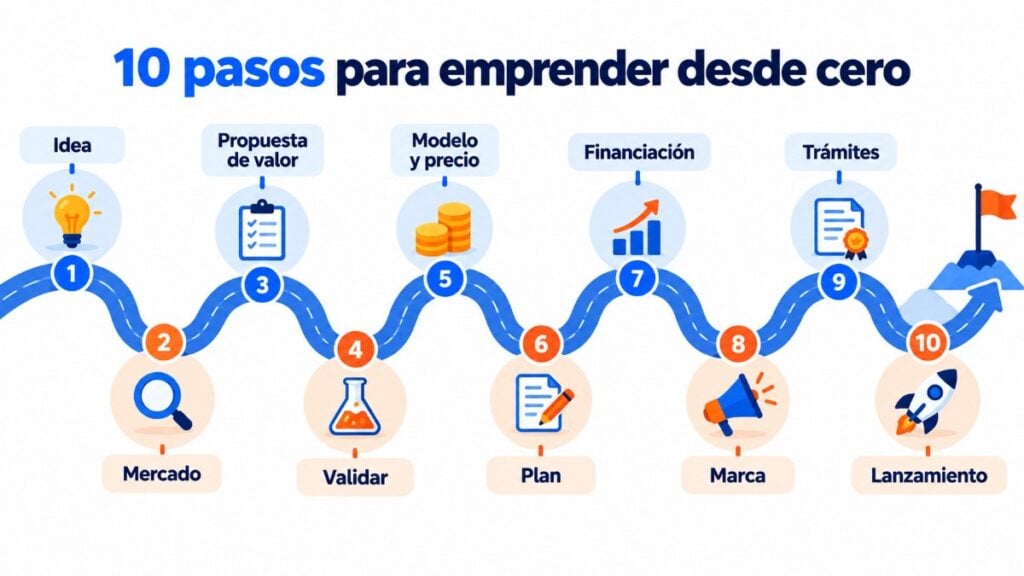
Passion helps, but it doesn’t pay the bills. A good business idea lies where three things meet: what you enjoy, what you’re good at and what the market needs.
Make a list of 5 to 10 ideas and score each one from 1 to 5 on those three criteria. Keep the two or three with the highest scores.
If you need inspiration, check out these sustainable business ideas or think about problems you’ve had yourself. Many businesses are born out of a personal frustration.
Now it’s time to check whether there’s a market. Are there people with that problem? Do they already pay to solve it? Who solves it for them today?
You don’t need to hire a consulting firm. With a simple market research study you can answer the basics:
With what you learn, sketch out your buyer persona: who they are, what worries them and where they look for information. If you want to go a step further, analyze your industry with Porter’s 5 forces.
Your value proposition answers one question: why should someone buy from you and not from someone else?
It could be price, speed, specialization, customer service or a different way of doing things. What matters is that it’s specific and that your customer cares about it.
Try writing it with this structure:
I help [type of customer] [achieve a result] without [the problem that holds them back the most].
That sentence will be the basis of your USP or unique selling proposition, your website and your first sales messages.
This is the step that saves the most money and the one most people skip. Validating means getting proof that someone will pay for your product before you fully build it.
For that you use a minimum viable product: the simplest version that solves the problem. It’s the foundation of the lean startup method. Some ways to validate with very little money:
My advice is to start with the waiting list. If you can’t get people to give you their email, they’re unlikely to give you their money. And that list will be your first sales channel on launch day.
Create your waiting list for free
Collect the emails of your first interested people with a form and let them know on launch day.
With your idea validated, decide how you’re going to make money: one-off sales, subscriptions, hourly services, commissions or a freemium model. You’ll find examples of each one in our guide to business models.
Next, set a price. Don’t copy your competitors’ price or pick one by guesswork. Work out your costs, your break-even point and what your customer is willing to pay. I explain it step by step in how to price a product.
Also think about whether your business can grow without you working twice as hard. That’s the difference between self-employment and a scalable business.
A business plan helps you think in an orderly way and explain your project to a bank or a partner. It doesn’t have to be long: it has to be honest.
At first, a single page that answers the following is enough, as in the Business Model Canvas:
| Section | What to answer |
|---|---|
| Problem and customer | What you solve and for whom |
| Value proposition | Why they’ll choose you |
| Channels | How your customers will find you |
| Revenue | How much you charge and how |
| Costs | What you need to pay each month |
| Metrics | Which number will tell you you’re on track |
For the last row, choose a few KPIs and a North Star Metric that sums up your progress. For example, customers who pay every month.
Also set goals for 3, 6 and 12 months. They’ll help you decide when to keep going and when to change course.
Add up what you need to get started (equipment, website, paperwork, initial stock) and what you’ll spend each month until the business pays for itself. Add a cushion to that figure, because almost everything takes longer than planned.
These are the most common sources of funding when you’re starting out:
Before asking for money, read this guide on liquidity and financing. It will help you avoid running out of cash in the first few months.
Your brand is how people recognize and remember you. Start with the name: short, easy to pronounce and with the domain available. You’ll find ideas in this guide to naming and in these tips for creating business names.
You don’t need an agency for your logo at first. You can create a logo for free and improve it as the business grows.
Also define your voice: how you speak, which words you use and which you don’t. All of that makes up your branding and your corporate image, even if today it’s just you.
In Spain, the usual route when starting on your own is to register as self-employed: register with the Tax Agency and with Social Security. If you’re going to start the business with partners or take on more risk, consider setting up a limited company.
Find out about the reduced fee for new self-employed workers, known as the flat rate, and the licenses your activity or your local council requires. An accountant will save you from mistakes at this stage and usually isn’t expensive.
If you want to start without too much risk, here are 3 keys to becoming self-employed without risking money.
Then set up the minimum you need to operate: invoicing, payments, a simple website and your day-to-day tools. In our digital stack you’ll find alternatives for every task.
A launch isn’t a day, it’s a process. Get your waiting list ready a few weeks in advance, offer something special to your first buyers and ask for feedback from the very first order. You’ll find a complete plan in this guide to product launches.
To win customers, choose one or two channels and do them well before you branch out. Social media gives you visibility, but it’s not a good idea to depend on it alone. You’ll find more tactics in how to attract customers.
And measure. Every week, check your sales, your customer acquisition cost and which channel brings you the most customers. What you don’t measure, you can’t improve.
Win your first customers by email
Send your launch newsletter and measure who opens, clicks and buys with Mailrelay.
Starting a business on a small budget isn’t just possible: it’s often the most sensible thing to do. Having a small budget forces you to validate before you spend.
These are the rules that will help you avoid burning through your savings:
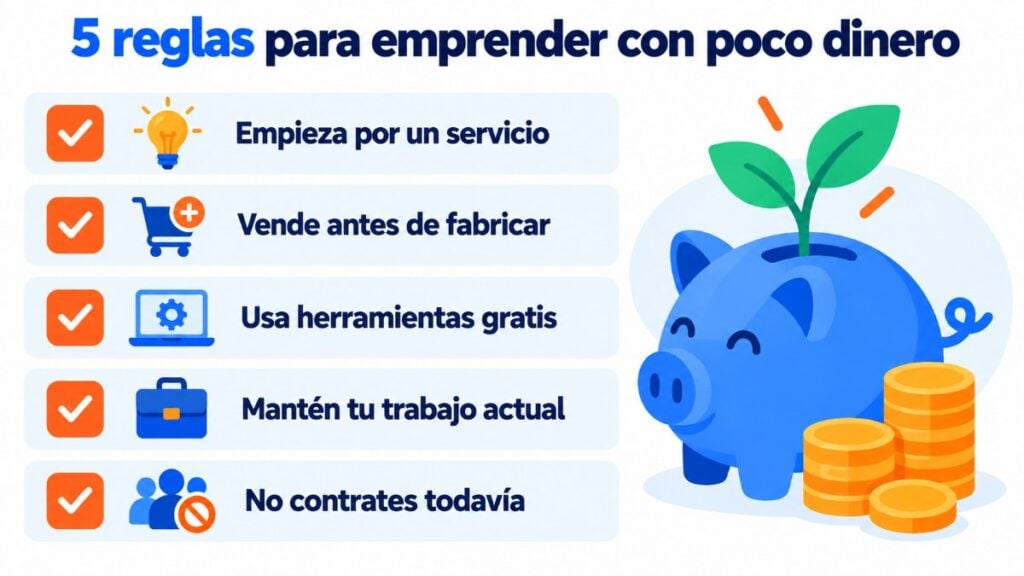
Starting a business from home greatly reduces fixed costs: you don’t pay for premises and you start with the equipment you already have. It’s the most common option for digital and service businesses.
Some ideas you can launch from home:
You’ll find more options in this guide to making money online step by step. One thing to keep in mind: working from home means separating spaces and schedules, or the business will end up taking over everything.
These are the mistakes I see most often in people who are starting out:
When problems come, and they will, you’ll find ideas for solving them in solutions to the problems of starting a business.
I say this as an insider, because this is my job: your contact list is the only channel that’s truly yours. Algorithms change and advertising gets more expensive, but an email reaches the people who have given you permission to write to them.
Starting to build your list from the validation stage has three advantages:
To get your first subscribers, offer something useful in exchange for their email. Here are 20 lead magnet ideas. And if you’ve never sent a newsletter, start with this guide on what email marketing is.
With Mailrelay you can start for free, with up to 80,000 emails a month and 20,000 contacts. That’s more than enough room for the first few years of a business starting from scratch.
Starting a business from scratch isn’t about having everything figured out on day one. It’s about taking small steps, checking whether they work and correcting quickly.
If I had to sum up this guide in three tips, they would be these:
Once your business is up and running, the next step is making it profitable. I cover it in how to start a profitable business.
Send your newsletters with Mailrelay
Up to 80,000 emails a month and 20,000 contacts for free, with human support on every plan.
These are the questions that come up most often when someone starts a business from scratch.
Start with problems you know well: those in your job, your industry or your hobbies. Make a list, talk to people who have them and check whether they already pay to solve them. A validated idea is worth more than an original one.
With no money at all it’s hard, but with very little, yes. Service businesses, digital businesses and those that sell before they produce need a small initial investment. The key is to reinvest your first revenue instead of seeking funding from the start.
The ones that work best from home are online professional services, training and infoproducts, online stores and content projects. Choose one that fits what you already know how to do to shorten the learning curve.
It depends a lot on the industry, the investment and the business model. A service can be profitable in a few months, while a product that needs stock or development usually takes longer. That’s why it’s a good idea to work out your break-even point and plan a cushion for that period.
In Spain, if you’re going to sell on a regular basis, yes: you need to register with the Tax Agency and with Social Security. Before you invoice, check your case with an accountant or with the entrepreneur support services in your autonomous community.
You’ll find free resources at chambers of commerce, European business and innovation centers (BICs), municipal business incubators and your autonomous community’s programs. It will also help to surround yourself with other entrepreneurs, in a coworking space or in online communities.

Jose Argudo
CMO at Mailrelay. Writes about email marketing, copywriting and conversion for SMEs and entrepreneurs.