
Keyword density is a concept, within the field of digital content, that is closely tied to SEO.
Not long ago it was an indisputable ranking factor that all of us web and blog writers monitored in detail. However, the various Google algorithm updates have reduced its weight.
Its importance has been a matter of debate in the industry, but lately there seems to be growing agreement among SEO and content professionals.
I’m going to explain what keyword density is and how it currently relates to these search engines. At the end of the post you’ll find some tools so you can measure it.
· What Is Keyword Density?
Keyword density is the percentage that shows the ratio between the number of times a keyword appears and the total number of words in the text.
For example, imagine we’re writing a post about how digital transformation is affecting business growth, its importance in a globalized world and the keys to a digitalization plan. Our keyword is “digital transformation”.
The text has 1,500 words and the keyword appears 12 times. We can easily calculate that the keyword density is 0.8%. If it appeared 20 times, it would be 1.3%. If it appeared 40 times, 2.6%.
The formula applied is the following:

· What Is Keyword Stuffing?
Keyword stuffing is the excessive use of a keyword within a text.
Note that it’s closely tied to the topic we’re discussing.
A few years ago it was a very widely used ranking technique, since it seemed to be proven that repeatedly using a keyword helped a page rank.
Today, Google penalizes this practice, so I recommend you forget about it.
Keyword stuffing lowers the quality of digital content, and we already know that what Google likes is to answer its users’ questions and meet their needs, just as I suggest you do with your texts.
Some out-of-touch SEOs still use it with their clients, but it’s a gun without ammunition, since the search engine punishes its use.
Maybe you’re now wondering: “so, if I have to use keywords without overusing them, what is the right keyword density percentage?”
Let’s look at that right now. 🙂

· What Keyword Density Percentage Is the Most Appropriate?
In the world of digital marketing we have a stock answer: “it depends”. And we can apply it to this case too. Why is that? Because, above all, logic and common sense prevail.

To rank a text more easily, you have to please two main players:
- Your readers.
- Google.
We often see posts that are aimed at one or the other, but why not aim at both? That’s my recommendation for you.
So, when writing a digital text, it’s best to be natural and focus on your users, on what they need. Strive to give them useful content, because Google will notice.
But also try to apply an SEO strategy to give your content a boost in the SERPs.
Within this strategy, think about keyword density. With it, you’re helping Google understand what your post is about.
And now that I’ve explained these two important aspects, I’ll give you the answer you’re looking for.
You have to judge the ideal keyword percentage yourself, based on your experience. That said, make sure it doesn’t exceed 2% because Google’s algorithms will flag you as a candidate for a penalty.
However, remember that Google doesn’t apply this formula to the texts we publish, but calculates it algorithmically.

· How Does Keyword Density Affect SEO?
We’ve been looking at the clear relationship between SEO and keyword density. Let’s get a bit more specific.

* It Helps Google Understand the Topic of Your Text
We just covered this in the previous section, but I’m stressing it here because it’s important that you understand why we use keyword density.
Repeating the keyword a few times helps search engines understand what you’re writing about. A few lines further down I’ll show you where to place the keyword to achieve this effect.
* Keyword Stuffing Is Counterproductive
I won’t go on about it here, because we’ve already given it its own section. Read about it, or review it at the beginning of the post.
* Having an Appropriate Keyword Density Doesn’t Guarantee You Top Positions in Search Results
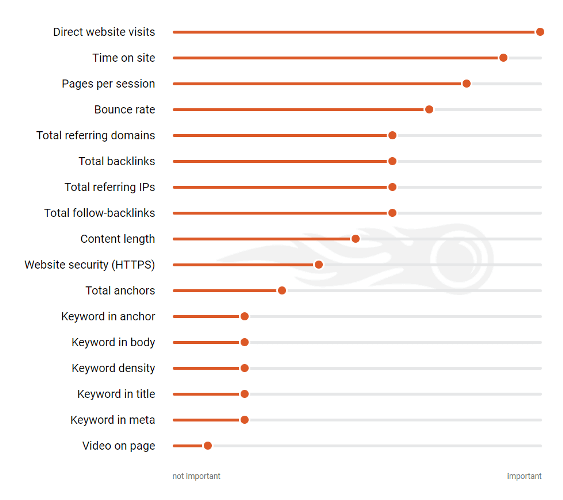
Many factors influence the ranking of a post or a web page. Among them is the topic we cover, but on its own, keyword density won’t get you ranked. It’s essential that you prioritize the quality and usefulness of your content.
SEMrush published a study in 2017 ranking the SEO factors that do help you appear in the top search engine results.
* You Can Compete for the Same Keywords Your Competitors Already Rank For
When you design an SEO strategy, it’s essential to do keyword research, which helps you find out which keywords your potential customers type into search engines when they look for information.
The next step is to analyze how your competitors use them and what keyword density the posts and pages that already rank in the top results have. That way, you can improve on that strategy and join the fight to win those coveted positions.
In this post I give you some tools you can use for that (a bit further down).

· Tips for Making Keyword Density Help You Rank
As we’ve said in this post, while keyword density isn’t decisive for getting your texts to rank well, it can help you get there.
What you’re about to read are some tips generally accepted by the community of SEOs and content creators (and also backed by my own experience) that strengthen the SEO of your texts.
*1. Use Synonyms
Using synonyms is necessary in any text we write, digital or not. We were already taught about them at school because they enrich content and make the ideas we present easier to understand.
Also, in the SEO context we’re talking about, synonyms serve another purpose: appearing in the search results of other people who use words different from our keyword but expect to find the same answer we offer.
I’m talking about the search intent users have when they search on search engines.
*2. Singular and Plural Forms Are the Same Keyword
You should know that Google’s algorithms don’t distinguish between singular and plural. To them, they’re the same word.
It’s important that you know this detail so you don’t fall into keyword stuffing thinking they’re different. On the other hand, this way you’ll be able to increase the density percentage that’s optimal for you.
*3. Where Should You Place the Keyword in the Text?
There are strategic places where your keyword should appear so that:
- You catch your readers’ attention and make them want to read your content
- Search engines can easily crawl your page and rank it based on their algorithmic factors and on how users behave with your publication.
They are:
– In the H1 post title:
It’s the first thing people who visit your blog or website will read. That’s why it’s important that they understand, at a glance, whether the post is about something they’re looking for or not. That “something” is your keyword.
– In the SEO title:
It’s the title we want Google to show in its results. It can be different from the H1, but it also has to contain our keyword.
– In the meta description:
Google likes to find our keyword here, but again, we’re also giving people hints about what they’ll find if they click that link.
Here’s an example so you can see it more clearly:

You can see that the keyword is “Master SEO” and this company has used it in the 3 strategic places we just talked about.
When you search on Google, the result shows up with the SEO title and the meta description, but when you open the post, the H1 is different.
They wanted to catch the user’s attention with the first one.
– In the first lines of the post:
You know it’s advisable for posts to have a short introduction at the beginning. Look at the post you’re reading right now. Placing the keyword there lets everyone know from the start what we’re talking about. I’m sure you already know what this post’s keyword is, right?
– In the CTA at the end of the post:
Just as we do in the first line of the post, it’s also a good idea to write the keyword in the call to action that closes it. It’s the moment when you ask your users to do something you want, related to the topic you’ve covered.
– In file and video names:
If you upload a file to the page or post, reinforce its content with your keyword. With videos, you’re also helping their SEO.
– In image alt attributes:
Remember that search engines have a section for images, which means they also rank and are affected by SEO. Help them find a good position by including the keyword in the alt tags.
– In the URL of the page or post:
An extremely important spot, since it’s one of the first places where Google’s spiders look to work out the topic of your content.
– In the text:
Of course, your keyword must appear spread throughout the text. And this is where you have to be able to do it with the naturalness we were talking about.
Now it’s time for the math. You have to add up the number of times you’ve written your keyword, count the total number of words in the content, and calculate the percentage.
There’s your keyword density! Remember not to overdo it.

· 5 Tools to Calculate the Keyword Density of Digital Content
There are quite a few tools that report the keyword density of published content. I’ll point out a few of them, so you can pick the one you like best or feel most comfortable with.
1* Word or PDF
I understand you’ll want to measure your text’s keyword density before publishing it, so get out your calculator.
If you work in Word, you just have to go to “find”, type your word and see how many times you’ve written it. Then, look at the bottom bar, on the left, for the total number of words you have. And apply the formula.
If you’re working with a PDF, press and hold Ctrl and F. A small search box will open where you can type the keyword.
2* Yoast SEO
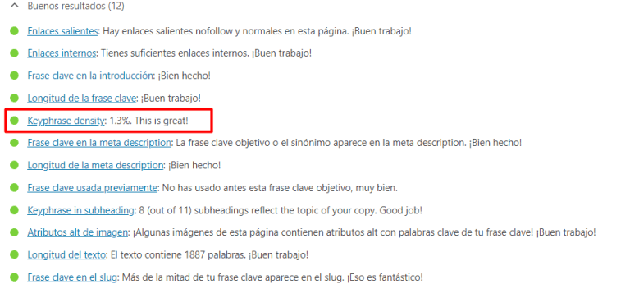
Yoast is the must-have WordPress plugin that helps us so much. It shows us key elements we shouldn’t overlook in the content we put together with it.
Its famous traffic light is sometimes frowned upon because it can be strict in its interpretations of what’s right or wrong, from an SEO point of view, of course. However, its update has made it a bit more “human” and it’s much more interesting now than it was back then.
Still, don’t forget that you’re talking to an automated system that doesn’t think like people do.
3* SEOquake
SEOquake is a small Chrome extension that you can turn on and off whenever you want. It’s quite useful for SEO and has a tab called “density” that analyzes the text.
To use it, open the page you want to look at and activate it.

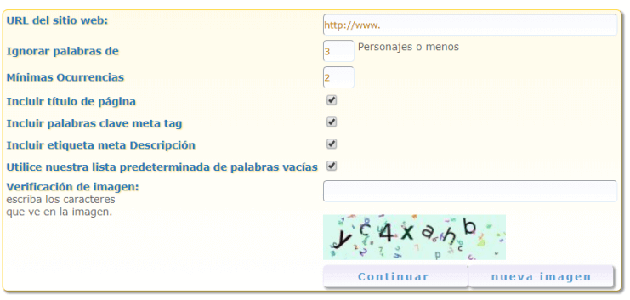
4* Keyword Density Analyzer
Keyword Density Analyzer is an online tool that’s simple to use and tries to imitate the work of search engines.
Open it in a new tab and paste the URL of the page you’re looking at. It presents the result in a table.
5* SEO Chat
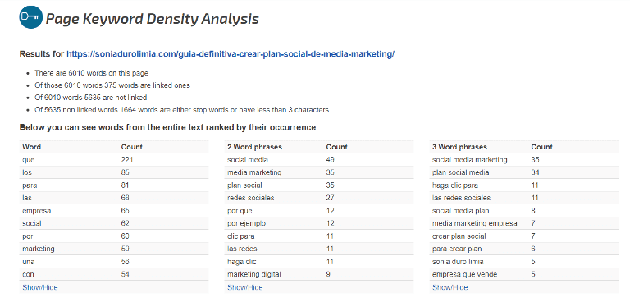
SEO Chat is also an online tool where you just need to paste the URL you want to study. It has lots of SEO analytics features, but right now we need “Page Keyword Density Analysis”.
In the image below you can see the example I ran with one of the posts on my blog.
Final Thoughts
If you’re just starting out with SEO-optimized content marketing, above all I’d like to tell you not to get overwhelmed by everything we’re supposed to take into account to rank.
There are a great many variables, and the one we’re talking about today isn’t the most important, though it is one more that we have to address. But take it step by step. One day you deal with keyword density, and once you’ve got it under control, you tackle internal links.
As you write posts, you’ll see that in the end you don’t have to measure your content, because you’ve already got the hang of it. Yoast will be very useful to nudge you into writing the meta description and the SEO title.
And, in the end, you’ll only use the other tools to measure your competition (and not always). Remember this post, and in a while let me know how it went, okay?
Right, now is when I wrap up with a CTA that includes the keyword. Here it goes:
With what we’ve seen today in this post, do you think it’s worth investing time in taking care of the keyword density of your content? Ready to do it?