
Just as private companies use content marketing strategies to win over and attract their customers, in Public Administration we also need to put this kind of practice in place to inform, raise awareness or encourage citizen participation.
We need to invest in content marketing strategies for Public Administration if we want to reach citizens. To do that, it will be important to change the way we communicate and adopt a closer, more direct format that helps us connect.
Public Administrations are increasingly aware of how important it is to be on social media in order to reach citizens. But not all of them manage these social networks strategically.
To do so, we need to understand the areas of communication and digital marketing and have a social media plan that helps us achieve our goals.
This plan will set out the content marketing strategy for reaching citizens.
But if you’re not sure what content marketing is and all the advantages that applying it in Public Administration can bring, don’t miss this post.
· What is content marketing
Content marketing is an area of digital marketing that seeks to attract, win over and retain its users by producing different types of content.
The creation of this content must be relevant and valuable to attract the target audience.
· What is a content marketing strategy
Through content marketing we create, publish and share content of interest to our users.
But in order to launch these actions, we first need to define our buyer persona. Taking our audience and goal into account, we will design our communication plan and define the content marketing strategy that best suits our interests.
We must always keep in mind that we have to respond to a need or problem. And as a Public Administration, our goal must be to meet this request or demand from citizens.
Only then will we build a successful strategy. If we create content that has nothing to do with what citizens are asking for, our content marketing strategy won’t be of much use.
If we look at the concept of content marketing for Public Administration, we think of new content and formats that help us reach citizens: infographics, video tutorials…

· Advantages of content marketing in Public Administration
Designing a content marketing and social media strategy in Public Administration can help us to:
► Improve brand image
The presence of the Administration on social media improves its reputation and image.
A content marketing strategy in Public Administrations will help us reach citizens through content tailored to their interests, allowing us to achieve a closer, more open and transparent image.
► Build a closer relationship
Social media helps us interact in a simple way. This makes a direct relationship with citizens easier.
In addition, creating attractive, useful and dynamic content will help encourage participation.
A content marketing strategy in Public Administration helps us move from one-way to two-way communication.
► Encourage citizen participation
Social media has changed the way we take part as citizens. Public Administrations are offering us more and more tools to voice our opinions, make suggestions, ask questions or complain, on both a local and a general level.
It’s clear that these digital tools have opened up new avenues for citizen participation. If we design a content marketing strategy for our Administration, we must not forget to encourage citizen participation through new channels.

· 9 Types of Content Strategy for Public Administration.
In a content marketing strategy we implement different types of content, taking into account our audience and overall goal.
But we will always try to go for:
- Fresh, novel content.
- Information that is relevant to the user (citizen)
- The user must be at the center and the text should be geared towards this idea.
The goal of content marketing in a company or business is to attract customers through relevant, high-quality content so that they follow the brand and eventually become customers.
In the case of Public Administrations, the goal of content marketing will be to make information easier for citizens to access, offering relevant, high-quality content in a more simple and attractive way, so that in addition to following the entity, they come to trust it.
To achieve this we will need to create a good content plan and schedule it, according to the goal and the audience we want to address.
To be able to design this content calendar within our strategy, we need to know what types of content we can include in our plan.
The key to a successful calendar is offering the right content at the ideal moment.
For this we will need to analyze our audience very carefully and understand their needs well, so that we can offer the content they need at exactly the right time. And of course, choose the format that is most suitable for this audience.
For example, addressing a young person who may qualify for a scholarship is not the same as addressing a 60-year-old who has to file an income tax return. Audiences and goals are different, so the format must also be adapted to these points.
The content must be high quality, but the format in which we present it also matters if we want to reach citizens.
We are going to look at 9 types of content and formats that we can implement in our Administration’s digital marketing strategy:

1. BLOG
A blog, a digital publishing platform that allows individuals or companies to communicate ideas, opinions, etc., is a tool to bear in mind if we need to put together a content strategy for a Public Administration.
An appropriate digital marketing strategy is to design a calendar of blog posts or articles.
Offer citizens articles on a regular basis and also manage the comments that citizens post.
The blog is a vehicle for communicating and staying in touch with citizens, and as a Public Administration we shouldn’t overlook it, since it is a golden opportunity.
Social media will be our megaphone, but having our own digital space will let us express or communicate ideas on specific topics, public programs or services, from a different perspective.
A website can become the institutional window, but citizens can’t interact.
With a blog, however, we can opt for a closer style in which users can also start a direct conversation, socialize and share their opinions or suggestions.
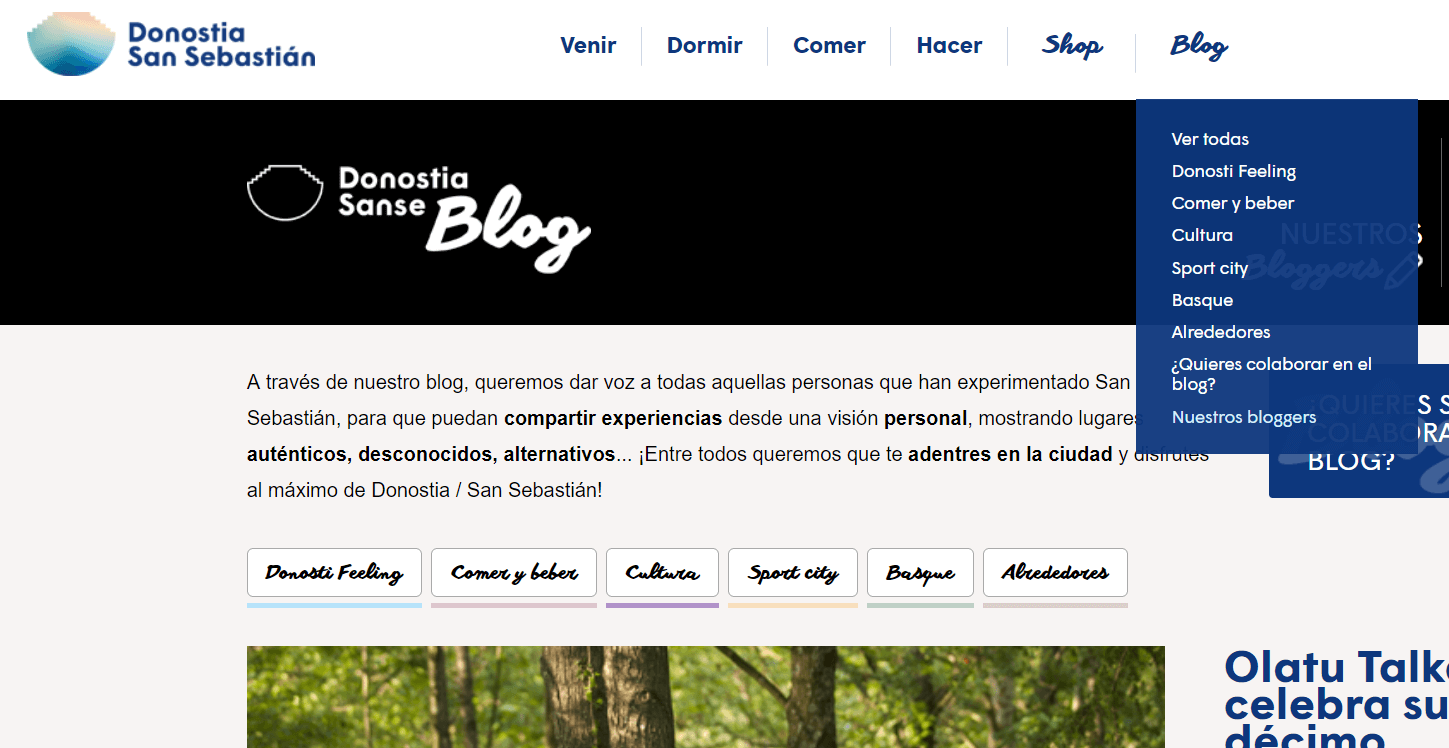
Example of the SanSebastianTurismo.eus Blog

2. INFOGRAPHICS
The power of images in communication, and specifically on social media, is important. There is no doubt about that.
If we want to give citizens information in a clear, concise, specific way, we should go for visual formats that simplify all the complexity of certain processes.
We need to go visual. Formats such as the infographic help to present information very clearly. Quality will depend on the content and aesthetics we offer in these formats.
They are very useful formats for Public Administrations because they help us summarize key ideas in an attractive and accessible way.

Example of images (respetoimagenesintimas.com)

3. VIDEO TUTORIALS
Video is a format that is being consumed more and more. Aware of this, many companies and brands have opted for video marketing strategies.
Just as in private companies, Public Administrations should also go for audiovisual formats.
In this case, the video tutorial format will help citizens find information, make it easier for them to complete a procedure or help them solve a problem.
Example. Parental mediation guide video to protect minors on the Internet

4. GIFS
More and more brands are choosing to use GIFs in their marketing strategy.
At first, it may sound odd for a Public Administration to commit to this kind of format. But we need to analyze our audience carefully.
Let’s imagine that our audience is young people and we are going to focus on the social network Instagram.
The GIF format can help us connect with this audience. The idea is not to fill every social media post with these animated images. The goal is to use them in moderation, assessing how appropriate they are each time.
We can add them to a newsletter, in replies to comments, when running a contest, etc. We can even customize them with our logo, services, products.
They can also be an educational tool that lets us teach how to do something step by step, quickly and easily. So, another interesting format to note down in our content marketing strategy.

5. VIDEO PRESENTATIONS/TESTIMONIALS
In addition to video tutorials, we should include a video marketing strategy in our content strategy. These audiovisuals can range from video presentations and video testimonials to short videos for our Instagram strategy.
This will of course depend on the resources we have, and on the audience and goal.
Integrating audiovisual content into our strategy will help to improve our corporate brand.
It also allows us to communicate more in less time. As users, we have less and less time, and our consumption habits make us more impatient, so audiovisual formats help us get the answer quickly and visually.
It’s a way of getting to know a service, for example, from a different perspective. It allows us to humanize the entity and make it more approachable.
On many occasions Public Administrations seem very distant to citizens. Through emotional marketing, this type of video lets us bring services closer and makes an emotional connection easier.
Stories help citizens empathize, make the institution feel closer, humanize it and let people get to know it from the inside.

6. STREAMING/LIVE BROADCASTS
Live broadcasting is a very interesting option for our content strategy. Social media offers us these features, and we could take advantage of them.
As a Public Administration, bringing any event, activity, press conference or ceremony to citizens is content we shouldn’t forget in our marketing strategy.
It is useful, valuable content that helps bring citizens closer to everything that public institutions organize, convene or launch.
Going live is a commitment to transparency, immediacy, proximity and authenticity. We will increase the added value of our content and our differentiating value.

7. WEBINAR
Webinar, seminar, videoconference or live sessions, but through a platform designed for that purpose.
The goal is to convey knowledge on a subject through an internet tool.
Both the person giving this videoconference and the users must be connected on the day and at the time announced beforehand, that is, it is live. Although they are usually recorded and the recording is sent to all subscribers.
And why not implement the webinar format in Public Administrations?
In private companies, businesses or brands, the ultimate goal of this type of content is usually sales. But in Public Administration it could be used as a way to generate engagement with our audience while we share content that interests them.
For example, let’s imagine we want to organize a conference on a specific topic and we want to invite a specialist in that area. Inviting this expert, booking a convention center, handling all the protocol, etc.
All these arrangements will mean a very high budget. However, if we organize an online conference with experts in the field through a webinar, the budget will be much lower and it will let us bring highly valuable content to citizens.
In addition, we make it easier to take part. These types of formats allow interaction with the speaker, with the chance to ask questions, make suggestions or comment.

8. PODCAST
The podcast is an audio format that lets us listen to content anywhere, at any time. Because it is so easy to consume, more and more brands are choosing to implement the podcast in their marketing strategy.
In Public Administrations we can also opt for this type of format. Citizens will be able to access news or any other kind of content on a range of topics in audio format.
It is a very interesting tool that lets us offer original, approachable, easy-to-consume and accessible content. We can also reach people with visual impairments, thereby promoting social inclusion policies.
This type of format has great public-service potential and supports a wide variety of content: interviews, manuals, tutorials, guides…
Another very interesting format to consider when designing our content marketing strategy for Public Administration.

9. EBOOK
Ebooks are downloadable formats and can be a very interesting educational resource to implement in our marketing strategy.
Public Administration can also produce guides, tutorials or various materials created by experts for citizens to download.
The key will be getting the content, topic and publication timing right. But the aesthetics and the design will also be essential to attract and retain our audience.
It must respond to a need of citizens.
If we get the content and design right, it can be a very valuable resource.
This type of format will help us generate leads so we can segment our lists. If we know citizens’ needs, we’ll be more likely to get our strategy right.

· Conclusion
Little by little, Public Administrations have realized that marketing isn’t just for private companies.
Citizens’ habits have changed and, therefore, Public Administrations must also adapt to these changes if they want to reach them.
We can’t keep using classic methods; we need to make it easier to access information, and for that we must give citizens new communication channels and new formats that help them ask questions, participate or stay informed.
In this way, it will be important to prepare a good content calendar. But to design the calendar we must analyze the audience, identify the goal we want to achieve and, bearing that in mind, choose the right format, content and moment.
These new approaches open up a world of possibilities for Public Administration. As a public service, we will be able to serve people more simply, quickly and closely, offering content that adds value for citizens.
Investing in a content marketing strategy in Public Administrations is a great opportunity that should be seized. It will help create closer institutions, improve their reputation and image, facilitate and encourage participation, collaboration and feedback, and promote transparency.
Do you think Public Administrations should take advantage of content marketing strategies?
In addition to the content types proposed, do you think any other format could be implemented in the strategy?
· https://www.linkedin.com/in/nagoregarcia/
· https://twitter.com/garcianagore
· https://www.facebook.com/nagoregarciasanz/
· https://www.instagram.com/nagore_garcia_sanz/
These strategies are part of something bigger: find out what content marketing is and how to apply it to your institution.