
Today, internationalization is a necessity for every company, even for companies that are well positioned in their home country.
We’re talking about SMEs and large companies alike: internationalization affects all of them, since most are prepared to start internationalizing from the outset, growing and expanding beyond the domestic market (the usual market where a company operates without leaving its country).
We say it’s a necessity for companies because it’s an incredible business opportunity that, in this case, Spain has experienced exponentially in recent years, taking advantage of the competitive advantages developed at home to expand internationally.
First of all, we need to consider our company’s available resources and capacity, although we can also exploit resources in other countries, adding value by specializing developed economies in knowledge-intensive activities.
Internationalization is a process that requires conviction, commitment and willpower, in which the challenge for companies is exporting, optimizing processes as much as possible and offsetting each product’s seasonality within the global market.
Telling internationalization and globalization apart
These two terms are often confused because they’re so similar, but there are slight differences: internationalization is a business strategy that involves creating products and services that are as adaptable as possible so they can easily enter other national markets, while globalization is understood as a set of practices through which organizations connect better with their users and partners around the world. This includes every aspect of operating in different national markets, from product design to packaging.
Why do we attach so much importance to globalization and internationalization?
Very simple: we live in a world where digitalization has advanced enormously, users are connected 24 hours a day, 365 days a year, and as a result markets are active all year round thanks to technological development.
Globalization is an irreversible process that keeps accelerating and expanding as the years go by, and companies that can’t adapt to these advances stagnate.
We need to think globally and not set geographic limits on selling our products and services, since we should take advantage of the opportunities in today’s emerging markets, such as China, India or Brazil.
The advantages of internationalizing include greater competitiveness, more market growth, consolidation of products and the brand abroad, and lower costs thanks to economies of scale.
But not everything will be perfect: internationalizing is an option every company should take, but at the same time you must be very clear that it’s a complex process and that the ideologies and customs of other countries often differ greatly because of each country’s economic, political or other differences.
Drivers of globalization and internationalization
1. Economic liberalization
2. Adoption of free-market ideologies
3. The rise of developing countries
4. New technologies
5. Removal of trade and financial barriers

So, what is globalization?
It focuses on settling permanently in another geographic area to sell products and/or services. It focuses on using other countries’ available resources strategically to take advantage of the different opportunities other markets offer.
We can talk about globalization in several ways, depending on whether it’s globalization across the whole world, in a particular country or in a specific industry.
On a global scale, we’re talking about economic interdependence between the countries involved, reflected in cross-border flows such as goods, services or capital.
On the scale of a particular country, we analyze how intensely that country’s economy interacts with the rest.
On the scale of a specific industry, it’s the degree to which the competitive position of a company in that industry in one country is determined by its competitive position in another country.
Requirements for globalization and internationalization
● You need to know the state of the international market. In other words, it’s especially important to know the customers or target market you’ll be facing, since in each country you’ll find consumers with different tastes, preferences, values and purchasing power, not to mention their customs and ways of doing things.
● Knowledge of trade regulations: when selling in another country, we need to be clear about the legal rules that apply there, since they may differ from those of the home country, and analyze the obstacles and barriers to international trade.
It’s very important to find out whether the target country applies protectionist policies.
● Knowledge of business partners: you need the support of business partners or distributors who make it easier to enter the different markets to sell your products.
● Access to qualified staff: you need advice from specialists in different areas, such as the legal, commercial, marketing or financial aspects of the country you want to enter.
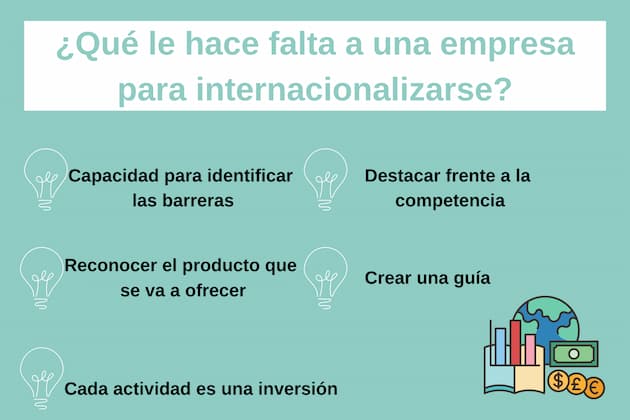
What does a company need to internationalize?
1. Ability to identify barriers: the first thing a company must do is know what barriers it faces in order to grow in the international market.
2. Knowing the product it will offer: it’s very important to know which product to offer in each market, since it won’t be received the same way everywhere.
3. Standing out from the competition: if I offer the same as my competitors and have nothing that sets me apart, success won’t be guaranteed.
4. Creating a guide: it’s especially necessary to put together a guide with the steps to follow to internationalize, because otherwise I won’t have a structure for what I want to achieve.
5. Every activity is an investment: keep in mind that the returns on each activity may come in the long term, and you need to operate with a margin in case mistakes or problems arise.
Legal aspects of internationalizing
Keep in mind that the World Trade Organization is the international organization responsible for the rules for taking your business to foreign markets; that payment methods in international transactions vary depending on the country we’re targeting; and that you need to take customs tariff law and VAT into account.
Stay on top of the target country’s tax system and, finally, attend meetings and events with people from your company’s industry to learn about the business opportunities in other countries where we haven’t expanded yet.
Stages a company goes through to internationalize
1. Creating an export department: without a department to help run and manage the internationalization process, it will be very hard to face the challenges it involves.
1. Carrying out an internal analysis: it’s essential to assess where the company stands to know whether it’s ready to respond to the new demands that arise.
2. Betting on innovation: the companies that end up internationalizing stand out from the rest because they and their projects are innovative, since they have a broader view of the business world.
3. Choosing the markets: there are many kinds of obstacles to selling our products abroad, so it’s essential to choose carefully which markets we’ll target.
4. Finding a sales channel: it can be with or without a physical presence, depending on whether you sell products or services. If you need a physical presence, it would be ideal to have the support of a local partner; otherwise, you’d go the direct route.
5. Starting the promotion: promoting yourself is essential if you want to stand out from the competition and get users to know you.
6. Consolidating the company’s internationalization: once we’re immersed in the digital world, it’s time to move forward and establish your company fully and physically in other markets, whether through subsidiaries or franchises.
Digital strategies we can use to improve internationalization
International SEO
Implementing SEO strategies to rank well online, creating an optimized website and adding posts with high-quality, relevant, up-to-date content to the company blog.
International content marketing
It focuses on generating engagement among users and qualified leads. Through content such as a lead magnet, a blog, social media, emailing…
Ecommerce
It’s an affordable platform for starting to make real, direct sales to consumers in other countries who are interested in your products or services, thanks to technological advances and digitalization.

Examples of companies that have chosen internationalization
To better understand the world of internationalization, let’s look at the example of Amazon, a pioneer in selling in different countries that has managed to adapt its products and services to each country’s policies, customs, ideologies and legal requirements.
It thus offers all kinds of products adapted to different types of consumers, and that’s exactly what internationalization is about: opening up to new markets, taking that big leap and positioning yourself among the best companies against the competition.
Amazon Marketplace is the world leader in online sales, taking advantage of European logistics by storing its products in Spain so as not to face tax problems in the buyers’ countries.
That’s the case of Amazon, but most companies that have implemented a good strategy have managed to expand their business to other markets, taking advantage of their competitive advantages and becoming internationally recognized brands.
Conclusion
Having analyzed everything we need to know about internationalization, we can conclude that today it’s a vital necessity for every company, even for companies that are well positioned in their home country.
Internationalization is a process that requires conviction, commitment and willpower, in which the challenge for companies is exporting, optimizing processes as much as possible and offsetting each product’s seasonality within the global market. If you manage to do this, your company will run like clockwork.
So if you’re wondering whether or not to internationalize your company, this is the sign you needed: hesitate no more and choose to grow your business.
If you have any questions or suggestions, feel free to leave a comment. I’ll be happy to answer. One person’s question may be the answer for many!
Before taking this step, it’s a good idea to rely on a PESTEL analysis of the new market and be very clear about who your ideal customer will be in that country.