
Starting a business is a journey full of ups and downs.
While vision and passion are essential, problems are a constant in any business venture.
From financial problems to team conflicts and market changes.
Every entrepreneur will have to face a series of obstacles.
However, these problems aren’t necessarily a dead end.
Well managed, they can become opportunities to grow and strengthen the business.
In this article, we’ll explore effective solutions for addressing and solving the problems in your business.
The Importance of Addressing Problems Effectively
It’s not enough to recognize problems — you have to face them directly and decisively.
Addressing problems effectively not only prevents them from getting worse, but also lets you learn from them and steer the business back on track.
Effective problem management is, in essence, an investment in the future of the business.
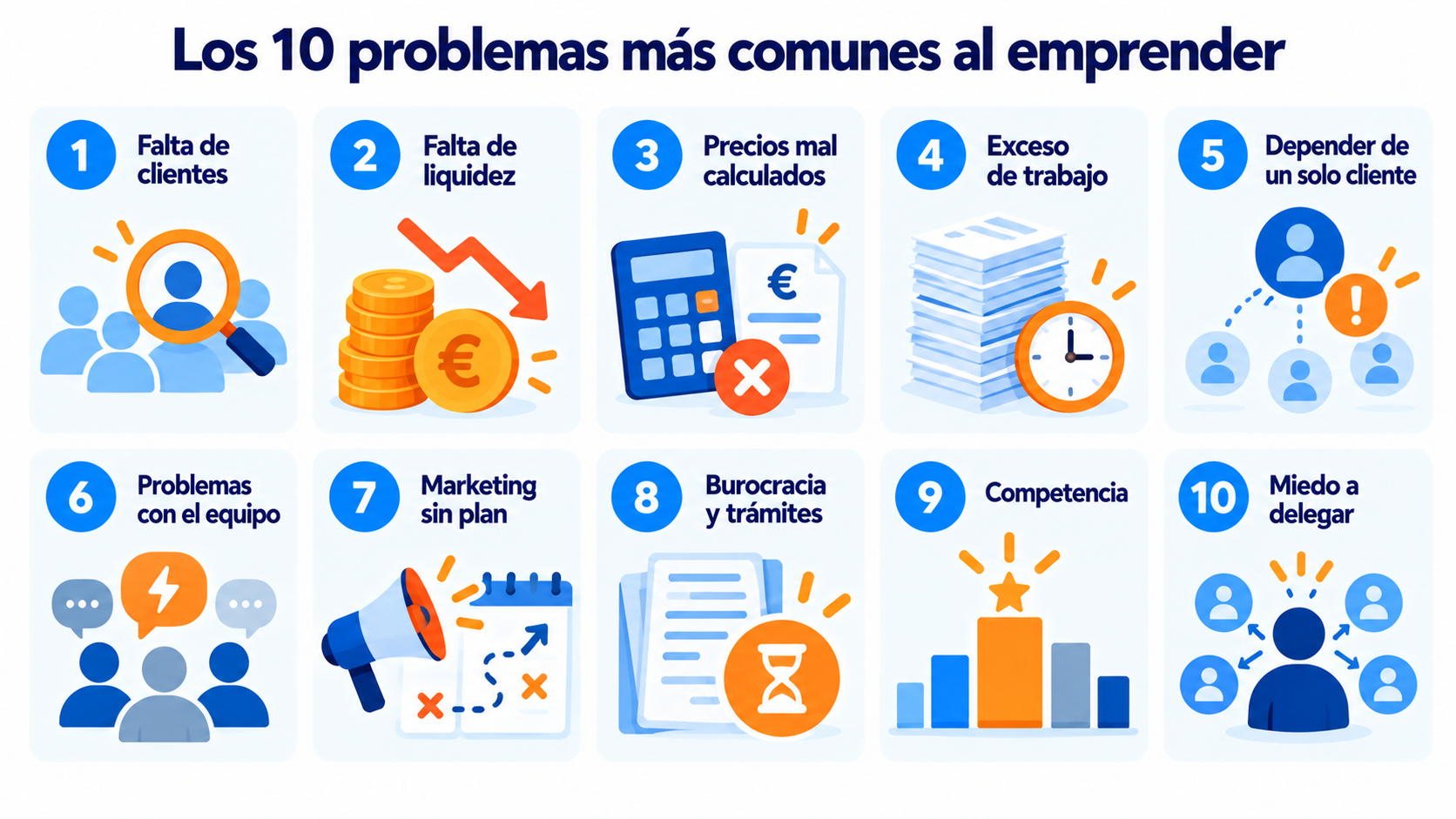
The 10 most common problems when starting a business and how to solve them
Almost every entrepreneur runs into the same problems. Spotting them early is what makes the difference:
| Problem | Warning sign | Solution |
|---|---|---|
| Lack of customers | Sales depend on word of mouth and aren’t growing | Build a contact list and stay in touch with it every week |
| Lack of cash flow | You pay suppliers before you get paid | Forecast your cash flow 3 months ahead and negotiate payment terms (liquidity and financing) |
| Poorly calculated prices | You sell a lot but earn little | Calculate costs and margin before setting the price (how to price a product) |
| Overwork | You work more than 10 hours a day and still can’t keep up | Prioritize and automate repetitive tasks (time management) |
| Relying on a single customer | One customer accounts for more than 30% of revenue | Keep looking for new customers, even when you’re fully booked |
| Team problems | There’s turnover, repeated mistakes or conflicts | Define roles, goals and follow-up meetings |
| Marketing without a plan | You run one-off actions and don’t know which ones work | Choose 1 or 2 channels and measure their results every month |
| Red tape and paperwork | Delays, fines or surcharges | A tax calendar and an accounting firm you trust |
| Competition | You lose customers on price | Work on your competitive advantage, not just price |
| Fear of delegating | Everything goes through you and the business stops if you’re not there | Document your processes and delegate one task each month |
You don’t need to solve all 10 at once. Start with the one you struggle with most today (almost always getting customers or having enough cash) and apply the method you’ll see below. If selling is what you struggle with most, also go over these marketing problems businesses face and how to solve them.
Not enough customers? Start with your email list
Signup forms, newsletters and segmentation to sell to people who already know you.
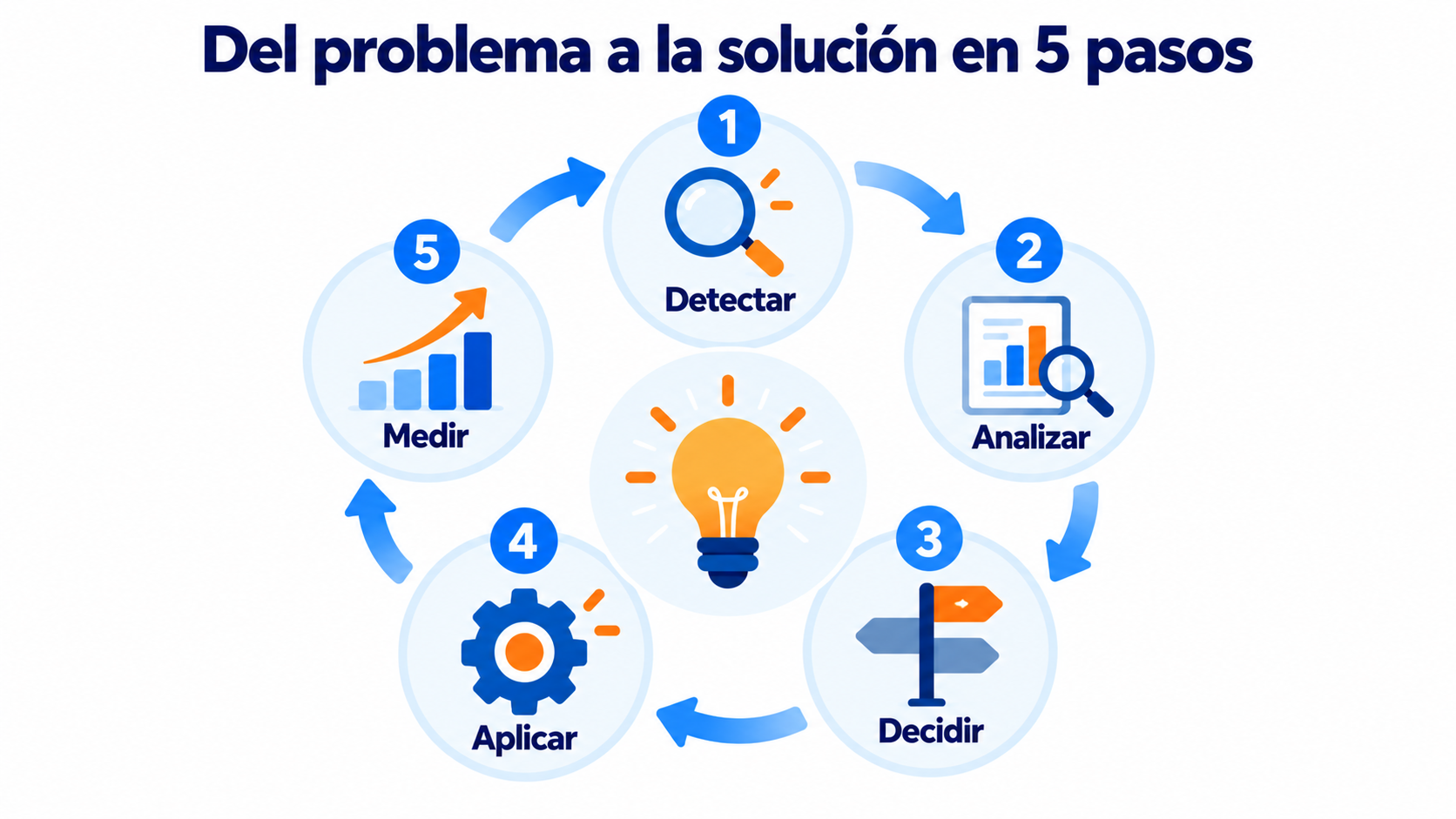
Identifying Problems
Before solving any problem, it’s essential to identify it.
In the world of entrepreneurship, recognizing problems in time can be the difference between success and failure.
This section is designed to help you spot and understand the challenges your business may face, giving you the tools you need to take proactive, effective action.
How to recognize the warning signs in your business
Problems don’t come out of nowhere.
They usually give warning signs.
It’s very important to pay attention to indicators like:
- A sustained drop in sales
- Growing discontent within the team
- An increase in customer complaints
- Or a decrease in profitability
All of these can be signs that something is happening that’s affecting the business.
Tools and techniques for assessing problems
Not all problems are the same, and each one requires a different approach.
Here, we’ll explore tools and techniques that will let you assess your business’s problems objectively and effectively.
From a SWOT analysis, which helps you understand your business’s Strengths, Weaknesses, Opportunities and Threats.
To financial audits that give you a detailed view of your company’s financial health.

Analysis and evaluation
Once problems have been identified, the next step is to understand their nature and scope.
This involves a meticulous analysis and a quantitative and qualitative evaluation.
Methodologies for analyzing problems
In the business world, there are various methodologies designed to analyze problems in a systematic, structured way. For example:
- Cause-and-Effect Analysis: This methodology, also known as the Ishikawa diagram or fishbone diagram, helps identify, explore and visualize the possible causes of a specific problem.
- 5 Whys: This approach involves repeatedly asking “Why?” (usually five times) until you reach the root cause of the problem.
- Pareto Analysis: This technique is based on the idea that 80% of problems are caused by 20% of the causes. It helps identify the most critical areas to focus your efforts on.
Quantifying impact: losses and risks
Assessing the economic and operational impact of problems is crucial.
This involves not only quantifying financial losses, but also understanding the associated risks, such as losing customers, reputational damage or lower team morale.
Some important steps are:
- Calculating financial losses: Determine the direct cost of the problems, including lost revenue, additional costs incurred, etc.
- Risk assessment: Identify and evaluate the possible side effects of the problems, such as long-term customer loss or damage to the brand’s reputation.
- Scenario analysis: Imagine and plan different future scenarios, based on how the current problems are addressed.

Strategies for resolving business problems
In entrepreneurship, facing and solving problems is a critical skill.
Problems, big or small, require a methodical and creative approach to find effective, sustainable solutions.
Creative solutions and lateral thinking
To stay competitive in a constantly changing market, entrepreneurs need to cultivate creative, flexible thinking.
An effective strategy is to organize structured brainstorming sessions that encourage generating ideas without restrictions.
Specific lateral thinking techniques, like the reversal technique — which involves thinking about how to achieve the opposite of the goal — can open up new perspectives and reveal unconventional solutions.
Informed, data-driven decision-making
Making decisions based on solid, reliable information is essential.
This involves setting up procedures to gather relevant data through market surveys, customer behavior analysis and tracking financial metrics.
Specific tools and software, like Google Analytics and Tableau, become key allies in this process.
Allowing entrepreneurs to analyze data efficiently.
Negotiation and mediation in internal conflicts
Internal conflicts, whether between partners, employees or departments, can be challenging and, if handled incorrectly, harmful to the business.
Here, applying the “win-win” negotiation technique is a proven strategy: it seeks solutions where all parties feel valued and heard.
In more tense situations, bringing in an impartial third party, like a professional mediator, can be key to facilitating communication and reaching a peaceful, constructive resolution.
It’s also important to recognize when you need to seek outside help, such as legal advice, in situations of severe conflict.

Implementing Solutions
After analyzing and selecting the right strategies to solve the problems, the next critical step is effectively implementing those solutions.
This process involves developing a solid action plan, monitoring progress in real time, and managing the necessary changes within the business.
Creating an action plan
Creating a detailed action plan is the first essential step in implementing solutions.
This plan should define clear, measurable objectives, the necessary resources, the responsibilities assigned to each team member, and a specific timeline with set deadlines.
By detailing every step needed to reach the desired solution, this plan serves as the roadmap that will guide the whole team through the implementation process.
Analyzing and adjusting strategies in real time
Once the action plan is underway, it’s essential to monitor progress in real time.
This involves setting key performance metrics (KPIs) and using tracking tools to regularly assess whether the strategies are delivering the expected results.
If deviations from the plan or unwanted results are identified, it’s crucial to be ready to make quick, effective adjustments to the strategies underway.
Managing change in your business
Implementing solutions often requires significant changes within the business, which can generate resistance among team members.
Effective change management is therefore essential.
This means clearly communicating the changes that are going to be made, explaining the reasons behind them, and providing the necessary support — like training and resources — to help the team adapt.
Successful change management also includes actively listening to the team’s feedback and concerns and responding empathetically and constructively.

Save time with automations
Welcome, reminder and follow-up emails that send themselves, even on the free account.
Evaluating results
Once solutions have been implemented, it’s essential to evaluate the results to determine how effective the strategies applied were.
This stage involves using key performance indicators, making adjustments based on the feedback received, and the ability to learn and adapt for future challenges.
Key performance indicators (KPIs)
Key Performance Indicators (KPIs) are specific, quantifiable metrics that help assess how well the implemented strategies are performing.
It’s important to clearly identify and define these KPIs before implementation, so they serve as a clear reference point during the evaluation phase.
Examples of KPIs can include the customer retention rate, return on investment (ROI) and revenue growth.
Adjustments and improvements based on feedback
Feedback, whether from team members, customers or stakeholders, is a valuable tool for continuous improvement.
It’s vital to carefully analyze this feedback and use it to make informed adjustments to the current strategies.
This may involve refining processes, adjusting marketing tactics or revising project priorities based on the responses and the market’s needs.

Prevention and preparedness
Beyond responding to problems after they arise, a proactive approach to prevention and preparedness is essential for the long-term stability and success of a business.
How to anticipate future problems
Anticipating future problems means developing a proactive, strategic mindset.
This can be achieved through constant monitoring of the business environment, including market trends, competitors’ actions and regulatory changes.
It’s also essential to carry out periodic risk analyses that identify possible areas of vulnerability within the business.
With this information in hand, it’s possible to design strategies that address these risks before they become significant problems.
Creating a contingency plan
A contingency plan is a set of predetermined actions the business will take if certain risk scenarios materialize.
To create one, you need to identify and classify potential risks in terms of their likelihood and impact.
From there, you can develop specific strategies for each scenario, assigning resources and responsibilities in advance.
This plan should be reviewed and updated regularly to make sure it stays relevant and effective in a constantly changing business environment.
Conclusion
Starting a business is, without a doubt, an exciting journey, but one that’s also full of challenges.
Along the way, problems aren’t just inevitable — they’re an integral part of the growth and learning process.
This article has explored effective strategies ranging from identifying and analyzing problems to implementing solutions and evaluating results.
It has also emphasized the importance of prevention and preparedness, highlighting how a proactive approach can turn potential threats into opportunities for improvement and growth.
Ultimately, an entrepreneur’s ability to manage problems effectively not only determines whether their business survives, but also charts the path toward sustainable, meaningful success.
Getting ahead of many of these problems is easier if you first do a good PESTEL analysis of your environment.
Many of these problems are also easier to anticipate when you can count on stable income, like the kind a good MRR (Monthly Recurring Revenue) provides.
Create your free account
Up to 80,000 free emails a month, with human support on every plan.
Recommended reading
How to start a profitable business
8 low-investment business ideas to get started as an entrepreneur.
Making money online step by step
Realistic ways to earn income online, compared.
What business models are
What a business model is and which ones matter most.
Capital flight: how companies lose money
Where a business’s money slips away and how to spot it in time.

Jose Argudo
CMO at Mailrelay. Writes about email marketing, copywriting and conversion for small businesses and entrepreneurs.