CRO: what conversion rate optimization is and how to apply it
How to get more sales and signups from the same traffic, one test at a time
CRO (Conversion Rate Optimization) is the process of improving a website, a landing page or an email so that more people take the action you want. For example, buying, signing up, requesting information or downloading a resource.
Instead of getting more visits, CRO aims to get more out of the ones you already have. It’s based on data, testing and understanding why users don’t take the next step.
What does CRO mean?
CRO stands for Conversion Rate Optimization. In other words, optimizing the conversion rate.
In digital marketing, that’s always what it refers to. Outside marketing, the same acronym has other uses, such as clinical research organizations (Contract Research Organization).
What is a conversion?
A conversion is any valuable action a user takes. There are two types:
| Type | What it is | Examples |
|---|---|---|
| Macro conversion | The main business goal | A purchase, a service signup, a quote request |
| Micro conversion | An intermediate step toward that goal | Subscribing to the newsletter, adding to cart, watching a video, downloading a guide |
The conversion rate measures what percentage of users convert: conversions divided by visits, times 100. If 2,000 people visit your page and 40 sign up, the rate is 2%.
Why is CRO important?
Because it multiplies results without increasing your investment in traffic. An example:
| Before CRO | After CRO | |
|---|---|---|
| Visits per month | 10.000 | 10.000 |
| Conversion rate | 2 % | 3 % |
| Signups per month | 200 | 300 |
With the same traffic, the company gets 50% more signups. And since each customer costs less, it improves the ROI of all your campaigns: ads, SEO, social media or email.
How do you do CRO step by step?
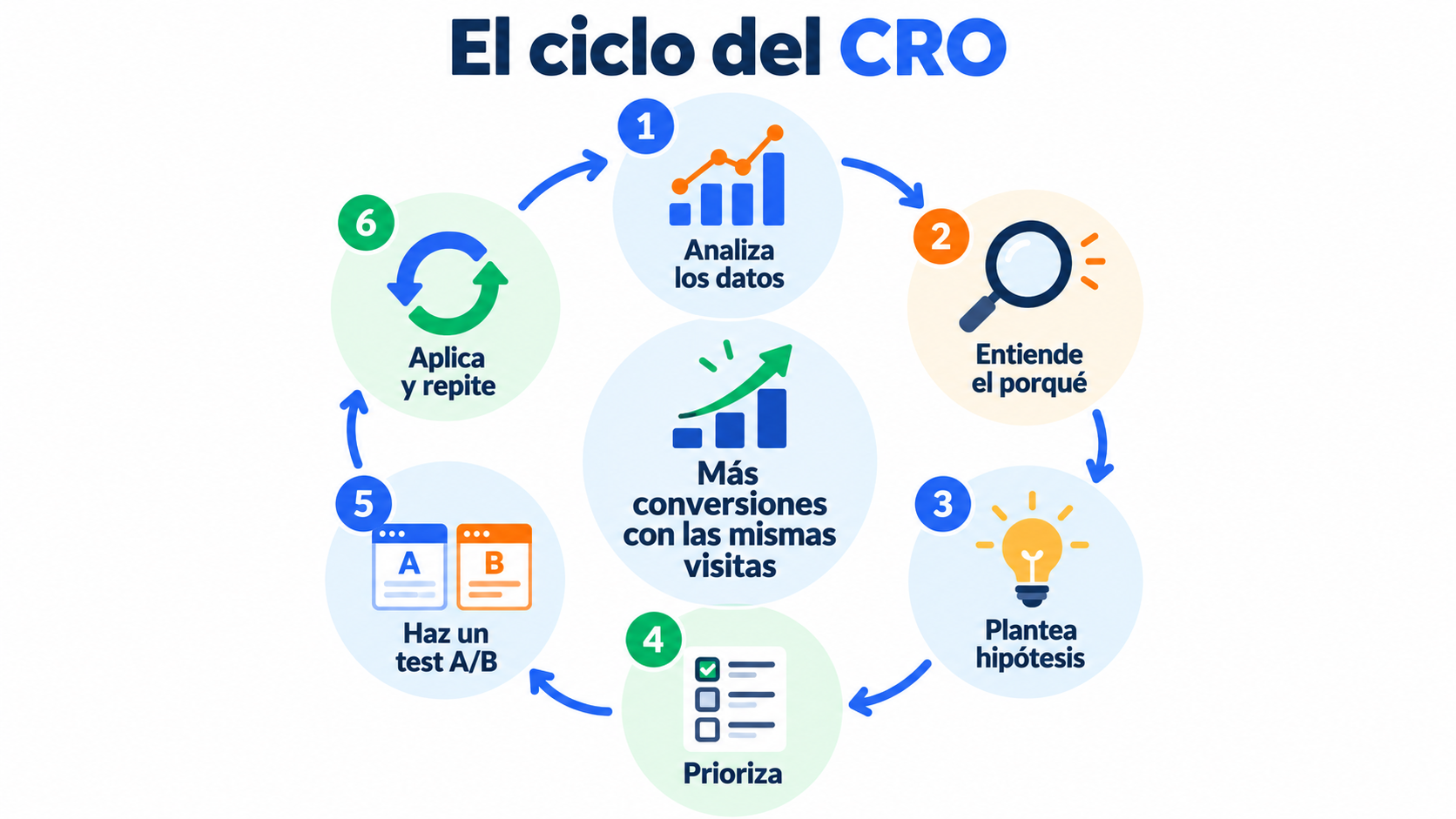
CRO is a cycle that never ends. These are its steps:
1. Analyze the data. Check your analytics to see where users drop off: which pages have the highest bounce rate and at which step of the checkout process they’re lost.
2. Understand why. Use heatmaps, session recordings and surveys to see what people do and what holds them back.
3. Form hypotheses. For example: “If we shorten the form to three fields, more people will sign up.”
4. Prioritize. Start with the changes that have the most impact and take the least effort, on the pages with the most traffic.
5. Run an A/B test. Show the current version to half of your users and the new one to the other half with an A/B test.
6. Apply and repeat. If the new version wins, keep it and move on to the next hypothesis.
Which elements can you optimize?
Almost everything the user sees affects conversion. These are the elements that usually improve the most:
| Element | What to test |
|---|---|
| Headline | That it explains the benefit in one sentence |
| Call to action | The button’s text, color, size and position |
| Form | Fewer fields and clear error messages |
| Social proof | Reviews, success stories and customer logos |
| Price and offer | How it’s presented, guarantees and free trial |
| Loading speed | Lighter images and fewer scripts |
| Mobile version | Easy-to-tap buttons and readable text |
| Checkout | Fewer steps and no mandatory account to buy |
Convert more with your emails
Test two subject lines with an A/B test in Mailrelay and send the one that performs best to the rest of your list.
CRO tools
There are tools for every phase of the process. These are some of the most widely used:
| Used for | Tools |
|---|---|
| Analytics | Google Analytics 4 |
| Heatmaps and recordings | Hotjar, Microsoft Clarity (free) |
| A/B testing on your website | VWO, Optimizely, AB Tasty |
| User surveys | Hotjar, Typeform |
| A/B testing in email | Your email marketing platform |
Google Optimize, Google’s free A/B testing tool, was shut down in September 2023. Today you need to use a third-party tool.
CRO in email marketing
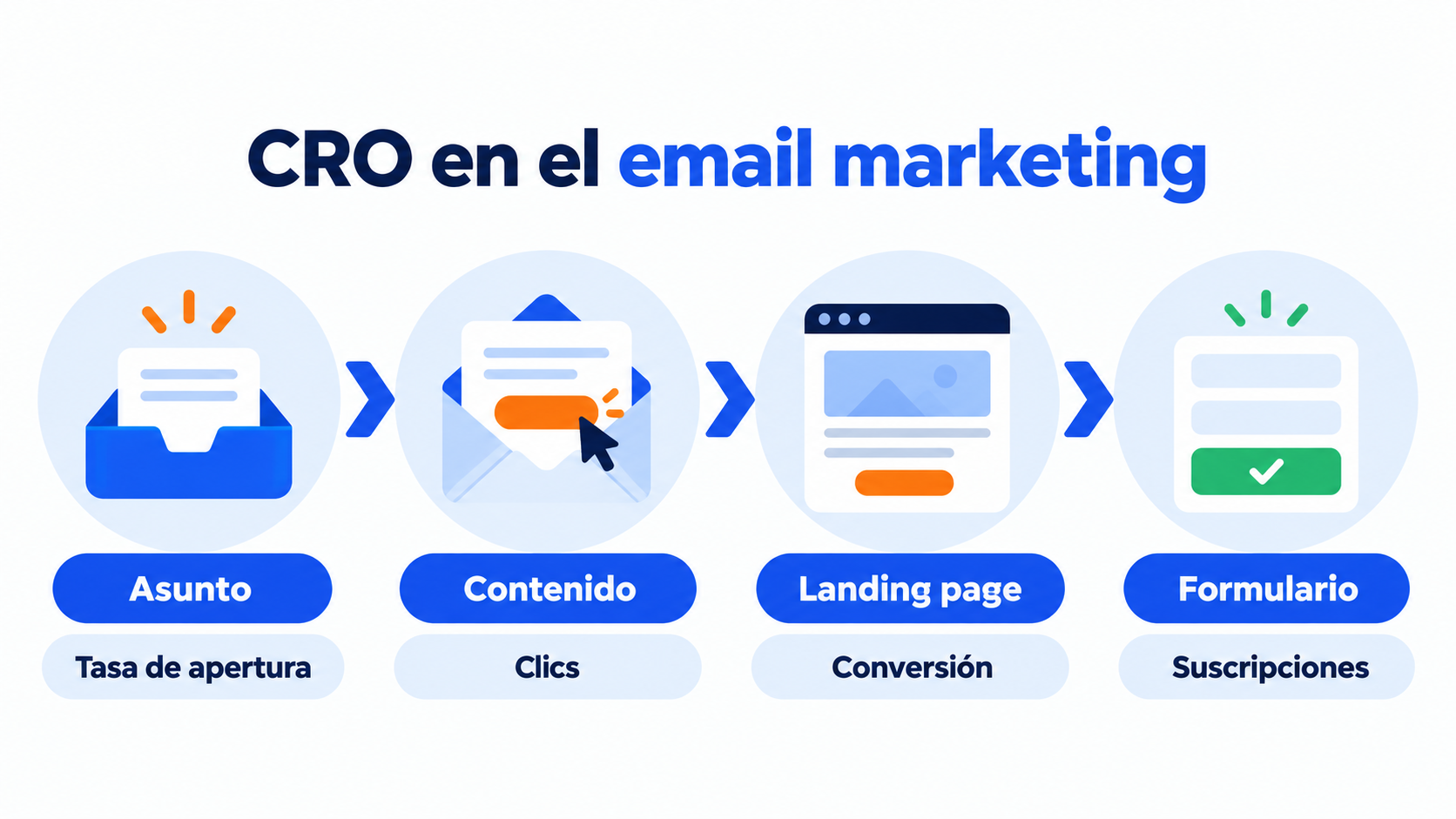
CRO isn’t just for websites. Every email is a small funnel, and people drop off at every step too:
| Email stage | Metric | What to optimize |
|---|---|---|
| Inbox | Open rate | Subject line, preheader and sender name |
| Content | CTR and CTOR | Message, design and button |
| Landing page | Conversion rate | That it follows through on what the email promised |
| Signup form | Subscription rate | Fields, incentive and placement |
The subject line is a good place to start. An A/B test with two versions, sent to part of your list, tells you which one works better before you send it to the rest. And segmentation boosts conversion because each group gets what interests them.
Common CRO mistakes
Changing several things at once. If you change the headline, the button and the image in the same test, you won’t know what worked.
Stopping the test too early. The first few days are misleading. Wait until you have enough visits and conversions.
Testing with very little traffic. With few visits, the differences may be down to chance.
Copying what another company does. What works on one website won’t necessarily work on yours.
Forgetting about mobile. A large share of traffic comes from phones, and that’s where the most is lost.
How Mailrelay helps you
With Mailrelay you can run A/B tests on the subject line and sender and send the winning version to the rest of your list. In the statistics you can see who opens and clicks on each link.
You can also create subscription forms and landing pages to capture contacts, and segment your list so that every campaign converts more. The free account includes up to 80,000 emails a month and 20,000 contacts, with human support by chat, ticket and phone.
Send your newsletters with Mailrelay
Up to 80,000 emails a month and 20,000 contacts for free, with human support on every plan.
Frequently Asked Questions
These are the most common questions about CRO.
What is CRO in a nutshell?
It’s improving a website, a landing page or an email so that more visitors do what you want, such as buying or signing up.
What’s the difference between CRO and SEO?
SEO brings in visits from Google. CRO gets those visits to convert. The two complement each other.
What is a good conversion rate?
It depends a lot on the industry and the goal. What matters is comparing your rate against your own results and improving it one test at a time.
How long should an A/B test run?
The usual approach is to run it for at least one or two full weeks, to cover both weekdays and weekends, and until you have enough conversions.
Is CRO useful for small businesses?
Yes, although with little traffic it’s best to start with big, clear changes, such as the form or the offer, rather than details like the color of a button.