Diwali
India’s festival of lights and biggest shopping season
Every autumn, homes, streets and shops across India fill with oil lamps. It’s Diwali, the most important festival in the Hindu calendar and the time of year when the country shops the most. For any brand with Indian customers, it’s a date you can’t improvise.
What is Diwali?
Diwali, also known as Deepavali, is the festival of lights. The name comes from the Sanskrit dipavali, meaning “row of lights”. It symbolises the victory of light over darkness and good over evil.
It’s celebrated mainly by Hindus, but also by Jains, Sikhs, who mark Bandi Chhor Divas on the same day, and some Buddhist communities. It’s a public holiday in India, Nepal, Singapore, Malaysia, Mauritius, Fiji and Guyana. And it’s widely celebrated by the Indian diaspora in the UK, the US, Canada and the UAE.
Over several days, families clean and decorate their homes. They light diyas (clay lamps) and draw colourful rangoli on the floor. They also pray to Lakshmi, the goddess of prosperity, and exchange sweets and gifts.
Plan your Diwali email campaign
Send your greetings, segment your list and launch your festive offers by email and SMS. With Mailrelay you can send up to 80,000 emails a month for free.
Create a free accountDiwali 2026 dates
The date changes every year because it follows the lunar calendar. It falls on the new moon of the month of Kartika, between mid-October and mid-November. In 2026 the main day, Lakshmi Puja, is Sunday 8 November.
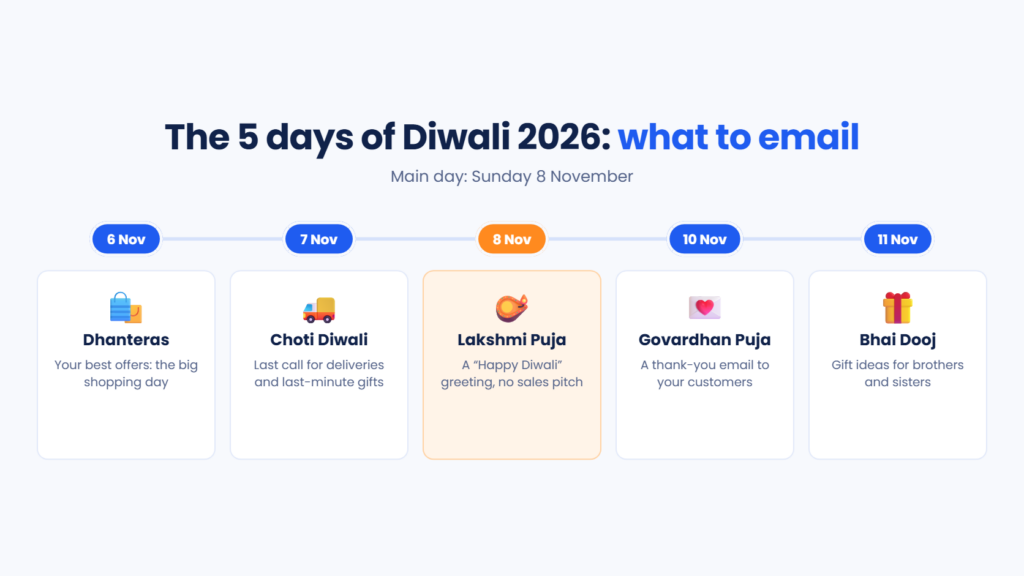
The celebrations spread over five days. In 2026 they run roughly from 6 to 11 November: Dhanteras (6), Choti Diwali (7), Lakshmi Puja (8), Govardhan Puja and Bhai Dooj (10 and 11). Depending on the region and the calendar followed, some dates may shift by a day.
Why Diwali matters for marketing
Diwali is to India what Christmas is to Europe: the season of gifts, new clothes and big purchases. On Dhanteras, for example, it’s traditional to buy gold, silver, kitchenware or appliances, because the day is considered auspicious.
That’s why online retail has its peak season here. The big sales, such as Flipkart’s Big Billion Days or Amazon’s Great Indian Festival, start weeks earlier so that orders arrive in time for the festival.
The numbers back it up. According to Unicommerce, online orders during the 2025 festive season grew 24% compared with 2024, and Tier II and III cities accounted for around 55% of the total. Quick commerce, with delivery in minutes, grew 120%.
How to plan a Diwali email campaign
A good Diwali campaign isn’t Black Friday with lamps. It blends sales with good wishes and stays with the customer through all five days of the festival.
Start early. Your customers buy gifts weeks ahead and want to recieve them on time. A first email in mid-October with a gift guide and shipping cut-off dates works very well.
Save your best offers for Dhanteras. It’s the shopping day of the festival, so schedule the campaign in advance and back it up with an SMS or a WhatsApp message.
On the main day, send greetings, not a sales pitch. A well-crafted “Happy Diwali” email, with a warm design full of lights and colour, does more for your brand than any discount. And it’s the kind of message people open and remember.
Segment your list. Not all your contacts celebrate the festival. And greeting people who don’t can feel forced. Create a group with your customers in India and the diaspora, or with those who bought in previous festive campaigns.
Get the personalisation and timing right. Use the customer’s name and recommend products based on their history. Send at a sensible hour in their time zone, too. India Standard Time is UTC+5:30, so it’s 5 hours and 30 minutes ahead of London in November.
But don’t forget what comes after. Govardhan Puja and Bhai Dooj close the festival: it’s a good moment for a thank-you email and, sometimes, a last offer designed for gifts between brothers and sisters.
Mistakes to avoid
Treating the festival as a mere excuse to sell usually backfires. Using religious symbols lightly or copying generic messages without adapting them doesn’t help either.
And watch your deliverability: email volume soars in peak season. Check your authentication, clean your list and spread your sends if your contact base is large.
How Mailrelay helps
With Mailrelay you can create a specific group for this campaign, design it in our editor and schedule every send for the day and time that fit best. You combine email and SMS from the same dashboard, and our real-time reports tell you which message works best.
On top of that, the free plan includes up to 80,000 emails a month and 20,000 contacts, with multilingual support on every account.
Light up your customers’ inbox this Diwali
Segment your customers, schedule your greetings and track every campaign in real time. Get started with Mailrelay for free.
Try Mailrelay for freeDiwali FAQ
When is Diwali in 2026? The main day is Sunday 8 November 2026. The celebrations last five days, roughly from 6 to 11 November.
What does Diwali mean? It comes from the Sanskrit dipavali, “row of lights”. It celebrates the victory of light over darkness.
How do you wish someone a happy Diwali? The most common greetings are “Happy Diwali” and “Shubh Deepavali”. In an email, a simple greeting and a warm design work better than a very elaborate message.
Does a Diwali campaign make sense outside India? Yes, if you have customers in the Indian diaspora, for example in the UK, the US, Canada or the UAE. Segment so you only send it to that group.
In short
Diwali is both a deeply meaningful festival and India’s biggest shopping season. If you have customers who celebrate it, plan ahead, stay with them through all five days and pair good wishes with well-thought-out offers.