WhatsApp marketing: what it is, how to run campaigns and examples
How to use WhatsApp to sell and build loyalty without getting blocked: campaign types, examples and tools
WhatsApp marketing is the strategy of using WhatsApp to communicate with customers and prospects: sending offers, notifications and reminders, and handling conversations that end in sales.
WhatsApp marketing works because the message lands in the same place where people talk to their family. That’s why it gets read so much.
And that’s exactly why an irrelevant message is punished quickly, with a block.
What is WhatsApp marketing?
Doing marketing on WhatsApp means using WhatsApp as one more channel in your strategy, just like email marketing or SMS marketing.
Its strong point is conversation: the customer can reply in the same chat.
There are two ways to do WhatsApp marketing. With the free WhatsApp Business app, you handle chats manually and send broadcast lists of up to 256 contacts.
With the WhatsApp Business API, you launch campaigns to your entire contact base from a platform.
The first one is good for getting started. The second one is for when you want to send to many contacts, automate notifications and measure results.
What is WhatsApp marketing used for?
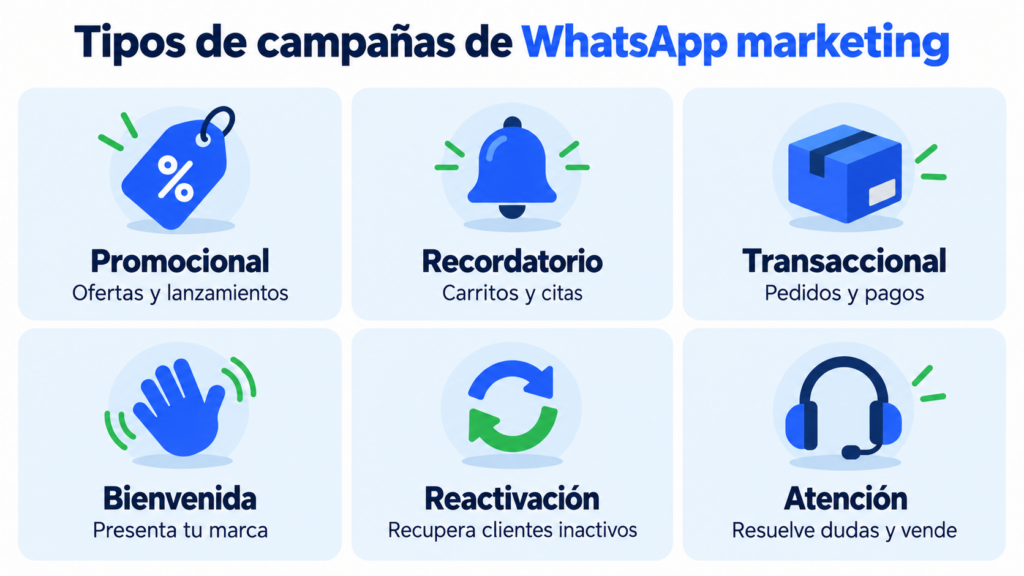
It covers almost the entire customer lifecycle. These are the most common campaign types:
| Campaign type | Used for | Example |
|---|---|---|
| Promotional | Selling an offer or a launch | 48-hour sale for customers |
| Reminder | Recovering a sale or preventing no-shows | Abandoned cart or tomorrow’s appointment |
| Transactional | Informing about an order or a payment | Order shipped with its tracking link |
| Welcome | Introducing your brand to a new contact | Message with a sign-up discount, like a welcome email |
| Reactivation | Winning back inactive customers | “We miss you” with a perk (winback campaign) |
| Customer service | Answering questions and closing sales | Answers about sizes or delivery times, also with a chatbot |
Almost all of them have an email version. The difference lies in the tone, shorter and more personal, and in the immediacy.
What are its advantages and disadvantages?
The main advantage of WhatsApp marketing is the attention it gets. It’s the most widely used messaging app in Spain, and messages are almost always opened within minutes.
It also lets you have conversations. A customer with a question writes in, you reply, and the sale is closed in the same chat. That’s conversational marketing in its purest form.
But it has its limits. Every message in an API campaign has a cost charged by Meta, and templates must be approved.
There’s little space for content, and sending too many messages is punished with blocks.
That’s why it works best in combination. The newsletter shares your news at a relaxed pace, and WhatsApp drives the specific action.
How do you build a WhatsApp marketing strategy?
Imagine a cosmetics online store that wants to sell more with WhatsApp marketing in its seasonal campaigns. These would be its steps:
- Define the goal: sales, appointments, cart recovery or customer service.
- Get your contacts’ permission with a clear checkbox in the subscription form and confirm it with double opt-in.
- Segment your contacts by interests or purchase history, just as you would with segmentation in email.
- Create the templates: a short message, one image, one button and a single call to action.
- Choose the frequency. One or two campaigns a month are usually enough.
- Measure deliveries, reads, replies and sales, and adjust.
Permission is not optional. The GDPR requires consent for commercial communications, and Meta also requires it to use its platform.
Want to launch WhatsApp campaigns?
Connect your number to Meta and send to your contact groups from the same dashboard as your email.
WhatsApp marketing message examples
Here are three templates to adapt to your business. Notice that they are all short and have a single action.
Hi Laura, Only until Sunday: 20% off our entire facial care range for customers like you. Want us to save it for you? [View offers]
Hi Daniel, This is a reminder of your appointment at the clinic tomorrow at 10:30. If you can’t make it, tap here to reschedule. [Reschedule appointment]
Hi Marta, You left these sneakers in your cart. Free shipping today if you complete your purchase. [Complete order]
The third one is a version of the classic abandoned cart email. Many stores combine them: first the email and, if there’s no purchase, a WhatsApp message the next day.
What tool do you need for WhatsApp marketing?
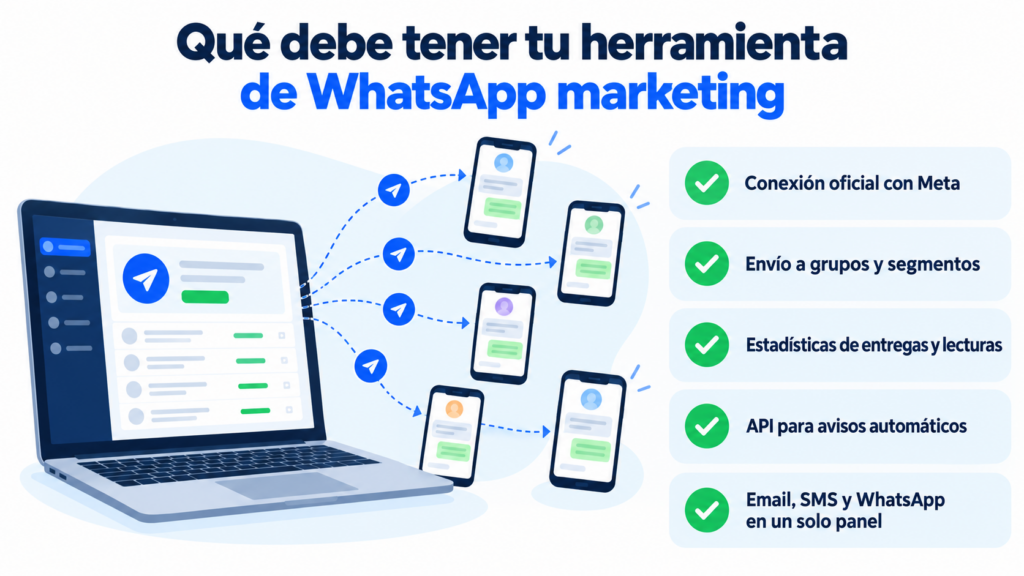
To get started, the free app is enough. When your contact base grows, you need a platform connected to the WhatsApp API. Before choosing one, check these points:
- It connects officially with Meta and helps you get templates approved.
- It lets you send to groups and segments, not just to standalone lists.
- It shows statistics on deliveries, reads and replies.
- It has an API to send automatic notifications from your store or your CRM.
- It combines WhatsApp with email and SMS in the same dashboard.
This last point matters more than it seems. Good WhatsApp marketing doesn’t work alone: coordinating channels is the foundation of omnichannel marketing and multichannel automation.
How does Mailrelay help you?
With Mailrelay, you can send WhatsApp campaigns from the same dashboard as your emails and SMS. You connect your number to Meta, and your WhatsApp Business account keeps working on your phone.
You create templates with an image or video, text and buttons, choose your subscriber groups and send. Then you see how many messages were delivered and read, and you reply to your contacts.
If you code, the Mailrelay API manages numbers, templates and campaigns, and sends transactional WhatsApp messages.
WhatsApp sending is included in the Standard and Enterprise plans. The free account includes a 10-day trial; after that, WhatsApp sending costs €9.95 per month, according to the pricing page.
Meta’s per-message fees are not included: you pay them directly to Meta.
Email, SMS and WhatsApp in a single tool
Create your free account and try WhatsApp sending for 10 days.
Frequently Asked Questions
These are the most common questions about WhatsApp marketing.
Is WhatsApp marketing free?
With the WhatsApp Business app, yes. With the API, Meta charges for each template message delivered, and the platform you use has its own fee.
Is it legal to send advertising via WhatsApp?
Yes, if the contact has given you consent to receive commercial communications through that channel and can easily unsubscribe.
How many messages can I send per month?
With the app, broadcast lists reach up to 256 contacts and WhatsApp is testing monthly limits. With the API, Meta sets a daily limit that starts at 250 recipients and grows with the quality of your sends.
Which is better, WhatsApp or email marketing?
They don’t compete. Email is better for long-form content and newsletters; WhatsApp, for urgent notifications, reminders and conversations. Ideally, combine them.
How do I run WhatsApp campaigns for my business?
Get your contacts’ permission, connect your number to a platform that uses the API, create Meta-approved templates and send them to specific segments. Then measure and adjust.