Performance marketing: what it is and how it works
The advertising where you only pay for what you get
Performance marketing, also called results-based marketing or goal-based marketing, is a type of advertising in which the advertiser pays based on the results of the campaign. These results are usually measured through specific actions: clicks, sign-ups or purchases.
It is a strategy built on getting the user to do something, and that action decides whether the campaign has worked. That is why it is advantageous for the advertiser, who pays when the goals are met.
If you want to see the types (SEM, SEO, social media, email and affiliates) and examples of campaigns, you’ll find them in our performance marketing guide.
How does performance marketing work?
The goal of any marketing campaign is to generate a profit for the brand running it, whether it is based on inbound marketing or outbound marketing. But constant changes in customers’ buying habits and needs have greatly changed the way to reach them and make sales.
That is why digital marketing today is more transparent and dynamic than in its early days, with new advertising formulas that satisfy both advertisers, who know the ROI of their actions in detail, and the channels they use for their campaigns.
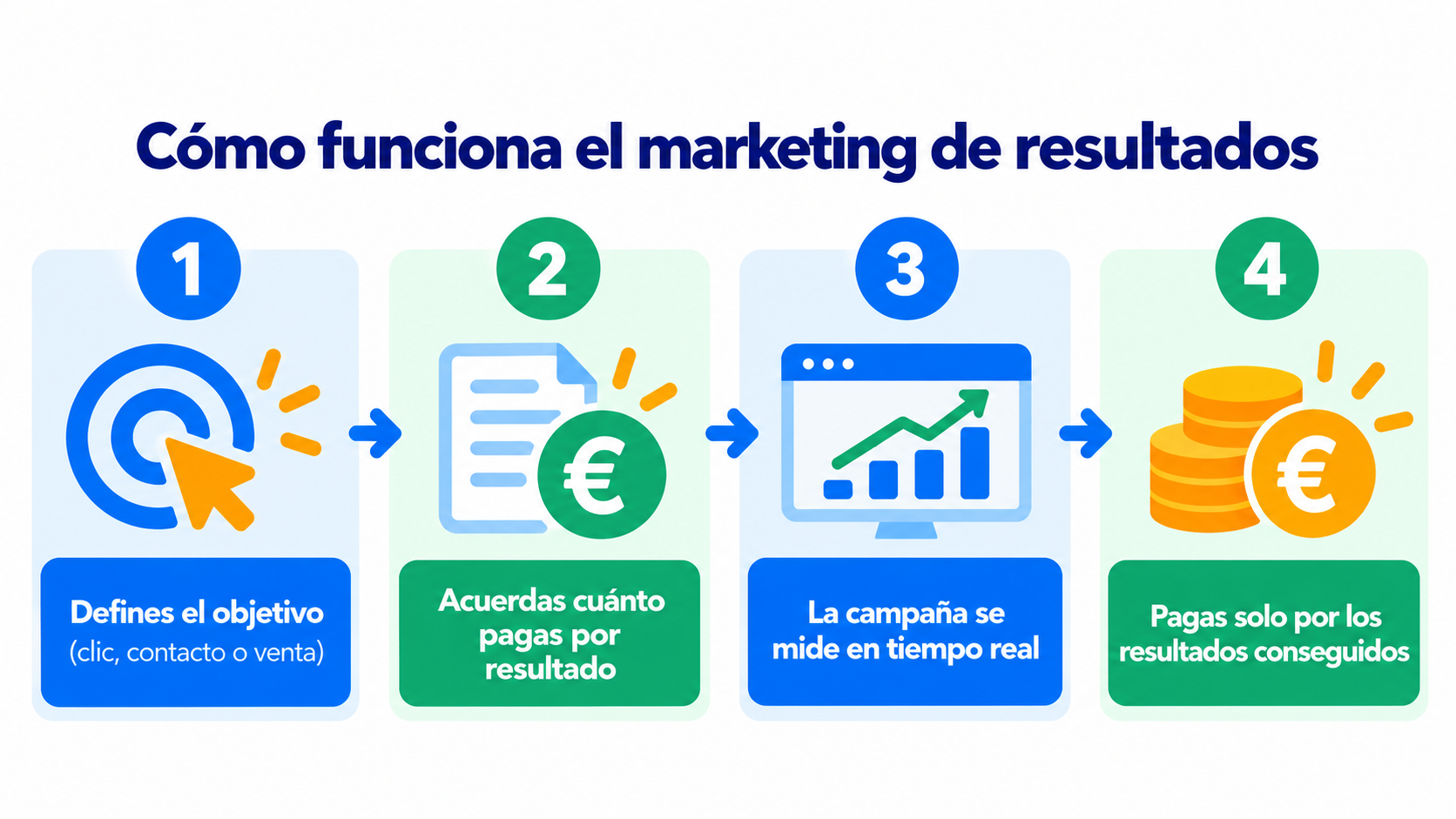
Performance marketing uses the latest technology to track consumers and their behavior. This makes measuring results much easier, and precise indicators can be created to know whether the set goals have been achieved.
Only if the set goals are achieved is the campaign considered complete, and the advertiser pays the channel where it ran, according to the agreement reached.
Measure what your emails achieve
Send campaigns, see which links get clicks and add UTMs to track sales in Google Analytics. Get started for free with Mailrelay.
Advantages of performance marketing
The advantages of performance marketing have made it a good formula for all kinds of businesses. But it is above all small and medium-sized businesses, which don’t have large marketing budgets, that run the most campaigns of this kind.
The main advantages of performance marketing are:
- Measuring return on investment (ROI) is easy. Since only results defined in advance count, the return on investment is known in real time.
- Clear conversion-based goals. Whatever the goal, usually leads or sales: if it is met, the campaign is paid for, and if not, it isn’t.
- Easy to optimize. Since it is measured in real time, the campaign can be improved while it is running, reinforcing what works best.
- Less risk. The advertiser doesn’t have to invest the budget without knowing how the campaign will perform. This gives them better control over their budget.
- It works on many channels. It can be used in email marketing campaigns, on social media, in display and in any channel of a content marketing strategy, among others.
Performance marketing payment models
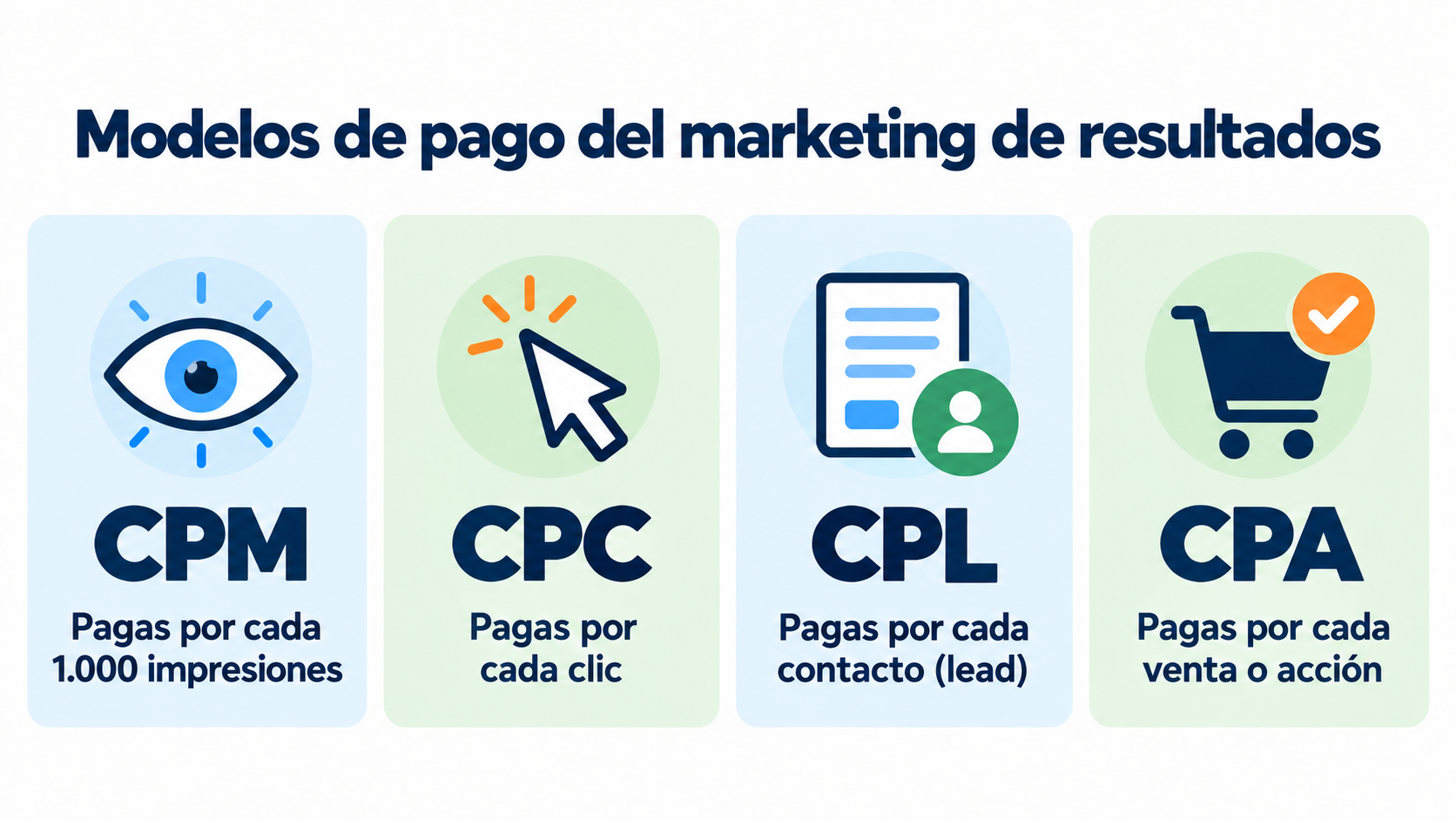
In online marketing almost everything can be measured, so there are several payment models. These are the most common:
| Model | You pay for | When it makes sense |
|---|---|---|
| CPM | Every 1,000 ad impressions | Building brand awareness. It is the least “performance-based”, because you pay even if nobody clicks |
| CPC | Every click | Driving visits to a website or a landing page |
| CPL | Every contact (lead) | Getting subscribers or information requests |
| CPA | Every sale or other agreed action | Online stores and affiliate marketing |
To track the campaign, you also look at the CTR, interactions with the ad, how long it was visible and the conversion rate.
Performance marketing in email marketing
In email marketing you don’t pay a media outlet for each click or each sale, because the subscriber list is yours. But you can measure each campaign with the same results-based logic:
- Clicks: how many subscribers click and on which link.
- Conversions: how many buy or sign up after the click. To find out, add UTM parameters to your links and check the conversions in Google Analytics.
- Cost per result: divide what the campaign costs you by the sales. If a campaign costs you €50 and gets 10 sales, the CPA is €5.
There are also newsletters and websites that sell advertising space with these same payment models, especially CPL and CPA.
How Mailrelay helps you
With Mailrelay you can measure what each email achieves:
- Click statistics per link (opens and clicks on the free account and on Enterprise).
- Links with UTMs to track sales in Google Analytics.
- A/B tests to keep the subject line or content that gets the most clicks.
- Segments and automations to send each subscriber what interests them most.
The free account includes 80,000 emails a month and up to 20,000 contacts.
A performance channel without paying per click
With email you don’t pay for each click or each contact. Send up to 80,000 emails a month for free with Mailrelay.
Frequently asked questions
What is performance marketing?
It is advertising in which the advertiser pays based on the results achieved, such as clicks, contacts or sales, rather than for the advertising space.
Are results-based marketing and performance marketing the same thing?
Yes. Results-based marketing is just another name for performance marketing. It is also called goal-based marketing.
Is it spelled performance or perfomance?
It is spelled performance. “Perfomance”, without the first r, is a common typo.
Which payment model is best?
It depends on the goal. To get visits, CPC. To get contacts, CPL. To sell, CPA. CPM is better suited to building brand awareness.
What is the difference between performance marketing and brand marketing?
Performance marketing seeks measurable short-term actions, such as a sale. Brand marketing seeks to make the brand known and remembered. We explain it in our post on brand marketing.