Advertising: what it is, what it means in Spanish and types of advertising
From billboards to social media ads: meaning, types of advertising and how to measure whether it works
Advertising is the paid communication a brand uses to make its products or services known so that people buy or remember them. In Spanish, it is called publicidad. It includes ads on television, radio, in the press, on billboards, in search engines and on social media.
In Spanish-speaking countries the English word is used mainly in agencies, marketing departments and digital platforms, alongside other English terms such as online advertising or ad.
What does advertising mean in Spanish?
In Spanish, advertising translates as publicidad. It comes from the English verb to advertise (anunciar in Spanish), which in turn comes from the Latin advertere, “to turn attention towards something”.
These are the most common words from the same family:
| English | Spanish |
|---|---|
| Advertising | Publicidad |
| Advertisement or ad | Anuncio |
| Advertiser | Anunciante |
| To advertise | Anunciar |
| Online advertising | Publicidad online o digital |
| Advertising agency | Agencia de publicidad |
It is often misspelled: “adversiting”, “advertaising” and “advertasing” are common mistakes.
Characteristics of advertising
Advertising has features that set it apart from other forms of communication:
- It is paid. The brand buys space or an audience in a medium.
- It has an identified sender. The audience knows which brand is behind the ad.
- It aims to persuade. Its goal is to get the audience to buy, remember the brand or change an opinion.
- It is aimed at an audience. Each campaign is designed for a specific target.
- It is repeated. An ad needs several exposures to stick in people’s memory.
Advertising vs. marketing: the differences
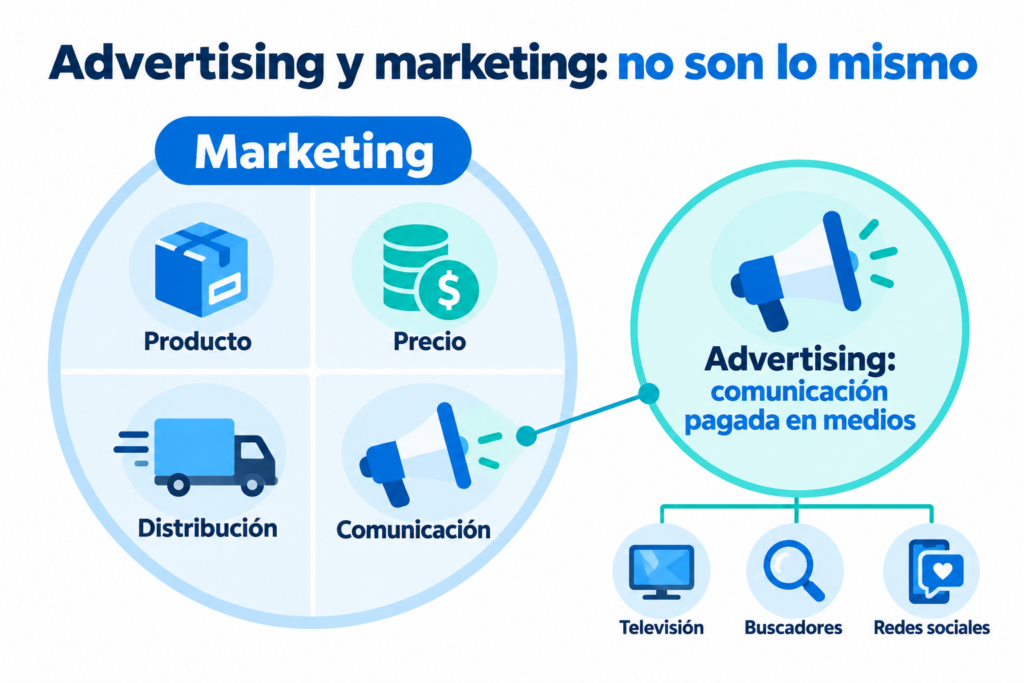
They are sometimes used as synonyms, but they don’t mean the same thing. Marketing is the set of decisions involved in selling a product: what to offer, at what price, through which channels and how to communicate it. Advertising is just one part of that communication.
| Aspect | Marketing | Advertising |
|---|---|---|
| Scope | Product, price, distribution and communication | Paid communication only |
| Goal | Win and keep customers | Raise awareness and persuade |
| Channels | All of them, including owned channels | Paid media |
| Examples | Market research, pricing, newsletters | TV ad, Google campaign |
Turn your ad clicks into subscribers
Collect the email addresses of people who arrive from your ads and stay in touch with them without paying for every impression. Free for up to 80,000 emails a month.
A brief history of advertising
Ads have existed since ancient times: in Pompeii, messages were painted on walls to advertise shops and shows. The printing press brought posters, and in the 19th century newspapers began to live off advertising.
The 20th century brought radio and television, and with them the big agencies. The first internet banner appeared in 1994, and today search engines and social media receive most advertising spend.
Types of advertising
Depending on the medium where it is shown, these are the most common types of advertising:
- Television and radio: commercials and radio spots between programs, with wide reach and high cost.
- Print: ads in newspapers, magazines and leaflets.
- Outdoor: billboards, bus shelters, public transport and street screens.
- Search: ads on Google or Bing based on what the user searches for, as part of SEM.
- Social media: targeted ads on Instagram, TikTok, LinkedIn or Facebook, also known as social ads.
- Display: banners and images on websites and apps, often bought through programmatic advertising.
- Video: ads before or during online videos.
The last five make up digital advertising, or online advertising, which today accounts for most of the spend.
Examples of advertising
This is how advertising is used depending on the goal:
| Goal | Example |
|---|---|
| Build brand awareness | TV ad from a drinks brand launching a new product |
| Drive sales | Google ad from an online store for “running shoes” |
| Gain subscribers | Social media ad offering a free guide in exchange for an email address |
| Win back visitors | Banner showing a product someone viewed but didn’t buy |
How advertising is measured
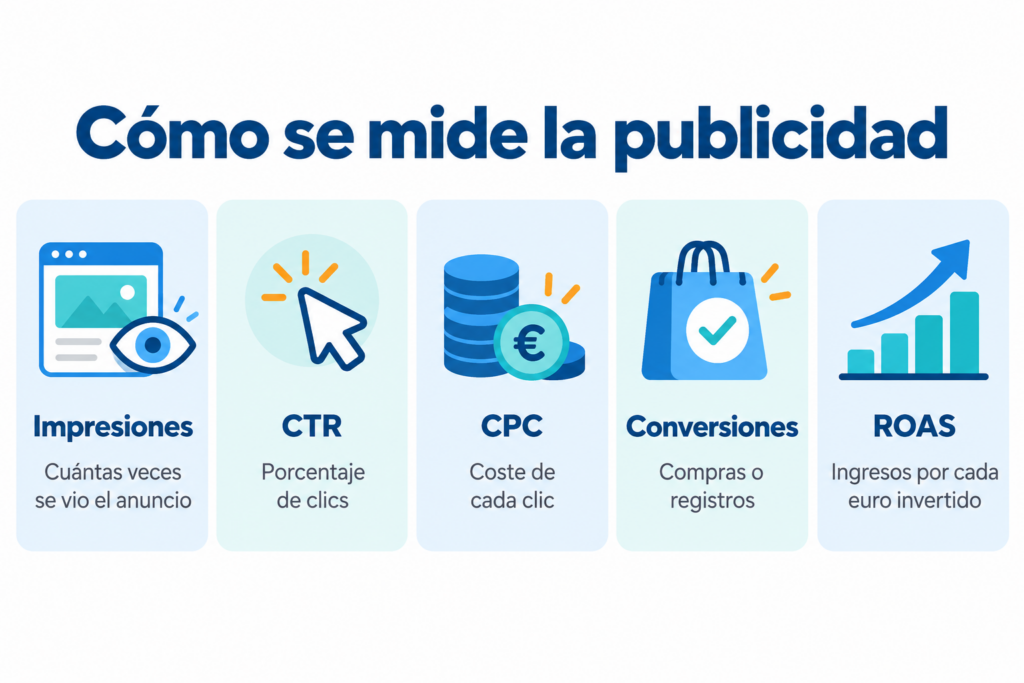
Advertising campaigns, especially digital ones, are measured with metrics like these:
- Impressions and reach: how many times the ad was seen and how many people it reached.
- CTR: the percentage of people who clicked.
- CPC: the cost of each click.
- Conversions: the purchases, sign-ups or downloads achieved.
- ROAS: the revenue generated for every euro spent on ads.
Advertising and email marketing
Advertising and email marketing complement each other. Ads attract new people; email lets you stay in touch with them without paying for every impression.
A common strategy is to use ads to gain subscribers, for example with a discount or a free guide, and then send them newsletters with content and offers. That way, every euro you spend on advertising keeps delivering results weeks later.
How Mailrelay helps you
With Mailrelay, you turn the traffic from your ads into a subscriber list of your own. You create signup forms, send an automatic welcome sequence and measure which campaigns bring in the most sign-ups and sales.
The free account includes up to 80,000 emails a month and 20,000 contacts, with human support on all plans.
Get more out of every euro you spend on advertising
Send newsletters and automations to the contacts you capture with your campaigns. Human support.
Frequently asked questions about advertising
These are the most common questions.
What is advertising?
It is the paid communication a brand uses to make its products or services known. In Spanish, it is called publicidad.
What does advertising mean in Spanish?
It means “publicidad”. An ad is an advertisement or ad (anuncio), and the brand that places it is the advertiser (anunciante).
What is the difference between advertising and marketing?
Marketing covers product, price, distribution and communication. Advertising is only the part of communication that is paid for in the media.
What is online advertising?
Advertising shown on the internet: in search engines, on social media, websites and apps, and on video platforms.
How do you spell advertising?
It is spelled advertising, with a “v” and “-tising” at the end. “Adversiting” and “advertaising” are common mistakes.