Indirect costs: what they are, types and examples
What indirect costs are, how they differ from direct costs, examples by type and how to allocate them to calculate the real cost of each product.
Indirect costs are the expenses a business needs in order to operate but that can’t be assigned to a specific product or service. Rent on the factory, the accounting team’s salaries or the office electricity bill are common examples.
They are also known as overhead. You may also see them called indirect expenses, general expenses or overheads.
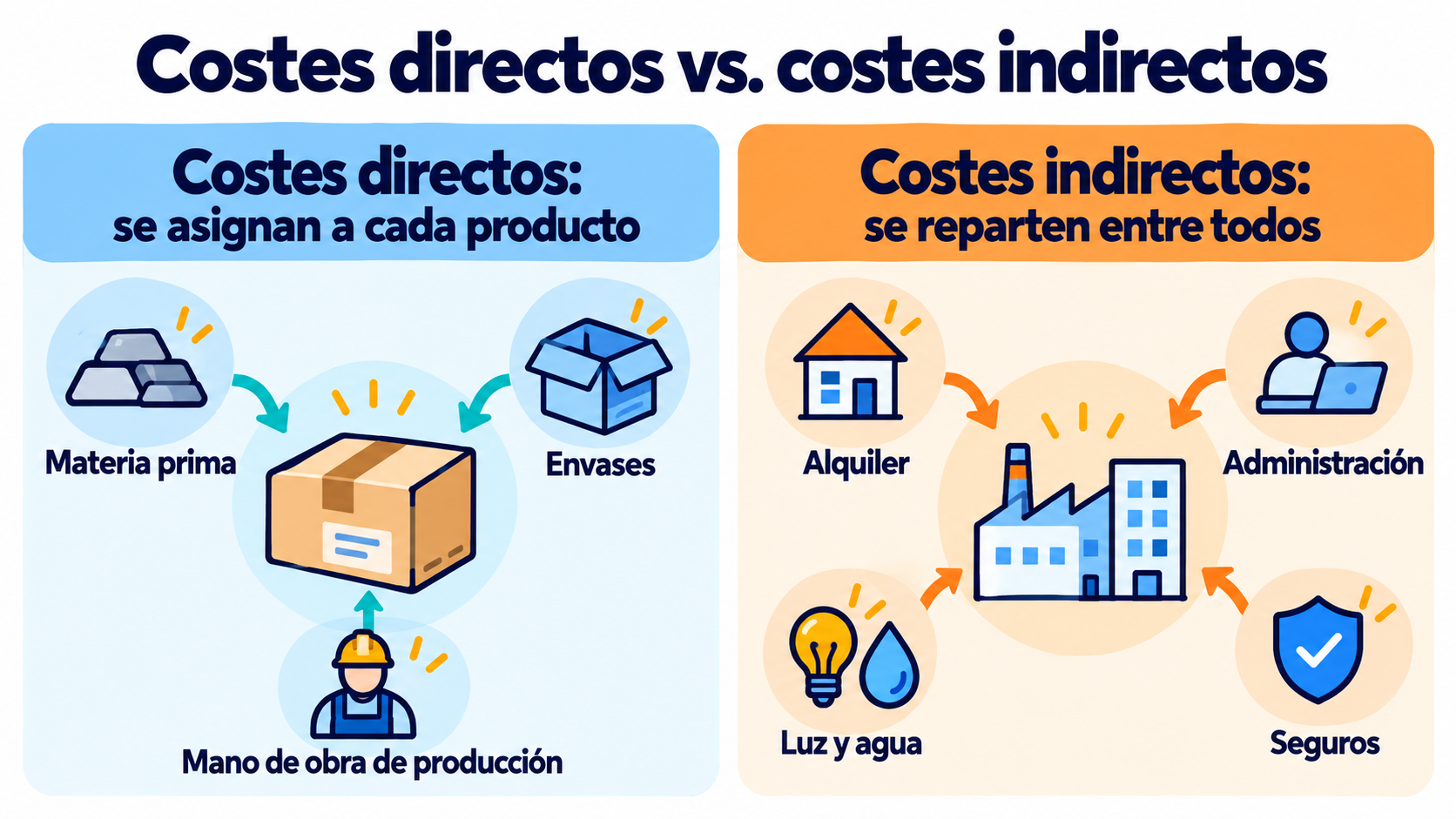
Their opposite is direct costs: the ones you can tie to each unit produced, such as raw materials or the wages of the people who make the product.
Difference between direct and indirect costs
The key question is: can I tell how much of this expense belongs to each product? If the answer is yes, it’s a direct cost. If not, it’s indirect.
| Direct costs | Indirect costs | |
|---|---|---|
| What they are | Expenses tied to each product or service | Expenses the business needs as a whole |
| How they are assigned | Directly, per unit | Using an allocation criterion |
| Examples | Raw materials, packaging, production labor | Rent, administration, electricity, insurance |
| If you stop making a product | They disappear | They usually remain |
Types of indirect costs
They are usually grouped by the area of the business that generates them: production or the rest of the company.
Manufacturing indirect costs
These are the expenses of the factory or production area that can’t be assigned to each unit. They are often referred to as manufacturing overhead. They fall into three groups:
Indirect materials. Used in production, but in quantities that are hard to measure per unit: lubricants, glue, screws and bolts, or cleaning products.
Indirect labor. Staff who support production without making the product: supervisors, quality control, maintenance or warehouse staff.
Other manufacturing expenses. Factory rent, plant electricity, machinery depreciation, repairs or insurance for the facilities.
General indirect costs
These are the expenses of the areas that don’t produce anything but that the business needs to operate:
Administrative. Salaries for management, accounting and human resources, outside advisors, management software and office supplies.
Sales and marketing. Advertising, marketing tools, sales team salaries or trade shows. Brand advertising is an indirect cost because it can’t be assigned to each unit sold.
Are they fixed or variable?
They can be either. Rent or insurance are fixed: they cost the same whether you produce a lot or a little. Factory electricity or machine maintenance are variable, because they rise with production.
10 examples of indirect costs
| Example | Type | Fixed or variable |
|---|---|---|
| Factory or premises rent | Manufacturing | Fixed |
| Production supervisor’s salary | Manufacturing | Fixed |
| Factory electricity and water | Manufacturing | Variable |
| Machine maintenance and repairs | Manufacturing | Variable |
| Machinery depreciation | Manufacturing | Fixed |
| Indirect materials: lubricants, cleaning products | Manufacturing | Variable |
| Administrative and human resources salaries | General | Fixed |
| Management software and licenses | General | Fixed |
| Business insurance | General | Fixed |
| Advertising and marketing tools | General | Depends on the campaign |
How to calculate and allocate indirect costs
Since they don’t belong to a specific product, you have to allocate them using a criterion called the allocation base.
The most common bases are machine hours, labor hours or units produced.
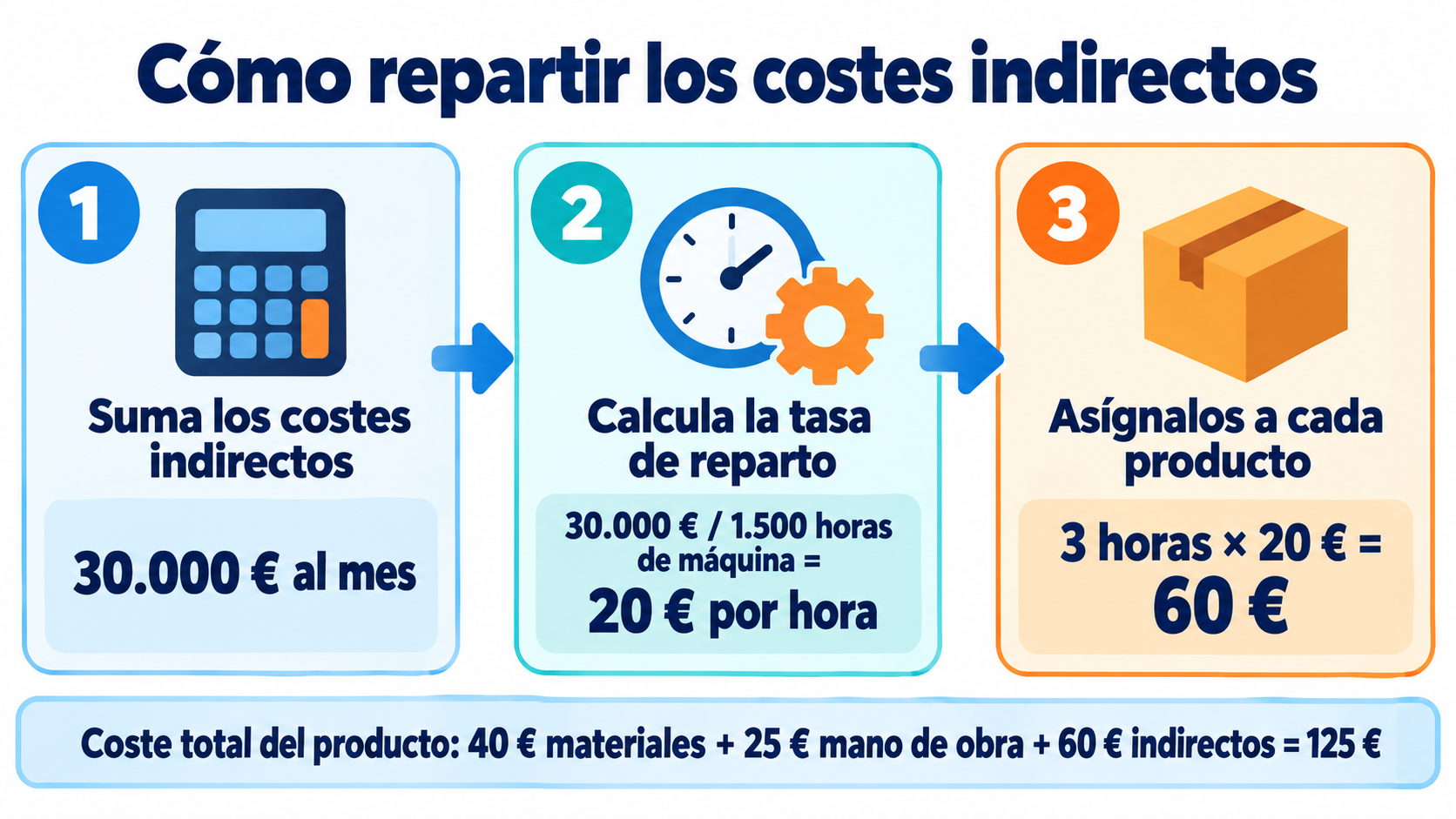
The calculation has three steps:
1. Add up the indirect costs for the period. For example, €30,000 a month in manufacturing indirect costs.
2. Calculate the allocation rate. Divide that total by the base you’ve chosen. If the factory runs 1,500 machine hours a month: €30,000 / 1,500 h = €20 per machine hour.
3. Assign them to each product. If a product needs 3 machine hours, it is allocated €60 of indirect costs.
With that, you know its total cost. If that product has €40 of materials and €25 of direct labor, its cost is 40 + 25 + 60 = €125. At any price below that, you lose money on every unit.
Companies with many different products often use activity-based costing (ABC). Instead of a single base, they allocate each expense according to the activity that generates it: orders, machine setup, shipping.
Why it’s important to keep them under control
To set prices. If you only count direct costs, you may sell below what each product actually costs you.
To know how profitable you are. These expenses tend to grow little by little without anyone reviewing them. Keeping them in check protects your margin.
To make decisions. Knowing what it costs to maintain your structure helps you decide whether to outsource, move premises or launch a new product.
How to reduce indirect costs
Review your contracts every year. Rent, insurance, cleaning, phone and software: renegotiating or switching providers usually brings quick savings.
Save energy. LED lighting, motion sensors and energy-efficient equipment.
Do preventive maintenance. A breakdown that halts production costs far more than a regular inspection.
Digitize processes. Invoicing, document signing and internal communication in the cloud save paper, space and hours of administrative work.
Outsource whatever isn’t your core business. Accounting advice, payroll or IT maintenance can be cheaper when done externally.
Choose marketing channels you own. Ads are paid for every click or impression. A subscriber list is yours, and writing to it costs very little.
You’ll find more ideas for cutting expenses in our article on how to keep a business afloat in times of crisis.
Reduce what it costs you to make sales
With Mailrelay you sell to your customers again by email without paying for every click. Start for free.
Indirect costs and marketing
Marketing is one of the indirect costs that varies most from one company to another. That’s why it’s worth measuring it with metrics such as customer acquisition cost (CAC) or the ROI of each channel, and giving it a clear budget.
Email marketing is one of the channels with the lowest cost per contact. With a tool and a list of your own, you sell to your customers again without paying each time to reach them. With Mailrelay you can start for free, with up to 80,000 emails a month and 20,000 contacts.
Send your newsletters with Mailrelay
Up to 80,000 emails a month and 20,000 contacts for free, with human support on every plan.
Frequently Asked Questions
These are the most common questions about this type of expense.
What are indirect costs?
The expenses a business needs in order to operate that can’t be assigned to a specific product or service, such as rent, administration or utilities.
What is the difference between direct and indirect costs?
Direct costs can be assigned to each unit produced, such as raw materials. Indirect costs are shared across the whole business and have to be allocated using a criterion.
Are indirect costs fixed or variable?
They can be either. Rent is a fixed indirect cost; factory electricity is a variable one.
What are manufacturing indirect costs?
Production expenses that can’t be assigned to each unit: indirect materials, indirect labor and other factory expenses, such as machinery depreciation.
Is advertising a direct or indirect cost?
Usually indirect: it benefits all of the brand’s products and can’t be assigned to each unit sold.