Would you like to know how to monetize a personal blog and turn your new online project into a profitable one? In this post, you’ll find the best resources to start making money.
The Internet isn’t just for sharing your photos on social media, looking up information or watching YouTube videos. Its reach goes much further. In fact, it’s almost infinite.
Besides entertaining users, the Internet is also a place to do business. And with that in mind, new doors inevitably open, with opportunities you didn’t know about until now.
If the Internet has become a profitable business for companies and entrepreneurs, can you also monetize a personal blog? The answer is yes.
When it comes to making money with a blog, there are countless options available to you if you want them.
However, to monetize a personal blog, you need to follow a few basic rules; otherwise, your efforts will be in vain.
Can you make money with a blog? How much, and how long it takes
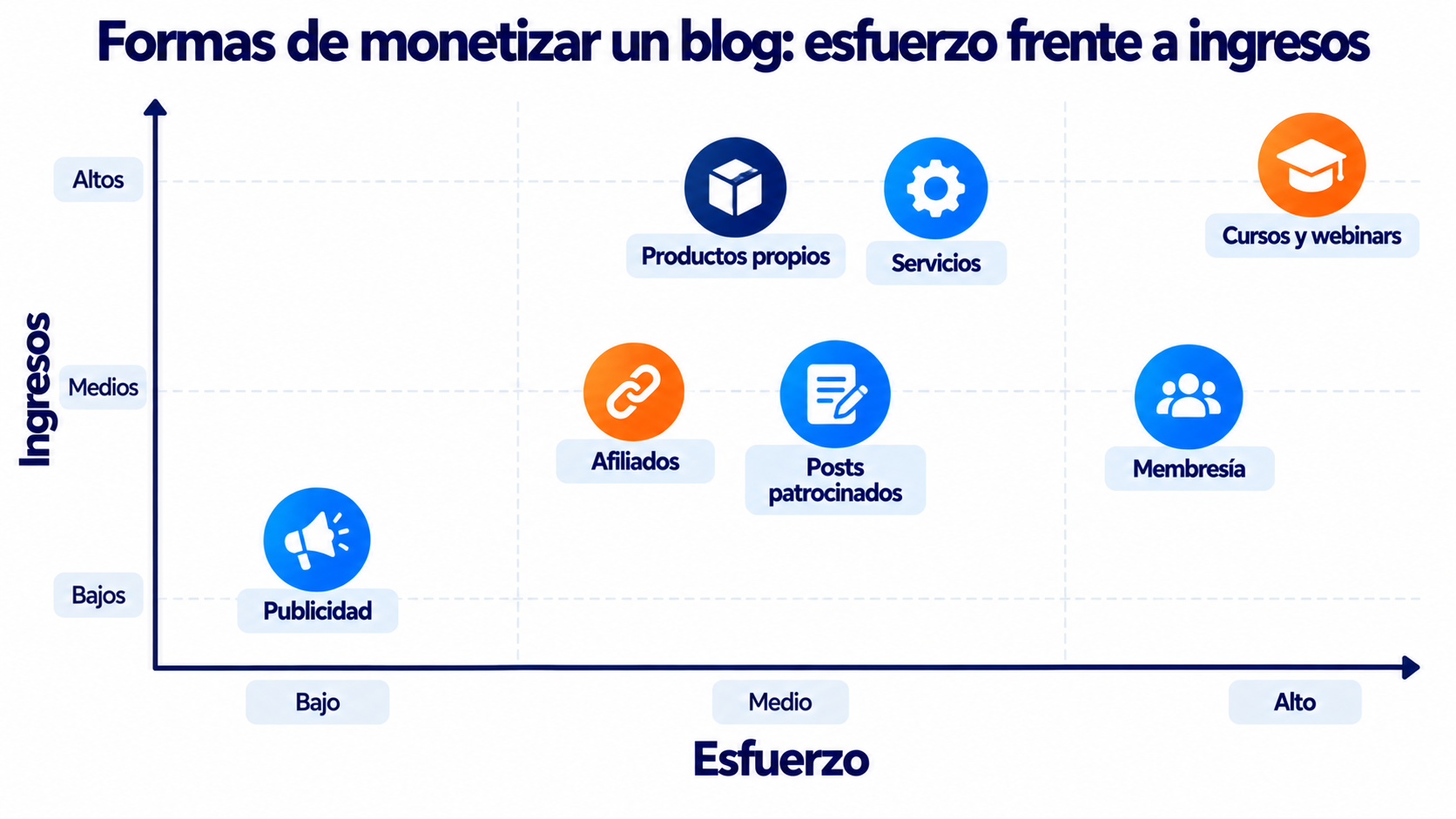
Yes, you can, but it isn’t quick. A blog starts generating income once it has steady traffic and an audience that trusts you, and that usually takes 6 to 12 months of publishing regularly. How much you earn depends mainly on your topic, your traffic and how you combine the different ways to monetize.
These are the main ones, with ballpark figures:
| Way to monetize | What you need | Earnings | When it starts working |
|---|---|---|---|
| Advertising (ads) | Lots of traffic: several thousand visits a month | Low, unless you have lots of traffic | Medium term |
| Affiliates | Review and comparison content, and trust | Medium | Medium term |
| Your own products (ebooks, templates) | Knowing your audience well | Medium or high | Once you have a subscriber list |
| Services (consulting, freelancing) | Being an expert in your topic | High | From the start, with little traffic |
| Courses and webinars | Experience and a community | High | Long term |
| Sponsored posts | A niche audience and a good reputation | Medium | Medium term |
| Membership or paid newsletter | Valuable exclusive content | Medium and recurring | Long term |
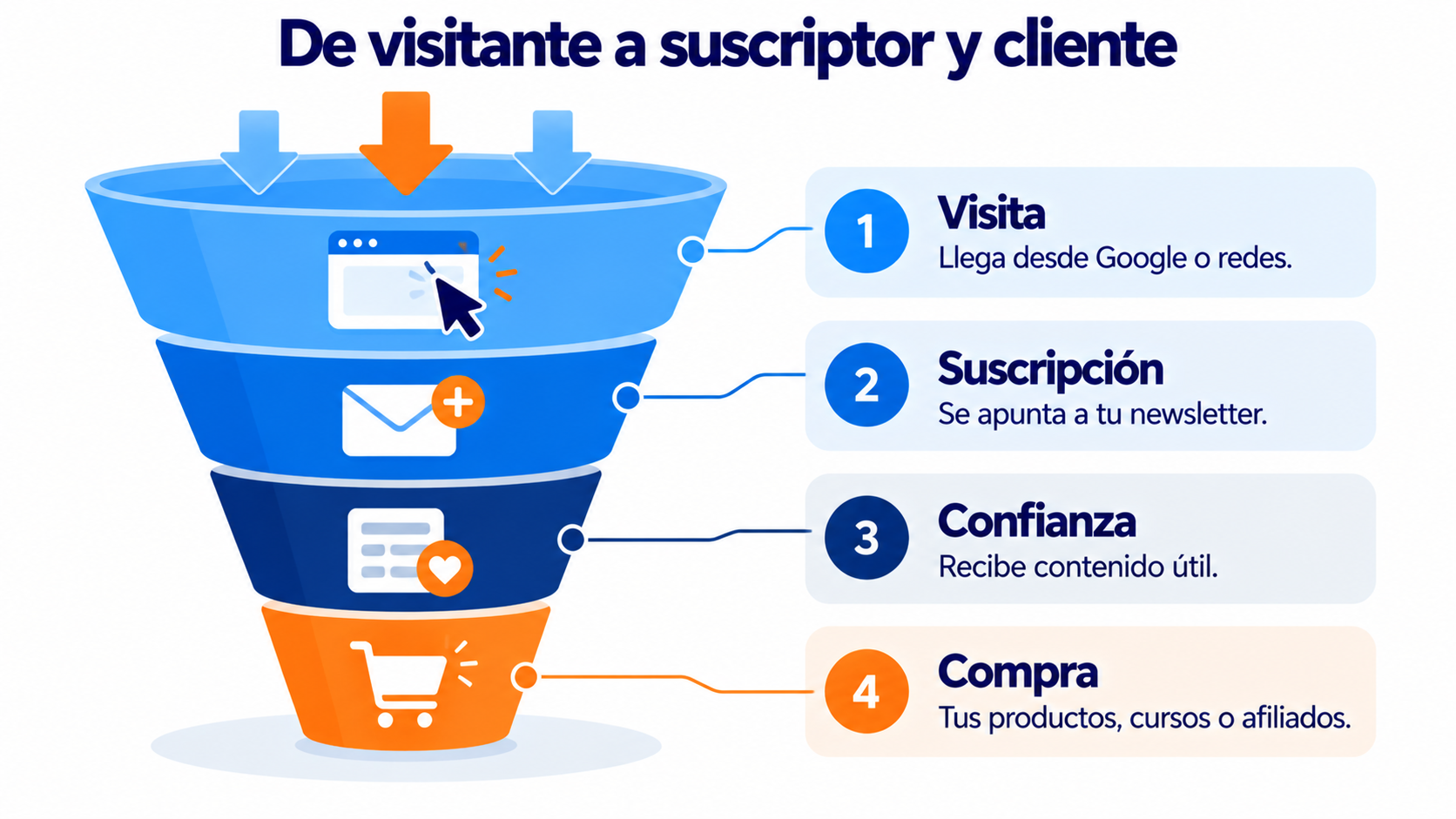
Your subscriber list is a blog’s most profitable asset. Traffic from Google and social media comes and goes, but your subscribers are yours. With a newsletter, you announce every new post, recommend affiliate products, launch your courses and sell your services without depending on an algorithm. If you don’t have a blog yet, start with our guide on how to create a blog.
Turn your readers into subscribers
Add a double opt-in form to your blog and start building your list from day one.
What should you keep in mind to monetize a blog?
It’s clear that if you want to monetize your blog, you have to make it professional. And to do that, you need to keep these points in mind:
- Get your own domain
- Pay for a hosting plan
- Use a responsive template with a design suited to your blog
- Build an SEO strategy to rank your blog in search engines
- Create a social media strategy to build influence on social networks
- Build a copywriting or content marketing strategy
- Have a newsletter signup form to capture subscribers
- Etc.
If you don’t follow any of the rules I’ve just mentioned, chances are you’ll never be able to monetize your blog.
Basically, because:
- Without your own domain and paid hosting, your blog won’t look professional
- If your template isn’t responsive, Google may penalize you, and if the design doesn’t fit your blog either, you’ll scare your audience away
- Without an SEO strategy, you’ll never get organic visibility. And, in practical terms, that’s damaging
- Without a social media strategy, your content won’t reach many people on social networks when you publish
- If you don’t apply a copywriting or content marketing strategy, you won’t manage to attract users
- If you don’t have an email marketing strategy, you’ll lose a lot of potential customers
I think the message is clear. If you meet these requirements, you’ll be heading in the right direction to make money with your personal blog.
Ways to monetize a personal blog
If you keep up with online business, you’ll know that many online businesses are personal blogs.
In fact, personal blogs have given rise to new online businesses, which shows there are plenty of ways to monetize, don’t you think?
In short, many personal blogs have been the driving force that has led other people to become entrepreneurs, fight for the life they want and make money with their online businesses.
With that said, I’m going to tell you all the possible options for monetizing your personal blog. Sound good? Then let’s get started:

Make money with a blog through advertising
One of the best-known ways to make money with a blog is to place ads on it.
There are many ways to put advertising on a blog, but one of the best known is Google AdSense.
However, this option will only help you earn a lot of money if you have high traffic; otherwise, you’ll only earn pennies. Just make sure you follow its rules to the letter if you don’t want to be kicked out of the program.
Another option is for companies to contact you to promote their brand with an advertising banner. In that case, the cost of the advertising will depend on you and on what the advertiser is willing to pay.
Sell affiliate products
Affiliate marketing has become one of the most profitable business models today.
Practically anyone with a blog, a website, an online store, a mobile app or even a YouTube channel can generate income through affiliate programs.
Affiliate marketing is simply promoting another brand’s products in exchange for a commission on every sale you make.
However, the world of affiliate marketing is very broad and covers many points that would be really tedious to detail here, because it deserves an article of its own.
To give you a rough idea, there are three ways to get affiliate products:
- Sign up directly as an affiliate with a company that offers this option
- Ask a company to give you a dashboard and an affiliate link so you can generate income by promoting its product
- Sign up on affiliate platforms
For example, Amazon has its own affiliate program where you can generate income from every sale you make. Many online stores today work this way.
As for the commissions you can earn per product, it all depends on each company’s terms.
Some companies, like Amazon, pay between 5% and 10% for every product sold (at least in Spain), but other brands pay as much as 50% or even more.
It’s a matter of searching and finding the best option for you. Just make sure they are safe and reliable companies.
Sell your own products
Another interesting, and certainly recommended, option is to sell your own products.
That could mean courses, e-books or traditional products from any store, if that’s what your personal blog is about.
This, in turn, gives you great advantages as an entrepreneur, because if you offer your own products and they are high quality:
- Your personal brand and online reputation will improve
- Your products can go viral
- If your products are good, users will share them with others
- You could even become an influencer in your industry
Just don’t forget to offer technical support and customer service in case users need to contact you for any reason.
Otherwise, you could get the opposite result: a bad reputation and lost sales

Have your own affiliates
Working with affiliate products is very interesting, but what if you have affiliates for your own product? You could generate income that way too.
It’s one of the cheapest and most effective ways to make money with your personal blog.
That’s because, on the one hand, your products will be promoted in other places across the web without you having to invest any money and, on the other, you’ll only pay affiliates for each sale they make.
Considering that an advertising campaign costs money, if you have your own affiliates, your profits will be 100%.
Now, how can you create your own affiliate platform? Here are two very interesting options:
- Commission Junction
- e-Junkie
These two platforms let you run your own affiliate program so other people can share your products.
Seen that way, it looks like an interesting option, right?
Offer your services
Just as you can offer your own or affiliate products on a personal blog, you can do the same if you offer services.
In that case, your personal blog becomes a true showcase of your professionalism, and that’s where you have to prove it by sharing everything you know, whether in videos, podcasts or through your writing.
There are many bloggers who, like me, make a living from their blog thanks to their services. You can do it too if you want.
Combine your personal blog with a YouTube channel
A very interesting option, and one that has worked wonderfully for many bloggers, is combining a personal blog with a YouTube channel.
The advantages are many and the disadvantages few, although you shouldn’t lose sight of them.
One of the biggest advantages of this approach is that you can reach a larger audience, since videos on YouTube can go viral if you get a good number of subscribers.
Add your blog’s visits to a YouTube channel, and imagine the impact you can have.
In this sense, your own products or affiliate products can be very profitable.
Another advantage of this approach is SEO. As well as getting an external link from one of the most influential social platforms, if you embed the video in your articles, they will rank better.
This means you’ll get more visibility not only on YouTube but also on Google search. And, in practical terms, that can make all the difference.
That said, managing a YouTube channel is not easy at all. On this platform, many users are used to trolling for no reason at all.
Your channel could be the next victim.
This kind of situation can happen to you, and knowing how to handle those moments will help you keep sight of what really matters: making money with your own online business.

Make money with email marketing
Making money with email marketing is possible, and in fact it’s one of the most profitable options because, as the saying goes, “the money is in the list”.
In short, if you have a personal blog, you should already have your own subscriber list.
There are practically free platforms like Mailrelay that can help you build a good email marketing strategy.
Of course, as with everything, making money with email marketing can be a very slow process at times, and you may even need to invest money in advertising campaigns to grow your list exponentially, although the return is much greater afterwards.
What’s more, having subscribers means you have a group of people who have become loyal to your brand.
And, in practical terms, that’s what really matters.
Sell your products and courses with your newsletter
Create welcome and launch automations that work for you, even on the free account.
Write sponsored posts
Another interesting way to monetize your personal blog is to write sponsored posts on it.
In exchange for money, you’ll be promoting a brand, although if you ever do it, I recommend you do the following:
- Work with reliable, trustworthy companies. Otherwise, you’d harm your personal brand
- Write sponsored posts that are related to your industry; otherwise, you wouldn’t add value and you’d lose audience
- Remember that the blog is yours. So you set the conditions. If you don’t, your site may lose relevance and turn into a ghost blog for lack of personality
Add a “buy me a coffee” widget
Many bloggers earn quite a lot of money by adding a “buy me a coffee” widget. If you’re wondering what it is, I’ll explain right now.
It’s a widget that gives your audience the chance to pay you whatever amount they want, if they see fit, as a thank-you for the good content you write.
One person may not pay you much, but others may pay quite a lot.
And of course, all of it added together can be a good amount of money.
To be honest, I’ve never tried this system, but there are real success stories you can use as a reference if you want to use this kind of monetization for your blog.

One monetization model that has become more relevant is creating exclusive content for members or premium subscribers.
These are people willing to pay a recurring fee (monthly or yearly, for example) in exchange for content, offers or experiences that aren’t available to the general public.
Patreon is one of the most popular sites in this category.
It lets creators of all kinds, from artists to bloggers, set up different membership tiers.
Each tier has a specific price and offers certain benefits, such as exclusive content, early access or direct interaction with the creator.
Buy Me A Coffee is another site that lets creators receive direct financial support from their followers, but with a more casual approach.
Fans can “buy a coffee” for creators, that is, make small donations as a token of appreciation.
However, you’re not limited to these platforms.
If you have the necessary skills and resources, you can set up your own subscription platform on your blog.
This gives you more control over the user experience, the pricing structure and the type of content you want to offer.
For example, you can create an exclusive section on your blog with in-depth articles, webinars, etc.
Run webinars, workshops or online courses
Webinars, workshops and online courses have become powerful tools for sharing knowledge and, at the same time, generating income.
If you have experience or skills in a specific area related to your blog’s topic, this could be an excellent way to monetize your content.
A webinar is essentially an online conference.
They can be either live or recorded, and they’re usually interactive, allowing participants to ask questions and interact with the presenter.
You can offer free webinars to attract a wider audience and then offer paid content or promote other products or services.
Workshops tend to be more hands-on and skill-focused, allowing participants to work on specific tasks or projects under the instructor’s guidance.
Online courses are a more structured form of teaching, with planned lessons, additional resources and, often, exams or assignments to measure the student’s progress.
By offering courses, you can build a more stable source of income, especially if the course runs over a long period.
As for tools, Teachable is a dedicated platform that lets you create and sell online courses.
It provides tools to structure your course, add multimedia content, set prices and manage students.
Udemy is another online course platform, but instead of hosting your own site, you list your course on its marketplace, which can expose it to a wider audience.
However, keep in mind that Udemy often offers aggressive discounts on courses, which could affect your potential earnings.
Finally, Zoom is a video conferencing tool that’s widely used for webinars and live classes because it’s easy to use and has interactive features.
When choosing between these options, consider which format best suits your content and how much control you want over the learning experience and the pricing structure.
The most important thing is to offer real value to your audience and make sure any training you offer is high quality.

Publish an eBook or advanced guides
eBooks and advanced guides have become valuable learning tools.
Besides being an excellent way to share your knowledge, these digital resources can also be a significant source of income if done right.
An eBook (electronic book) is essentially a digital version of a traditional book.
It can be as short or as long as you like, but the most important thing is that it offers valuable, well-researched content that benefits your readers.
It can cover a topic in depth, offer solutions to common problems, or even share your personal experiences and tips.
On the other hand, advanced guides are usually more specific, focused resources that cover a particular topic in detail.
These guides can include tutorials, case studies, charts, images and other resources that help illustrate the topic and improve understanding of it.
If you have in-depth knowledge or unique experience in a specific area related to your blog’s topic, consider writing and publishing your own eBook or advanced guide.
What’s more, you don’t need to be a design expert to create them.
There are various tools and software, such as Canva or Adobe InDesign, that can help you design an attractive, professional eBook.
Once your eBook or guide is ready, you can sell it directly from your blog or use platforms like Amazon Kindle Direct Publishing, Gumroad or Payhip to reach a wider audience.
Remember that, besides writing quality content, promotion is key.
Make the most of your social media, your mailing list and other platforms to get the word out about your digital book.
With the right effort and strategy, publishing an eBook or advanced guide can be not only a source of income but also an excellent way to establish yourself as an authority in your field.
Strategic partnerships and collaborations
In the dynamic world of blogging, working alone can limit your growth potential.
Strategic partnerships and collaborations offer a unique opportunity to expand your reach, improve your content and, at the same time, generate additional income.
Working together with other brands can be extremely beneficial.
Brands looking for an authentic way to connect with specific audiences often seek out bloggers with an authentic voice and an engaged audience.
These collaborations can take the form of sponsored content, product reviews, contests or even long-term campaigns where you, as a blogger, represent or promote a particular brand.
On the other hand, collaborating with other bloggers can be just as valuable.
Collaborations between bloggers can range from simple guest post swaps to larger joint projects such as podcasts, webinar series or even the joint creation of digital products.
These collaborations let both participants benefit from each other’s audiences, which translates into greater reach and recognition.
It’s crucial to remember that any collaboration or partnership must be genuine and aligned with your blog’s values and audience.
Transparency is essential.
You should always disclose when content is sponsored or when you’re working in partnership with a brand or individual.
Also, making sure the content produced in these collaborations adds real value for your readers will keep your integrity and reputation intact.
In short, strategic partnerships and collaborations are an excellent way to diversify your content.
They also expand your reach and generate income, as long as they’re managed with integrity and authenticity.
Use crowdfunding tools
Crowdfunding, or collective funding, has become a powerful tool for entrepreneurs, creators and visionaries to turn their ideas into tangible realities.
Instead of relying on traditional investors or bank loans, crowdfunding lets people raise funds directly from the community.
This turns each contributor into a micro-investor who backs a particular idea or project.
If you have a specific project or idea that goes beyond your blog’s regular content, and you think it could interest or benefit your audience, crowdfunding can be an excellent option.
It could be an innovative product, an event, a research project, a documentary, a print publication, or any other project that needs capital to get off the ground.
Kickstarter is one of the best-known crowdfunding platforms.
It focuses mainly on creative and artistic projects, and works on an “all-or-nothing” model, which means that if you don’t reach your funding goal, you won’t receive any money.
Nor will your backers be charged.
Indiegogo is another popular platform that offers more flexibility in terms of project types and funding options.
Unlike Kickstarter, Indiegogo lets creators keep the funds they raise even if they don’t reach their goal, although at a higher commission rate.
If you go the crowdfunding route, it’s essential to present your idea clearly and attractively, set realistic funding goals and offer valuable rewards to your backers.
Actively promoting your campaign on your social media, blog and mailing list is also key to reaching and exceeding your goal.
Sell photos or digital designs
The digital revolution has made the creation and distribution of visual content enormously easier.
For bloggers with skills in photography, graphic design or illustration, this is a golden opportunity to diversify their income streams and make the most of their visual talent.
If your blog has a visual focus, whether because it covers topics related to art, design, travel, fashion or food, or any other subject where images play a leading role, you can consider selling these visual assets.
Here are a few ideas:
Photos
High-quality images are in great demand in the digital age, for both editorial and commercial use.
If you’re a photographer, you can sell your photos on stock image sites such as Shutterstock, Getty Images or Adobe Stock.
If you’d rather have more control over your prices and customers, you can set up an online store on your blog or use platforms like Etsy to sell photo prints.
Illustrations and designs
If your skills lean toward illustration or graphic design, you can sell your creations as prints, posters, cards or even apply your designs to products such as T-shirts, mugs or bags.
Platforms like Society6 or Redbubble let you upload your designs and sell them on a variety of products, without having to worry about production or shipping.
Licenses for commercial use
Besides selling physical products or direct downloads, you can offer licenses for the commercial use of your photos or designs.
This lets companies or individuals use your creations in their own projects in exchange for a fee.
It’s essential to make sure your work is protected and to clarify the terms of use when you sell your visual assets.
Consider adding watermarks to images online to prevent unauthorized use, and set clear policies on licensing, copyright and permitted uses.
Monetization through mobile apps
For bloggers, venturing into the world of apps can be a natural extension of their platform, opening up new monetization opportunities and new ways to connect with their audience.
If you think your blog has the potential to be turned into or complemented by a mobile app, here are some ways you could benefit:
Extending your content
You can create an app that offers an optimized mobile version of your blog, adding exclusive features such as push notifications, offline modes or interactive content.
This can improve the user experience and build greater loyalty among your audience.
In-app ads
Just like a blog, mobile apps can display ads.
Platforms like Google AdMob let you integrate ads into your app and earn money based on views or clicks.
In-app purchases
If your app offers additional content or features, you can let users buy them directly from the app.
This can include access to premium content, additional tools or any other resource that adds value to the user experience.
Selling the app
If you think your app offers sufficiently valuable functionality or content, you can choose to sell it in stores like Google Play or the Apple App Store.
Although this requires an initial investment in marketing and promotion, if your app meets a real market need, it can become a significant source of income.
Developing a mobile app can require a significant investment of time, money and resources, especially if you have no development experience.
However, if you choose this path and your app meets a market demand, it can be an excellent way to diversify your income streams and strengthen your brand’s presence.
Implementing a paid chatbot or virtual assistant
Chatbots and virtual assistants have become tremendously popular in recent years, mainly because of their ability to automate responses, improve the customer experience and provide services 24 hours a day.
For bloggers, especially those with experience in consulting or advisory work, implementing a paid chatbot can be an innovative way to monetize.
Let’s look at how you can benefit from this strategy:
Automated consultations
If your blog focuses on a specific area of knowledge (for example, health, finance, technology, etc.), you can set up a chatbot to answer frequently asked questions.
Or to provide basic information on the topic. Instead of offering this service for free, you can charge a small fee per query.
Personalized advice
Although chatbots are designed to give preset answers, today’s technologies allow a certain degree of personalization.
If you have specialist knowledge, you can offer personalized advice through a virtual assistant that directs users to specific resources or content based on their queries.
Premium access
While the chatbot can be available to all your blog’s visitors, you can offer a premium access tier.
Subscribers or paying members could get access to more detailed answers, unlimited queries or even the chance to interact with you directly in live chat sessions.
Integration with products or services
If you offer products or services through your blog, the chatbot can act as a virtual salesperson, recommending products based on users’ queries or guiding them through the purchase process.
Building an efficient chatbot requires a clear understanding of your audience’s needs and behavior, as well as an investment in a good chatbot platform.
It’s important that any chatbot or virtual assistant you implement offers real value to your users by providing accurate, relevant answers.
Conclusion
Now that you know how to monetize a personal blog, it’s time to get to work and start monetizing in whichever way you like best.
Best of luck, entrepreneur.
What other ways would you recommend to monetize a personal blog?
Create your free account
Up to 80,000 free emails a month, with human support on every plan.

Jose Argudo
CMO at Mailrelay. Writes about email marketing, copywriting, and conversion for small businesses and entrepreneurs.